









- bhavya gada
- No Comments
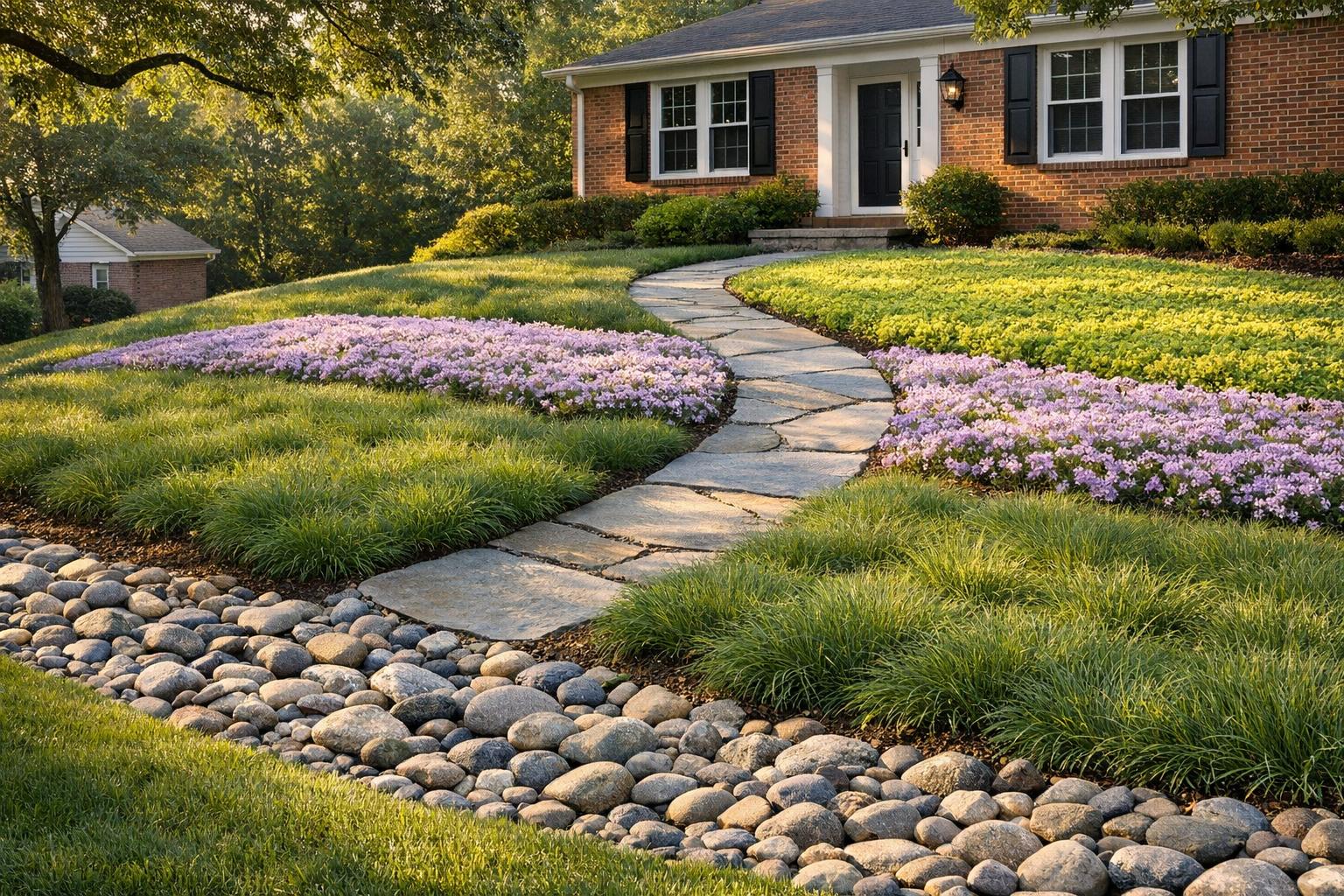
Low-maintenance ground covers are an excellent way to simplify yard care while improving your outdoor space. These low-growing plants reduce the need for mowing, watering, and fertilizing compared to grass lawns. They also prevent soil erosion, suppress weeds, and provide habitat for pollinators like bees and butterflies. Whether you’re dealing with shady areas, steep slopes, or dry patches, ground covers like Creeping Thyme, Wild Ginger, or Creeping Phlox can thrive in Maryland’s climate with minimal effort.
Key Benefits:
- Time & Cost Savings: Less mowing, watering, and fertilizing result in lower maintenance costs.
- Weed Suppression: Dense growth blocks sunlight, reducing weed growth naturally.
- Erosion Control: Ideal for slopes and embankments by stabilizing soil.
- Visual Appeal: Adds texture, color, and seasonal blooms to your yard.
- Eco-Friendly: Native options support local wildlife and reduce chemical use.
Best Picks for Maryland:
- Native Options: Creeping Phlox, Foamflower, Wild Ginger.
- Non-Native Choices: Carpet Juniper, Liriope, Dwarf Mondo Grass.
For best results, prepare your soil, choose the right plant for your site conditions, and space them properly to ensure full coverage. Once established, these plants require minimal care, making them a smart choice for Maryland homeowners looking to simplify landscaping.
10 Low-Maintenance Groundcovers for Everyday Gardens
Benefits of Low-Maintenance Ground Covers
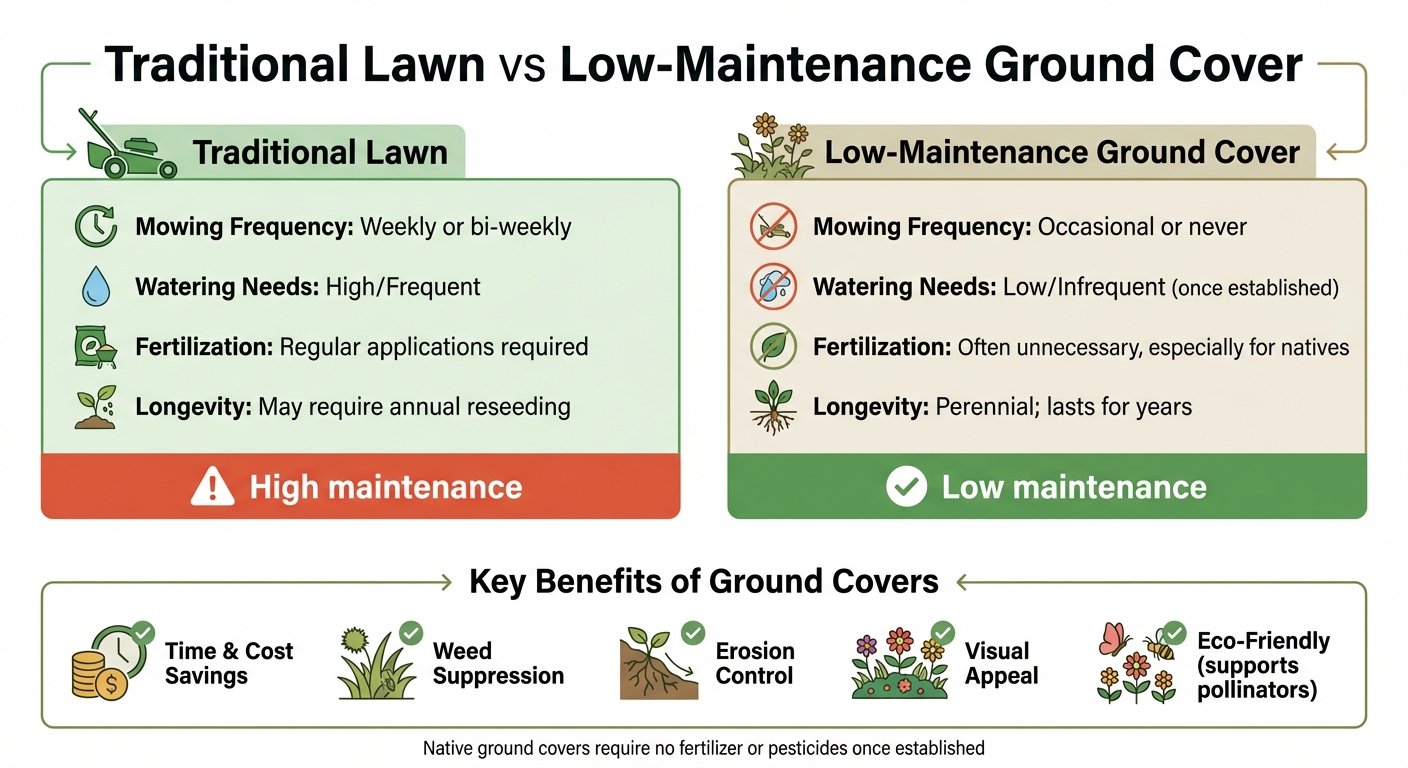
Traditional Lawn vs Low-Maintenance Ground Cover Comparison
Environmental Benefits
Ground covers act as a natural shield for your yard, protecting the soil by reducing runoff, preventing erosion, and cutting down on pollution [5]. They help retain moisture, reduce evaporation, and keep soil temperatures stable throughout the year [1][6].
"Covering exposed ground with plant growth as a ‘living mulch’ provides multiple benefits: suppressing weeds… controlling erosion and reducing runoff pollution… and enriching habitat." – University of Maryland Extension [5]
Unlike traditional grass lawns, ground covers promote biodiversity and support local wildlife by attracting pollinators like butterflies and bees [5]. Native species, in particular, thrive without fertilizers or pesticides, reducing chemical use [1]. To make your yard even more resilient, try planting a mix of ground cover species instead of sticking to just one. This approach can help guard against pests, diseases, and weather fluctuations [5].
On top of these eco-friendly perks, ground covers also bring aesthetic and practical benefits to your outdoor space.
Visual and Practical Benefits
Ground covers excel in areas where grass struggles, such as steep hills, rocky patches, or shaded spots under large trees [3][4]. They add variety to your yard with different textures and colors that change with the seasons. For instance, Creeping Thyme and Sedum offer stunning blooms that brighten up the landscape. Ajuga spreads up to 24 inches while staying low at 6 inches tall, while Creeping Juniper forms dense mats that can grow up to 10 feet wide and remain about 18 inches tall [1][4].
If you’re looking for walkable greenery, some ground covers like Creeping Thyme, Creeping Mazus, and Brass Buttons can handle foot traffic. These options are perfect for creating lush, functional pathways [4][6]. Pairing ground covers with elements like pavers can also add stability and create visually interesting designs [1].
Cost and Time Savings
Switching to low-maintenance ground covers can save you both time and money compared to traditional grass lawns. Grass lawns demand regular upkeep, including weekly or bi-weekly mowing, frequent watering, and ongoing fertilizer applications [4]. Ground covers, on the other hand, require minimal care – occasional trimming at most [3][4].
| Feature | Traditional Lawn | Low-Maintenance Ground Cover |
|---|---|---|
| Mowing Frequency | Weekly or bi-weekly | Occasional or never [4] |
| Watering Needs | High/Frequent | Low/Infrequent (once established) [4] |
| Fertilization | Regular applications required | Often unnecessary, especially for natives [1] |
| Longevity | May require annual reseeding | Perennial; lasts for years [4] |
Native ground covers like Creeping Phlox and Allegheny Spurge are well-suited to Maryland’s climate, requiring no fertilizer or pesticides [1][4]. Many varieties are drought-tolerant once established, which can lead to noticeable savings on water bills compared to traditional turfgrass [1][4]. Perennial options like Creeping Thyme can thrive for 5 to 6 years with proper care, eliminating the need for annual reseeding [4][6]. For those seeking quick results, pre-grown Sedum mats are available for around $34 at major retailers, offering a budget-friendly and low-effort solution [4]. These benefits make ground covers an attractive and practical choice for homeowners looking to maintain beautiful, low-effort landscapes.
Best Low-Maintenance Ground Covers for Maryland
Top Native Ground Covers
Native ground covers are a great fit for Maryland’s climate and soil conditions. They require less fertilizer and provide essential support for local pollinators [1].
Creeping Phlox is a standout option. Varieties like Moss Phlox (evergreen) and shade-loving types bring vibrant spring blooms. Once established, they’re also resistant to drought [5].
Foamflower (Tiarella cordifolia) thrives in shady areas with consistent moisture, making it a favorite for woodland gardens or spots beneath large trees [3]. Wild Ginger (Asarum canadense) is another versatile choice, growing well in conditions ranging from full sun to shade, as long as the soil stays moist [2].
"Since native plants cannot be invasive, using native ground covers like creeping phlox (Phlox subulata) solves this problem [of invasiveness]." – Nancy Schaffer, House Digest [4]
While native plants are ideal for natural settings, non-native ground covers can offer added flexibility for urban and suburban spaces.
Best Non-Native Options
Non-native ground covers work well in Maryland’s urban and suburban areas, offering durability and quick coverage. Carpet Juniper (Juniperus procumbens/horizontalis) is a sun-loving evergreen that forms dense mats up to 10 feet wide, staying under 18 inches tall. It’s both drought- and deer-resistant, making it a great choice for slopes or retaining walls where weed control and heat resistance are key [4][3].
Liriope (Lilyturf) is another hardy option, thriving in dry shade. It spreads via runners, creating a dense mat perfect for erosion control or defining borders [3]. Dwarf Mondo Grass works well as a lawn alternative or filler between pavers, tolerating full sun to partial shade. However, it prefers slightly acidic soil [1].
For areas near roadways, Siberian Cypress is a smart pick due to its ability to withstand salt spray and pollution [1]. Pachysandra terminalis (Japanese Spurge) thrives in shady suburban yards, tolerating drought and heat where grass might fail. However, it can spread aggressively if not managed [2][3]. For larger spaces, Rock Cotoneaster is a good option, with its spreading varieties reaching up to 8 feet wide when planted 4 to 5 feet apart [4].
"Choosing the right ground cover is not just about aesthetics; it’s a strategic decision that contributes to the overall health and appearance of your landscaping." – Leah Knowles, Ultimatescape [1]
sbb-itb-843f8be
How to Plant and Maintain Ground Covers
Site Selection and Soil Preparation
Start by assessing your site’s conditions – sunlight, moisture levels, and soil type – to choose ground covers that will thrive there. Clear away weeds and debris beforehand to minimize competition for water and nutrients. Test your soil’s pH using a kit from a garden center or your local extension service. Most ground covers in Maryland prefer a pH of 6.5 or lower [2]. For plants like Mondo grass, which favor slightly acidic soils, you may need to add lime if the soil is too acidic.
To improve soil structure and fertility, mix in compost or well-rotted manure. This is especially helpful for plants like Mondo grass. Ensure the area has proper drainage to avoid root rot. For moisture-loving ground covers like Irish moss, pick naturally damp spots, while drought-resistant options like Sedum thrive in sunny, well-drained areas. Once the soil is ready and the site conditions are clear, determine the appropriate spacing to maximize ground cover effectiveness.
Planting and Spacing Guidelines
Proper spacing is key to creating a dense, weed-resistant ground cover. For larger shrubs like Creeping Juniper and Rock Cotoneaster, which can spread 8 to 10 feet, space them 4 to 5 feet apart [4]. Smaller ground covers like Ajuga and dwarf Mondo grass spread about 24 inches and 12 inches, respectively [1]. Plant Mondo grass right after the last spring frost or in early summer [2].
When planting Wild Ginger, place it slightly deeper than usual to improve germination. For aggressive spreaders like Blue Star Creeper or Creeping Mazus, consider using landscape edging to keep them contained. After planting, apply a layer of mulch to help retain moisture and suppress weeds while the ground cover establishes itself. For a quicker option, pre-grown sedum mats are available for around $34 at stores like Lowe’s [4]. Once planted, follow care instructions to support healthy growth.
Regular Care Tips
Water new plantings consistently until they’re well-established to encourage strong root systems. Once mature, many ground covers become more drought-tolerant, but even hardy types like Creeping Phlox and Vinca Minor may need extra watering during long dry spells [2]. For Mondo grass, keep it trimmed to about 2 inches, avoiding cuts that are too short [1].
Prune Creeping Thyme after it blooms and divide perennials like Lamb’s Ear every few years [4]. If soil tests reveal nutrient deficiencies, opt for a diluted, general-purpose or low-nitrogen organic fertilizer instead of a stronger chemical option [2]. Native ground covers, such as kinnikinnick, typically won’t need additional fertilization once they’ve settled into a naturalized landscape [4].
Using Ground Covers with Pro Landscapes MD Services

Landscape Design and Planting
Pro Landscapes MD takes a tailored approach to landscape design, carefully evaluating factors like soil pH, drainage, and sunlight to select the right ground covers for Maryland’s USDA zones 5–8. Their expertise ensures plants are placed where they’ll thrive – moisture-loving varieties like Irish Moss go in damp areas, while drought-resistant options like Sedum are reserved for sunny, well-drained spots. Ground covers serve multiple purposes, from controlling erosion on shady slopes to suppressing weeds in garden beds. They also offer a low-maintenance alternative to traditional lawns, cutting down on both mowing and water usage.
During the design phase, Pro Landscapes MD considers each plant’s mature size, spacing them strategically to ensure full coverage without overcrowding or leaving bare patches.
Drainage and Eco-Friendly Solutions
Ground covers are a natural complement to Pro Landscapes MD’s drainage solutions, helping create sustainable outdoor environments. Whether installing French drains, building dry riverbeds, or grading sites for proper water flow, they use ground covers as a living layer to retain soil moisture and prevent erosion. Plant selection is always site-specific – Siberian Cypress is ideal for areas prone to occasional flooding, while Lily of the Valley works well in spots needing excellent drainage to avoid root rot.
Their eco-conscious methods prioritize native Maryland plants that thrive without synthetic fertilizers or pesticides. For example, dense ground covers like Carpet Bugleweed naturally suppress weeds, reducing the need for chemical herbicides. They also incorporate environmental pavers that allow rainwater to seep into the ground, with ground covers stabilizing the soil around these surfaces for added sustainability.
This thoughtful approach ensures ground covers not only protect the environment but also integrate seamlessly with other landscaping elements.
Combining Ground Covers with Hardscaping
Pro Landscapes MD blends ground covers with hardscaping to create outdoor spaces that are both functional and visually appealing. Steppable varieties like Creeping Thyme and Blue Star Creeper are placed between flagstone walkways and paver patios, forming lush, durable carpets that handle foot traffic while keeping weeds at bay. For retaining walls and stone features, cascading plants like Creeping Phlox and Creeping Jenny soften the hard edges, adding a natural, flowing aesthetic.
| Hardscape Feature | Recommended Ground Cover | Primary Benefit |
|---|---|---|
| Flagstone Walkways | Creeping Thyme, Brass Buttons | Durable under foot traffic |
| Retaining Walls | Creeping Phlox, Creeping Jenny | Cascades over edges for a soft look |
| Patios & Edges | Siberian Cypress, Coral Bells | Adds evergreen texture and color |
| Rock Gardens | Sedum (Stonecrop), Hardy Ice Plant | Thrives in heat and rocky soil |
Heat-tolerant varieties like Sedum are perfect for areas near stone surfaces, which can absorb and radiate heat during Maryland’s hot summers. Pro Landscapes MD also pays close attention to color coordination, matching ground cover hues with pavers and stonework to enhance the overall design. By planting ground covers on slopes near patios or at the base of retaining walls, they prevent soil erosion, helping to protect the integrity of hardscaping over time.
Conclusion
Low-maintenance ground covers offer a practical way to suppress weeds, prevent erosion, and retain soil moisture, all while reducing upkeep costs. Once established – usually within 2 to 3 growing seasons – these plants need little watering, fertilizing, or mowing, making them a great choice for Maryland homeowners who want to simplify yard care [8]. Beyond functionality, ground covers bring a variety of textures and colors, turning tricky areas like shady slopes or dry spots into thriving, attractive landscapes.
Choosing the right ground cover depends on factors like soil type, sunlight, and moisture levels. Native plants such as Wild Ginger and Creeping Phlox are excellent options since they thrive in Maryland’s climate without the need for synthetic fertilizers or pesticides, all while supporting local wildlife [1][4]. On the flip side, invasive species like English Ivy and Japanese Pachysandra should be avoided, as they can dominate local ecosystems and create long-term maintenance headaches [7][9].
For particularly challenging spots – like dry, shaded areas – professional advice can make all the difference. Experts often recommend specialized plants like Epimedium or Sweet Woodruff for these conditions [8][9]. Proper soil preparation is another critical step in minimizing future maintenance [8].
Pro Landscapes MD provides the expertise needed to maximize these benefits. Their team specializes in landscape design, drainage solutions, and integrating hardscaping elements. They assess your property’s unique conditions and recommend ground covers that work seamlessly with features like flagstone paths, retaining walls, and eco-friendly pavers. Whether you’re looking to replace a high-maintenance lawn, tackle erosion, or enhance the areas around your hardscaping, their professional guidance ensures long-term results.
Interested in making your yard easier to maintain and more beautiful? Contact Pro Landscapes MD to schedule a consultation and take the first step toward transforming your outdoor space.
FAQs
How long does ground cover take to fill in?
Ground cover plants typically take anywhere from several months to a year to fully spread out, depending on the species and the environment they’re growing in. If you choose fast-growing types and provide ideal conditions, they can establish themselves in as little as three to six months.
What are the best ground covers for dry shade?
Creeping Thyme, Sedum, and Bearberry are great options for areas with dry shade. These ground covers are well-suited for low-water, shady conditions and can handle drought with ease, making them perfect for such challenging spots.
How do I keep ground cover from spreading too far?
To keep ground cover plants from spreading too far, try using barriers or edging to set clear boundaries. Regular upkeep, such as trimming or pruning, is also key to keeping them in check. Choosing ground cover varieties that grow at a slower pace can help prevent overgrowth, particularly in tricky spots like slopes or shaded areas. These practices can help maintain your ground cover exactly where you want it, without letting it take over.
Chat with Us