









- bhavya gada
- No Comments
Maryland offers several programs to help property owners manage stormwater runoff while reducing costs. These initiatives provide tax credits, rebates, and fee reductions for installing features like rain gardens, permeable pavers, and rain barrels. Benefits include financial savings, improved water quality, and solutions for common property issues like erosion and drainage. Here’s a quick overview:
- Anne Arundel County: 10% tax credit (up to $10,000 over 5 years) and up to 50% fee reduction for approved practices.
- Prince George’s County: Rain Check Rebate Program offers up to $6,000 for residential properties and $20,000 for commercial sites.
- Montgomery County: RainScapes Rewards provides up to $7,500 for residential and $20,000 for commercial properties, along with fee reductions up to 80%.
- Baltimore County: Property tax credits for legally required stormwater systems.
- Howard County: Up to 100% fee reduction and 75% reimbursement for installation costs.
- Frederick County: Tax credits for legally mandated stormwater structures.
These programs vary by location, eligibility, and application process. For example, Anne Arundel County requires applications within 45 days of project completion, while Montgomery County mandates pre-approval before starting projects. Each program supports efforts to protect Maryland’s waterways and manage stormwater effectively.
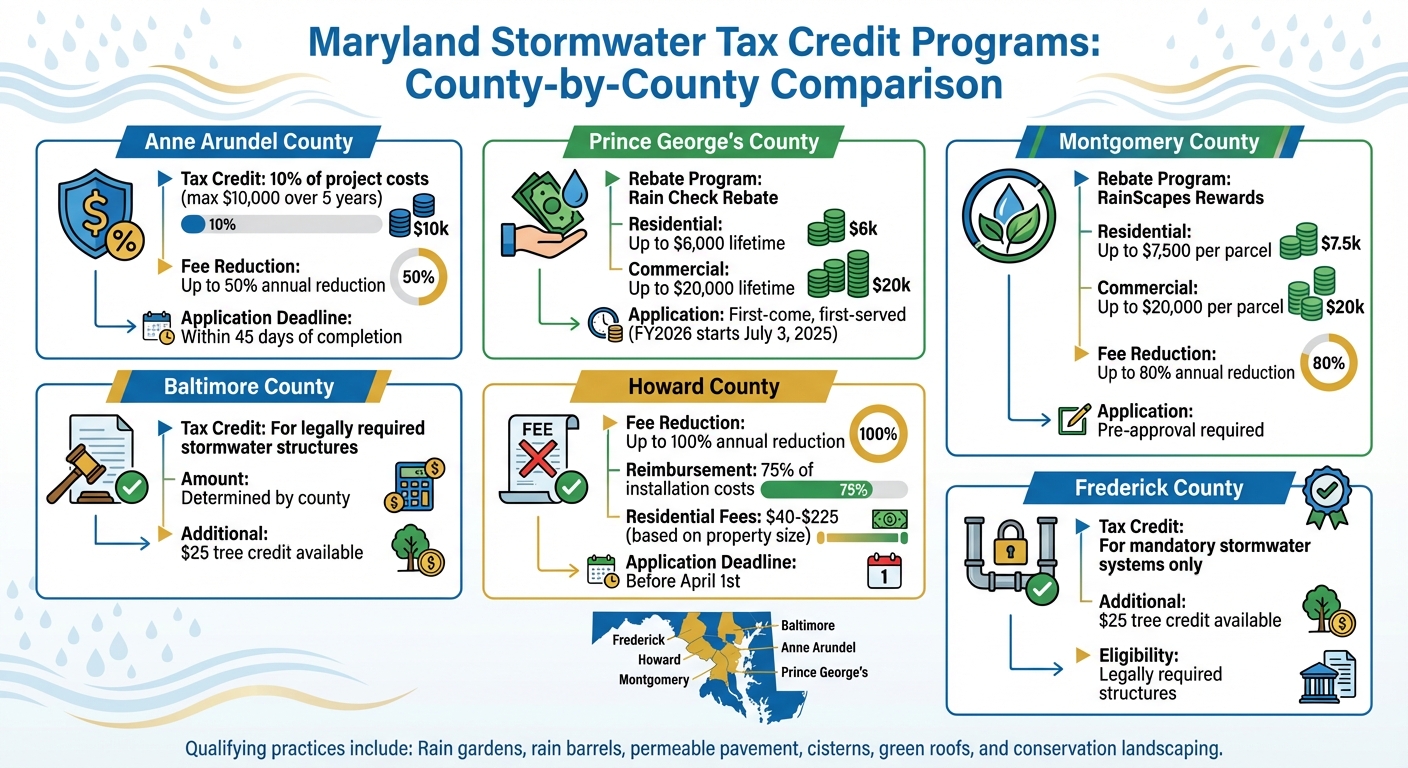
Maryland Stormwater Tax Credit Programs Comparison by County
1. Anne Arundel County Stormwater Management Property Tax Credit
Anne Arundel County offers a property tax credit for homeowners who voluntarily install approved stormwater management features. The credit covers 10% of the materials and installation costs, up to a maximum of $10,000, and is distributed over a five-year period [1]. Beyond reducing costs, this program encourages better stormwater management practices. Here’s what you need to know about eligibility, the credit amount, and how to apply.
Eligibility Requirements
To qualify, the stormwater features must be voluntarily installed – any improvements required by permits or regulations are not eligible [1][3]. The practices must also be on the approved devices list maintained by the Anne Arundel County Department of Public Works. After installation, County staff will inspect the feature to ensure compliance. Additionally, you’re required to maintain the practice for the entire five-year credit period, as the County reserves the right to inspect it at any time [1].
Credit or Rebate Amount
The tax credit is calculated as 10% of the total cost of materials and installation, with a cap of $10,000 [1]. This amount is divided evenly over five years and applied directly to your County real property tax bill. However, you cannot combine this credit with other property tax credits. That said, you may still qualify for the Watershed Protection and Restoration Fee (WPRF) credit, which can reduce your stormwater fees by up to 50% annually [1][3].
Application Process
Applications must be submitted within 45 days of completing the installation [1][3]. Start by downloading the Stormwater Management Tax Credit Application Form from the County website. You can submit the form via email to taxcredits@aacounty.org or by mailing it to the Anne Arundel County Office of Finance in Annapolis [1]. The Department of Public Works will review your application and schedule an inspection. Once approved, you’ll receive written confirmation, and the credit will apply to the next taxable year. Be sure to keep records of your material and labor costs, as these are required for calculating the credit [1].
Qualifying Stormwater Practices
Examples of approved stormwater management practices include rain gardens, rain barrels, permeable pavement, infiltration trenches, dry wells, and rainwater harvesting systems (like cisterns with specific uses). Make sure your chosen method is listed on the County’s approved devices list [5][2][1].
sbb-itb-843f8be
2. Prince George’s County Rain Check Rebate Program
Prince George’s County runs the Rain Check Rebate Program, which provides cash incentives for approved stormwater management and landscape projects. This initiative, similar to other Maryland programs, encourages better stormwater practices while reducing financial strain on property owners. Starting July 3, 2025, for FY2026, residential properties can receive up to $6,000 in lifetime rebates, while commercial, industrial, and institutional properties can get up to $20,000. The program is administered by the Chesapeake Bay Trust, with applications processed on a first-come, first-served basis [6].
Eligibility Requirements
To qualify, your property must be located in Prince George’s County. However, there are a few exceptions. Properties within the City of Bowie are not eligible, as Bowie runs its own stormwater program [6][7]. Similarly, residents of Cheverly, University Park, and College Park cannot receive rebates for urban tree canopy projects since those municipalities offer their own tree programs [7].
Projects tied to permit requirements for new construction or renovations are not eligible. To qualify, your project must meet the Department of the Environment’s best practice guidelines, pass a post-installation inspection, and receive approval within 12 months of completion [6][7]. Once approved, property owners can choose from a variety of rebate-eligible stormwater practices.
Credit or Rebate Amount
Rebates are calculated based on the type of stormwater practice:
- Rain barrels: $2 per gallon (minimum 50 gallons for residential properties)
- Rain gardens: $10 per square foot (minimum 100 square feet)
- Permeable pavement: $12 per square foot
- Urban tree canopy projects: $150 per tree, or $300 per tree in underserved communities under the Five Million Maryland Trees for Climate Progress initiative [6]
The rebate amount will be the lesser of the maximum allowance or the actual costs. For instance, a resident who planted 15 trees received a rebate of $2,250 [6].
Application Process
Once you confirm eligibility and rebate details, the application process begins. Except for rain barrels, all projects require pre-approval from the Chesapeake Bay Trust before installation [6][7]. Pre-installation site visits and post-installation inspections are mandatory [6]. Applications are typically processed within two weeks, but the entire process – from application to receiving payment – may take 2 to 4 months or even up to a year, depending on project timelines [6].
Be sure to save all itemized invoices and receipts, as the rebate is based on actual costs [6]. If your project involves disturbing more than 5,000 square feet of land or moving over 100 cubic yards of earth, check with the County’s permitting office for additional requirements [6].
Qualifying Stormwater Practices
The program covers eight types of stormwater practices: rain barrels, cisterns, rain gardens, conservation landscaping, urban tree canopy, pavement removal, permeable pavement, and green roofs [6][7]. Some specific requirements include:
- Native plant species must be used for rain gardens, conservation landscaping, and urban tree canopy projects [6].
- Permeable pavement must be installed by a qualified contractor [6].
- Green roofs require a structural load analysis conducted by a licensed structural engineer [6].
"This is a very worthwhile program to help protect our local waterways and the Chesapeake Bay. We planted over 15 trees on our property to help reduce stormwater runoff and we received full reimbursement." – Jessica and Franklin, Program Participants [6]
3. Montgomery County RainScapes Rewards Rebate Program
Montgomery County’s RainScapes Rewards Rebate Program, overseen by the Department of Environmental Protection, is a cost-sharing initiative aimed at supporting stormwater management efforts. Through this program, residential property owners can receive up to $7,500 per parcel, while commercial, institutional, HOA, and multi-family property owners can qualify for up to $20,000 per parcel [4]. However, properties within Rockville, Gaithersburg, and Takoma Park are excluded, as these cities have their own separate programs [4]. Below, you’ll find details on eligibility, rebate calculations, and the types of projects that qualify.
Eligibility Requirements
To participate, your property must be located in Montgomery County but outside the municipalities of Rockville, Gaithersburg, or Takoma Park. You’ll also need your Property Tax ID when starting your application in the RainScapes Rewards portal [4]. Importantly, do not begin any work until you’ve received a site assessment and formal plan approval – starting early will disqualify your rebate application [4].
Once your site assessment is complete, you have three months to submit your plan and six months from plan approval to finish the installation [4]. After submitting your application, a county planner will typically contact you within 2 to 4 weeks to conduct the site assessment [4]. Once your project is installed, a final inspection will be scheduled, and rebate checks are usually issued within 8 to 12 weeks [4]. To secure your rebate, you must sign the Property Owner Agreement, submit all receipts, and ensure the rebate is based on actual costs up to the program’s maximum [4]. Additionally, before starting any excavation, always call 811 (MISS Utility) to avoid potential issues [4].
Credit or Rebate Amount
Your rebate amount will depend on the actual costs of your project, capped at the maximum allowed for your property type. Beyond this rebate, you may also qualify for a Water Quality Protection Charge (WQPC) credit, which can reduce your annual stormwater fee by up to 80% [8]. To maintain eligibility for this ongoing credit, projects must be kept in good condition and will be inspected every three years [4][8].
Qualifying Stormwater Practices
Eligible stormwater practices include a variety of environmentally friendly options, such as:
- Stormwater gardens: Rain gardens and conservation landscapes
- Water harvesting systems: Rain barrels and cisterns
- Permeable pavement: Surfaces that allow water to pass through
- Pavement removal: Replacing impervious surfaces with vegetation or pervious materials
- Green roofs: Vegetated roof systems that manage stormwater [4]
These practices not only help manage stormwater but also contribute to healthier ecosystems and improved water quality in the community.
4. Baltimore County Stormwater Remediation Fee Credit Programs
Baltimore County offers property tax credits for owners with legally required stormwater structures. This program, authorized under Maryland state law, acknowledges property owners who construct and maintain sediment control ponds or stormwater management systems. The goal is to encourage practices that help manage runoff and improve water quality, aligning with similar initiatives across Maryland counties.
Eligibility Requirements
To be eligible for the tax credit, your property must include a stormwater management structure or sediment control pond mandated by law[9]. These structures must also comply with all construction and maintenance regulations[9].
Once eligibility is confirmed, you can explore the credit details provided below.
Credit Amount and Duration
The amount and duration of this credit are determined by Baltimore County’s governing body[9]. For the most accurate and up-to-date information, contact Baltimore County officials, as the credit can vary depending on the type and size of your stormwater system.
Qualifying Stormwater Practices
Qualifying practices include the installation of required sediment control ponds or stormwater management structures[9]. Additionally, Baltimore County residents can take advantage of the Maryland Tree Credit program, which offers a $25 coupon toward purchasing trees to assist with runoff management[2].
5. Howard County Stormwater Fee Credit Program
Howard County offers a Stormwater Fee Credit Program that can reduce annual Watershed Protection Fees by up to 100% for property owners who implement approved stormwater management practices. This fee generates around $20 million annually, helping the county comply with federal requirements to treat 20% of its untreated impervious surfaces[11].
Eligibility Requirements
If your residential property was built before January 1, 2003, you may qualify by installing stormwater practices that meet the standards outlined in the 2000 Maryland Stormwater Manual. Homes built after 2002 are generally excluded, as they already meet modern stormwater regulations. Commercial and non-residential properties can qualify based on how much impervious surface area is treated on-site by approved stormwater systems or Best Management Practices, as verified by an engineer.
Non-profits can participate by joining the Nonprofit Watershed Protection Partnership and implementing practices to the Maximum Extent Practicable. Agricultural property owners must maintain either a Soil Conservation and Water Quality Plan through the Howard Soil Conservation District or a Forest Conservation and Management Plan through the Maryland Department of Natural Resources[10][11].
Credit Amount
The program allows all property types to receive credits of up to 100% of their Watershed Protection Fee. Base fees are as follows:
- $40 for townhouses and condos
- $115 for single-family homes on lots up to 0.25 acres
- $225 for single-family homes on larger lots
- $40 per 500 square feet of impervious surface for commercial properties
- $155 flat fee for agricultural properties with approved conservation plans
Additionally, property owners can combine benefits: they may apply for a one-time reimbursement that covers 75% of installation costs and still receive ongoing annual fee credits for the same stormwater practice[10][11].
Application Process
Applications must be submitted before April 1st to apply credits to the current year’s tax bill. The Howard County Office of Community Sustainability accepts applications online. Once approved, property owners must recertify every three years through self-certification. Random inspections are conducted to ensure compliance.
If your bill contains errors, such as incorrect impervious surface calculations, you have 30 days from the bill’s issuance to file a Fee Adjustment Request. It’s also wise to verify your lot size through the State Department of Assessments and Taxation to ensure you’re being billed under the correct fee tier[10][11].
Qualifying Stormwater Practices
Eligible practices include rain barrels, rain gardens, conservation landscapes, tree planting, permeable pavers, and removing impervious surfaces. These methods must manage runoff in line with the 2000 Maryland Stormwater Manual’s standards. Impervious surfaces, for calculation purposes, include rooftops, driveways, parking areas, private roads, and even compacted gravel.
If you’re considering professional installation for features like permeable pavers, check out Pro Landscapes MD.
Next, we’ll look at Frederick County’s comparable credit program.
6. Frederick County Stormwater Management Credits
Frederick County provides property tax credits specifically for properties with mandatory stormwater management structures. Under Maryland law, counties can offer these credits to properties containing sediment control ponds or other stormwater systems required by law. The credit is directly applied to the annual property tax bill[9].
Eligibility Requirements
This program is not for voluntary installations – it’s strictly for legally required stormwater systems. To qualify, the property must have a mandated stormwater structure that complies fully with all applicable regulations[9]. Additionally, Frederick County residents may be eligible for a separate $25 tree credit when purchasing qualifying trees.
Qualifying Stormwater Practices
The credit covers sediment control ponds and other stormwater systems that were legally required at the time of construction[9]. Unlike some incentive programs, this one is administered solely for systems that were mandated by law, not for those installed voluntarily.
For homeowners interested in improving stormwater management through landscaping solutions like rain gardens or permeable pavers, professional services are available throughout Frederick County and central Maryland. Companies like Pro Landscapes MD specialize in designing drainage and stormwater features that enhance both functionality and property aesthetics.
These credits, combined with other programs, offer Maryland homeowners an opportunity to make smart investments in stormwater management.
Program Comparison Table
Here’s a quick rundown of key details for Maryland stormwater programs:
| County / Program | Incentive Type | Maximum Amount/Credit | Application Deadline |
|---|---|---|---|
| Anne Arundel County (Property Tax Credit) | Property Tax Credit | 10% of project cost, capped at $10,000 over 5 years | Within 45 days of project completion |
| Anne Arundel County (WPRF Fee Credit) | Fee Reduction | Up to 50% reduction of the annual fee | October 1 deadline |
| Montgomery County (RainScapes Rewards) | Cash Rebate | $7,500 (Residential) / $20,000 (Commercial) | Pre-approval required before installation |
| Montgomery County (WQPC Credit) | Fee Reduction | Up to 80% reduction of the annual charge | September 30 |
The programs differ in how they provide financial benefits. For example, Montgomery County offers a one-time cash rebate through its RainScapes Rewards program, which can reach up to $7,500 for residential properties or $20,000 for commercial ones. Additionally, its WQPC Credit provides an ongoing fee reduction of up to 80%, which can be particularly beneficial for properties with large impervious surfaces[8].
On the other hand, Anne Arundel County provides a property tax credit that covers 10% of eligible project costs (up to $10,000 over five years)[1]. It also offers a fee reduction via its WPRF credit, allowing property owners to save up to 50% of their annual fee[3].
This table and explanation help property owners easily compare options and decide which program best suits their needs.
Conclusion
Maryland’s stormwater credit programs offer a practical way to cut taxes while contributing to healthier waterways. For example, Anne Arundel County provides a 10% tax credit (up to $10,000), and Montgomery County’s RainScapes program offers rebates up to $7,500 along with fee reductions that can lower stormwater charges by as much as 80% [1][4][8].
But the benefits go beyond just financial savings. These stormwater solutions help prevent erosion, minimize standing water, reduce upkeep costs, and even increase property value. Plus, they create better habitats for wildlife by following the principle: "Slow It Down, Spread It Out, and Soak It In" [2][4].
To make the most of these programs, it’s essential to stick to all deadlines and requirements. For instance, Montgomery County requires a site assessment before installation, while Anne Arundel County enforces a 45-day post-installation application window [1][4]. Additionally, projects must meet specific technical standards and pass inspections to qualify [3].
If you’re looking for expert help, Pro Landscapes MD specializes in stormwater management across central Maryland. Whether it’s French drains, rain gardens, permeable pavers, or grading, they ensure your project meets all standards, helping you secure credits and enjoy the long-term benefits.
Take advantage of these programs to lower your tax bill, improve your property, and support Maryland’s waterways.
FAQs
Can I combine a stormwater rebate with a stormwater fee credit?
Yes, if you own property in Maryland, you can use stormwater rebate programs alongside stormwater fee credits. However, the specifics depend on where your property is located. For instance, counties like Anne Arundel might limit how certain credits are combined, while Baltimore City operates under its own set of rules. To make sure you’re eligible and following the guidelines, review the requirements for your local program.
Will I lose the credit if I don’t maintain the stormwater practice?
If you don’t maintain the stormwater practice, you won’t automatically lose the credit. However, failing to keep it in proper condition or not meeting requirements during inspections could lead to the credit being revoked or reduced.
Do I need pre-approval before I start my stormwater project?
Yes, if you’re planning a stormwater project in Maryland, pre-approval is usually a must. Most counties require you to get approval for your plans before starting any installation work. Additionally, if you’re applying for a tax credit or rebate, make sure to submit your application within 45 days of completing the project to ensure it gets reviewed and approved. Always refer to your local county’s guidelines for the exact steps and requirements.
Chat with Us