









- bhavya gada
- No Comments
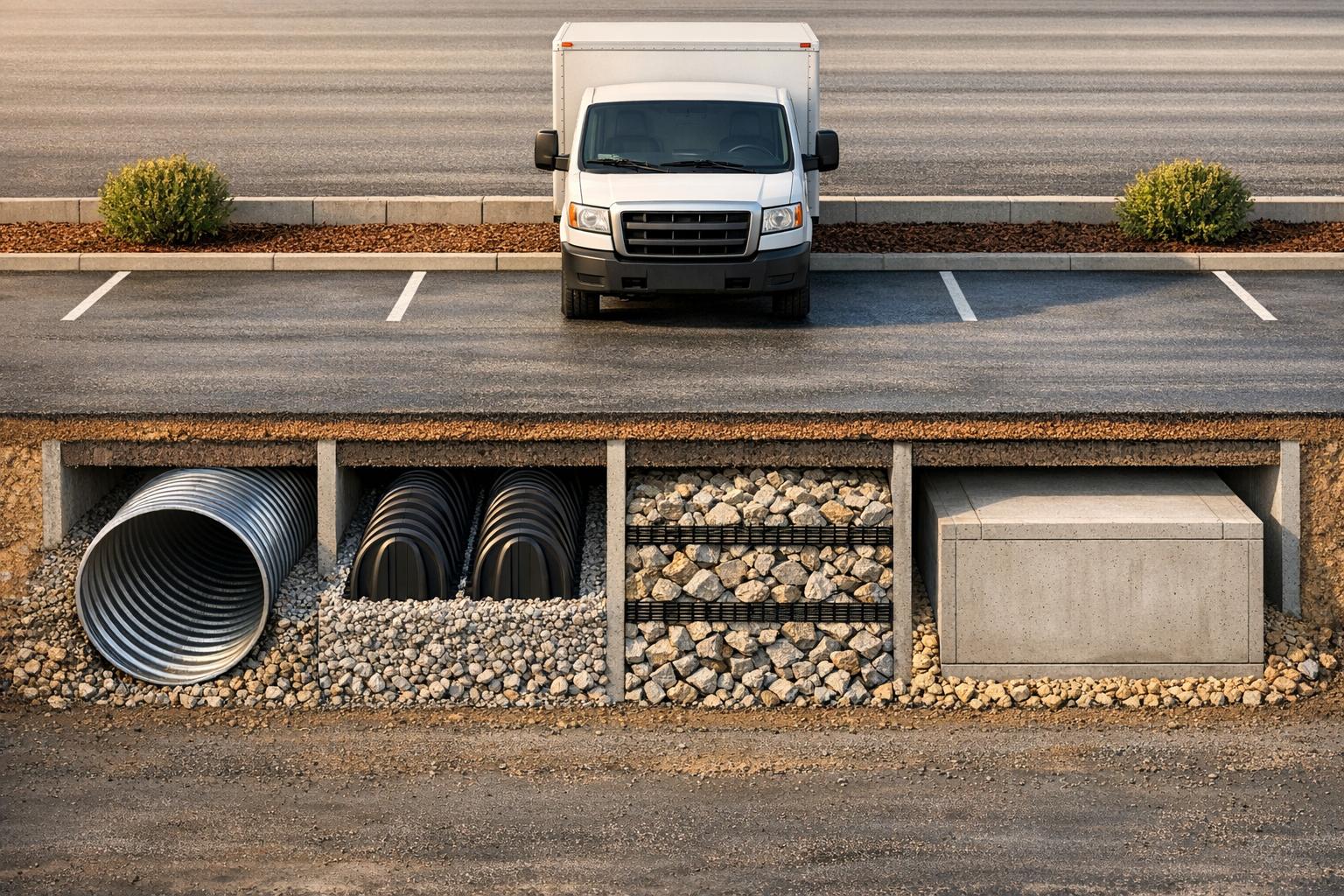
Choosing the right material for underground detention systems depends on load capacity, durability, cost, and storage volume. Here’s a quick breakdown of the four main options:
- Corrugated Metal Pipe (CMP): Strong, flexible, and budget-friendly. With proper coatings, it lasts 75+ years and handles heavy loads effectively. Best for large-scale projects with tight budgets.
- Plastic/Thermoplastic Chambers: Lightweight, easy to install, and cost-effective. Great for uneven terrain but may face durability challenges over time.
- Geosynthetic-Reinforced Stone Chambers: Durable and excellent for drainage. Ideal for managing water pressure and heavy loads, especially in areas with variable soil conditions.
- Concrete Vaults/Arch Chambers: The most durable and compact option. Handles extreme loads and lasts up to 100 years but has higher upfront costs.
Quick Comparison:
| Material | Load Capacity | Durability | Cost | Storage Volume |
|---|---|---|---|---|
| Corrugated Metal Pipe (CMP) | High | Moderate to High | Low | High |
| Plastic/Thermoplastic | High | Moderate | Low | Moderate |
| Geosynthetic Stone Chambers | High | High | Moderate | Very High |
| Concrete Vaults/Arch Chambers | Very High | Very High | High | High |
Each material has specific strengths and trade-offs. Your choice should align with the project’s load requirements, site conditions, and budget. Continue reading for a detailed evaluation of each option.
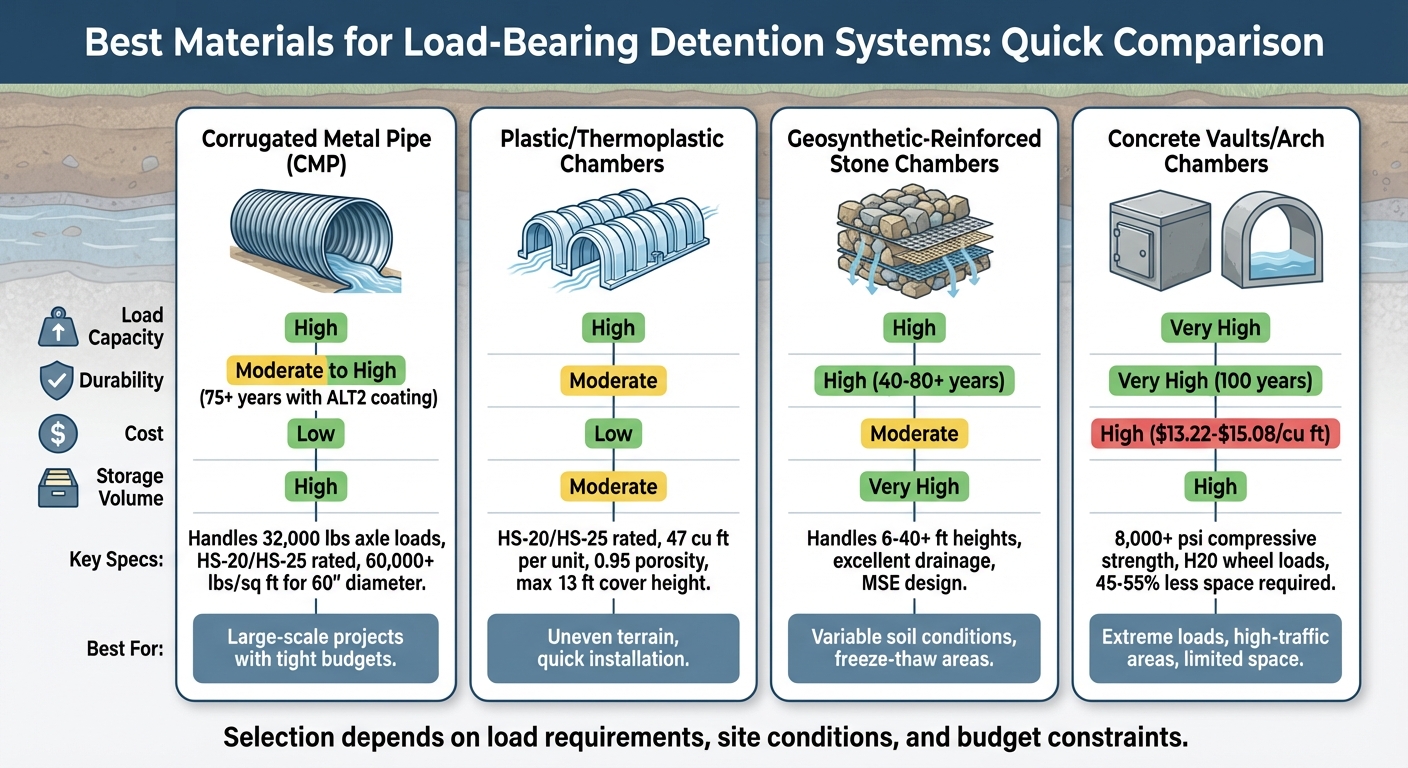
Comparison of Load-Bearing Detention System Materials: Load Capacity, Durability, Cost & Storage
Beneath the Surface: Exploring Underground Stormwater Detention Material Options
sbb-itb-843f8be
1. Corrugated Metal Pipe (CMP) Systems
Corrugated metal pipe systems combine strength and practicality by utilizing steel pipes with corrugated profiles. These profiles work together with the surrounding soil to evenly distribute loads. The corrugated design not only boosts the pipe’s rigidity but also allows for flexibility during installation.
Load Capacity
CMP systems are designed to meet HS-20 and HS-25 highway load ratings, capable of handling axle loads up to 32,000 lbs [6]. Factors like steel gauge, pipe diameter, corrugation, and soil cover depth influence the load capacity. For instance, a 60-inch diameter pipe made from thick 8-gauge steel can support vertical loads exceeding 60,000 lbs per square foot [6].
The system’s strength lies in the interaction between the pipe and the surrounding soil. Proper backfilling and maintaining a soil cover depth of 1 to 3 feet are crucial for transferring loads away from the pipe [6]. Advanced features like double corrugation and stiffening ribs can reduce stresses by 20% and deflections by 50% [7]. For larger structures, achieving 97% soil compaction during installation ensures the pipe maintains its shape under heavy loads [7]. This robust load capacity makes CMP systems reliable for a wide range of applications.
Durability
Durability is another key strength of CMP systems. Protective coatings play a critical role in extending the lifespan of these pipes. Aluminized Type 2 (ALT2) coating, for example, provides a dual-layer protection system: an aluminum surface and an aluminum-iron alloy underneath. This combination offers excellent corrosion resistance and abrasion protection, resulting in a service life of over 75 years in most conditions [8][9]. For more demanding environments, polymer coatings can push the lifespan beyond 100 years [9].
"Aluminized Type 2 (ALT2) CMP features a steel base coated in Type 2 aluminum, which oxidizes to form a corrosion-resistant layer… This material provides a service life of 75+ years in most applications." – Robert Chapman, Contech [9]
A real-world example comes from June 2018, when Contech sales engineer AJ Margetis inspected a 10-year-old, 96-inch ALT2 pipe at Fremd High School in Palatine, IL. Despite some mud staining, cleaning revealed the aluminized coating remained intact, proving its resilience to environmental exposure [8]. Research from the Florida DOT also shows that ALT2 lasts nearly three times longer than traditional galvanized steel under the same conditions [9].
Cost-Effectiveness
CMP systems are often the most budget-friendly option for large-scale underground detention projects. Their lightweight design reduces labor costs and allows for smaller construction equipment during installation. Additionally, the material itself is less expensive upfront compared to concrete alternatives. The modular design speeds up assembly on-site, and with a lifespan exceeding 75 years and minimal maintenance needs, CMP systems provide long-term cost savings for projects with tight budgets.
Storage Volume
CMP systems are available in large diameters, such as 96-inch (8-foot) pipes, making them highly effective for storing significant amounts of stormwater [8]. These pipes not only handle heavy soil pressure but also ensure smooth water flow. Their high storage capacity and structural strength make them ideal for detention systems beneath parking lots, roadways, and commercial developments. These qualities position CMP systems as a competitive choice when evaluating alternative materials in upcoming sections.
2. Plastic and Thermoplastic Modular Chambers
Plastic and thermoplastic modular chambers play a key role in load-bearing underground detention systems by reducing weight and speeding up installation. These chambers, made from materials like high-density polyethylene (HDPE), polypropylene (PP), and fiberglass-reinforced thermosetting plastic (FRP), feature an arch or parabolic shape. This design helps distribute loads effectively to the surrounding stone and soil, ensuring stability and functionality [11]. Their modular nature allows for quick assembly and flexible layouts to suit different site needs.
Load Capacity
These systems meet HS-20 and HS-25 live load requirements as outlined in AASHTO LRFD design guidelines for stormwater chambers [10][11]. Among the materials, FRP chambers stand out for their superior strength and stiffness compared to HDPE and PP options [12]. Proper installation, following ASTM F2787 standards, is critical for achieving optimal structural performance [11][12]. Reinforced plastic chambers can handle a maximum cover height of up to 13 feet, while a minimum cover depth of 1.5 feet is necessary to maintain their structural integrity [12]. Additionally, the surrounding stone backfill is crucial for support – using uniformly graded, washed angular crushed stone (1-inch or 2-inch size) with a porosity of 0.4 provides the required stability [11].
Durability
HDPE and PP chambers resist corrosion and chemical exposure, making them reliable in various environments. However, challenges like freeze-thaw cycles and heavy clay soils can create hydrostatic pressure if moisture is not managed effectively [2][3].
Cost-Effectiveness
One of the standout advantages of plastic chambers is their lightweight design, which significantly lowers installation costs. Workers can carry individual units by hand, reducing the need for heavy machinery and associated expenses [10][14]. In 2021, modular tank systems – including plastic recharge chambers – accounted for 59% of the $516.1 million global stormwater detention market, underscoring their popularity [13]. Their affordability, combined with minimal maintenance needs, makes them a practical choice for projects with tight budgets.
Storage Volume
Plastic chambers excel in storage efficiency. For example, the ChamberMaxx system provides approximately 47 cubic feet (1.3 cubic meters) of storage per unit [10]. Plastic crates deliver an exceptional porosity of 0.95, outpacing arched chambers (0.50–0.65) and concrete vaults (0.75–0.85) [11]. This higher porosity means they can store more water in less space. Low-profile plastic chambers are particularly useful for sites with limited depth, offering maximum storage while meeting load requirements [10]. To enhance performance, these systems often include isolator rows or pretreatment devices to trap sediment before it enters the main storage area [10][11]. This combination of structural reliability and efficient water storage sets the foundation for comparing them to geosynthetic-reinforced stone chambers.
3. Geosynthetic-Reinforced Stone Chambers
Geosynthetic-reinforced stone chambers combine crushed stone with geogrid and geotextile materials to create stable, load-bearing systems. This method, known as Mechanically Stabilized Earth (MSE), uses reinforcement layers within the stone backfill to lock the aggregate together. It’s particularly effective for structures taller than 3 to 4 feet or those exposed to surcharge loads, like driveways or parking areas [2]. The design ensures impressive load-bearing capabilities.
Load Capacity
These chambers transform the reinforced stone into a gravity block, which resists lateral pressure and supports significant structural loads. MSE designs can handle heights ranging from 6 feet to over 40 feet, making them an excellent choice for large-scale detention applications [1]. The geogrid reinforcement enhances interlocking friction, allowing the weight to distribute evenly. For structures exceeding 3 to 4 feet, many municipalities require engineered designs or permits [2]. The system’s ability to tolerate differential settlement ensures reliability on uneven or variable soil conditions, which are common in stormwater projects [1].
Durability
Geosynthetic materials, typically made from polycarbonate fibers, are highly resistant to corrosion and chemical exposure, outperforming natural fibers in longevity [15]. These systems, when built with stone and geosynthetics, can last 40 to 80+ years, similar to gabion structures [2]. Gabion-style chambers, which incorporate wire mesh, often use galvanized or PVC-coated mesh to prevent corrosion in wet environments. Additionally, geotextile fabric beneath the stone base prevents fines from migrating, which could otherwise clog the chamber and affect drainage [2][4]. In areas prone to freeze-thaw cycles, the free-draining aggregate wrapped in filter fabric helps prevent water buildup, reducing the risk of cracking [2].
Cost-Effectiveness
For structures between 13 and 40 feet tall, geosynthetic-reinforced systems offer a cost-efficient alternative to traditional concrete. They significantly cut material and labor expenses [1]. Their modular design speeds up installation compared to cast-in-place concrete, shortening construction timelines and lowering associated costs. Using select granular backfill with low fines (≤8–12% passing a No. 200 sieve) ensures both structural stability and natural drainage, often eliminating the need for additional infrastructure. Additionally, lighter compaction equipment near the chamber face (within 3–4 feet) minimizes outward movement without requiring heavy machinery [1]. This approach balances long-term durability with affordability for stormwater management projects.
Storage Volume
The open-graded stone used in these chambers not only provides strength but also offers excellent permeability, allowing water to pass through quickly. This reduces hydrostatic pressure, which could otherwise compromise the structure [4]. While the porosity depends on stone size and grading, the system effectively handles both storage and structural loads. Perforated drain pipes, installed at the base and sloped to a discharge point, help manage heavy rainfall without affecting the chamber’s load-bearing capacity [2].
4. Concrete Vaults and Arch Chambers
Concrete vaults and arch chambers stand out as some of the most durable and reliable choices for underground detention systems. Built to endure extreme loads and tough conditions, these systems are ideal for scenarios where lighter materials might fail. Precast concrete vaults ensure consistent quality and strength [16]. Similarly, reinforced concrete arch systems are specifically designed to handle H20 wheel loads, making them perfect for high-traffic areas like parking lots and roadways [18].
Load Capacity
Concrete structures are unmatched when it comes to handling heavy loads. Poured reinforced concrete performs exceptionally well in tight spaces and requires minimal footprints [1][2]. These systems are designed to handle static earth pressure, a critical feature for below-grade or braced structures without lateral strain [1]. High-strength concrete used in detention vaults can achieve a 28-day compressive strength exceeding 8,000 psi [17]. To ensure stability, the footings are designed with safety factors of at least 1.5 for sliding and 2.0 for overturning under static conditions [1]. Additionally, concrete arch systems require 45–55% less space compared to other detention technologies, reducing excavation and backfill needs [18]. This combination of strength and efficiency makes concrete a reliable choice for urban environments that demand durability.
Durability
Concrete systems are built with longevity in mind. Standard designs for reinforced concrete aim for a 100-year lifespan [1]. These vaults strike a balance between durability and performance, thanks to the high alkalinity of concrete (pH 12.5–13.5). This alkalinity forms a protective oxide layer on the embedded steel reinforcement, preventing corrosion as long as the pH remains above 11.5 [19]. Concrete systems are also engineered to withstand seismic activity, freeze-thaw cycles, and heavy rainfall without compromising their structural integrity [16]. Unlike plastic chambers, concrete eliminates risks like deformation under heavy loads or the need for specialized compaction [18].
Cost-Effectiveness
While concrete systems may come with higher initial material costs, they offer savings in other areas. Off-site manufacturing reduces on-site labor and speeds up construction [16]. Precast concrete systems range in cost from $13.22 to $15.08 per cubic foot [20]. By comparison, arch chamber systems cost between $9.45 and $13.24 per cubic foot, and plastic modular tanks range from $8.60 to $10.98 per cubic foot [20]. Despite the upfront expense, concrete systems prove economical over time, thanks to their durability, reduced labor needs, and smaller footprint. This makes them especially practical in areas where land is limited or heavy surface loads demand long-term reliability [16][22].
Storage Volume
Concrete vaults are designed to maximize storage capacity while maintaining their structural integrity under pressure. Their closed-vault design allows easy access to the excavation floor for sediment removal and inspections [21]. In contrast, open-bottom arch chambers typically require 40–60% more stone backfill, making them less efficient. Concrete vaults optimize void space and reduce the need for imported clear stone, making them an excellent option for urban areas where space is limited and load demands are high.
Advantages and Disadvantages
Each material used in underground detention systems comes with its own strengths and limitations. Understanding these trade-offs is essential for selecting the right option for a specific project.
Corrugated Metal Pipe (CMP) stands out for its flexibility and ease of installation. Its spiral corrugations enhance structural integrity and allow it to adapt to soil settlement. Depending on maintenance and environmental factors, CMP systems can last anywhere from 25 to 100 years [23][24].
Plastic and Thermoplastic Modular Chambers are ideal for areas with uneven settlement. They are quicker to install than concrete systems and cost-effective for taller setups [1]. Their modular design simplifies assembly on uneven terrain. However, they require a broader reinforced zone – typically 0.7 to 0.8 times the chamber’s height – which increases their overall footprint. Over time, issues like polymer creep and chemical exposure may impact their durability.
Geosynthetic-Reinforced Stone Chambers excel in natural drainage, thanks to the void spaces between stones. These chambers are effective at managing water pressure and reducing erosion [4][5]. They efficiently distribute heavy loads by functioning as a reinforced soil mass [1], and their installation costs are generally moderate.
Concrete Vaults and Arch Chambers provide exceptional load-bearing capacity within a compact footprint. Designed to last up to 100 years [1], these systems are highly durable. However, they come with higher material costs, and improper handling during installation can lead to cracking [2][5].
| Material | Load Capacity | Durability | Cost | Storage Efficiency |
|---|---|---|---|---|
| Corrugated Metal Pipe | High – flexible design adapts to settlement | Moderate to High (25–100 years with care) | Generally low | High – customizable shapes |
| Plastic/Thermoplastic Chambers | High – relies on reinforced soil mass | Moderate – depends on polymer properties | Economical | Moderate – requires wider zone |
| Geosynthetic-Reinforced Stone | High – excellent load distribution | High – benefits from stone durability | Moderate | Very High – maximizes void space |
| Concrete Vaults/Arch Chambers | Very High – rigid structural support | High – engineered for long lifespans | Higher upfront cost | High – minimal footprint |
This comparison highlights the importance of matching material features to the specific needs of a project. The right choice depends on factors like load requirements, site conditions, and budget constraints, ensuring the system performs effectively in the long term.
Conclusion
When designing load-bearing detention systems, it’s crucial to choose materials that align with structural needs, local site conditions, and budget constraints. In Maryland, where high-traffic areas and extreme weather are common, materials built to withstand these challenges are essential. For instance, concrete vault systems offer excellent load-bearing capacity in a compact design, making them ideal for limited-space, high-traffic locations. Similarly, geosynthetic-reinforced stone chambers are particularly well-suited to Maryland’s freeze-thaw cycles and heavy rainfall, ensuring durability over time.
However, material selection is only part of the equation. Effective drainage design plays a critical role in system longevity, especially in Maryland’s unpredictable climate. Hydrostatic pressure caused by water-saturated soil is one of the leading causes of structural failure. To combat this, incorporating drainage solutions like French drains, perforated pipes, and free-draining aggregate backfill can help redirect water and prevent soil erosion.
Addressing Maryland’s stormwater management challenges requires a well-rounded approach that tackles both surface runoff and subsurface water pressure. Pro Landscapes MD specializes in engineered solutions tailored to meet Maryland’s strict performance standards, offering drainage systems designed to protect landscapes and comply with local regulations. Ensuring these systems meet local codes is a key part of the process.
Keep in mind that structures exceeding 3–4 feet in height often require permits and professional engineering. Additionally, excavating down to undisturbed native soil is crucial to prevent shifting or settling over time. By combining materials designed for Maryland’s environment with a robust drainage plan, you can create a detention system that performs dependably for years to come.
FAQs
How do I choose the right detention material for my site?
When choosing detention materials, you’ll want to weigh factors like durability, cost, site conditions, and specific project requirements. Some common options include:
- Concrete vaults: Known for their durability, but they come with a higher price tag.
- Plastic pipes: Lightweight and more budget-friendly, though they might require anchoring in areas with wet soils.
- Steel and aluminum: Additional options that balance strength and cost, depending on the project.
For the best results, consider consulting local experts – like Pro Landscapes MD – who can guide you through material selection. They’ll help ensure your choices align with regulations, soil conditions, the water table, load requirements, and your budget.
What soil and backfill requirements matter most for load ratings?
To ensure proper load ratings, the foundation must be capable of supporting the combined weight of the pipe and backfill. Any unsuitable soil should be excavated and replaced with stable, granular material to prevent settlement issues. Backfill material should have a well-graded composition to prevent the movement of fine particles, maintaining its integrity during construction and ensuring stability over time.
When do I need an engineer or permit for these systems?
When it comes to load-bearing detention systems, whether you need an engineer or a permit often depends on local regulations and the specific details of your project. Larger or more complex systems frequently require professional oversight to ensure they meet safety and stormwater management standards. This is especially important for high-risk or large-scale projects where compliance and safety are critical.
Chat with Us