









- bhavya gada
- No Comments
Native plants thrive in Maryland’s climate, requiring less water, fertilizer, and pesticides once established. They support local wildlife, reduce soil erosion, and improve water quality. However, they need proper care during their first 1-2 years to develop strong roots. Here’s how to create a maintenance schedule:
- Assess Your Garden: Identify native plants, understand their growth cycles, and evaluate soil, light, and moisture conditions.
- Seasonal Care:
- Spring: Delay cleanup until it warms up to protect wildlife. Mulch beds, prune selectively, and plant after the last frost.
- Summer: Water new plants weekly during dry spells, remove weeds carefully, and deadhead flowers.
- Fall/Winter: Plant or divide natives, mulch around trees and shrubs, and prune during dormancy.
- Watering & Fertilizing: Water deeply during dry periods and use minimal fertilizer, focusing on organic, slow-release options.
- Pruning: Remove dead or damaged branches, prune at the right time based on plant type, and sanitize tools to prevent disease.
Track your progress with a checklist or app, and consider professional help for complex tasks. By following these steps, you’ll create a thriving, low-maintenance native garden that supports Maryland’s ecosystem.
Step 1: Assess Your Native Plants and Garden Conditions
Identify Native Plants in Your Garden
Take a closer look at the native species already thriving in your garden. Resources like the Maryland Native Plant Society (MNPS) can provide valuable insights into their care needs. Additionally, your local cooperative extension service is a great place to find advice tailored to the central Maryland region [1].
If you’re working with an existing landscape, check any available plans or site manuals to understand the original layout and purpose. For instance, you might discover that certain groundcovers were intended to grow together, or that shrubs were meant to retain their natural shapes [2]. A native seedling guide can also help you identify and protect beneficial native volunteers that might pop up [2].
It’s important to know the difference between dormancy and death. For example, spring ephemerals like Virginia bluebells may look like they’ve disappeared in summer, but their roots are still very much alive [2]. By understanding the natural life cycles – known as phenology – of your plants, you’ll avoid mistakenly removing those that are simply in their resting phase.
Evaluate Your Site Conditions
Central Maryland’s landscape is diverse, and your property likely has its own unique microclimates. To start, examine your soil type, drainage, and light exposure across different areas of your garden. Pay attention to how the tree canopy affects light, where water tends to collect, and any spots impacted by winter conditions or deicing salts. Areas near gutter downspouts or low-lying patches are ideal for rain gardens filled with moisture-loving native plants [1].
To get a clear picture of soil moisture, dig at least 4 inches below the surface using a soil knife or even your fingers. Surface conditions can be misleading, so this deeper check is key [2].
When you align your plants with their specific microclimates, they’re far more likely to thrive with minimal effort. Once you’ve assessed both your native plants and the conditions of your site, you’ll be ready to create a seasonal maintenance plan that sets your garden up for long-term success.
sbb-itb-843f8be
Native Gardening 101: Maintenance for All Seasons
Step 2: Create a Seasonal Maintenance Calendar
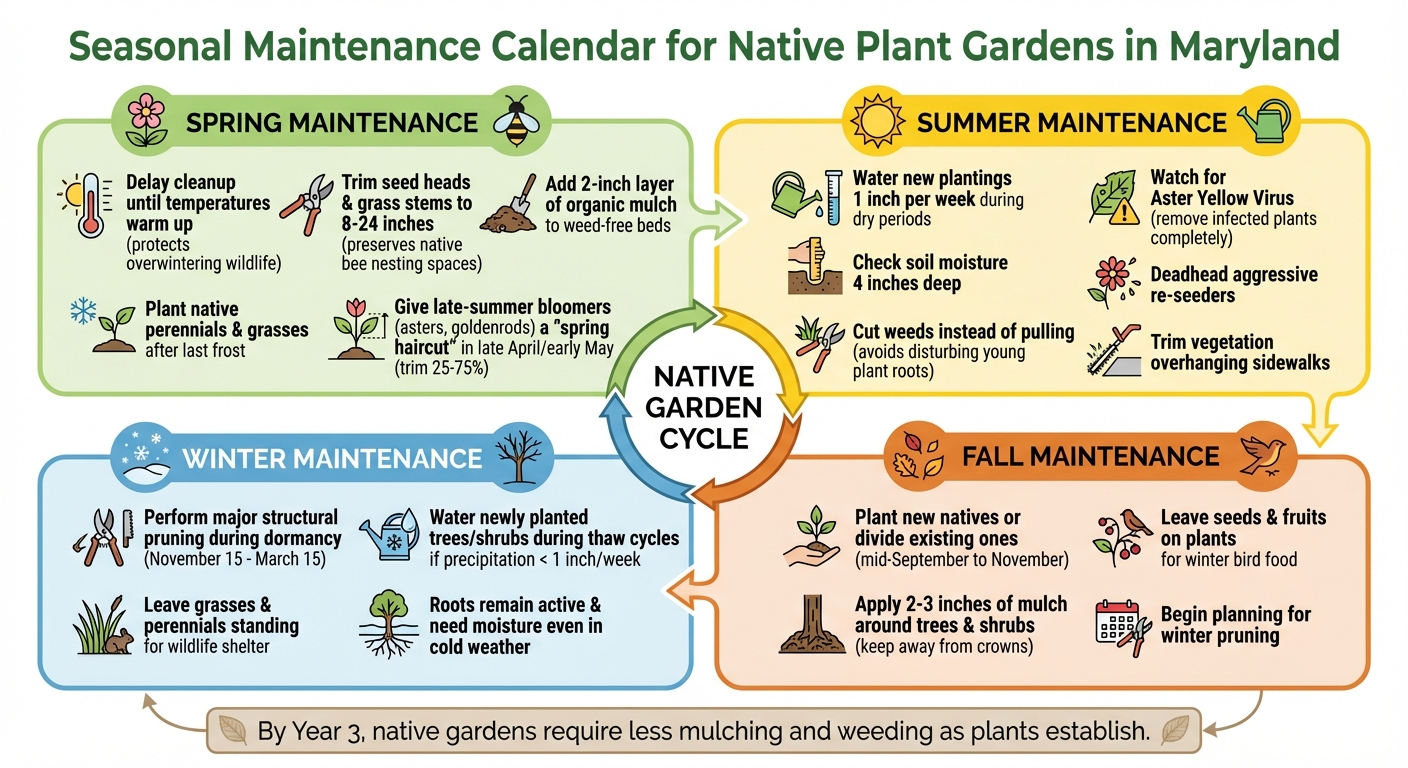
Year-Round Native Plant Maintenance Calendar for Maryland Gardens
After assessing your plants and site, the next step is crafting a yearly maintenance plan. A seasonal calendar helps you stay organized and ensures your efforts align with the natural cycles of your native plants. As Josh Nelson, Development Director at Wild Ones, explains:
"Once established, native gardens generally require much less upkeep than traditional lawns. That means less mowing, fewer inputs, and more time spent enjoying a yard instead of working on it" [1].
Spring Maintenance Tasks
Hold off on garden cleanup until temperatures warm up, which helps protect overwintering wildlife [2]. When tidying up, trim seed heads and grass stems to a height of 8–24 inches rather than cutting them to the ground. This preserves nesting spaces for native bees, whose larvae develop inside those hollow stems over the course of a year [2].
Add a 2-inch layer of organic mulch – such as compost, shredded leaves, or pine needles – to weed-free beds. This helps retain moisture and keep weeds at bay, but avoid piling mulch against plant crowns [2]. Once the last frost date has passed in your area, you can begin planting native perennials and grasses. For plants like asters and goldenrods that bloom later in summer, consider giving them a "spring haircut" in late April or early May by trimming them back 25% to 75%. This encourages compact, bushier growth [2].
As spring transitions into summer, focus on regular watering and keeping weeds under control.
Summer Maintenance Tasks
New plantings need about 1 inch of water per week during dry periods. To check soil moisture, dig 4 inches deep, as outlined in your site assessment [2]. Spend time "editing out" unwanted seedlings and invasive weeds. Instead of pulling weeds, try cutting them to avoid disturbing the roots of young native plants [2].
Watch for signs of Aster Yellow Virus, which often affects plants like coneflowers and black-eyed Susans. If you notice infected plants, remove them completely and dispose of them in the trash – not the compost [2]. To manage aggressive re-seeders, deadhead flowers as needed, and trim vegetation that encroaches on sidewalks to ensure safety.
As summer draws to a close, start preparing your garden for fall planting and winter protection.
Fall and Winter Maintenance Tasks
From mid-September to November, plant new natives or divide existing ones [2]. Leave seeds and fruits on plants like blazingstar and beautyberry, as they serve as essential food sources for birds during the winter months [2]. Apply 2 to 3 inches of mulch around trees and shrubs, but keep it away from plant crowns to prevent rot.
Winter is the ideal time for major pruning, as most trees and shrubs enter dormancy. Plan structural pruning between November 15 and March 15 [2][3]. Continue watering newly planted trees and shrubs during thaw cycles if weekly precipitation falls below 1 inch – roots remain active and need moisture even in cold weather [2]. Leave grasses and herbaceous perennials standing through winter to provide shelter and nesting materials for wildlife [2].
Step 3: Follow Best Practices for Watering, Fertilizing, and Pruning
Once you’ve set up your seasonal care calendar, it’s time to focus on essential landscaping services: watering, fertilizing, and pruning. These steps are key to keeping your native plants healthy and thriving. Since native plants are naturally suited to local conditions, they often need minimal maintenance when cared for properly.
Watering Best Practices
While native plants don’t usually require constant watering, the first three years after planting are crucial for root development [2]. To check if watering is needed, test the soil about 4 inches deep – if it feels moist, you’re good to go. For new plants, aim for about 1 inch of water per week during dry periods. Even in winter, environmental factors like wind or freeze-thaw cycles can dry out the soil. During winter thaws, if there’s less than 1 inch of precipitation in a week, water newly planted trees and shrubs for 10 to 20 seconds.
It’s also helpful to understand a plant’s natural cycle. Some native species may shed leaves or look stressed, but this is often a natural response rather than a problem. To help maintain soil moisture, consider planting fast-spreading ground covers like wild strawberry (Fragaria virginiana) between taller plants. As your garden matures, dense planting will shade the soil, reducing the need for extra watering.
Once watering is under control, the next step is managing nutrients.
Minimal Fertilizing for Healthy Growth
Native plants are already adapted to the local soil, so they rarely need extra fertilizer once established [4] [6] [8]. In fact, over-fertilizing can harm plants by promoting weak, top-heavy growth while neglecting root development. According to the Lady Bird Johnson Wildflower Center:
"Native plants usually do not require fertilizer. Many thrive in poor soil, and applying fertilizer could chemically burn them or stimulate weak foliage growth with few flowers." [6]
Excess fertilizer can also cause environmental problems, such as groundwater contamination and algal blooms in waterways [4] [7] [9]. Before adding fertilizer, test your soil to pinpoint any nutrient deficiencies [5] [9]. For trees and shrubs, wait at least a year before fertilizing to allow roots to establish. For herbaceous perennials and young woody plants, only fertilize at the start of the growing season (late winter to early spring). Avoid fertilizing during droughts or when plants are water-stressed.
If fertilizer is necessary, choose organic, slow-release options with at least 50% Water Insoluble Nitrogen (WIN) and apply sparingly – about 1 pound of nitrogen per 1,000 square feet. For a gentler nutrient boost, try fish emulsion or a "manure tea" (a 1:3 mix of manure and water). Mulches like compost and shredded leaves can also enrich the soil while improving its structure [4] [2].
With nutrients addressed, proper pruning is the final step to encourage healthy growth and structure.
Pruning Guidelines
Pruning is essential for maintaining plant health and shape, but it’s important to do it correctly. Stick to the "4 D’s" rule: remove branches that are Dead, Damaged, Diseased, or Deranged. Avoid cutting more than 25% of a plant’s live growth at one time [2]. Timing also matters. For spring-flowering plants, prune right after they finish blooming since they flower on old wood. Summer-flowering plants, which bloom on new wood, should be pruned in late winter or early spring before new growth starts. For deciduous trees, pruning during dormancy (mid to late winter) makes it easier to see the tree’s structure [10] [12].
Douglas F. Welsh, a horticulture expert, advises:
"In most cases, it is better not to prune than to do it incorrectly." [12]
When pruning, use thinning cuts – removing branches at their origin – to maintain the plant’s natural shape while reducing density. If cutting back to a lateral branch, ensure the remaining branch is at least half the diameter of the one being removed [12] [13]. Always cut just outside the branch collar to avoid leaving stubs. For larger branches (over 1.5 inches), use a three-part cut to prevent bark tearing. Lastly, sanitize your tools with 70% isopropyl alcohol or a 10% bleach solution between plants to prevent disease spread [11] [12]. Avoid pruning in wet weather or late summer and fall, as new growth could be damaged by winter frost.
Step 4: Build a Custom Checklist and Track Your Progress
Now it’s time to organize your garden care routine into a checklist tailored to your garden’s needs and design goals.
Design a Maintenance Checklist
Start by defining your garden’s design intent. As Grow Native! puts it:
"Knowing the design intent of a designed native landscape will determine many maintenance factors, such as whether to ‘edit out’ (weed) native plants that are heavy seeders, allow native ground covers to knit together, pinch back taller plants to control height, or limit the pruning on shrubs to maintain their natural shape." [2]
If you prefer a polished, "tidy" look, you’ll likely need to prune and manage plant growth more often. On the other hand, a wilder, natural aesthetic allows plants to spread, self-seed, and grow more freely.
Organize your checklist by season to align with your region’s climate and gardening needs. Use this seasonal breakdown to plan tasks like mulching, trimming, watering, and planting. Keep track of each plant’s growth cycle – when it emerges, blooms, and goes dormant. For example, spring ephemerals might look dead in the summer but are simply dormant. You could also set a rule: if 75% of a plant is in decline and it’s not dormant, consider removing and replacing it.
Don’t overlook safety checks. Before mowing, check for ground-nesting birds during breeding season, and trim any vegetation that overhangs sidewalks or pathways. [2]
A well-thought-out checklist not only keeps your garden on track seasonally but also evolves with your plants, ensuring they stay healthy and thriving.
Use Tools to Track Progress
Whether you prefer a printable calendar or a digital app, tracking tools can help you stay organized. Document completed tasks and schedule future ones. Monitoring your plants’ phenology – when they bloom, grow, and go dormant – can guide better care decisions over time.
For newly seeded landscapes, create a "Year One" log. For instance, mow areas to 6 inches whenever growth reaches 10–12 inches to promote healthy establishment. [2]
Keep your original landscape plan or site manual close by for reference. These resources can remind you of the design intent and specific care requirements for your plants. To refine your tracking and maintenance skills, check out resources like Wild Ones, which offers free webinars and native garden design programs. Local cooperative extension services are also a great way to learn through garden tours and volunteer opportunities. [1]
Step 5: Work with Professional Services for Long-Term Success
Once you’ve established a solid maintenance schedule, collaborating with experts can take your native garden to the next level, ensuring its health and beauty for years to come.
Pro Landscapes MD Services

A good plan is a strong start, but professional landscapers can help transform a garden from just surviving to truly thriving. Pro Landscapes MD specializes in native plant care, serving central Maryland communities with a deep understanding of this unique approach to landscaping.
Their team of horticulturists knows that native plant care isn’t the same as traditional landscaping. They focus on preserving the original "design intent" of your garden. For example, they can decide whether ground covers like wild strawberry should grow together to create a natural "green mulch" or if certain aggressive plants need to be removed to maintain the garden’s aesthetic balance. This kind of expertise is especially important during the early stages of your garden, where proper watering schedules and targeted weeding are critical to protecting young native plants from invasive species.
Pro Landscapes MD also handles seasonal tasks with precision. They offer services like structural pruning for trees and shrubs during the dormancy period (November 15 to March 15), invasive species control (targeting plants like buckthorn, honeysuckle, and garlic mustard), and even monitoring for plant diseases like aster yellow virus. Their careful attention ensures that every aspect of your garden’s care, from seasonal upkeep to long-term strategy, is handled efficiently and effectively.
By working with professionals, you’re not just maintaining your garden – you’re enhancing its overall design and ecological value.
Improve Your Landscape with Pro Landscapes MD
Pro Landscapes MD takes a tailored approach to Maryland’s unique climate and wildlife. Their designs go beyond maintenance, creating layered landscapes that mirror natural ecosystems. They incorporate structural trees and shrubs, mid-level seasonal blooms, and dense groundcover plantings that not only look beautiful but also suppress weeds and attract pollinators and other helpful insects.
For larger properties or seeded landscapes, they use advanced techniques like prescribed burns or high mowing during the critical establishment phase. These methods ensure your garden looks intentional and well-cared-for while meeting local weed control regulations. Whether you need help with an initial site evaluation, a late-winter clean-up (typically in March), or ongoing maintenance, their team provides the expertise to keep your native garden thriving and visually stunning for years to come.
Conclusion
Crafting a maintenance schedule for your native plant garden doesn’t have to feel overwhelming. Begin by deciding whether you want a formal or natural aesthetic for your space. Next, learn to identify your plants and understand their life cycles – this helps you tell the difference between dormant native plants and actual weeds. From there, create a seasonal calendar that includes tasks like spring cleanup, summer watering for new plantings, fall dividing or planting, and winter pruning.
These seasonal practices set the stage for a thriving, low-maintenance native garden. By the third year, most native gardens need less mulching and weeding as the plants establish themselves fully [2]. Keeping stems at proper heights and leaving leaf litter intact can also provide critical support for wildlife.
Josh Nelson, Development Director at Wild Ones, highlights the benefits perfectly:
"Once established, native gardens generally require much less upkeep than traditional lawns. That means less mowing, fewer inputs, and more time spent enjoying a yard instead of working on it" [1].
Once their roots are established, native plants are remarkably self-reliant, needing extra water only during their initial growth phase or in periods of extreme drought [2].
To make sure your efforts continue to pay off, use a checklist to track seasonal tasks and tweak your approach based on how your plants perform. These small, consistent steps can help you avoid costly errors and keep your garden flourishing.
Whether you handle the upkeep yourself or work with Pro Landscapes MD, having a clear maintenance plan ensures your native garden thrives while benefiting local ecosystems. By planning now, you’ll save time and effort in the future while making a meaningful contribution to environmental health in central Maryland.
FAQs
How do I tell dormancy from a dead plant?
To figure out if a plant is dormant or dead, look for signs of life. Start by checking the roots – healthy ones are firm and pale. You can also try the scratch test: gently scratch the bark to see if there’s green tissue underneath. Dormant plants might lose their leaves, but their branches usually stay flexible. If the branches snap easily, are brittle, and show no green tissue, the plant is likely dead. Another red flag is the absence of new growth once the dormancy period has passed.
How often should I water natives in year one?
Native plants usually don’t require frequent watering during their first year, but they do benefit from occasional watering during extreme droughts. This practice encourages the development of strong root systems. Prioritize watering during extended dry periods, particularly in the early stages, to promote healthy growth and ensure they adapt well to their environment.
When should I prune spring- vs. summer-bloomers?
Prune spring-blooming plants as soon as their flowers fade, typically in late spring or early summer. For summer-blooming plants, it’s best to prune during late winter or early spring, before they start to bloom.
Chat with Us