









- bhavya gada
- No Comments
Native plants can drastically lower your yard’s carbon footprint by reducing maintenance needs and improving soil carbon storage. Unlike shallow-rooted turf grass, many native species develop roots that reach 6–10 feet deep, storing up to 1.8 metric tons of carbon per hectare annually – over four times more than traditional lawns. Plus, they eliminate the need for gas-powered mowers, synthetic fertilizers, and excessive irrigation, cutting emissions from routine upkeep.
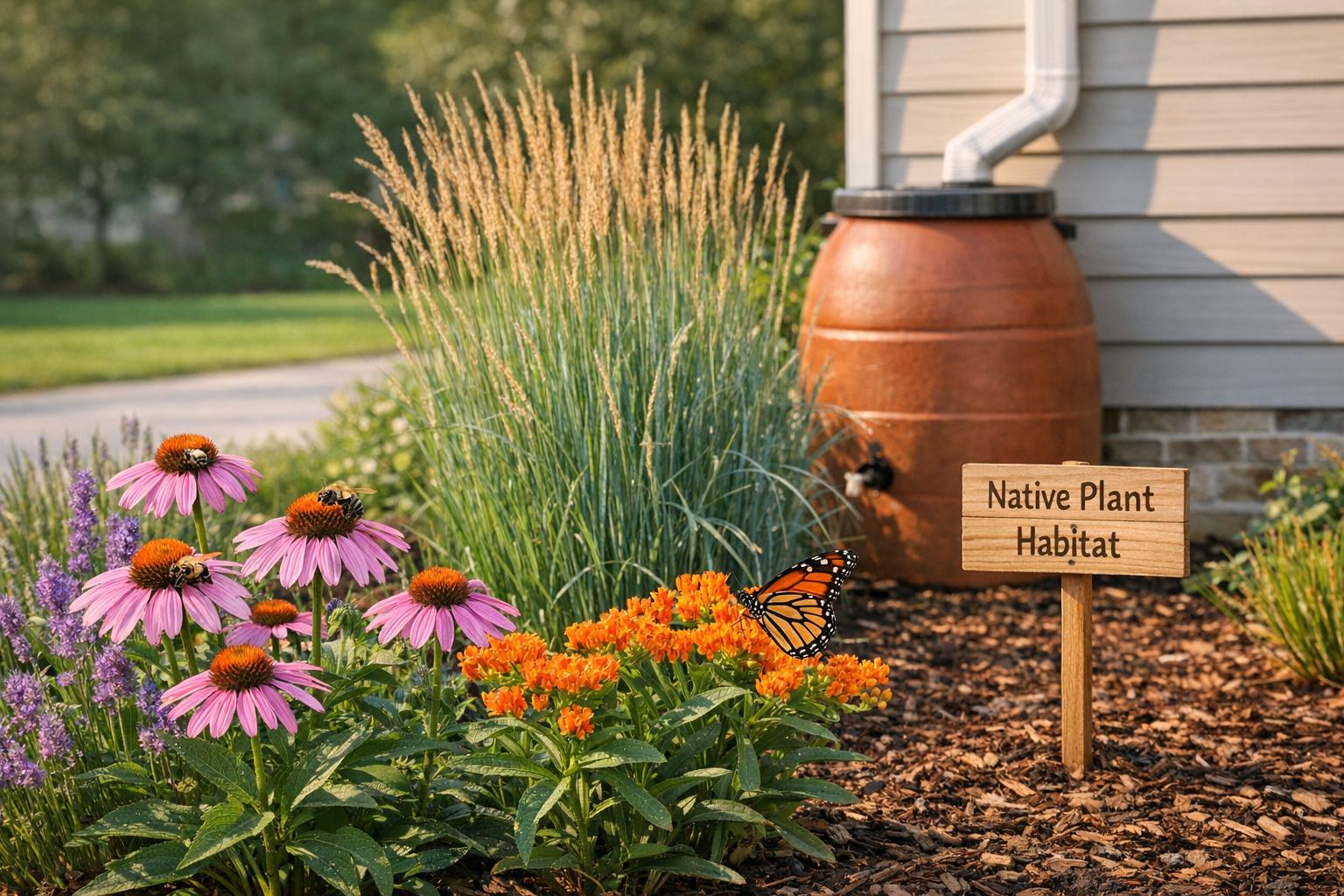
Native landscaping also supports local ecosystems. By planting species suited to Central Maryland’s conditions, like Summersweet, wild ginger, or milkweed, you can create a low-maintenance, resource-efficient yard that benefits pollinators and birds. For best results, choose local ecotype plants and avoid disturbing the soil, as this helps preserve existing carbon stores.
Switching to native plants isn’t just better for the environment – it’s easier to manage and often protected by Maryland laws supporting eco-friendly landscaping.
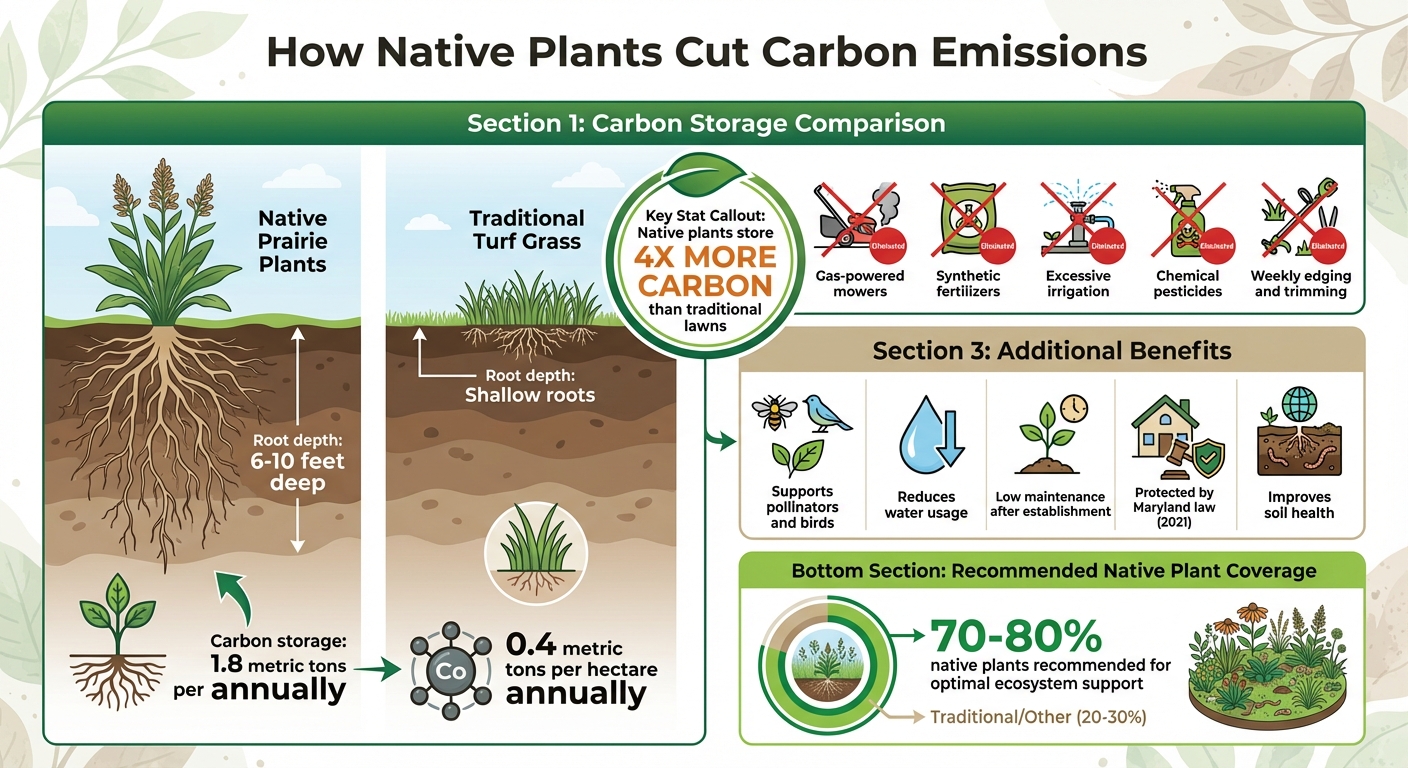
Native Plants vs Traditional Lawns: Carbon Storage and Maintenance Comparison
How Native Plants Reduce Carbon Emissions
Carbon Storage and Resource Conservation
Native plants are exceptional at capturing and storing carbon. With their deep, extensive root systems, they push carbon far below the surface, locking it into the soil for the long haul. Eli Sagor from the University of Minnesota highlights that some prairie species can develop roots that stretch 6 to 10 feet underground, making them highly effective carbon sinks [6].
The soil itself becomes a key player in this process. Many native plants, especially legumes, form partnerships with nitrogen-fixing bacteria, naturally enriching the soil and reducing the need for synthetic fertilizers. This cuts down on the carbon emissions tied to fertilizer production. Trees also play a major role, as their biomass is about 50% carbon by dry weight [6]. Letting leaves decompose naturally and avoiding soil tilling helps preserve the carbon already stored in the soil.
But native plants don’t just store carbon – they also help reduce the emissions created by routine landscape maintenance.
Lower Maintenance Emissions
Once established, native landscapes require far less upkeep than traditional lawns, leading to significant emission reductions. Unlike conventional lawns, which demand regular mowing, edging, and trimming, native meadows or perennial beds thrive with minimal intervention [7].
Native plants also do away with the need for chemical inputs like synthetic fertilizers and pesticides. These chemicals are not only energy-intensive to produce but also release greenhouse gases. Additionally, native species are perfectly suited to local conditions, meaning they typically don’t need extra irrigation after their first year. This saves water and reduces the energy used for irrigation systems.
Adrian Ayres Fisher, Sustainability Coordinator at Triton College, sums it up well:
"Crucial to carbon gardening is choosing plants… that will not require high-carbon inputs such as synthetic fertilizer, weekly mowing, frequent edging and hedge trimming or the use of leaf blowers."
sbb-itb-843f8be
The Best Way to Put Carbon Back in the Ground
Selecting Native Plants for Central Maryland
Now that we’ve covered how native plants can help reduce carbon emissions, let’s dive into picking the right ones for Central Maryland’s specific environment.
Native Plants by Site Conditions
The secret to successful native planting lies in choosing plants that fit your site’s unique conditions. Central Maryland falls within the Piedmont Region, which has distinct soil and climate characteristics that influence plant suitability.
For sunny, moist areas with at least six hours of sunlight, consider planting Summersweet (Clethra alnifolia), Winterberry holly (Ilex verticillata), or Anise hyssop (Agastache foeniculum). These not only add beauty to your garden but also attract and support local wildlife. Keep in mind that Winterberry holly requires both male and female plants to produce its signature red berries.
If your site has moderate sun and drier conditions, options like wreath goldenrod, woodland sunflower, moss phlox (Phlox subulata), and Eastern redcedar are great choices. For shadier spots (three hours or less of sunlight), try wild ginger (Asarum canadense), spicebush (Lindera benzoin), or flowering dogwood (Cornus florida) – all of which thrive in medium to wet soils.
To truly benefit native birds and insects, aim for at least 70% native plants in your landscape [4]. Deep-rooted species like milkweed, false blue indigo (Baptisia australis), and New England aster are particularly effective at capturing carbon and promoting biodiversity.
The key is to match plants to your site’s conditions. Choosing local ecotype plants will further enhance your garden’s success.
Why Local Ecotype Plants Matter
Not all native plants are equally suited to Maryland’s environment. Local ecotype plants, grown from seeds collected in Maryland’s wild populations, are better adapted to the state’s specific soils, humidity, and weather patterns [7]. These adaptations improve survival rates, which is critical for maintaining long-term carbon storage.
When shopping for plants, ask for local ecotype varieties instead of generic native cultivars. Additionally, confirm that the plants haven’t been treated with neonicotinoids – these pesticides can harm the pollinators your garden is meant to support. Trusted resources like the Maryland Native Plant Society and the University of Maryland Extension can help you find growers who specialize in authentic local ecotype plants.
How to Plant Native Species
Getting the planting process right can make a big difference in how effectively your landscape stores carbon.
Step 1: Assess Your Site and Soil
Before you start digging, test your soil to check its nutrient levels and pH [4]. This step helps you avoid over-amending, which can harm native plants that are naturally suited to tougher conditions.
Next, evaluate your planting areas by noting light exposure (full sun is 6+ hours of direct sunlight, while full shade is 3 or fewer hours) and soil moisture (dry, medium, or wet). After a heavy rain, take a walk around your property to pinpoint low spots where water collects. Also, keep in mind that surfaces like driveways or patios can reflect heat, increasing the sun exposure in nearby areas [4][9].
One key thing to remember: don’t till deeply. Soil holds about four times more carbon than the atmosphere, and tilling releases that carbon into the air [3]. If you need to manage weeds, limit tilling to a depth of 1–2 inches. Even better, try solarization: soak the area with water, cover it with clear plastic, and let the sun do the work over several months to kill weeds without disturbing the soil [1][3].
"Because soil holds four times the amount of carbon stored in the atmosphere, how we use the land under our care will determine how well it sequesters carbon." – Doug Lockard, South Carolina Native Plant Society [3]
Once you’ve assessed your site and prepared the soil, you’re ready to find plants that match your local conditions.
Step 2: Source High-Quality Native Plants
Not all plants labeled as "native" are the same. Look specifically for local ecotype plants, grown from seeds collected from wild populations in your region. These plants are naturally suited to Central Maryland’s environment and are better at thriving and storing carbon [8][7].
When shopping, ask nurseries if their plants are free of neonicotinoids – insecticides harmful to pollinators, which are a key part of your native garden [9]. Reliable nurseries should be able to confirm this.
Always choose nursery-grown plants instead of taking them from the wild, which can disrupt natural ecosystems. To find trusted sources, check lists maintained by the Maryland Native Plant Society or the University of Maryland Extension.
Step 3: Planting and Establishing
When it’s time to plant, dig a hole larger than the root ball to give roots space to spread while keeping carbon stored in the soil. Place the plant so the soil from its container sits level with the ground [1].
Start planting near structures to avoid compacting soil in other areas [4]. When removing plants from containers, handle them by the root ball, not the stems, to prevent damage.
Spread organic mulch up to 3 inches deep around plants, keeping it away from stems, to retain moisture and protect roots during the critical early weeks [4]. For plants like yuccas that prefer drier conditions, use mineral mulches like crushed granite instead [1].
Water your plants regularly for the first 2–3 weeks to help them establish [4][1]. After that, most native plants will need little additional watering, even during dry periods.
Once your plants are established, shift to low-maintenance practices to keep your landscape healthy and carbon-friendly.
Step 4: Maintaining a Native Landscape
Native landscapes are easier to maintain than traditional lawns, and that’s part of what makes them so effective at reducing carbon emissions.
Stick to a no-till approach to keep soil carbon intact. Native plants are adapted to thrive without fertilizers or other chemical inputs.
Instead of bagging fallen leaves, leave them under trees and shrubs. This builds soil health, recycles nutrients, and creates habitat for pollinators during winter [2][6]. If you’re worried about appearance, rake the leaves into garden beds rather than removing them entirely.
Cut back on gas-powered tools like mowers and leaf blowers. Native prairie ecosystems, for example, can store up to 1.8 metric tons of carbon per hectare annually, compared to just 0.4 metric tons for turf grass lawns that require constant mowing [5].
"Almost anything done to improve soil health and structure will also increase carbon in the soil." – Christine Jones, Soil Scientist [2]
If you’re part of a homeowners association, Maryland’s 2021 law protects your right to create low-impact landscaping, including pollinator and rain gardens. HOAs cannot impose "unreasonable limitations" on these eco-friendly practices [4]. Your native garden isn’t just good for the planet – it’s also backed by law.
Native Plant Services from Pro Landscapes MD

Professional services can transform your property into a greener, more sustainable space by harnessing the benefits of native plants.
Custom Native Planting and Landscape Design
Pro Landscapes MD specializes in creating native landscapes tailored to central Maryland’s unique environment. Their process starts with detailed soil tests and site evaluations, ensuring that the chosen native plants thrive under your property’s specific light, moisture, and soil conditions. This approach not only maximizes plant health but also enhances carbon absorption, turning your property into a natural carbon sink[4][1].
One standout service is their turf replacement program, which swaps shallow-rooted grass for deep-rooted native perennials, shrubs, and trees. This transition boosts biodiversity and improves carbon storage. They also focus on removing invasive species and restoring ecosystems with diverse, climate-adapted native plants[4]. By using no-till practices and organic soil amendments, they protect soil structure and preserve existing soil carbon during installations.
Pro Landscapes MD also helps homeowners comply with Maryland’s 2021 legislation, which prevents homeowners’ associations from imposing unreasonable restrictions on eco-friendly landscaping like rain gardens and pollinator habitats[4]. To support local wildlife, they aim for landscapes to include 70% to 80% native plant species, which is key for sustaining beneficial insects and birds[4][2].
Their services don’t stop at planting. They also integrate eco-friendly hardscaping options to enhance the functionality and aesthetics of native landscapes.
Eco-Friendly Hardscaping Options
Pro Landscapes MD offers hardscaping solutions that complement native plantings while addressing stormwater management and carbon reduction. Their environmental pavers create permeable surfaces that reduce heat reflection and allow rainwater to seep into the ground, supporting the deep root systems of native plants. French drains are another option, designed to redirect water flow, prevent erosion, and maintain soil health.
Rain gardens are a highlight of their offerings. These features not only capture and filter stormwater runoff but also provide habitats for moisture-loving native plants. In some Maryland areas, installing rain gardens or replacing traditional turf with native landscaping may qualify for RainScapes Rebates[7]. To ensure these landscapes blend seamlessly into neighborhood settings, Pro Landscapes MD incorporates design elements like defined edges, pathways, and natural stone accents, creating a polished and intentional look[7].
Conclusion
Native plants offer a powerful way to lower your property’s carbon footprint while creating a landscape that’s easier to maintain. Many native prairie species have deep root systems that reach 6 to 10 feet into the soil[6], allowing them to store up to 1.8 metric tons of carbon per hectare each year[5]. Once established, these plants eliminate the need for synthetic fertilizers, irrigation systems, and gas-powered mowing – cutting emissions from routine maintenance.
Beyond carbon storage, native landscaping protects essential resources and boosts local biodiversity. Replacing even part of your lawn with native perennials, shrubs, and trees suited to Central Maryland’s environment provides food and shelter for pollinators and birds. It also helps filter harmful runoff, protecting waterways like the Chesapeake Bay. Thoughtful land management like this plays a key role in addressing climate challenges[3].
To make the most of these benefits, expert guidance ensures your native landscape thrives from the start. Pro Landscapes MD uses professional assessments, soil testing, and insights into local plant ecotypes to design landscapes that maximize carbon absorption and ecological impact. Their no-till methods also help maintain existing soil carbon, making the transformation more sustainable.
Native landscaping isn’t just good for the environment – it’s practical and rewarding for property owners too. Pro Landscapes MD offers a full range of services, including custom native planting, eco-friendly hardscaping with environmental pavers, and French drains, making the process straightforward and effective.
Want to cut your carbon footprint while enhancing your outdoor space? Contact Pro Landscapes MD to learn how native landscaping can turn your property into a flourishing, low-carbon haven.
FAQs
How much lawn should I replace to see a carbon impact?
Replacing a large part of your lawn with native plants can make a big difference in capturing carbon and shrinking your yard’s carbon footprint. Experts suggest that filling at least 70% of your landscape with native plants is ideal. This not only helps the environment but also cuts down on the time and effort needed for upkeep.
How long does it take native plants to become low-maintenance?
Native plants typically need about 2 to 3 years to settle into their new environment. During this period, they gradually adapt, becoming more resilient and requiring less attention over time. Once established, they tend to thrive with minimal care.
What’s the easiest way to switch to natives without disturbing soil carbon?
To transition to using native plants while keeping soil carbon intact, take a gradual approach. Begin by carefully removing or relocating non-native plants, focusing on areas close to buildings or other structures. Then, introduce native species to fill the gaps. This method helps maintain soil carbon levels and encourages a healthier, more diverse ecosystem.
Chat with Us