









- bhavya gada
- No Comments
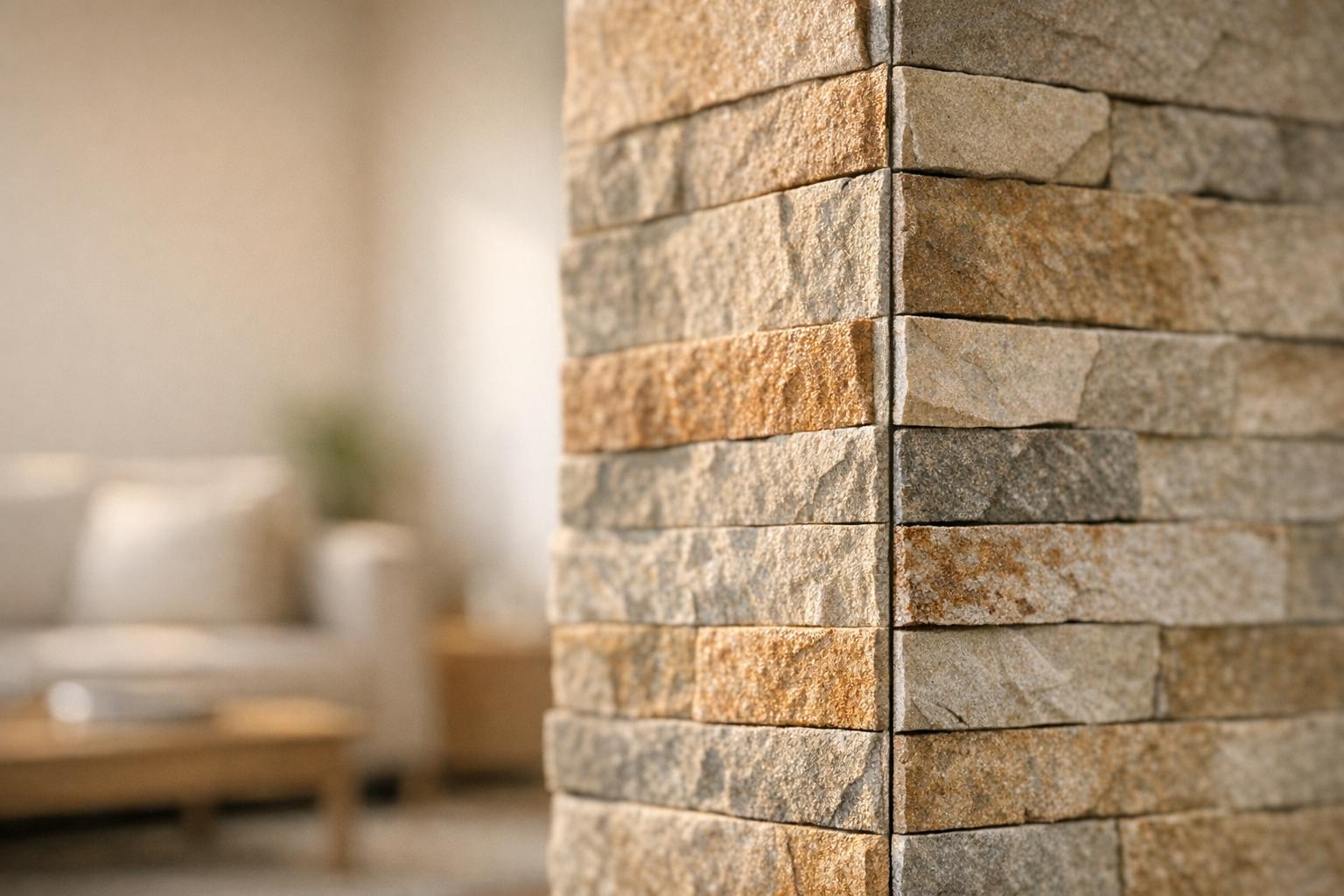
Looking to upgrade your interior walls without the hassle of heavy materials or high costs? Natural thin stone veneer offers the beauty of real stone with less weight, lower installation costs, and more design options. Here’s why it’s a smart choice:
- Lightweight: At 7–15 lbs per square foot, it’s up to 74% lighter than full-thickness stone (35–45 lbs per sq. ft.).
- Cost-Effective: Material costs range from $6–$12 per sq. ft., with installation averaging $21–$37 per sq. ft. – about 30–40% cheaper than full-thickness stone.
- Easy Installation: No need for structural reinforcements; it can be applied to drywall, plywood, or masonry surfaces.
- Space-Saving: Thin profile (0.5–1.5 inches) works well in tight spaces like bathrooms, kitchens, or hallways.
- Design Options: Available in various styles like ledgestone, mosaic, and ashlar, it suits any interior aesthetic.
Whether you’re reimagining a fireplace, accent wall, or backsplash, thin stone veneer delivers the look of stone without the weight or complexity.
Quick Comparison
| Aspect | Thin Stone Veneer | Full-Thickness Stone |
|---|---|---|
| Weight | 7–15 lbs/sq. ft. | 35–45 lbs/sq. ft. |
| Cost (Total) | $21–$37/sq. ft. | $33–$55/sq. ft. |
| Installation | No footing required | Requires structural support |
| Thickness | 0.5–1.5 inches | 3–5 inches |
| Best For | Tight spaces, retrofits | Bold, high-impact features |
Thin stone veneer simplifies your project while delivering lasting style and value.
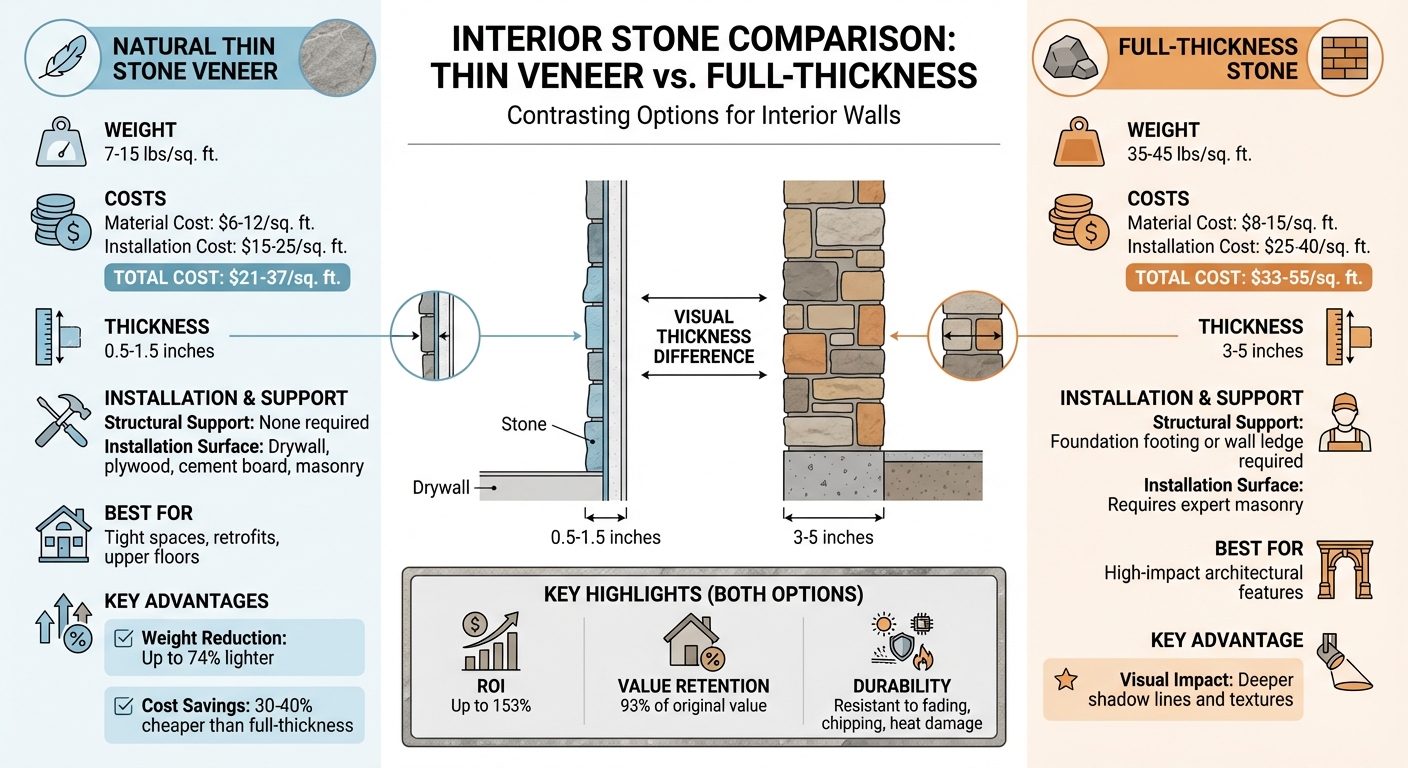
Natural Thin Stone Veneer vs Full-Thickness Stone Comparison
1. Natural Thin Stone Veneer
Weight
One of the standout features of natural thin stone veneer is its lighter weight. At just 7 to 15 pounds per square foot [2], it can be installed directly onto standard drywall or plywood without needing extra structural support. Unlike full-thickness stone, it doesn’t require foundation footings or ledges, which simplifies the process and cuts down on costs like shipping [1]. This reduced weight makes it easier to handle, install, and transport, adding to its overall practicality.
Cost
The lightweight nature of thin stone veneer directly impacts its affordability. Material costs typically range from $6 to $12 per square foot, while professional installation averages $15 to $25 per square foot [2]. Its easier installation process means less time and labor compared to traditional full-bed masonry [4]. Additionally, natural stone cladding holds its value exceptionally well, retaining up to 93% of its original worth at its peak [7], making it a smart investment for homeowners.
Installation Requirements
Thin stone veneer is versatile when it comes to installation. It can be applied to surfaces like drywall, plywood with metal lath, cement board, masonry, or concrete [1]. For drywall, a moisture barrier and metal lath are recommended, along with a polymer-modified thin-set mortar for secure adhesion [8]. Its slim profile – ranging from 1/4 to 1 inch thick [4] – makes it perfect for tight spaces, offering flexibility and convenience in a variety of settings.
Design Flexibility
This veneer fits effortlessly into a wide range of interior styles. Whether you prefer the clean lines of ledgestone, the handcrafted feel of mosaic patterns, or the classic look of ashlar cuts, there’s a design to match your vision [9]. It’s perfect for enhancing spaces like fireplace surrounds, kitchen islands, backsplashes, wine cellars, wet bars, entryway niches, and even interior columns [3]. The natural variations in color and texture give it a rich, dynamic appearance [3]. To maximize its effect, consider pairing it with thoughtful lighting to emphasize the texture. Also, keep in mind how natural light changes throughout the day, subtly altering the stone’s hues, so choose blends that complement the overall color scheme [3].
sbb-itb-843f8be
Thin Stone Veneer Installation With Moisture Control
2. Full-Thickness Stone
Unlike the lightweight and adaptable thin veneer, full-thickness stone requires additional structural support, making it a more demanding option.
Weight
Full-thickness stone, also known as full-bed stone, is significantly heavier than natural thin stone veneer, weighing between 35 and 45 pounds per square foot [2][5]. This weight necessitates foundation footings or wall ledges for proper support [1][2]. Because of its heft, it may not be practical for many interior applications [1][2].
Cost
The financial commitment for full-thickness stone is notably higher. Material costs range from $8 to $15 per square foot, while installation labor can add another $25 to $40 per square foot [2][5]. These costs reflect the need for heavier materials, structural reinforcements, and skilled masonry work. Additionally, shipping expenses are higher due to the stone’s bulk and weight [1][2][5]. Together, these factors highlight the challenges of using full-thickness stone compared to thinner alternatives.
Installation Requirements
"Full-thickness building stone veneer represents the traditional approach to natural stone applications… requiring proper footing and structural support for installation."
– Jon Smiley, Owner, Stone Center [2]
Full-bed stone cannot simply be applied to surfaces like drywall or plywood. Its installation demands proper footing and expert masonry, often requiring additional reinforcement, which increases both costs and complexity [2]. When considering full-thickness stone, it’s crucial to confirm that floors and walls can handle the load of 35 to 45 pounds per square foot. These structural demands play a key role in the design process and influence the final aesthetic, especially in interior spaces.
Design Flexibility
One of the standout features of full-thickness stone is its ability to create deeper shadow lines and more pronounced textures compared to thin veneer [2]. Jon Smiley describes it as "perfect for high-impact, high-value architectural features" [2]. However, its 3 to 5-inch depth can reduce usable floor space, making it less practical for smaller spaces like compact bathrooms or narrow hallways [2][4][5]. While its durability is advantageous in high-impact areas, these benefits are less essential in controlled indoor environments [1][2]. Ultimately, while full-thickness stone delivers a bold, dramatic look, its structural demands and space limitations often make thin stone veneer a more practical choice for interior projects.
Advantages and Disadvantages
When deciding between natural thin stone veneer and full-thickness stone for your interior project, it’s important to weigh their strengths and limitations. Thin veneer stands out for its affordability and adaptability, while full-thickness stone delivers a bold, architectural look but comes with a higher price tag.
Weight is a key consideration. Thin veneer is significantly lighter, weighing between 7–15 lbs per square foot, which reduces installation costs and eliminates the need for additional structural support. In contrast, full-thickness stone comes in at 35–45 lbs per square foot and often requires extra reinforcement to handle the load [2]. This makes thin veneer a more budget-friendly option for installation.
Space efficiency is another area where thin veneer shines. With a thickness of just 0.5 to 1.5 inches, it’s perfect for tight spaces like bathrooms or hallways, where every inch matters [2]. Full-thickness stone, on the other hand, ranges from 3 to 5 inches deep, which can encroach on usable space and feel overwhelming in smaller rooms [2]. For retrofitting projects or upper-story applications, the lighter weight and easier installation of thin veneer make it a practical choice. These factors not only simplify installation but also expand design possibilities for your interior.
Here’s a quick comparison to help you decide:
| Aspect | Natural Thin Stone Veneer | Full-Thickness Stone |
|---|---|---|
| Weight | 7–15 lbs/sq. ft. [2] | 35–45 lbs/sq. ft. [2] |
| Cost | $21–$37/sq. ft. (total) [2] | $33–$55/sq. ft. (total) [2] |
| Installation Requirements | No footing needed; applies to drywall or masonry [2] | Requires foundation footing or structural ledge [2] |
| Design Flexibility | High; suitable for retrofits, upper floors, curved surfaces [5] | Limited by weight and structural demands [2] |
| Thickness | 0.5"–1.5" [2] | 3"–5" [2] |
Both options have their place, but thin veneer’s lighter weight and versatility make it especially appealing for projects where space, cost, and ease of installation are top priorities.
Conclusion
Natural thin stone veneer provides the aesthetic appeal of real stone while simplifying installation. Weighing just 7–15 lbs per square foot – compared to the 35–45 lbs per square foot of full-thickness stone – it reduces structural support requirements and can lower installation costs by as much as 40% [2][5].
Its slim profile, ranging from 0.5 to 1.5 inches thick, makes it a practical choice for areas where traditional stone would be too bulky. This includes tight spaces like bathrooms, hallways, and kitchen backsplashes. It’s also ideal for upper-story installations and fireplace updates, offering design flexibility that heavier materials often can’t match [2].
Beyond ease of installation, thin veneer delivers in terms of durability and long-term value.
"Thin stone veneer is transforming both interior and exterior architecture with its natural beauty, design flexibility, and structural advantages." – Lompoc Stone [1]
Projects using stone veneer have demonstrated impressive returns, with ROI rates reaching up to 153%. Natural stone also retains about 93% of its original value over time [6][7]. Its durability ensures resistance to fading, chipping, and heat damage, while maintenance is minimal – usually just a quick clean with mild soap and water [3][5].
For those seeking a cost-effective way to elevate their interiors, natural thin stone veneer offers the striking look of stone with fewer hurdles.
FAQs
Do I need to reinforce my wall for thin stone veneer?
Thin stone veneer on interior walls usually doesn’t require reinforcement because it’s both lightweight and stable. However, it’s always a good idea to consult a structural engineer or a professional installer. They can evaluate your wall’s specific conditions and confirm that the installation will be done correctly.
Can thin stone veneer be used in wet areas like bathrooms?
Thin stone veneer isn’t typically recommended for wet areas like bathrooms because it tends to absorb water, which can result in damage or even mold growth. That said, with the right sealing and consistent upkeep, it can be used in these spaces – but only with extra care.
How do I clean and maintain thin stone veneer indoors?
To keep your natural thin stone veneer looking great indoors, start with regular dusting and wiping using a soft, damp cloth. For a more thorough clean, mix a mild soap or a cleaner made specifically for stone with water – steer clear of harsh or acidic chemicals, as they can damage the surface. Clean up spills right away to avoid staining, and consider sealing the veneer occasionally to guard against dirt and wear. With gentle upkeep, you can preserve its beauty and strength for years.
Chat with Us