









- bhavya gada
- No Comments
Building a patio doesn’t have to drain your wallet. Whether you’re in Maryland or elsewhere, here are 7 practical ways to cut costs without compromising durability or quality:
- Choose affordable materials: Concrete pavers ($10–$25/sq. ft.) or stamped concrete ($8–$12/sq. ft.) offer durability and cost savings compared to natural stone.
- Build in phases: Start with a basic patio and add features like fire pits or kitchens later to spread out expenses.
- Install in the off-season: Fall and winter installations often come with lower contractor rates and faster permit processing.
- DIY site prep: Save $500–$2,000 by handling excavation and grading yourself.
- Keep the design simple: Straight lines and smaller sizes reduce labor and material costs.
- Understand permit rules: Avoid fines or delays by knowing local requirements. Smaller patios may even skip permits.
- Hire local contractors: Maryland-based experts can save you 10–15% by using suitable materials and avoiding mistakes tied to the state’s climate and soil.
Key takeaway: Smart choices in materials, timing, and design can help you save thousands while ensuring a long-lasting patio. Below, we’ll explore each tip in detail to help you plan your project effectively.
Patio Material Costs and Savings Comparison Guide
1. Use Budget-Friendly Materials Like Concrete Pavers or Stamped Concrete
Affordability of Materials
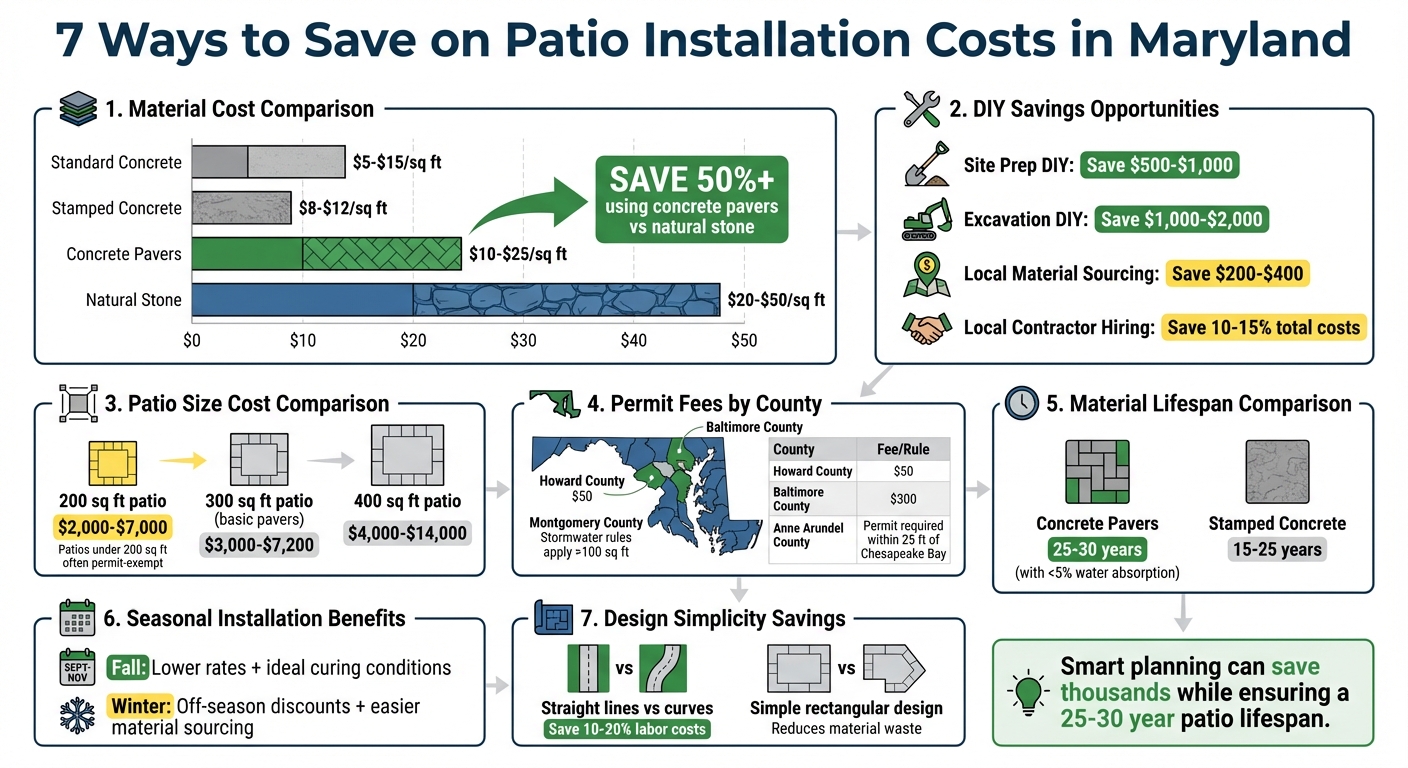
When it comes to patio materials, your choice can have a huge impact on costs. Standard concrete is one of the most economical options, priced between $5–$15 per square foot, while natural stone can cost $20–$50 per square foot. If you’re looking for something in the middle, stamped concrete and concrete pavers offer durability and versatility at $8–$25 per square foot [1][2]. For example, a 300-square-foot patio made with concrete will likely cost much less than one constructed with natural stone.
"Stamped concrete can mimic pricier materials for $8-$12 per square foot, offering affordable elegance." – Diligent Exterior Remodeling [1]
Concrete pavers, priced around $10–$25 per square foot, are designed to meet ASTM C936 standards, meaning they’re built to handle freeze-thaw cycles without cracking. In fact, they actually increase in strength over time during temperature fluctuations, unlike solid concrete slabs [2]. Plus, their modular design offers a practical advantage: if one paver gets damaged, you can replace it individually instead of redoing the entire surface, saving anywhere from $500 to $2,000 [1].
Choosing these materials not only helps you save upfront but also sets the stage for smarter, long-term cost management.
Cost-Saving Strategies
The savings don’t stop at material selection. Smart sourcing and installation techniques can also help you stretch your budget. For example, buying materials locally in Maryland can eliminate long-distance delivery fees, potentially saving you $200 to $400 [1]. Concrete pavers, with their low water absorption rate (less than 5%), typically last 25 to 30 years, while stamped concrete has a slightly shorter lifespan of 15 to 25 years, partly due to its higher thermal expansion rate [2].
To cut down on future maintenance costs, consider using polymeric sand between pavers. This helps prevent weed growth and washout, reducing upkeep. Additionally, sealing concrete surfaces is crucial to protect against moisture infiltration, which can lead to cracks that cost more than $1,000 to repair [1][2]. Proper sealing not only extends the life of your patio but also saves you money in the long run.
sbb-itb-843f8be
2. Build Your Patio in Phases to Spread Out Expenses
Cost-Saving Strategies
When tackling a patio project in Maryland’s unpredictable climate, breaking it into phases can be a smart way to manage costs. Start with the essentials – a durable base patio – and hold off on extras like fire pits or outdoor kitchens until your budget allows. This method not only keeps costs manageable but also helps you avoid taking on high-interest financing while still enjoying a functional outdoor area right away.
"Install the base patio now, add BBQs or lighting later to spread costs." – Diligent Exterior Remodeling [1]
A strong foundation is key. Use an 8 to 10-inch base of compacted 21A crushed limestone to prevent frost heave and ensure your patio stands the test of time [2].
Design Simplicity
Careful planning during the initial phase can save you from costly headaches later. For example, if you’re thinking about adding a gas fire pit or outdoor kitchen down the line, consider pre-installing gas and electrical lines during the first excavation. This small step can save you anywhere from $2,000 to $12,000 in future modifications [3].
Start with a straightforward design, like a geometric shape, and use materials that allow for easy expansion, such as concrete pavers or modular stones. Avoid stamped concrete for the base, as it’s nearly impossible to match perfectly if you decide to expand later [3].
A basic 300-square-foot paver patio typically costs between $3,000 and $7,200, giving you a functional outdoor space right away [1]. Over time, you can enhance it with features like built-in seating ($3,000 to $15,000), outdoor lighting systems ($2,500 to $10,000), or a custom patio cover ($5,000 to $20,000) [3]. This phased approach not only spreads out expenses but also allows you to test how you use the space before committing to a more elaborate design [1].
3. Schedule Installation During Fall or Winter for Lower Rates
Seasonal Discounts
The timing of your patio installation can have a big impact on your overall costs. During the off-season, contractors typically experience a drop in demand, which often translates to lower rates and quicker project start times.
In Maryland, late September through early November is an ideal time for installations. The mild temperatures and lower humidity during this period are perfect for materials like concrete and polymeric sand to cure properly[2]. If you’re looking to save even more, winter installations are an option, though you should be prepared for potential weather-related delays.
These seasonal advantages not only reduce labor costs but also make processes like permitting smoother and ensure materials are more readily available.
Cost-Saving Strategies
One key benefit of off-season installations is faster permit processing, which helps avoid delays from local governments or HOAs[4]. Additionally, building materials are often easier to source during this time, minimizing the risk of backorders.
"Since the winter is the off-season, you have the potential to save more money. The supplies and building materials are easier to come by and have less potential to be out-of-stock or on backorder." – 7th State Builders[4]
Another strategy is to install the base of your patio during the winter months to take advantage of lower rates, and then add features later. Maryland’s climate usually allows for winter construction without major issues, as the thawing ground reduces delays[4]. However, keep in mind that if you plan to add utilities like electrical lines or gas pipes later, frozen soil might require additional labor, which could offset some of your savings[3].
For expert guidance on planning your off-season patio installation in Maryland, reach out to the knowledgeable team at Pro Landscapes MD.
4. Do Your Own Site Prep and Demolition Work
DIY Feasibility
Cut down on costs by taking on site preparation and demolition yourself. In Maryland, hiring professionals for site prep usually costs between $500 and $1,000, while excavation services can run from $1,000 to $2,000. By doing this work yourself, you can save money to invest in better materials or extra features for your project.
Here’s what the work involves: excavating 8–10 inches, clearing debris and old structures, and grading the site to ensure proper water drainage. In urban areas like Bethesda, limited access for machinery can add $200–$500 to excavation costs – savings you can pocket by going DIY. These efforts pair well with other cost-saving tactics, helping you create a patio that meets Maryland’s standards without breaking the bank.
Cost-Saving Strategies
Before you start any demolition or digging, remember to call 811 at least three business days in advance. This free service, provided by Miss Utility, ensures underground gas and fiber optic lines are marked – a requirement under Maryland law. As Rock Remodeling wisely notes:
"Utility marking is free, accidents are not."
When it’s time to prepare your base, consider renting a plate compactor instead of relying on hand tools. Maryland’s clay-heavy soils and freeze-thaw cycles make proper compaction essential to avoid settling issues. Use 4–6 inches of compacted 21A crushed limestone, topped with 1–2 inches of concrete sand and geotextile fabric for stability. For the best outcome, compact the limestone in 2-inch layers to reach a density of 90–95%.
Permit and Compliance
Don’t forget to check local permit requirements. In Maryland, permit fees range from $50 in Howard County to $300 in Baltimore County. Many counties require permits for patios larger than 200–500 square feet or for projects involving utility connections, like outdoor kitchens. Taking care of permits early can save you from delays and potential fines later on.
5. Keep the Patio Size Small and Design Simple
Design Simplicity
One effective way to cut costs is by keeping your patio design straightforward and compact. Opting for straight lines instead of curves can shave off 10–20% in labor costs. Why? Because curved and multi-level patios require extra time for precise cutting and leveling, which increases both installation time and expenses [1]. A basic rectangular or square layout avoids the need for intricate hand-cutting of pavers, saving time and reducing material waste from leftover scraps.
When it comes to materials, simple designs also help keep costs in check. For example, stamped concrete can mimic the look of natural stone for $8–$20 per square foot, which is much cheaper than natural stone, priced at $20–$50 per square foot [1][2].
Cost-Saving Strategies
The size of your patio has a big impact on your budget. A smaller 200-square-foot patio typically costs between $2,000–$7,000, while a larger 400-square-foot patio can range from $4,000–$14,000 [1]. A good middle ground is a 12′×15′ patio, which provides enough space for small gatherings without driving up costs. Since labor makes up 40% to 50% of installation costs, a smaller patio means fewer labor hours and lower overall expenses [1].
To make a compact patio feel more spacious without adding costly hardscaping, you can mix large precast pavers with affordable fillers like gravel, pebbles, or low-maintenance ground cover. This approach not only enhances the patio’s appearance but also keeps costs manageable [3].
Permit and Compliance
A smaller patio can save you more than just construction costs – it may also help you avoid permit fees. In many Maryland counties, patios under 200 square feet are often exempt from building permit requirements, sparing you the 2-to-4-week approval process and the associated fees [1][2]. Additionally, in Montgomery County, stormwater management regulations apply to projects over 100 square feet. Keeping your patio footprint small helps you sidestep these costly compliance measures [2].
6. Check Permit Rules and Buy Materials Locally
Permit and Compliance
Understanding Maryland’s permit rules is key to avoiding costly mistakes. For patios under 200 square feet, permits are generally not required. However, those sized between 200 and 500 square feet usually need a building permit, which takes about 2–4 weeks for approval [2]. Larger projects, over 500 square feet, often require both a building permit and a site plan review, with a timeline of up to six weeks [2].
Permit fees vary widely across Maryland counties. For instance, Howard County charges $50, while Baltimore County’s fees can go up to $300 [1]. Additionally, specific county regulations can add to your expenses. In Montgomery County, stormwater management is mandatory for projects exceeding 100 square feet. Meanwhile, in Anne Arundel County, permits are required for any hardscape built within 25 feet of the Chesapeake Bay Critical Area [2]. Skipping permits altogether can lead to stop-work orders, costly corrections, or even the demolition of non-compliant structures [2].
Once you’ve sorted out the permits, the next step is to focus on sourcing materials locally to cut costs.
Cost-Saving Strategies
Buying materials locally can significantly reduce expenses. For example, it can save you $200 to $400 in delivery fees when shipping to areas like Rockville or Annapolis [1]. Local suppliers also offer materials suited to Maryland’s climate, such as Pennsylvania bluestone or ASTM C936-compliant pavers, which are built to handle the state’s freeze-thaw cycles and humid summers [1][2]. This helps avoid the expense of replacing unsuitable imported materials that might fail within five years [2].
Additionally, hiring local contractors who are familiar with Maryland’s diverse soil conditions – ranging from sandy soils in the east to clay-heavy soils in Frederick County – can save you 10–15% on total costs. These professionals ensure proper base stabilization and help avoid code violations, reducing the likelihood of delays or rushed fixes [1][2].
7. Hire Local Contractors Who Know Maryland Conditions
Contractor Expertise
Bringing in local contractors can cut your costs by 10–15% by avoiding delays and expensive mistakes [1]. Maryland’s diverse soil types – ranging from sandy in the east to clay-heavy in other areas – require specific installation techniques. Plus, the state’s climate, which swings from -10°F in winter to 95°F in summer, creates freeze-thaw cycles that can wreak havoc on poorly built patios, often causing damage within just five years [2]. Local professionals understand these challenges and choose materials that meet ASTM C936 standards, ensuring low absorption rates (under 5%) to minimize cracking and early wear [2]. Clint Houk from Rock Remodeling emphasizes:
"Building a great patio in Maryland is all about the details: proper base preparation, using freeze-thaw-rated materials, and installation techniques adapted to local soil conditions." [2]
This level of expertise not only ensures quality but also helps you save money in the long run.
Cost-Saving Strategies
Local contractors can source materials nearby, cutting $200 to $400 in delivery fees, and they’re familiar with Maryland’s specific permit processes, which vary by county [1]. Their precision in installation can extend your patio’s lifespan by 20–30%, often backed by warranties like a standard 5-year guarantee against settling. These warranties alone can save you $500 to $2,000 in future repairs [1]. Before signing a contract, confirm that the contractor holds a valid Maryland Home Improvement Commission license (required for projects over $500) and has a clear plan to address your soil conditions to prevent frost heave [2]. Also, make sure all utility lines are properly marked and safeguarded before any digging starts. By tailoring their work to Maryland’s unique environment, local contractors ensure your patio stands the test of time without unnecessary expenses.
How Much Does a Paver Patio Cost
Conclusion
To wrap up, the strategies outlined above can help you significantly reduce patio installation costs while maintaining durability and quality. Opting for affordable materials like concrete pavers and tackling site preparation on your own can lead to substantial savings – using concrete pavers instead of natural stone can cut costs by more than 50%, and DIY site prep can save anywhere from $500 to $1,000.
That said, quality matters. A well-installed patio not only boosts your home’s value but also ensures lasting performance. Skimping on proper installation, especially in Maryland’s challenging climate, can lead to premature cracking and repairs that may cost over $1,000.
Hiring local contractors familiar with Maryland’s specific conditions is another smart move. They know how to construct a frost-resistant base and can navigate permit requirements efficiently, potentially saving you 10–15% on total expenses.
Pro Landscapes MD serves central Maryland, including areas like Howard County, Montgomery County, Carroll County, Frederick County, Prince George’s County, Baltimore County, and Washington, DC. Their skilled team delivers patios built to last for decades, combining cost-saving techniques with warranties that protect against settling. This ensures you avoid future repair bills while enjoying a stunning outdoor space that adds genuine value to your home.
FAQs
Which patio material is cheapest long-term in Maryland?
Concrete pavers are often the most budget-friendly option for patios in Maryland when you consider long-term value. They offer an excellent balance of affordability and durability, making them a smart pick for homeowners who want to minimize installation and upkeep expenses while still ensuring a high-quality finish.
When is the best time of year to install a patio for discounts?
The ideal time to install a patio at a lower cost is usually during the off-season, like late fall or winter. During these months, contractors often reduce their prices because demand tends to drop. Planning your project for this time can help you save money while still ensuring top-notch results.
What patio work can I DIY without risking failures?
When it comes to creating your patio, there are plenty of tasks you can handle yourself. For example, you can plan and design the layout by measuring your space and sketching out a design that suits your needs. Simple projects, like choosing and arranging outdoor furniture or laying basic pavers, are also within reach for most DIY enthusiasts.
That said, some jobs are better left to the pros. Tasks like grading the area, preparing the sub-base, and installing proper drainage require expertise to ensure your patio lasts and avoids future problems. Skipping professional help on these critical steps could lead to costly repairs down the line.
Chat with Us