









- bhavya gada
- No Comments
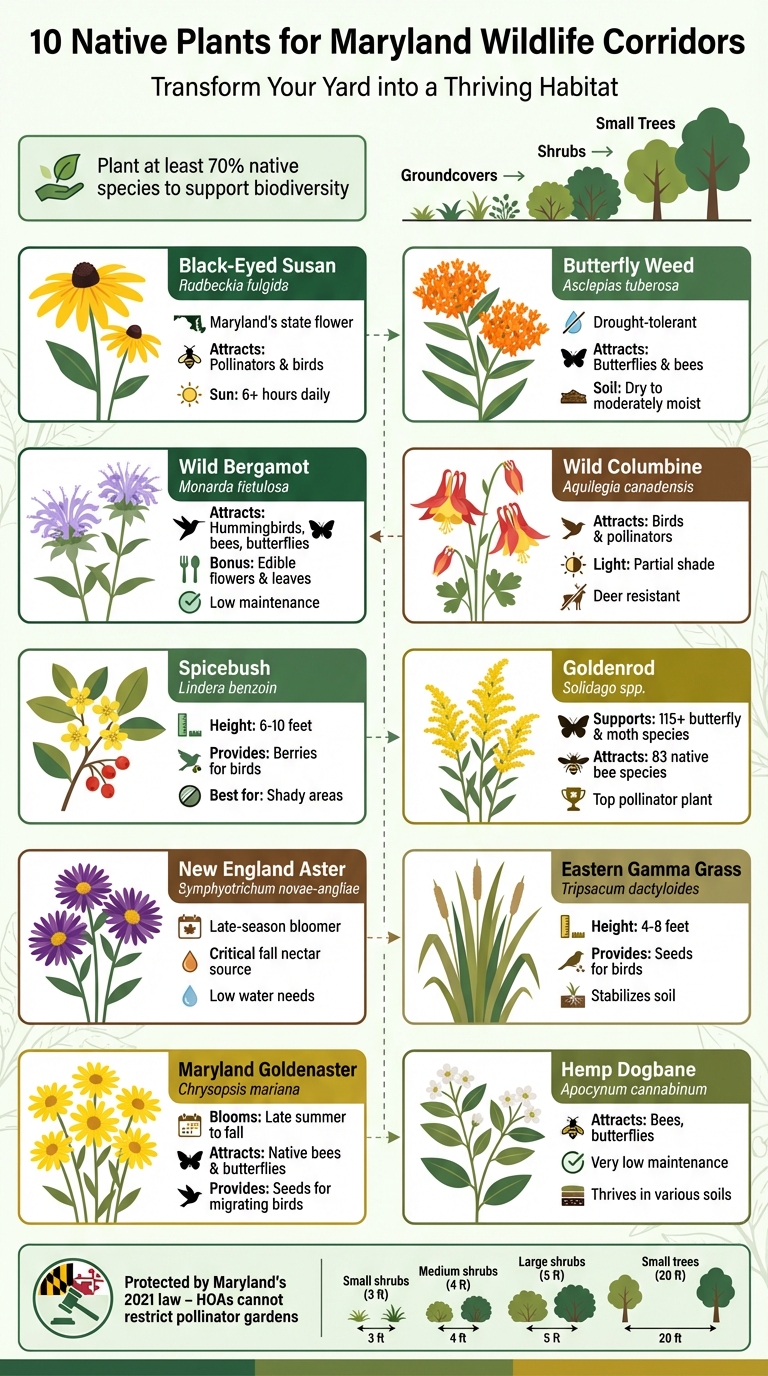
Maryland homeowners can transform their yards into thriving wildlife corridors by incorporating native plants. These corridors help connect fragmented habitats, providing food and shelter for pollinators, birds, and other animals. By dedicating at least 70% of your yard to native plants, you support biodiversity while reducing maintenance. Here are 10 native plants perfect for Maryland’s climate and wildlife needs:
- Black-Eyed Susan: Maryland’s state flower attracts pollinators and birds while thriving in various soil conditions.
- Butterfly Weed: A magnet for pollinators, it’s drought-tolerant and visually appealing.
- Wild Bergamot: Supports hummingbirds and bees while being low-maintenance.
- Wild Columbine: Provides nectar for birds and thrives in partial shade.
- Spicebush: Offers berries for birds and shelter for insects.
- Goldenrod: Supports over 100 species of butterflies and moths.
- New England Aster: A late-season nectar source for pollinators.
- Eastern Gamma Grass: Stabilizes soil and provides seeds for birds.
- Maryland Goldenaster: Blooms late in the season, supporting pollinators and birds.
- Hemp Dogbane: A hardy plant that attracts pollinators and requires minimal care.
Quick Tip: Use a layered planting approach – groundcovers, shrubs, and small trees – to maximize habitat benefits. Maryland law protects homeowners who create wildlife-friendly landscapes, making it easier to contribute to local ecosystems.
10 Native Maryland Plants for Wildlife Corridors with Key Benefits
1. Black-Eyed Susan (Rudbeckia fulgida)
Native to Maryland and the Mid-Atlantic Region
The Black-Eyed Susan, Maryland’s state flower, is a native wildflower that thrives in the region’s natural environment. The University of Maryland Extension highlights it as an excellent choice for Maryland gardens, particularly in the Coastal Plain and Piedmont areas, where it complements the local ecosystem [3][2].
Supports Pollinators and Local Wildlife
This perennial does more than beautify gardens – it plays a vital role in supporting local wildlife. It attracts pollinators like bees and butterflies while also providing seeds for birds and drawing insects that contribute to the food web [2][1].
Perfect Fit for Maryland’s Climate and Soil
The Black-Eyed Susan is well-suited to Maryland’s climate, needing at least six hours of sunlight daily. It can handle a variety of soil conditions, from dry to moderately moist, making it a versatile and resilient plant [2][4]. These qualities make it a low-maintenance option for gardeners looking to create eco-friendly landscapes through professional yard maintenance and projects.
Easy to Care for with Added Ecological Perks
Once established, the Black-Eyed Susan requires minimal upkeep. A 3-inch layer of mulch after planting helps retain moisture and protects the roots during winter. Regularly checking soil moisture during the first year ensures healthy growth [2]. Over time, these plants spread naturally, allowing you to divide and replant them to fill more space. This not only reduces the need for mulching but also helps control weeds [2]. For the best results, perform a soil test and mix in organic matter before planting to give your Black-Eyed Susans a healthy start [2].
sbb-itb-843f8be
2. Butterfly Weed (Asclepias tuberosa)
Native to Maryland and the Mid-Atlantic Region
Butterfly Weed is a native wildflower perfectly suited for Maryland’s unique ecoregions, including the Piedmont area. According to the University of Maryland Extension, it’s an excellent choice for home gardens and landscapes across the state [3]. As a perennial that naturally belongs to Maryland, it creates a vital link between residential gardens and the larger ecosystem. By planting it, homeowners can help boost biodiversity in suburban areas where natural habitats are often fragmented [1]. Like the Black-Eyed Susan, Butterfly Weed plays a key role in strengthening wildlife corridors while adding vibrant beauty to your yard.
Supports Pollinators and Local Wildlife
This wildflower is a powerhouse for Maryland’s pollinators and beneficial insects. It supports essential pollination services and contributes to natural pest control in your garden [2]. Including a variety of native plants like Butterfly Weed in your landscape encourages ecological balance and helps maintain a resilient environment [2].
How It Adapts to Maryland’s Climate and Soil
Butterfly Weed thrives in full sun, needing at least six hours of direct sunlight each day [2]. Thanks to its adaptability, it performs well in Maryland’s varied terrain, flourishing in dry to moderately moist soils. This makes it especially well-suited for sunny slopes [2][3]. As a native species, it’s better equipped to handle Maryland’s changing climate and natural conditions compared to non-native ornamental plants [2].
Low Maintenance Requirements and Ecological Benefits
To get the best results, test your soil and enrich it with organic matter before planting [2]. Applying mulch up to 3 inches deep helps retain moisture and protects the roots [2]. During the first year, keep an eye on soil moisture to ensure proper establishment [2]. Thanks to a 2021 Maryland law, homeowners are now protected when planting pollinator-friendly gardens like those featuring Butterfly Weed. This law prevents HOAs from enforcing unreasonable restrictions on these eco-friendly landscapes [2].
3. Wild Bergamot (Monarda fistulosa)
Native to Maryland and the Mid-Atlantic Region
Wild Bergamot is a wildflower naturally found in Maryland’s ecoregions, making it a great fit for the state’s conditions [3]. The University of Maryland Extension suggests this perennial for home gardens and landscapes across Maryland, as it consistently supports wildlife corridors and helps link fragmented habitats [1]. By providing food and shelter, Wild Bergamot plays a key role in supporting local wildlife and strengthening these vital ecological connections.
Great for Pollinators and Local Wildlife
This plant is a magnet for pollinators like hummingbirds, bees, and butterflies, making it a top choice for pollinator gardens. Beyond that, it attracts beneficial insects, which can help with natural pest control. As a bonus, its flowers and leaves are edible and can be used to brew herbal tea, adding a practical use for gardeners.
Perfectly Suited to Maryland’s Climate and Soil
Wild Bergamot thrives in sunny spots and handles Maryland’s weather, pests, and diseases with ease. It adapts well to local soil and even helps absorb stormwater, which reduces the risk of pollutants entering nearby waterways. This makes it not only a resilient plant but also an eco-friendly choice for gardens.
Easy to Care For with Big Benefits
To plant Wild Bergamot successfully, follow standard practices for native plants: test the soil, add organic matter, and use a 3-inch mulch layer to support root growth and control weeds during the establishment phase. Regular watering during the first year is crucial for strong root development. Once established, this plant is low-maintenance and requires minimal care. Maryland’s 2021 law also protects homeowners from unreasonable HOA restrictions on pollinator gardens, making it easier to incorporate this native plant into your landscape. These straightforward care steps align with broader guidelines for native plants in the state, ensuring both ecological and aesthetic benefits.
4. Wild Columbine (Aquilegia canadensis)
Native to Maryland and the Mid-Atlantic Region
Wild Columbine, often called Eastern Columbine, is a perennial wildflower native to Maryland’s ecoregions, including the Piedmont area [3]. The University of Maryland Extension recommends it for home gardens because it contributes to creating biodiverse habitats essential for wildlife corridors. This plant thrives in Maryland’s soil and climate, making it a natural fit for local gardens. By planting Wild Columbine, homeowners can help maintain the continuity of wildlife-friendly spaces across the state [2].
Supports Pollinators and Local Wildlife
With its vibrant blooms, Wild Columbine is a magnet for pollinators, provides nectar for birds, and is naturally resistant to deer, ensuring it remains beneficial to the ecosystem [2][4]. It also attracts helpful insects, which can aid in natural pest control, offering an advantage over many non-native plants.
Adapts Well to Maryland’s Climate and Soil
This plant thrives in dry to medium moisture conditions and performs best in shady or partially shaded spots [2]. As a native species, it is well-suited to Maryland’s environmental conditions and can better handle the challenges brought by climate variations. When choosing a planting site, keep in mind that hard surfaces like patios or walls can reflect heat and light, intensifying sunlight in the area [2].
Easy to Maintain with Added Ecological Benefits
To set up Wild Columbine for success, test your soil, mix in organic matter, and apply up to 3 inches of mulch to retain moisture and shield the roots [2]. During the first year, monitor the soil moisture closely, but once established, the plant requires minimal care. Over time, dividing mature plants can expand their coverage, reducing the need for frequent mulching and weeding. Plus, Maryland’s 2021 law protects homeowners from restrictive HOA rules, making it easier to incorporate native pollinator gardens into residential landscapes [2].
5. Spicebush (Lindera benzoin)
Native to Maryland and the Mid-Atlantic Region
Spicebush is a hardy native shrub that fits seamlessly into Maryland’s ecoregions. It’s well-suited for home gardens, requiring little to no fertilizers or pesticides. The University of Maryland Extension highlights it as an excellent choice for gardeners looking to support local ecosystems.
A Lifeline for Pollinators and Wildlife
The bright red berries of the Spicebush are a crucial food source for birds and other wildlife. Its flowers, which bloom throughout the growing season, offer nectar and pollen to pollinators while aiding in natural pest control. To encourage cross-pollination and ensure berry production, it’s best to plant at least two shrubs. This combination of food and pollinator support makes Spicebush a vital addition to wildlife-friendly landscapes.
Perfect Match for Maryland’s Climate and Soil
Spicebush thrives in shady spots with medium to wet soils, making it ideal for areas with limited sunlight – less than three hours daily. It performs particularly well under tree canopies or on slopes, making it a strong candidate for wildlife corridors. With a mature height and spread of 6–10 feet, spacing plants about 5 feet apart is recommended. Fall is the best time to plant, although spring planting is also possible if you can provide extra watering during warmer weather.
Easy Care and Environmental Impact
Once established, Spicebush requires minimal care aside from monitoring soil moisture during its first year. Before planting, test the soil, add organic matter, and apply up to 3 inches of mulch to help retain moisture. If you’re designing larger wildlife corridors, prioritize planting taller shrubs like Spicebush early to protect smaller, more delicate plants from being trampled. Thanks to a 2021 Maryland law, homeowners have the freedom to create native habitat gardens with plants like Spicebush, ensuring eco-friendly gardening practices are supported and protected.
6. Goldenrod (Solidago spp.)
Native to Maryland and the Mid-Atlantic Region
Goldenrod, a perennial native to Maryland, thrives in the region’s soils and climate. It plays a crucial role in local ecosystems, acting as a keystone species that supports a wide range of wildlife.
"Tallamy actually studied how many species of butterflies and moths are attracted to each plant and the winner was goldenrod, which attracts 115 species." – Homestead Gardens [6]
This makes Goldenrod the top choice for perennial planting in the Mid-Atlantic. A study from the University of Maryland revealed that roadsides with Goldenrod supported 83 species of native bees [5]. With Maryland beekeepers reporting a 55% winter loss in 2021, planting Goldenrod to create pollinator corridors has become more critical than ever [5]. Its ability to support such a diverse range of species highlights its importance in maintaining ecological balance.
Supports Pollinators and Local Wildlife
Goldenrod provides essential habitat for bumblebees, birds, and beneficial insects that naturally control pests [5]. Beyond wildlife, these plants also help manage stormwater by absorbing runoff and reducing pollution in Maryland’s waterways [7]. To ensure sustainable landscapes, experts recommend that at least 70% of plantings consist of native species, with Goldenrod being a key component [2].
Low Maintenance and High Rewards
Goldenrod is easy to care for once established. It thrives in sunny areas with little need for supplemental watering. To get started, test the soil, enrich it with organic matter, and apply a 3-inch layer of mulch during the first year [2]. Over time, Goldenrod naturally suppresses weeds, reducing the need for additional mulch. Thanks to Maryland’s 2021 law (HB 631/SB 470), homeowners now have more freedom to create pollinator-friendly gardens without interference from HOA restrictions [2].
7. New England Aster (Symphyotrichum novae-angliae)
Native to Maryland and the Mid-Atlantic Region
The New England Aster is a hardy perennial native to Maryland’s diverse landscapes. It thrives across various soil types and seasonal conditions, making it better suited to adapt to changing environments than many non-native plants. Its natural adaptability means it requires less care while offering important ecological advantages. This plant also plays a vital role in connecting wildlife habitats, acting as a bridge in fragmented ecosystems.
A Late-Season Lifeline for Pollinators
Blooming later in the growing season, the New England Aster becomes a critical nectar source for pollinators. These insects not only help control pests naturally but also serve as an essential food source for birds, supporting the broader ecosystem.
Easy to Maintain with Big Ecological Payoffs
This aster is a low-maintenance alternative to traditional lawns and modern landscaping, making it an excellent choice for reducing the demands of turf care. Once established, it adjusts well to Maryland’s environmental shifts, creating a biodiverse and sustainable landscape. By fostering biodiversity, it strengthens connections between fragmented natural areas, enhancing the effectiveness of wildlife corridors. Its low water needs and minimal upkeep make it a practical yet impactful choice for anyone looking to support local ecosystems.
8. Eastern Gamma Grass (Tripsacum dactyloides)
Native to Maryland and the Mid-Atlantic Region
Eastern Gamma Grass is a warm-season perennial that grows naturally in Maryland, forming dense clumps that can reach heights of 4–8 feet. These towering clumps not only create visual interest but also play a key role in wildlife corridors. Thanks to its deep root system, this grass stabilizes soil effectively and thrives in a variety of conditions, from wet bottomlands to drier upland areas. Its ability to adapt to different environments makes it an essential component in maintaining healthy ecosystems.
A Resource for Pollinators and Wildlife
The seeds of Eastern Gamma Grass are an important food source for birds during the fall and winter months. Beyond that, its dense structure provides shelter and support for beneficial insects that help with natural pest control. These clumps also act as critical stopover habitats for migrating species, offering a safe place to feed and breed along their journey [2][5].
Minimal Maintenance with Year-Round Benefits
Once established, Eastern Gamma Grass is incredibly low-maintenance. Its deep roots allow it to withstand drought and grow without the need for frequent watering or fertilizers. This makes it a practical choice for homeowners looking to reduce lawn upkeep while supporting local ecosystems. In fact, Maryland legislation passed in 2021 protects homeowners’ rights to use native plants like Eastern Gamma Grass, encouraging sustainable and low-impact landscaping practices [2].
9. Maryland Goldenaster (Chrysopsis mariana)
Native to Maryland and the Mid-Atlantic Region
The Maryland Goldenaster is a wildflower native to the sandy soils and open woodlands of Maryland and the Mid-Atlantic. Its bright yellow, daisy-like flowers bloom from late summer into fall, thriving even as the seasons change. Thanks to its natural hardiness, it stands up to Maryland’s shifting conditions better than many non-native plants [2]. This makes it an essential part of the late-season landscape.
Supports Pollinators and Local Wildlife
When other flowers start to fade, the Maryland Goldenaster steps in to provide nectar and pollen for pollinators like native bees and butterflies. These insects not only benefit from the plant but also play a role in natural pest control. Meanwhile, its seeds become a food source for birds during fall migration and the early days of winter, offering critical support to local wildlife [2].
Ecological Benefits for Your Landscape
Adding Maryland Goldenaster to your garden doesn’t just beautify – it strengthens the connection between your yard and surrounding ecosystems. By planting this native species, you help boost biodiversity and create a more balanced environment. Plus, reducing turf in favor of native plants like this can lead to a more sustainable and wildlife-friendly landscape year after year [1][2].
10. Hemp Dogbane (Apocynum cannabinum)
Native to Maryland and the Mid-Atlantic Region
Hemp Dogbane is a perennial wildflower found naturally in Maryland and throughout the Mid-Atlantic. It plays a key role in connecting ecosystems within wildlife corridors.
Draws Pollinators and Supports Birds
The flowers of Hemp Dogbane are a magnet for native pollinators like bees, butterflies, and other helpful insects. These creatures not only assist with pollination but also help manage pests naturally. Plus, they provide an essential food source for local birds. Its pollinator-friendly blooms make it a great addition to landscapes that thrive with little effort.
Low-Maintenance with Ecological Benefits
Beyond its wildlife support, Hemp Dogbane is incredibly easy to care for. It thrives in various soil types and doesn’t need much attention, making it a perfect plant for linking fragmented habitats. Gardens featuring this plant also contribute to greater resilience in the face of climate changes [1][2].
Transforming a Maryland Landscape with AMAZING Native Plants!
How to Design Wildlife Corridors with Native Plants
Designing a wildlife corridor that effectively supports local ecosystems starts with the 70% rule: ensure at least 70% of your plants are native species. This percentage is critical to sustain native insects and birds, transforming your yard into a functional habitat rather than just a decorative space [2]. Once you’ve committed to this guideline, the next step is creating a purposeful design.
A layered approach is key to a successful wildlife corridor. Think of it as building vertical tiers of plants that mimic natural ecosystems. These layers include groundcovers (under 1 ft), perennials, small shrubs (2–4 ft), medium shrubs (4–6 ft), large shrubs (6–10 ft), and small trees (15–30 ft) [2]. For example, you could plant a Black-Eyed Susan at ground level, a Spicebush at mid-height, and a small tree overhead. This setup offers wildlife multiple levels to feed, nest, and shelter.
Grouping plants by their needs is another important consideration. Match plants based on their light (full sun or full shade) and moisture preferences (dry, medium, or wet soil) [2]. Proper spacing is also crucial: small shrubs should be planted 3 ft apart, medium shrubs 4 ft, large shrubs 5 ft, and small trees 20 ft apart [2]. This dense planting strategy not only supports wildlife but also minimizes weeds and reduces the need for mulch.
To keep wildlife thriving throughout the year, focus on year-round support. Include berry-producing plants like Winterberry holly, Red chokeberry, and Northern bayberry to provide food for birds during colder months [2]. For winter shelter, evergreen or semi-evergreen plants such as Inkberry holly and Common juniper are excellent choices [2]. When planting hollies or bayberries, remember to include both male and female plants to ensure fruit production [2]. Adding native grasses, like Little Bluestem, alongside perennials and shrubs enhances structural diversity and provides seeds for ground-feeding birds [3].
As you implement these strategies, start planting nearest to structures and gradually work outward. This phased approach minimizes soil compaction and prevents smaller plants from being trampled during later stages [2]. Before planting, test your soil, amend it with organic matter, and apply up to 3 inches of mulch to retain moisture and improve soil health [2].
It’s worth noting that Maryland law, as of 2021, protects your right to create pollinator gardens and wildlife habitats. Homeowners’ associations are no longer allowed to impose unreasonable restrictions on these eco-friendly landscaping projects [2]. So, you can confidently design your wildlife corridor knowing your efforts are supported by law.
Pro Landscapes MD Planting Services for Biodiversity

Pro Landscapes MD specializes in turning wildlife corridor designs into reality with their expert planting services. Focused on creating wildlife-friendly landscapes, they offer horticultural expertise tailored to central Maryland’s unique environment. By prioritizing native plant species and environmentally conscious design, they ensure their landscapes thrive in Maryland’s varied microclimates. Their team of trained horticulturists knows exactly which plants work best in different areas and how to craft layered landscapes that support local ecosystems.
Operating across central Maryland – including Howard, Montgomery, Carroll, Frederick, Prince George’s, and Baltimore Counties – Pro Landscapes MD has an in-depth understanding of the region’s soil types, climate patterns, and wildlife needs. This local knowledge allows them to design landscapes that not only look beautiful but also provide meaningful support for biodiversity.
Their strategies include using native plants that enhance wildlife habitats year-round. For example, they incorporate berry-producing shrubs for food, evergreens for winter shelter, and native grasses that offer seeds for ground-feeding birds. These thoughtful designs ensure continuous support for local wildlife throughout the seasons [2]. Additionally, their phased installation process and sustainable techniques help maximize ecological benefits while maintaining practicality.
Whether you’re looking to replace traditional grass lawns with native plantings or establish a pollinator garden aligned with Maryland’s 2021 HOA legislation, Pro Landscapes MD can transform your outdoor space. Their expertise in landscape design and restoration helps create thriving wildlife corridors that boost both ecological health and visual appeal [2].
Conclusion
Transforming your Maryland yard into a wildlife corridor doesn’t have to happen all at once. Small steps can make a big difference for local wildlife. For instance, swapping out a portion of your lawn for native plants like black-eyed susans, butterfly weed, or spicebush can provide much-needed food and safe resting areas for animals passing through.
The University of Maryland Extension notes that "landscapes with more plant diversity are more resilient to changes in the environment and native plants support beneficial insects that provide pollination, food for birds, and natural pest control" [2]. By aiming for at least 70% native plants in your yard, you can support Maryland’s ecosystem while also cutting down on maintenance. It’s a win-win – fostering biodiversity while keeping yard care manageable.
Even small additions like window boxes filled with native perennials, a few shrubs along your foundation, or a corner pollinator garden can help connect fragmented habitats in your community.
Every native plant you introduce strengthens the ecological web that Maryland’s wildlife depends on. By making these changes, your yard becomes part of a larger network that helps local species thrive.
FAQs
Why should I use native plants in Maryland wildlife corridors?
Using native plants in Maryland wildlife corridors offers a range of benefits for your yard and the surrounding environment. These plants are perfectly suited to Maryland’s climate and soil conditions, which means they’re easier to care for – they need less water, fertilizer, and pesticides compared to non-native species. Plus, they’re a lifeline for local wildlife, providing essential food, shelter, and breeding spaces for birds, bees, butterflies, and other pollinators.
Beyond supporting wildlife, native plants help stabilize soil, reduce erosion, and improve rainwater management. They also enhance soil health, which is crucial for maintaining a balanced ecosystem. By adding native plants to your wildlife corridor, you’re not just improving your outdoor space – you’re creating a healthier, more sustainable habitat for the environment.
How can I create a layered garden design to support local wildlife?
To design a garden that supports local wildlife, focus on using native plants to create layers that mimic natural ecosystems. This layered setup typically includes three levels: a canopy of trees, an understory of shrubs, and ground-level plants. Each layer plays a role in providing food, shelter, and habitat for various species.
For the canopy, native trees such as oaks, maples, or hickories are excellent choices. They offer shade, nesting spots, and food like acorns and seeds. In the shrub layer, plants like serviceberry or black chokeberry are ideal, as they attract pollinators and provide berries for birds. At ground level, consider adding native groundcovers and perennials like ferns, asters, or native grasses to support insects, small mammals, and birds.
This thoughtful layering not only creates a thriving environment for local wildlife but also adds natural beauty and charm to your yard.
Are there any laws or guidelines in Maryland that support wildlife-friendly landscaping?
Maryland has put several programs and guidelines in place to encourage landscaping practices that support wildlife and the environment. One standout initiative is Maryland’s Wild Acres, run by the Maryland Department of Natural Resources (DNR). This program motivates homeowners to incorporate native plants and create habitats that help local wildlife thrive. The goal? To restore natural ecosystems and boost biodiversity.
On top of that, a 2021 state law ensures homeowners can embrace low-impact landscaping methods. These include pollinator gardens, rain gardens, and xeriscaping – all approaches aimed at conserving resources while promoting native plant and animal life. That said, it’s important to double-check local ordinances, as rules can differ depending on the municipality.
Maryland’s efforts make it clear: sustainable landscaping isn’t just encouraged – it’s supported in ways that benefit both the environment and the people who live there.
Chat with Us