









- bhavya gada
- No Comments
Vegetative buffer zones are planted areas that reduce water runoff, prevent soil erosion, and support wildlife. For Maryland, using native plants is ideal because they thrive in local conditions and help maintain ecological balance. Here’s a quick list of top plants for these zones:
- Native Sedges and Rushes: Great for stabilizing soil and filtering water in wet areas. They also provide food and cover for birds and small mammals.
- Pickerelweed: An aquatic plant that attracts pollinators like bees and butterflies while feeding waterfowl with its seeds.
- Blue Flag Iris: Supports pollinators such as hummingbirds and bees while adding visual appeal to wetlands.
- Swamp Milkweed: Essential for monarch butterflies and effective at preventing soil erosion in moist areas.
- Lizard’s Tail: Thrives in wet soils, stabilizes streambanks, and attracts pollinators and birds.
- Cardinal Flower: Known for its vibrant red blooms, it supports hummingbirds and thrives in riparian zones.
- Buttonbush and Native Grasses: A combination that strengthens soil stability and provides habitat for pollinators and birds.
Why Native Plants Matter
Native plants are well-suited to Maryland’s climate and soil, making them low-maintenance and effective at sustaining local ecosystems. They also help reduce the impact of invasive species and support biodiversity.
Quick Tips for Buffer Zones
- Plan Ahead: Remove aggressive plants and stabilize soil before planting.
- Choose the Right Plants: Match species to soil type, moisture levels, and sunlight.
- Plant in Layers: Combine groundcovers, shrubs, and trees for better erosion control and wildlife support.
- Plant in Fall or Spring: Cooler seasons help roots establish with less watering.
- Minimal Maintenance: Once established, native plants require little care beyond occasional pruning.
Vegetative buffer zones are a practical way to protect waterways and create habitats for wildlife. With the right native plants, Maryland landowners can enhance their landscapes while supporting the environment.
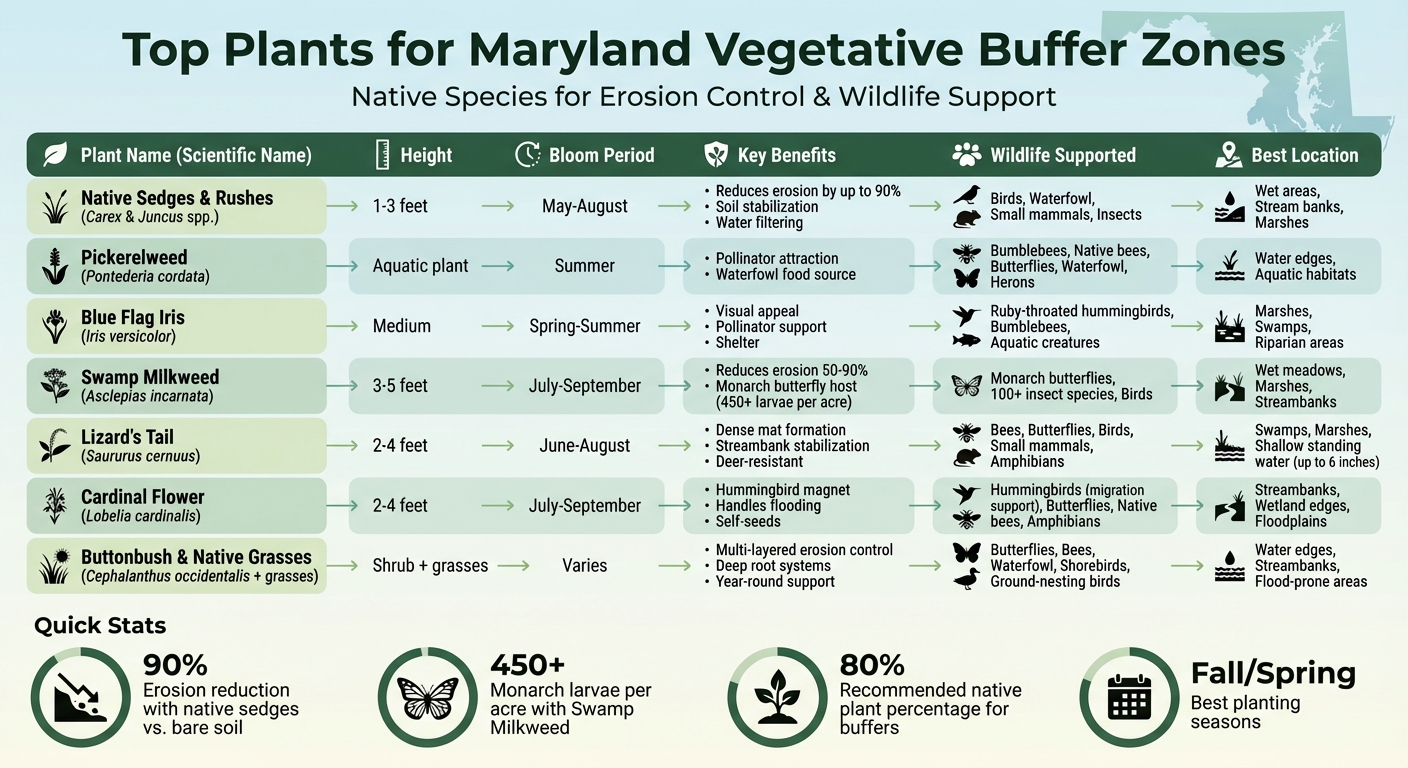
Top 7 Native Plants for Maryland Vegetative Buffer Zones Comparison Chart
1. Native Sedge and Rushes
Native to Maryland
Native sedges (Carex spp.) and rushes (Juncus spp.) are perennial, grass-like plants that thrive across Maryland, from the Coastal Plain to other regions of the state. They are included on Maryland’s official native plant lists for their role in wildlife habitat and conservation landscaping [4][5][6]. Among them, tussock sedge (Carex stricta) stands out for creating effective buffer zones, growing 1–3 feet tall and blooming from May through August [4][5]. These plants are a practical choice for Maryland landscapes due to their adaptability and low-maintenance nature.
Erosion Control and Soil Stabilization
Sedges and rushes are excellent for stabilizing soil and preventing erosion, thanks to their fibrous root systems. They are particularly effective along stream banks, slopes, and other areas with saturated soils. According to Maryland DNR conservation guidelines, native sedges can reduce erosion by up to 90% in riparian buffers compared to bare soil or turfgrass [3]. Their dense, clump-forming growth also acts as a natural filter, trapping sediments and pollutants before they reach waterways [2].
Wildlife Habitat Support
These plants provide year-round support for local wildlife. Their seeds are a food source for birds and waterfowl, while their dense growth offers cover and nesting sites for insects and small mammals. When placed near water, native sedges and rushes can attract wading birds like herons, as well as ducks and geese, enhancing the biodiversity of the area.
Suitability for Wet or Riparian Areas
Perfectly suited for wet or moist environments, sedges and rushes thrive in saturated soils, marshes, streamsides, shrub swamps, and drainage ditches. They can handle a wide pH range – from 3.5 to 7.0 – and adapt well to clay or loamy soils. Once established, they require little upkeep – no need for extra water, fertilizers, or pesticides. For best results, plant them 1–2 feet apart in full sun or partial shade. Their seedheads persist through winter, providing an additional food source for wildlife. These resilient plants lay the groundwork for healthy buffer zones and complement other native species effectively.
sbb-itb-843f8be
Best Plants for Erosion Control | How to Protect Your Landscape with Native Plants 🌿
2. Pickerelweed
Pickerelweed brings even more life to buffer zones, complementing the role of native sedges and rushes in supporting biodiversity.
Native to Maryland
Known scientifically as Pontederia cordata, pickerelweed is a perennial aquatic plant that thrives along the water edges of Maryland. Its presence is a natural fit for the region’s ecosystems.
Wildlife Habitat Support
Pickerelweed is a vital resource for wildlife. Its nectar attracts bumblebees, native bees like the pickerelweed bee, and butterflies. Beyond pollinators, its large seeds are a food source for waterfowl, while its dense growth offers essential cover for wading birds such as herons. This plant is a cornerstone for many species that depend on aquatic habitats.
3. Blue Flag Iris
The Blue Flag Iris isn’t just a feast for the eyes – it’s a powerhouse for supporting ecosystems. Much like pickerelweed, this plant combines aesthetic appeal with practical benefits, making it an excellent choice for buffer zones. Found in Maryland’s marshes, swamps, and riparian areas, the Blue Flag Iris (Iris versicolor) plays a key role in maintaining ecological balance and aiding local wildlife [7].
Wildlife Habitat Support
This vibrant iris provides nectar for the Ruby-throated Hummingbird and long-tongued bees, such as bumblebees (Bombus spp.), which are crucial for pollination. Beyond its role as a food source, its thick foliage offers shelter for small aquatic creatures and insects, helping to boost biodiversity in wetland habitats [7].
4. Swamp Milkweed
Swamp Milkweed stands out as a great choice for Maryland’s buffer zones, offering both soil stabilization and essential support for local wildlife.
Swamp Milkweed (Asclepias incarnata) is a perennial plant native to Maryland. Growing between 3 and 5 feet tall, it blooms with clusters of flowers from July through September. You’ll often find it thriving in wet meadows, marshes, and along streambanks throughout the Coastal Plain and Piedmont regions [4][6].
Native to Maryland
This plant naturally grows across Maryland, and the Maryland Department of Natural Resources recommends it in their Native Plants for Chesapeake Bay Critical Areas guide. It’s particularly suited for wet environments and is a reliable resource for wildlife [4]. Unlike its relative, the common milkweed, Swamp Milkweed thrives in consistently moist conditions and doesn’t spread aggressively [6].
Erosion Control and Soil Stabilization
Swamp Milkweed’s deep root system is excellent for stabilizing soil, especially in flood-prone areas. In riparian zones, it can reduce erosion by as much as 50–90% [2][3]. Its tendency to form colonies adds another layer of stability, as it can withstand saturated soils and periodic flooding.
Wildlife Habitat Support
This plant plays a critical role in supporting monarch butterflies, serving as a host for their larvae. Its toxin-rich foliage aids larval survival, with some buffers hosting over 450 monarch larvae per acre in ideal conditions [4]. Beyond monarchs, Swamp Milkweed attracts over 100 insect species and offers seeds that birds rely on.
Ideal for Wet or Riparian Areas
Swamp Milkweed thrives in full sun to partial shade and prefers moist clay or loamy soils. To establish strong colonies, plant them 18–24 inches apart. For wetland restoration projects, the Maryland DNR often pairs Swamp Milkweed with other native plants like Joe Pye Weed, Blue Flag Iris, and sedges along Chesapeake Bay tributaries [3]. For the best results, source plants from local nurseries to ensure they’re Maryland ecotypes, and cut them back in late winter to encourage healthy regrowth [6].
5. Lizard’s Tail
Lizard’s Tail is a standout native species in Maryland, particularly suited for buffer zones in wet environments. This plant thrives in some of the state’s wettest areas, making it a great choice for improving water management and stabilizing soil.
Lizard’s Tail (Saururus cernuus) is a perennial herb that grows between 2 and 4 feet tall, with heart-shaped leaves and distinctive white flower spikes resembling a lizard’s tail. These flowers, measuring 2–6 inches long, bloom from June to August. It naturally occurs in Maryland’s swamps, marshes, and along streambanks, especially in the Coastal Plain and Piedmont regions [4][6].
Native to Maryland
This plant is found throughout Maryland and is highly recommended by the Maryland Native Plant Society and the University of Maryland Extension. It thrives in poorly drained, erosion-prone areas, making it a valuable addition for stormwater management and habitat restoration. It’s also semi-evergreen in mild winters and deer-resistant, which makes it a low-maintenance option for buffer zones [4][6].
Erosion Control and Soil Stabilization
With its extensive rhizomatous root system and colony-forming growth, Lizard’s Tail forms dense mats that effectively stabilize soil and combat erosion. It has been successfully used in Maryland’s Critical Area buffers, particularly in herbaceous emergent zones along tidal waterways. For instance, in Dorchester County, it has helped stabilize eroding streambanks [3][4][5].
Wildlife Habitat Support
Lizard’s Tail plays an important role in supporting wildlife. Its flowers attract pollinators like bees and butterflies, while its seeds provide food for birds. The plant’s dense foliage also creates cover for small mammals and amphibians in wetland margins, contributing to a balanced ecosystem [1][4][6].
Ideal for Wet or Riparian Areas
This plant thrives in consistently moist or saturated soils and can tolerate shallow standing water up to 6 inches deep. It’s best planted in spring or fall, with spacing of 12–18 inches to encourage colony formation. Over time, it spreads via rhizomes to form a 3–6 foot ground cover. Maintenance is simple – just cut back dead foliage in late winter and skip fertilizers, as it prefers low-nutrient soils [4][6].
6. Cardinal Flower
The Cardinal Flower is one of Maryland’s most eye-catching native plants, perfect for vegetative buffer zones. Its brilliant red blooms make it a great choice for wet landscapes.
The Cardinal Flower (Lobelia cardinalis) stands between 2 to 4 feet tall and showcases stunning scarlet-red flower spikes from July to September. It naturally thrives along Maryland’s streambanks, wetland edges, and floodplains, making it well-suited to the state’s riparian areas. Its tubular flowers are a favorite of hummingbirds, which act as its main pollinators.
Native to Maryland
This plant is native to Maryland and flourishes in wetlands and riparian zones. It grows best in full sun to partial shade and prefers soil that is rich and consistently moist or wet. Unlike some other buffer zone plants, the Cardinal Flower can handle seasonal flooding and short periods of standing water. It also self-seeds easily, spreading along streambanks without becoming a problem for other plants.
Wildlife Habitat Support
The Cardinal Flower is a key supporter of Maryland’s wildlife, particularly pollinators. Hummingbirds are drawn to its tubular red flowers, which provide an essential nectar source during their late summer migration. Butterflies and native bees also visit the blooms, while its dense foliage offers shelter for amphibians and beneficial insects. This ability to thrive in fluctuating water conditions makes it an important part of a healthy buffer zone ecosystem.
Ideal for Wet or Riparian Areas
This plant shines in wet or riparian buffer zones, where many other flowering perennials struggle to survive. It can handle saturated soils and periodic flooding, making it a great option for streambank stabilization. For best results, plant Cardinal Flowers in spring or early fall, spacing them 12 to 18 inches apart. Once established, they require little upkeep – just cut back dead stems in late winter and keep the soil moist during dry periods. Professional services for riparian buffer planting and maintenance are available throughout Maryland [8].
7. Buttonbush and Native Grasses
Adding Buttonbush alongside native grasses creates highly effective vegetative buffer zones in Maryland. These plants work together to control erosion and support local wildlife, thanks to their complementary root systems and structural properties.
Buttonbush (Cephalanthus occidentalis), a deciduous shrub, thrives along water edges, anchoring banks with its woody roots. Native grasses like Little Bluestem, Yellow Indiangrass, and Wool Grass provide dense ground cover, forming a multi-layered barrier that withstands both seasonal flooding and drier summer conditions [7].
Native to Maryland
Both Buttonbush and these grasses are well-suited to Maryland’s varied landscapes. The Coastal Plain’s sandy soils, Piedmont’s loams and clays, and the Ridge and Valley’s rocky terrain all support these plants. They require little irrigation or fertilization, making them a low-maintenance choice [9].
Erosion Control and Soil Stabilization
The deep root systems of these plants are key to their effectiveness. As Cultivating Flora explains, "Native species… improve soil health and stormwater infiltration by establishing deep root systems that match regional hydrology" [9]. Native grasses send roots several feet into the ground, creating a network that stabilizes soil during heavy rains and flooding. Buttonbush adds extra protection with its woody roots, making it ideal for streambanks and waterfront areas prone to occasional flooding [9].
For planting, dig a hole 2–3 times the width of the root ball and backfill with native soil. Add a 2–3 inch mulch layer around the plant, keeping it away from the stem to prevent damage and retain moisture. Conducting a percolation test or digging a test hole can help determine whether the area is seasonally saturated or well-drained [9].
Wildlife Habitat Support
Buttonbush blooms attract pollinators like butterflies, bees, and other insects, while its seeds provide food for waterfowl and shorebirds during cooler months. Native grasses complement this by offering nesting materials and cover for ground-nesting birds, small mammals, and beneficial insects. Together, these plants create year-round food and shelter, enriching Maryland’s riparian ecosystems [9].
How to Install Vegetative Buffer Zones in Maryland
The first step in creating a vegetative buffer zone is preparing the site. Start by manually removing invasive species like Japanese barberry, English ivy, and garlic mustard. Avoid heavy mowing or "bush hogging", as these methods can harm the soil structure in sensitive areas. Instead, stick to manual removal. Once the invasive plants are gone, immediately stabilize the soil by adding mulch or planting native ground cover [11][12].
After clearing and stabilizing the site, it’s time to assess local conditions. Identify your specific Maryland ecoregion, then evaluate factors like soil type, moisture levels, light availability, and drainage. If your property is near tidal waters or tributary streams, you’ll need to obtain approval for a Buffer Management Plan from your local planning office before proceeding with any clearing or planting [12]. For larger or more complex projects, consider hiring professionals like Pro Landscapes MD, who specialize in stormwater management, grading, and native plant installations in central Maryland. This ensures your buffer zone is set up to function effectively from the start.
Fall is the ideal time for planting. Adam Bray, Grants and Operations Specialist at Alliance for the Chesapeake Bay, explains:
"Fall is the best time of the year to plant native plants. Once September rolls around… Autumn days are cooler so it requires less water to get plant roots established" [10].
If fall planting isn’t an option, spring works too, but be prepared to provide extra water during the warmer months [11]. Once you’ve determined the best timing, focus on a planting strategy that prioritizes diversity and layering.
A layered planting strategy is key to creating a functional and attractive buffer zone. Use a mix of native groundcovers like Sensitive Fern, wildflowers such as Cardinal Flower, grasses like Little Bluestem, shrubs such as Winterberry Holly, and trees like River Birch. This approach not only improves erosion control but also supports local wildlife. In Maryland’s Critical Area buffers, planting credits are assigned based on plant size: canopy trees with a 3/4-inch caliper earn 100 square feet, understory trees earn 75 square feet, large shrubs earn 50 square feet, and small shrubs earn 25 square feet [12]. To maximize ecological benefits, aim for at least 80% native plants, which help sustain pollinators and other wildlife [11].
Once established, maintenance is minimal. Native species are well-suited to Maryland’s climate and typically require little to no additional fertilizer or watering after their first growing season. Prune lightly during late winter, but avoid removing more than 25% of the canopy [10][11][12]. This low-maintenance approach makes native plants a practical and eco-friendly choice for buffer zones.
Conclusion
Establishing a vegetative buffer zone with native plants brings numerous benefits to Maryland’s environment. These plantings help improve water quality by filtering runoff before it enters streams and the Chesapeake Bay. At the same time, their deep roots work to stabilize shorelines and slopes, reducing erosion. Native species like Cardinal Flower, Blue Flag Iris, and Buttonbush thrive in Maryland’s soil and climate, making them ideal choices for these efforts. Beyond these practical advantages, such zones also encourage healthier wildlife habitats.
Native buffer zones play a key role in supporting local ecosystems by offering crucial habitats for wildlife. By prioritizing native plants, landowners can strengthen the local food web, benefiting everything from pollinators to songbirds. This shift also transforms underutilized lawns into biodiverse, resource-efficient landscapes that require less maintenance than traditional turf grass.
To get started, Maryland landowners can consult resources like the Maryland Native Plant Guide: Piedmont Region to identify species that align with their local ecoregion. Replacing invasive ornamental plants with native alternatives not only limits the spread of invasive species but also creates layered, natural-looking buffer zones.
For more complex projects, such as those involving stormwater management or grading, Pro Landscapes MD provides expert services in native plant installations across central Maryland. Their team is well-versed in local regulations, including Critical Area buffer requirements, and can design buffer zones that meet both environmental and aesthetic goals. With their guidance, landowners can turn ideas into vibrant, functional landscapes.
FAQs
How wide should a vegetative buffer zone be?
A vegetative buffer zone is usually recommended to be between 30 and 100 feet wide, though the exact width depends on its intended use and the specific conditions of the site. In Maryland, a width of 30 to 50 feet is often suggested as sufficient for controlling erosion and filtering water effectively.
What are the best plants for my site’s sun and soil moisture conditions?
Native plants such as switchgrass, big bluestem, little bluestem, Virginia creeper, and moss phlox are excellent choices. These species naturally flourish in Maryland’s climate and soil, providing essential benefits like preventing erosion and supporting local wildlife. To create a thriving vegetative buffer zone, select plants that match your site’s sunlight and moisture conditions for long-term success.
Do I need permits to plant near a stream or tidal water in Maryland?
Yes, if you plan to plant near streams or tidal waters in Maryland, you’ll need permits. These areas fall under specific regulations designed to protect buffer zones and critical areas. To stay compliant, it’s essential to check local guidelines before beginning any planting project.
Chat with Us