









- bhavya gada
- No Comments
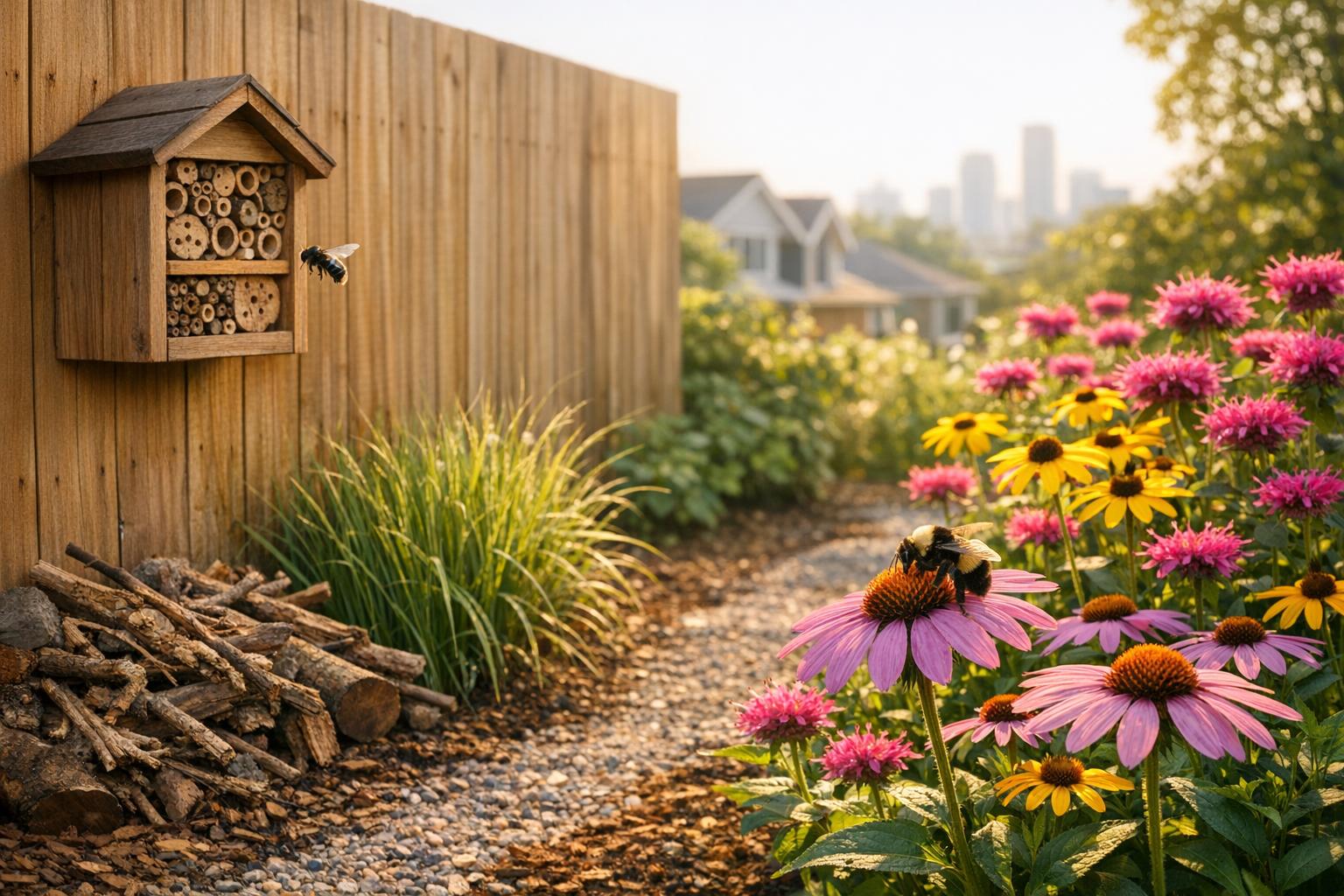
Pollinators like bees and butterflies need two key habitat features to thrive: shelter and open areas. Shelter provides nesting and overwintering spots, while open areas offer flowers for food. Without both, pollinator populations struggle to survive. Here’s why this balance matters:
- Shelter: Includes bare soil, hollow stems, dead wood, and leaf litter. These are essential for reproduction and protection during colder months.
- Open Areas: Sunlit spaces with diverse, native flowers supply the nectar and pollen pollinators rely on. Seasonal blooms are critical to meet their year-round needs.
- Urban Challenges: Urban and suburban development often eliminates natural habitats, but small changes like leaving bare soil patches or creating "insect hotels" can help.
- Balanced Habitats: Combining wooded shelters with open meadows ensures continuous resources, supporting more diverse and resilient pollinator populations.
Even small gardens or spaces can make a difference by including native plants, bare ground, and structural variety. This approach supports pollinators and strengthens local ecosystems.
Pollinator Habitat Requirements: Shelter vs Open Areas Comparison
Building Pollinator Habitat in Towns and Cities: Northeast / Mid-Atlantic Region
sbb-itb-843f8be
Shelter Requirements for Pollinators
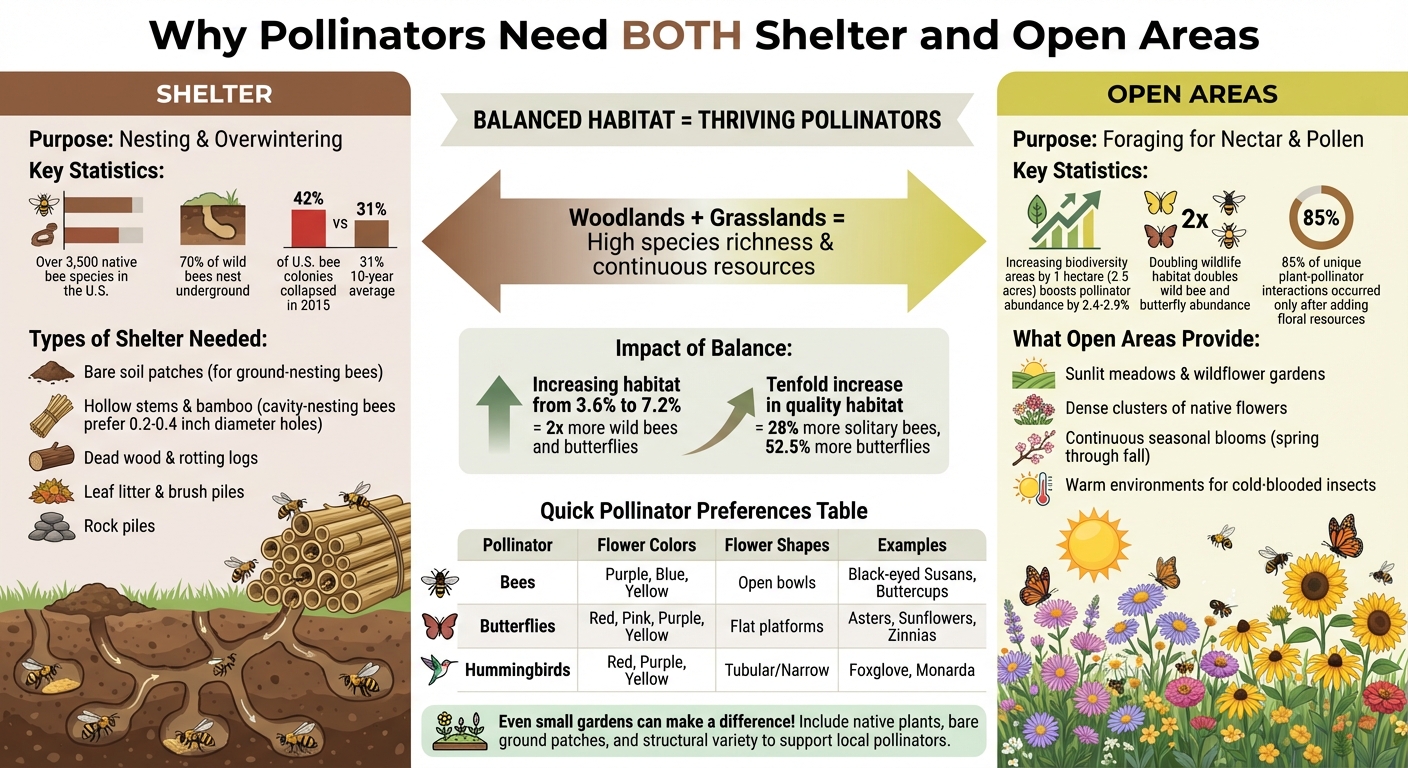
Pollinators need safe nesting spots to reproduce and survive through the colder months. In the U.S., there are over 3,500 species of native bees, each with its own shelter preferences [7]. Even the most flower-filled gardens won’t sustain pollinators long-term if nesting sites are missing.
Different pollinators prefer different types of shelters. For example, cavity-nesting bees use hollow reeds, bamboo poles, and dead wood cavities, while ground-nesting bees need patches of bare, undisturbed soil. Wood-boring beetles rely on rotting logs and decaying wood [7]. Other natural features like brush piles, leaf litter, rock piles, and bark offer critical winter habitats for various beneficial insects.
The decline in bee populations highlights how urgent it is to provide proper shelter. In 2015, 42% of U.S. bee colonies collapsed – a sharp increase compared to the 10-year average of 31% [7]. Habitat loss, particularly in urban and suburban areas where natural elements like dead wood and leaf litter are often removed, has played a significant role in this decline.
Cavity-Nesting Bees and Their Shelter Needs
Solitary bees and wasps don’t build hives. Instead, they lay their eggs in pre-existing holes, often in wood. These species are drawn to holes between 0.2 and 0.4 inches in diameter [7]. Drilling logs with a variety of hole sizes can support a range of species and boost biodiversity.
Materials like drilled logs, hollow bamboo poles, cardboard tubes, and pithy plant stems are excellent for cavity nesters. Urban areas, where natural habitats are limited, can benefit from "bug hotels" or "bee condos." These structures should be placed off the ground – what experts call "high-rise" placement – to protect larvae from predators like ants [7]. Positioning them in sunny, sheltered areas near flowers increases their effectiveness.
"An insect hotel in your garden will attract these beneficial insects, offering them a space where they can propagate and hunker down for the winter." – Robin Plaskoff Horton [7]
While wild habitats naturally support cavity nesters, urban settings require inventive solutions to fill the gap.
Ground-Nesting Pollinators
Most native bees prefer to nest underground rather than in hives or hollow stems. ground-nesting bees need undisturbed ground and proper drainage to establish their nests [4][5]. Unfortunately, heavy mulch, dense groundcover, or frequent tilling can destroy these nesting areas, disrupting reproduction.
Leaving small areas of bare ground – just a few square feet – can make a big difference. Even minimal unmulched patches can support multiple ground-nesting bee species. Bumblebees, essential early-season pollinators, often nest in undisturbed soil or abandoned rodent burrows. In developed areas, recreating these natural bare soil habitats is especially important.
Creating Shelter in Urban and Suburban Areas
Urban and suburban environments often lack natural nesting sites due to development and landscaped yards [7]. However, homeowners can take steps to reverse this trend by incorporating shelter-friendly features into their spaces.
For instance, leaving dead wood, brush piles, and leaf litter in specific areas can attract beneficial insects. Rotting logs provide nesting cavities, while rock piles, pieces of concrete, and even discarded planters can serve as what experts call "prime bug real estate" [7].
DIY insect hotels are another option. Using repurposed materials like old pallets, pine cones, bark, twigs, and hay, you can build structured shelters for pollinators. Commercial bee houses are also available, ranging from $15.52 for simple wooden models to $34.14 for more intricate designs [7]. The key is to place these shelters within a few hundred meters of flowering plants, as many wild bees have limited foraging ranges [5]. Combining these shelter strategies with open foraging spaces creates a balanced habitat that supports pollinator populations.
The Role of Open Areas in Pollinator Habitats
While shelter provides nesting spots, open areas supply the nectar and pollen pollinators need for foraging. Sunlit meadows, wildflower gardens, and other open spaces fuel pollinator activity. Without these foraging resources, even the best nesting sites can’t sustain a thriving pollinator population.
Open habitats also help fill seasonal flower gaps. For instance, woodlands offer early-season blooms before trees develop their full canopy. Once the canopy closes, these flowers decline, but grasslands and meadows take over, providing blooms throughout late spring and summer when pollinators need consistent nourishment [5]. This balance between shelter and open areas is essential for keeping pollinator populations healthy.
Sunlit open spaces also warm up quickly, allowing insects to fly and forage more efficiently [10]. Since pollinators like bees and butterflies are cold-blooded, they rely on warm environments. Cooler, shaded areas, even with flowers, don’t support the same level of activity.
Native Plants and Open Meadows
Dense clusters of native flowers are key to attracting pollinators [1][2]. These clusters create visible "pulses" of resources that pollinators can spot from a distance, making meadows and wildflower gardens far more effective than scattered plantings.
A study in Switzerland, conducted between 2014 and 2020, examined 74 annual flower strips. Researchers found that increasing biodiversity areas by just 1 hectare (around 2.5 acres) boosted pollinator abundance by 2.4% to 2.9% [1]. The study emphasized that it wasn’t just the variety of plant species but the density of blooms that made the difference. Areas with dense flower coverage consistently outperformed those with fewer blooms, even when species diversity was similar.
Between 2016 and 2018, the North Carolina Department of Agriculture & Consumer Services required pollinator habitat plantings at state research stations. Researchers Hannah K. Levenson and David R. Tarpy documented increased bee abundance and genus richness at 16 stations. However, they identified a critical issue: late-season blooms were missing. Most seed mixes focused on early and mid-season flowers, leaving pollinators without food in late summer and fall [2]. This highlights the importance of including plants that bloom throughout the entire growing season.
Gardens with a mix of plant families – like daisies, legumes, and mints – attract significantly more bees than single-species plantings [8]. Grouping diverse native species in clusters makes them easier for pollinators to locate, increasing visitation rates. Here’s a quick guide to flower preferences by pollinator group:
| Pollinator Group | Preferred Flower Colors | Preferred Flower Shapes | Example Plants |
|---|---|---|---|
| Bees | Purple, Blue, Yellow | Open bowls, sweet scent | Black-eyed Susans, Buttercups |
| Butterflies | Red, Pink, Purple, Yellow | Flat platforms for perching | Asters, Sunflowers, Zinnias |
| Hummingbirds | Red, Purple, Yellow | Tubular / Narrow | Foxglove, Monarda |
Avoid double-flowered hybrids, which may look beautiful but often make it hard for pollinators to access nectar and pollen [8][9]. Opt for single-flowered varieties with accessible central discs instead.
Bare Soil for Ground-Nesting Pollinators
Bare soil patches are another crucial element for supporting ground-nesting bees. Between October 2021 and March 2023, researchers at the University of Florida enhanced 16 residential gardens with eight bee-friendly plant species, including Salvia coccinea and Monarda punctata. With the help of 32 Master Gardener volunteers, the project recorded 10,564 visits and 602 unique plant-pollinator interactions. Notably, 85% of these unique interactions occurred only after adding floral resources, showing the importance of open-area enhancements in urban and suburban settings where natural habitats are limited [4].
Utility Corridors and Managed Open Spaces
Utility corridors, roadsides, and other managed open spaces can be transformed into pollinator-friendly habitats. These areas, often maintained as grasslands, can support substantial pollinator populations when planted with native flowers.
A study of 35 apple orchards in southern Wisconsin (2010–2013), led by Rachel Mallinger, revealed that orchards surrounded by a mix of grasslands and woodlands had greater bee richness. Woodlands provided early-season blooms before apple trees flowered, while grasslands ensured a continuous supply of blooms after the orchard’s peak [5]. This seasonal complementarity shows how open and closed habitats can work together to sustain pollinators throughout the growing season.
Increasing uncropped wildlife habitat on farms can have a big impact – doubling wildlife habitat has been shown to double the abundance of wild bees and butterflies [6]. Even a small area, like 1 acre, can support local pollinator communities if it’s designed with high flower density and diversity [2]. This means that homeowners, property managers, and municipalities can make a difference by converting underused open spaces into pollinator havens.
However, maintaining managed open spaces requires effort. Aggressive grasses and invasive species can outcompete native flowering plants if left unchecked [2]. Regular weeding and selective mowing are essential to ensure these spaces remain rich in pollinator resources throughout the season.
Combining Shelter and Open Areas: A Balanced Approach
Pollinators thrive in environments that blend shelter with open spaces for foraging. This mix supports "habitat complementarity", where different habitat types work together to meet the year-round needs of pollinators. For example, woodlands offer early-spring blooms and nesting spots before the tree canopy closes, while open grasslands provide a steady supply of flowers later in the year [5]. Without this balance, pollinator populations become less diverse and more vulnerable to changes in their surroundings.
The benefits of balanced habitats are clear. Research found that increasing natural shelter and habitat from 3.6% to 7.2% doubled the number of wild bees and butterflies [6]. In southern Wisconsin, apple orchards surrounded by a mix of woodlands and grasslands between 2010 and 2013 saw significantly higher bee abundance and species diversity compared to orchards with only one habitat type [5]. The woodlands provided food early in the season, while grasslands ensured resources later, creating a continuous supply from April to September.
But it’s not just about having enough habitat – it’s about its quality too. In areas where natural habitats are scarce, higher flower density and structural variety are essential for maintaining healthy pollinator communities [11]. High-quality habitats with diverse plants and varied structures – such as brush piles, bare soil patches, and layered vegetation – can boost pollinator abundance by 2.4% to 2.9% per hectare (about 2.5 acres) when paired with proper shelter [1]. Urban and suburban gardens, when enriched with native plants, showed that 85% of unique plant-pollinator interactions only happened after diverse floral resources were introduced to previously unbalanced spaces [4].
Balanced habitats also strengthen pollinator networks. By including both shelter and open areas, landscapes develop "network modularity", a structure that helps ecosystems handle environmental stress and recover from disruptions [4]. This resilience is especially crucial in urban areas where natural habitats are fragmented.
Comparing Habitats with and Without Balance
Different habitat configurations affect pollinator diversity and stability in unique ways. Here’s a closer look:
| Habitat Configuration | Species Richness | Abundance/Visitation | Ecological Benefit |
|---|---|---|---|
| Balanced (Woodland + Grassland) | High (Supports spring and summer specialists) [5] | High (Continuous resource availability) [5] | Strong resilience; diverse needs met [5] |
| Open Only (Meadows/Flower Strips) | Moderate (Lacks early-season resources or nesting sites) [5] | High (During peak bloom) [1] | High short-term visitation but less stability over time [5] |
| Shelter Only (Woodlands/Brush) | Moderate (Limited by canopy closure) [5] | Moderate (High in early spring only) [5] | Essential for nesting and early-season survival [5] |
| Unbalanced (Urban/Impervious) | Low (Loss of specialist species) [4] | Low (Turf and pavement dominate) [4] | Minimal benefits; ecosystems become homogenized [4] |
Practical Tips for Homeowners and Property Managers
Even small properties can become pollinator-friendly with the right strategies. Here are some practical steps to create a balanced habitat:
- Combine open flower beds with adjacent shelter features like brush piles, hollow stems, or woody edges. These provide nesting spots for cavity-nesting bees while ensuring nearby foraging areas. Since most wild bees forage within about 0.6 miles of their nests [5], keeping resources close is key.
- Leave bare soil patches in sunny, well-drained areas near flowers. Around 70% of wild bees nest underground [4][5], so they need access to unmulched ground. Even a small patch can support ground-nesting species.
- Plan for continuous blooms from early spring to late fall. Use at least eight native plant species to maximize pollinator interactions [4]. Include early bloomers like willows and serviceberries, mid-season options like black-eyed Susans and coneflowers, and late bloomers like asters and goldenrod. This ensures food availability throughout the growing season [2].
- Add structural variety to your landscape. Mix tall grasses and shrubs for wind protection with shorter plants that allow ground-nesting bees to access bare soil. Leave dead wood, hollow stems, and leaf litter for nesting and overwintering sites.
- Weed strategically without covering all bare ground. Regular maintenance prevents invasive species from overtaking native flowers [2], but avoid mulching every inch of soil. Ground-nesting bees rely on exposed patches to thrive.
If your property already has woodlands, enhance the understory with native shrubs and wildflowers that bloom before the canopy closes. For open spaces, plant small clusters of trees or large shrubs to create shelter zones. The goal is to provide sunlit foraging areas alongside shaded resting spots within a short distance. This combination supports a wide variety of pollinators and ensures the habitat remains functional throughout the year.
Transforming Your Landscape with Pro Landscapes MD

Designing a pollinator-friendly landscape in central Maryland takes a thoughtful approach to native plants, site preparation, and sustainable landscaping. Pro Landscapes MD specializes in helping homeowners and property managers across central Maryland create outdoor spaces that not only look beautiful but also support local pollinator populations.
Their approach focuses on the idea that small-scale habitat features – like diverse flowering plants and undisturbed soil – have a bigger impact on pollinators than the overall surrounding landscape [13]. Even smaller properties in communities like Bethesda, Columbia, Ellicott City, or Silver Spring can make a real difference when designed with pollinators in mind. By blending sheltered areas with open foraging zones, Pro Landscapes MD creates vibrant, year-round habitats for pollinators. Their services combine native planting, precise grading, and eco-conscious design to build spaces where pollinators can thrive.
Native Planting for Pollinator Gardens
Pro Landscapes MD emphasizes the use of native plants that have evolved alongside local pollinators, offering the nectar and pollen they need most [12]. Their horticulturists carefully select a variety of plants – like Monarda (bee balm), Salvia, and Helianthus (sunflower) – to ensure pollinators have food throughout their active seasons [4][8].
Instead of scattering plants randomly, they group native species in clusters, which makes flowers more visible to pollinators [8]. They also choose flowers with different shapes – such as bowl-shaped, tubular, and flat-topped blooms – to suit the feeding habits of various pollinator species. Additionally, they steer clear of double-flowered hybrids, which can block access to nectar and pollen [8].
Grading and Land Leveling for Better Habitats
With approximately 70% of wild bees nesting underground [4][7], site preparation is key to creating suitable habitats. Pro Landscapes MD’s grading and land-leveling services preserve bare soil patches and manage water flow to support these nesting areas. Their expertise in drainage and stormwater management ensures these nesting spots stay dry and accessible, particularly in sunny areas close to blooming plants.
By regrading properties in areas like Gaithersburg, Towson, or Potomac, they create zones where bare ground remains undisturbed and unmulched. This attention to detail not only protects nesting sites but also enhances nearby foraging areas.
Eco-Friendly Landscaping Solutions
Pro Landscapes MD goes beyond planting by incorporating sustainable hardscaping into their designs. They use environmental pavers and natural stone features to support biodiversity while creating functional outdoor spaces. These elements are thoughtfully placed to provide shelter without disrupting open foraging zones vital to pollinators.
Their maintenance practices avoid pesticides, protecting beneficial pollinators [4][7]. Even their lawn care services are tailored to promote pollinator health, steering away from overly manicured lawns that act as food deserts [12]. This balanced approach ensures that both shelter and open areas coexist, creating a supportive environment for pollinators to flourish.
Conclusion
Pollinators thrive when they have access to both shelter and open spaces. Ground-nesting and cavity-nesting bees rely on specific sites like bare soil patches, hollow stems, or dead wood to reproduce. Meanwhile, open meadows and diverse flowering plants provide them with the nectar and pollen they need for survival. Research highlights the importance of temporal complementarity in habitats – woodlands supply early-season resources, while grasslands offer food later in the year [5]. Expanding high-quality open habitats by tenfold can significantly increase endangered solitary bee richness by 28% and butterfly richness by 52.5% [3].
Creating effective habitats requires thoughtful placement of flowering plants and nesting areas. For pollinator populations to thrive, habitats should include at least 6% hoverfly, 16% solitary bee, 18% bumblebee, and 37% butterfly coverage [11]. High flower density boosts pollinator numbers, but only when combined with proper nesting sites and active management to control invasive weeds. Even small urban or suburban properties can make a meaningful impact when designed with care, especially in areas where floral resources are scarce [4].
These insights emphasize the importance of strategic landscape planning. Pro Landscapes MD specializes in transforming Maryland properties into pollinator-friendly spaces. Their eco-conscious approach includes native plantings, grading, and designs that integrate shelter and foraging areas. By incorporating bare soil patches for ground-nesting bees and selecting native plants with staggered bloom times, they create environments that support a wide variety of pollinator species.
Whether you live in Bethesda, Columbia, Ellicott City, or Silver Spring, taking steps to support pollinators not only strengthens local ecosystems but also enhances food security. With expert help, your property can become a sanctuary for bees, butterflies, and other vital pollinators, contributing to a healthier, more resilient environment.
FAQs
How much bare soil do bees need?
Ground-nesting bees thrive when they have access to patches of bare soil for nesting. While the precise amount of bare ground needed isn’t well-established, creating these spaces in your landscape plays a key role in supporting pollinator habitats and promoting biodiversity.
What’s the best way to add shelter in a small yard?
To make a small yard more welcoming for pollinators, focus on creating a variety of nesting and overwintering spots. You can leave dead wood in place, plant native perennials with hollow stems, or set up small brush piles. Ground-nesting bees will benefit from bare soil patches or rock piles. Allow natural debris and grasses to stay through the winter, offering crucial shelter during colder months. These easy steps can turn even a small space into a haven for pollinators.
Which native flowers provide early-to-late season blooms?
Native flowers that bloom at different times during the growing season play an important role in supporting pollinators. These include a mix of perennials and annuals that provide essential food and habitat. Choosing native plants with overlapping bloom periods ensures there are flowers available throughout the season, creating a steady supply of nectar and pollen. This approach not only supports pollinator health but also contributes to local biodiversity. For region-specific recommendations, consult reliable plant lists tailored to your area.
Chat with Us