









- bhavya gada
- No Comments
Maryland’s pool alarm laws aim to enhance safety and reduce drowning risks, especially for children. While there’s no statewide mandate, most counties follow International Residential Code (IRC) standards, requiring alarms for pools where a home wall acts as a barrier. Key points include:
- Door alarms must emit at least 85 decibels and activate immediately when opened.
- Installation height: Alarms or bypass switches should be mounted 54 inches above the floor.
- County-specific rules: Montgomery County requires alarms for pools deeper than 18 inches, while Prince George’s mandates locks on windows and doors.
- Exemptions: Fully fenced pools or those with ASTM-compliant automatic covers may not need alarms.
Non-compliance can result in fines, inspections, and legal liability. Always confirm local regulations with your county’s permitting office.
Pool Alarm Requirements for Residential Properties in Maryland
Are Pool Alarms Required by Law?
Maryland doesn’t enforce a single statewide rule for residential pool alarms. Instead, most counties follow safety guidelines based on the International Residential Code (IRC) and implement their own regulations at the local level[4].
For instance, if a wall of the house acts as part of the pool’s barrier, an audible door alarm is required. In Montgomery County, pools deeper than 18 inches must be enclosed, and any doors leading to the pool area must have an audible alarm if the house is part of the enclosure[3]. Maryland law also categorizes any enclosed water feature over 24 inches deep as a swimming pool, making it subject to safety regulations[4].
Newly built pools must pass inspections for barriers and alarms before they can be used, as part of the building permit process[3]. In Prince George’s County, these safety requirements apply to all pools, including ones already in use[4][6].
However, certain pool designs or features may qualify for exemptions from these rules.
Exemptions from Pool Alarm Requirements
Homeowners don’t need door alarms if the pool is fully enclosed by a compliant fence that doesn’t include the house wall as part of the barrier[4]. Pools with a depth of 18 inches or less are also exempt in Montgomery County[3].
Another option for exemption is installing an automatic pool cover that meets American Society for Testing and Materials (ASTM) standards. Montgomery County Code Sec. 51-15 states:
"Each door leading from the house to the pool must be equipped with an audible alarm; or the pool must be equipped with an automatic pool cover"[3].
Since regulations can vary by county, it’s a good idea to check with your local Department of Permitting Services or code enforcement office to confirm the specific requirements and exemptions in your area[3][4].
sbb-itb-843f8be
Door Alarm Requirements for Pool Barriers
Sound Level and Functionality Requirements
In Maryland, any door alarm installed as part of a pool enclosure must emit a sound of at least 85 decibels. The alarm is required to activate immediately when the door is opened, with no delay, and it must include an automatic reset feature. These alarms must also comply with UL 2017 standards, ensuring they meet established safety and performance criteria [4][8].
Installation and Placement Guidelines
Proper installation is key to ensuring these alarms work as intended. The alarm or its bypass switch should be mounted 54 inches above the finished floor to keep it out of reach of children. If this height isn’t possible, a bypass switch requiring a key should be used instead [4]. Every door that provides direct access to the pool area must have an alarm that meets these requirements [4]. Additionally, in Prince George’s County, any windows leading to the pool area must be equipped with locks to prevent unauthorized access [5].
County-Level Pool Alarm Regulations
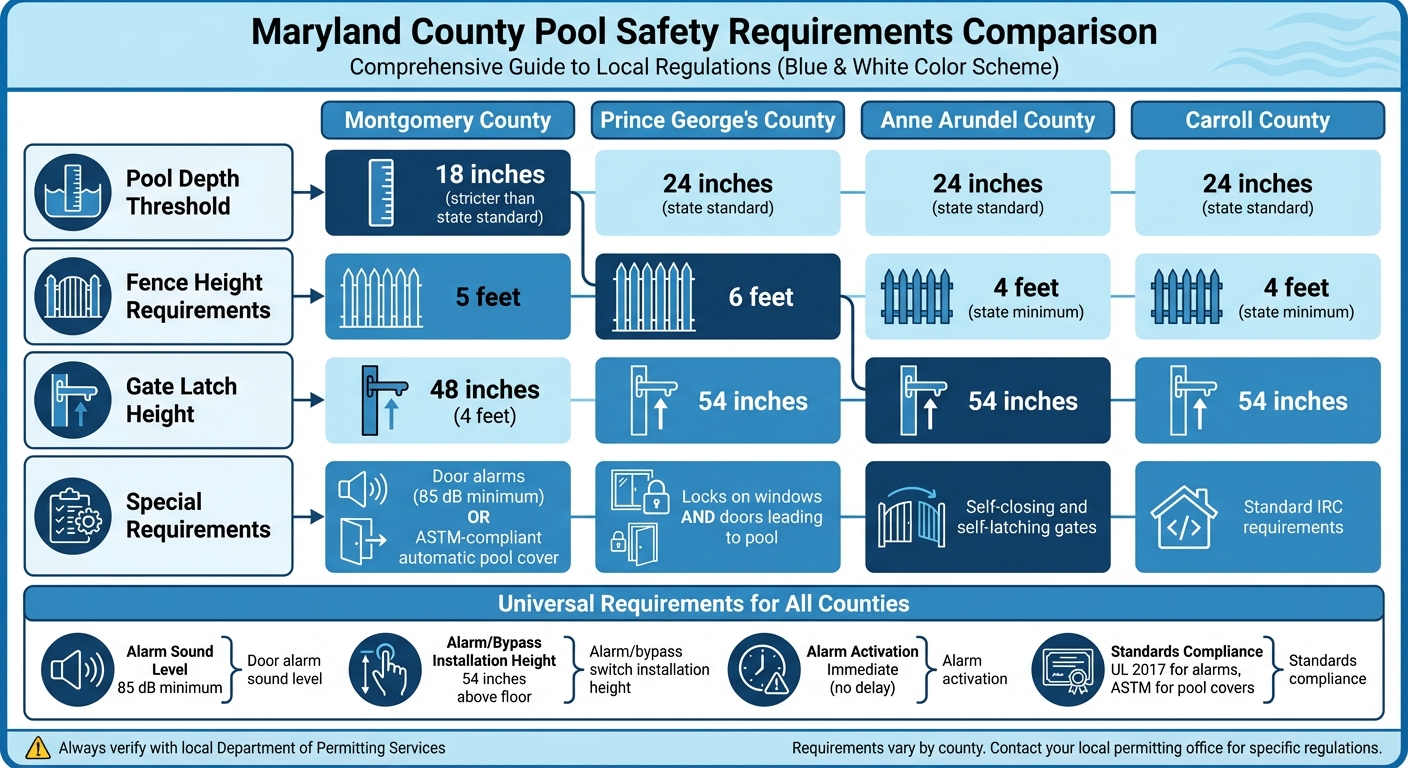
Maryland Pool Safety Requirements by County Comparison Chart
County-Specific Pool Alarm Rules
In Maryland, pool safety standards vary by county, which means installation requirements can differ significantly. For example, Montgomery County has stricter rules, requiring door alarms on all entries from the house to the pool area for pools deeper than 18 inches – a more stringent standard compared to the state’s 24-inch threshold [3][4].
Prince George’s County emphasizes securing access points by mandating locks on both windows and doors leading to pool areas to prevent unauthorized entry [5]. Meanwhile, Anne Arundel County prioritizes physical barriers, requiring gates to be self-closing and self-latching, with latches installed at a height of at least 54 inches from the ground [5].
Fence requirements also differ across counties. Montgomery County enforces a 5-foot fence for pools over 18 inches deep, Prince George’s County mandates a 6-foot fence, and Anne Arundel County adheres to the state minimum of 4 feet [9][5]. Gate latch height requirements vary as well: Montgomery County sets the height at 4 feet (48 inches), while Prince George’s, Anne Arundel, and Carroll counties require 54 inches [5].
Make sure to confirm these requirements with your local permitting office to ensure compliance.
How to Verify Local Requirements
To confirm your county’s specific pool safety standards, reach out to your local Department of Permitting Services or Department of Permitting, Inspections and Enforcement [3][6]. These offices handle pool permits and inspections and can provide the latest regulations.
For a detailed understanding of local codes, review documents like Chapter 51 of the Montgomery County Code, which outlines comprehensive pool safety requirements [3]. Many counties also offer online resources. For instance, Prince George’s County provides the "Momentum" portal, which includes checklists and building plan requirements that detail necessary safety barriers and alarms [6].
If online tools leave questions unanswered, contact your local inspections office directly. Prince George’s County residents, for example, can call 301-755-9000 to schedule a consultation or clarify code details [6]. Keep in mind, your pool must pass a final inspection by the Department of Permitting Services before it can be filled with water [3][2].
Technical Standards for Pool Alarms
Alarm Sound Levels and Alert Features
Maryland regulations require pool and door alarms to be audible, though they don’t specify an exact decibel level [7][3]. The alarm’s sound must be loud enough to effectively notify household members. Most industry-standard pool alarms range between 85 and 120 dB, ensuring they can cut through typical background noise [11]. Maryland classifies pool alarms under the emergency warning device exemption [10]. For reliable performance, choose alarms that emit at least 85 dB at a distance of 10 feet [11]. Many models also include a low-battery indicator – a critical feature since these alarms typically rely on 9-volt batteries with a lifespan of about one year [11].
Pool entry alarms work by detecting subsurface waves caused by objects weighing 15 to 18 pounds or more entering the water. Gate alarms, on the other hand, are designed to go off within 7 seconds of the gate being opened [11]. These features are designed to complement the installation guidelines previously outlined.
Durability and Weather Resistance
Beyond sound performance, durability is key to ensuring consistent alarm functionality in Maryland’s changing weather conditions. While specific durability ratings aren’t mandated, pool safety systems must be securely anchored and properly maintained [3][5]. High-quality pool alarms often come with stainless steel mounting systems for added strength and are built to withstand rain, snow, and temperature shifts [11]. Additionally, automatic pool covers must comply with ASTM power safety cover standards [3].
To ensure ongoing safety, it’s important to regularly test the alarm and replace its batteries as needed. This simple maintenance helps keep your pool area protected year-round.
Pool Alarms and Other Safety Features
Using Alarms with Fences and Gates
Pool alarms are most effective when used alongside physical barriers like fences and gates. In Maryland, regulations make it clear that alarms cannot replace fences; instead, they serve as an extra layer of security to prevent unauthorized access to the pool.
When a house forms part of the pool enclosure, every door leading to the pool must be equipped with an audible alarm. This adds an essential layer of security, especially in cases where a child might exit through the house instead of using the exterior gate.
"A gate left open is a dangerous liability. That’s why self-operating pool gate systems are a mandatory part of Maryland pool barrier codes."
– Mike Corkery, Pool Guard[4]
Self-closing gates provide a mechanical safeguard, but they can sometimes be left propped open. In such instances, alarms play a critical role by immediately alerting when a door or latch is compromised. To ensure maximum effectiveness, make sure door alarms meet the previously mentioned guidelines and install gate latches at a height that limits access for young children.[4]
Together, these components form a well-rounded pool safety strategy, combining physical and audible security measures.
Pool Alarms as Additional Safety Layers
In addition to barriers and locks, pool alarms provide real-time notifications, enhancing the safety of pool areas. Maryland safety officials recommend adopting a layered approach to pool security, as drowning can occur silently and within moments.[3] Each safety feature serves a distinct purpose: fences block entry, locks secure access points, and alarms alert you when someone breaches these defenses.
"Toddlers are naturally curious which is why it is critical to implement multiple safety strategies such as pool fencing, pool alarms and door locks."
– Montgomery County Fire and Rescue Service[3]
In some Maryland counties, like Montgomery, an automatic pool cover that meets ASTM standards can be used as an alternative to door alarms when a house forms part of the pool enclosure.[3] However, in most areas, both a physical barrier and an alarm system are required. Always check your local regulations to ensure compliance, as one safety feature cannot always replace another.
Penalties for Non-Compliance
Fines and Legal Actions
Maryland counties enforce pool safety rules through Property Maintenance Codes, with fines increasing based on the severity and length of the violation. In Anne Arundel County, for example, failing to meet pool alarm or barrier requirements can lead to escalating fines. Here’s a breakdown of the penalties:
| Violation Stage (Anne Arundel County) | Civil Fine Amount |
|---|---|
| First Violation | $125 |
| Second Violation | $500 |
| Third or Subsequent Violation | $1,000 |
| Ongoing Non-Compliance | Daily fines may apply for continued violations |
Daily citations can be issued until the issue is resolved [1]. In some situations, health officers or building officials may issue an abatement order, requiring immediate corrective action. If the property owner doesn’t comply, the county has the authority to address the hazard directly and charge the owner for the associated costs [1].
Beyond these government penalties, homeowners could face legal consequences if their non-compliance leads to injury or death. Property owners may be held liable for negligence, which could result in lawsuits for medical expenses, lost income, funeral costs, and emotional damages [5]. For instance, in Montgomery County, pools cannot be filled with water until they pass a final inspection confirming that all necessary safety features, such as door alarms or safety covers, are properly installed [3].
Addressing violations quickly is critical to avoid escalating penalties and potential legal troubles.
How to Correct Non-Compliance Issues
Taking immediate action to address violations can prevent further fines and legal complications. Here’s how to resolve non-compliance issues effectively:
Enforcement typically starts with a warning or written notice of violation, giving homeowners an opportunity to fix the problem before formal penalties are imposed. Responding promptly to these notices can help avoid fines or court appearances [12]. Once notified, contact your county’s Department of Permitting Services or code enforcement office to identify the specific issues that need correction.
If repairs or installations are required, ensure you obtain the necessary building permits. In Montgomery County, for example, homeowners must schedule a final inspection within five days of completing pool safety upgrades [3]. Multiple departments, such as Public Works, Licenses and Permits, and Health, may conduct separate inspections to verify compliance with various safety standards [12]. Keeping detailed records of professional installations and ASTM-compliant equipment can be helpful during inspections.
Regular maintenance of pool alarm systems is also essential for preventing unauthorized access and ensuring long-term compliance with safety regulations.
Conclusion
In Maryland, pool alarm laws are in place because drowning is the leading cause of unintentional injury-related deaths among children aged 1–4, with 87% of these tragedies happening in home pools and spas [3]. These regulations aim to prevent these devastating incidents, which can occur in mere seconds – even when children are being supervised.
Following pool alarm laws provides homeowners with critical protection. From a legal standpoint, your pool cannot be filled with water until it passes a final inspection. In counties like Montgomery, this means ensuring all required safety barriers and alarms are installed and functional [3][4]. Financially, neglecting to maintain these safety measures can lead to fines and, more gravely, legal liability for negligence if an injury or drowning happens [5]. As The Cochran Firm, D.C. explains:
"Property owners must maintain the safety of their swimming pools, if they fail to do this they may be held responsible for deaths and injuries resulting from their negligence" [5].
With such risks in mind, layering safety measures becomes non-negotiable.
Safety depends on combining physical barriers, alarms, and active supervision. For example, door alarms must emit at least 85 decibels and be installed 54 inches above the floor to stay out of children’s reach [4]. Regular testing of these systems ensures they remain effective and meet local safety codes.
Before purchasing or installing pool safety equipment, it’s crucial to consult your county’s permitting office, as requirements differ across Maryland. For instance, Montgomery County mandates 5-foot fences, while Prince George’s County requires 6-foot barriers [3][6]. Staying informed about local regulations helps avoid costly errors and safeguards your family right away.
FAQs
Do I need a pool alarm where I live in Maryland?
Yes, under Maryland law, a pool alarm is required if your pool has a depth greater than 24 inches. Along with this, state safety regulations emphasize additional precautions, such as installing fencing and self-latching gates. These measures are designed to reduce the risk of accidental drownings and enhance overall pool safety.
Can a fence or safety cover replace door alarms?
A fence or safety cover by itself isn’t enough to ensure complete safety. The combination of fences, safety covers, and door alarms offers the most reliable protection. Even if you already have a fence or cover installed, door alarms are still highly recommended to add an extra layer of security.
How do I pass the final pool inspection?
To successfully pass the final pool inspection in Maryland, it’s crucial that your pool area adheres to local safety and fencing regulations. Generally, this means having a fence that meets the required height, gates equipped with self-closing and self-latching locks, and barriers that are specifically designed to deter climbing. Before scheduling an inspection with your county’s permitting office, take the time to carefully check that all fencing and safety measures align with the local guidelines.
Chat with Us