









- bhavya gada
- No Comments
Post-construction stormwater reporting in Maryland focuses on protecting waterways by monitoring construction sites and ensuring compliance with Maryland Department of the Environment (MDE) regulations. If your project disturbs one or more acres of land, here’s what you need to know:
- Inspections: Conduct twice-weekly inspections during construction or weekly with post-storm checks (after 0.25 inches of rain).
- Documentation: Maintain detailed records for at least three years, including inspection logs, turbidity data, and as-built plans.
- Final Stabilization: Once the site is stable (verified visually after a storm), submit a Notice of Termination (NOT) within 30 days.
- Turbidity Monitoring: Stop dewatering if turbidity exceeds 150 NTUs and take corrective action immediately.
- Annual Reporting: Large sites must submit yearly maintenance and inspection reports to MDE.
Timely communication with MDE and proper record-keeping are key to avoiding penalties and ensuring compliance. This guide breaks down the process, timelines, and required documentation to help you meet Maryland’s standards effectively.
MDE Guidance For Protecting Stormwater Best Management Practices During Construction November 2023
sbb-itb-843f8be
Maryland Stormwater Reporting Regulations
Maryland’s updated stormwater reporting rules, effective April 1, 2023, operate under the reissued 20-CP General Permit. This permit applies to construction projects disturbing one or more acres of land and outlines specific requirements for the post-construction phase [1].
Once final stabilization is achieved, post-construction monitoring begins. During the first month, inspections can be reduced to twice per month. If no issues arise after a storm of 0.25 inches or more, inspections may be suspended following visual confirmation of site stabilization [1].
For projects involving dewatering, quarterly turbidity reporting remains a key requirement. Permittees must use the Turbidity Monitoring Report to compile data and submit it via the MDE ePermits system within 28 days. If turbidity readings exceed 150 NTUs, dewatering must stop immediately, and corrective action is required [1].
"The turbidity limit in this permit is a maximum of 150 NTUs. If the test result is above 150 NTUs then the associated dewatering operation must stop, and correction must be taken immediately." – Maryland Department of the Environment [1]
All records should be retained on-site for at least three years. Inspections must be supported by data from an on-site rain gauge or the nearest National Weather Service station. To close out the project, termination filings are required to confirm compliance.
Notice of Termination (NOT)
To officially end permit obligations, a Notice of Termination (NOT) must be submitted to MDE within 30 days of achieving final stabilization. Before submission, ensure that all temporary erosion controls have been removed, permanent stabilization measures are in place, and the site can handle storm events without sediment-laden runoff. This process is completed through the MDE ePermits portal, where all certifications and documentation are uploaded [1].
As-Built Plan Certification
As part of the final compliance process, licensed professionals – such as Professional Engineers or Registered Landscape Architects – must certify that as-built plans accurately represent the constructed stormwater management facilities. These certified plans must be submitted to the approving agency within 30 days of facility completion. The certification should include precise measurements and details confirming compliance with the approved design. Any deviations from the original plans must be documented, and significant changes may require re-approval before the certification is accepted [1].
Annual Reporting to MDE
Ongoing monitoring and annual reporting are required for post-construction stormwater management facilities, particularly for large commercial and industrial sites. These reports include inspection results, maintenance records, and details of any repairs or modifications. Typically aligned with the calendar year, reports may also include photos, water quality test results (if applicable), and a signed certification from a qualified professional confirming compliance. Property owners are encouraged to assign at least one team member with an MDE Responsible Personnel Certification (RPC) to oversee these activities [1].
Required Compliance Documentation
Accurate documentation is the backbone of verifying post-construction compliance. In Maryland, proving post-construction stormwater compliance hinges on maintaining complete and detailed records. These documents not only serve as evidence during inspections but also help avoid penalties like stop-work orders or bond withholdings.
Stormwater Management Plans and Records
Your Stormwater Management Plan (SWMP) should always be current and easily accessible. This document outlines the design and operation of stormwater controls [2][3]. If your project is located in a Tier II watershed, you’ll also need an Antidegradation Checklist to confirm compliance with on-site management protocols [2][4]. A common compliance issue is the failure to maintain essential records – such as chemical use plans or inspection logs [3]. To stay compliant, ensure your inspection records are detailed, up-to-date, and certified.
Inspection and Maintenance Certifications
Regular inspections and certifications are crucial to ensure stormwater systems function as intended. During construction, inspections must occur weekly and within 24 hours of any storm producing at least 0.25 inches of rain [3][8]. Post-construction, maintenance logs should document all repairs and system performance. Additionally, formal certifications must be submitted to MDE every five years [2][5]. These certifications often include detailed records of specific maintenance tasks – like cleaning French drains to prevent blockages – and must be signed by a Maryland-licensed professional engineer or land surveyor [7][8].
Compliance Report Submission
Once your planning and verification records are complete, the next step is electronic submission. Use MDE’s ePermits system to file all reports, including electronic signatures [2]. Submissions should include as-built plans that compare approved designs with the actual construction. Additionally, notify the approving agency at least 48 hours before starting any stormwater-related work [7]. Filing a Notice of Intent (NOI) through ePermits triggers a 14-day public notification period, allowing the community to review your project [2][3]. If you have questions about the submission process, reach out to MDE at 410-537-3510 [2][3].
Communicating with Stakeholders
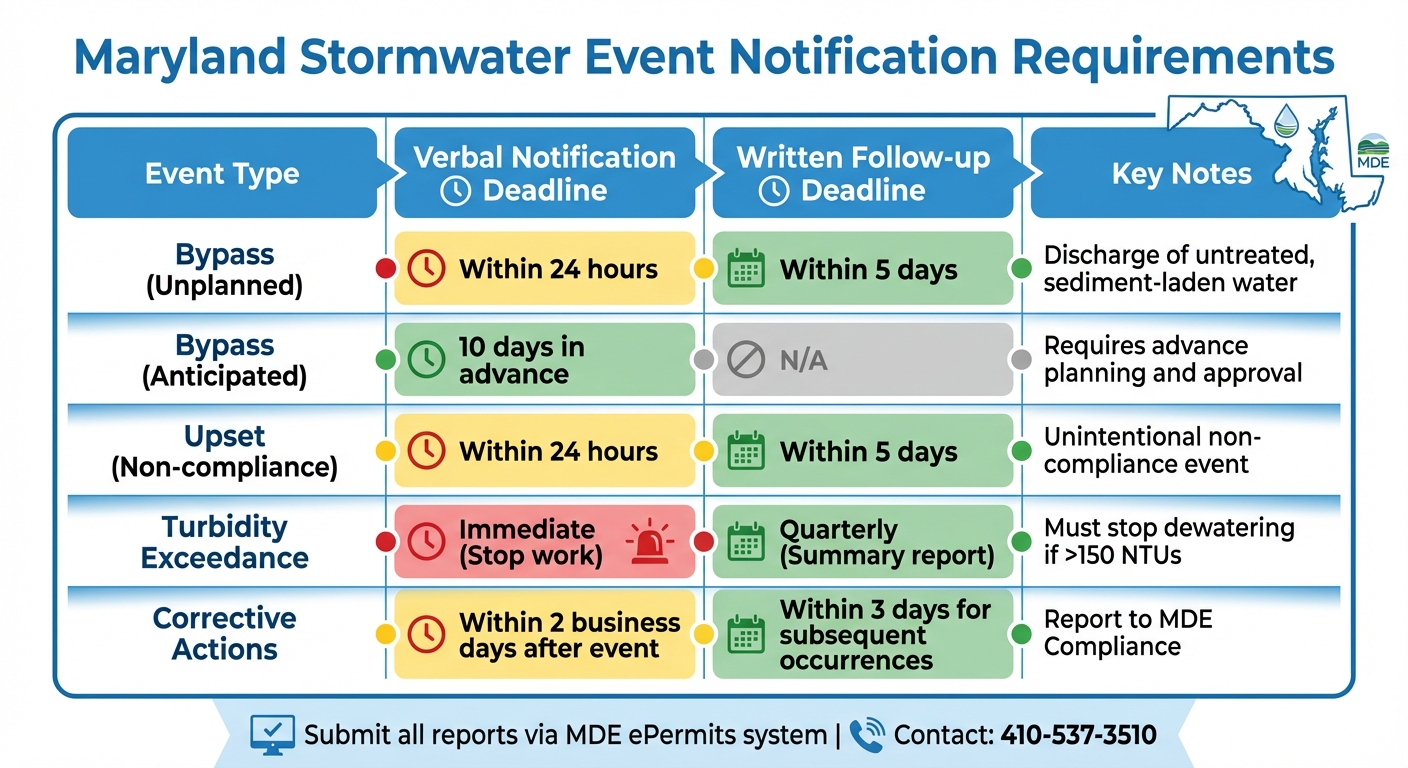
Maryland Stormwater Reporting Notification Deadlines and Requirements
Once compliance documentation is compiled, the next step is effective communication with stakeholders. This goes beyond just maintaining records – it’s about ensuring regulatory compliance, avoiding delays, and fostering trust throughout the reporting process. In Maryland, this requires coordination with both regulatory agencies and the public, each with specific notification rules and timelines.
Notifying Regulatory Agencies
The Maryland Department of the Environment (MDE) relies on its ePermits system for digital submissions. This is where you’ll upload required documents like Turbidity Monitoring Reports [1]. Timing is critical for incident reporting. If a bypass (discharge of untreated, sediment-laden water) or an upset (unintentional non-compliance) occurs, notify MDE within 24 hours and follow up with written documentation within 5 days [1]. For anticipated bypasses, you’ll need to provide at least 10 calendar days’ advance notice [1].
Corrective actions also have strict timelines. Notify MDE Compliance within two business days after an event, and for any subsequent occurrences, within three days [1]. To streamline these communications, it’s crucial to designate a stormwater team during the pre-construction phase. At least one team member must hold an MDE Responsible Personnel Certification, ensuring consistent and accurate communication with the agency. Beyond regulatory notifications, engaging with the public plays an equally important role in maintaining transparency.
Public Notifications and Comment Periods
Under the Maryland 20-CP permit, effective April 1, 2023, public notification is a key requirement. You must post a notice of permit coverage at a publicly accessible location near the construction site. The notice should be in a font size large enough to be easily read from the public right-of-way [1]. For larger linear projects, a single posting may not suffice. In such cases, alternative notification methods can be proposed to the MDE inspector during the preconstruction meeting for approval [1].
Submitting a Notice of Intent through the ePermits system initiates a 14-day public notification period, allowing community members to review the project [2][3]. This step not only ensures compliance but also builds trust, reducing the likelihood of objections during construction.
Here’s a quick summary of notification deadlines for various events:
| Event Type | Notification Deadline (Verbal) | Follow-up Deadline (Written) |
|---|---|---|
| Bypass (Unplanned) | Within 24 hours | Within 5 days |
| Bypass (Anticipated) | 10 days in advance | N/A |
| Upset (Non-compliance) | Within 24 hours | Within 5 days |
| Turbidity Exceedance | Immediate (Stop work) | Quarterly (Summary report) |
Pro Landscapes MD Stormwater Management Services

Post-construction stormwater compliance in Maryland involves more than just securing NOCC and as-built certifications. Property owners must also maintain ongoing BMP (Best Management Practices) solutions to avoid violations during the Maryland Department of the Environment’s (MDE) triennial reviews. Pro Landscapes MD provides the expertise in drainage and hardscaping necessary to keep properties compliant. Here’s how their services help ensure compliance.
Stormwater Solutions in Landscaping
Compliance doesn’t stop at meeting initial requirements – it extends into practical, long-term solutions for stormwater management. Pro Landscapes MD offers landscaping services designed to meet Maryland’s 20-CP permit standards. Their drainage systems, including French drains and dry riverbeds, can cut runoff by as much as 50% [2][3][5]. If MDE inspections uncover issues like drainage failures or improper grading, their services – such as drain pipe installation and yard leveling – can quickly address these deficiencies and restore compliance before they lead to Notices of Violation [6].
Hardscaping is another key component. Features like retaining walls, garden walls, and environmental pavers not only provide structural support but also align with eco-friendly practices. In counties where stormwater management for areas exceeding 5,000 square feet requires NOCC submission, these installations help properties meet both functional and regulatory standards. From Ellicott City to Bethesda, Pro Landscapes MD customizes its solutions to meet local MS4 (Municipal Separate Storm Sewer System) permit requirements.
Maintenance Agreements for Compliance
Physical upgrades are only part of the solution – ongoing maintenance is essential for sustained compliance. Maryland’s MS4 programs require regular inspections and maintenance certifications, which can be overwhelming for many property owners. Pro Landscapes MD offers maintenance agreements that align with MDE’s triennial review schedule, ensuring routine BMP inspections and proper documentation. This proactive approach reduces the risk of minor issues escalating into costly enforcement actions within the standard 30-day correction period [6].
These agreements include services like grading inspections, drain repairs, and system upkeep, all designed to keep properties compliant with Maryland’s post-construction stormwater rules. Regular maintenance not only meets regulatory demands but also promotes transparency and accountability.
Common Problems and Solutions in Stormwater Reporting
Navigating the documentation and reporting requirements for stormwater compliance can be tricky. In Maryland, post-construction stormwater reporting often runs into recurring issues that can complicate compliance efforts. Problems like missed deadlines, unresolved violations, and irregular inspections are common. These missteps can lead to enforcement actions by the Maryland Department of the Environment (MDE). Understanding these challenges and tackling them head-on is key to avoiding penalties and maintaining transparent communication with stakeholders.
Meeting Reporting Deadlines
Missing the annual NOCC reporting deadline is a frequent issue. For example, under Maryland’s 20-CP General Permit, permittees were required to submit Notices of Intent (NOI) by September 30, 2023, to maintain coverage [2]. Additionally, the 14-day public notification period for ePermits submissions requires careful coordination. Property owners must notify MDE at least two weeks before starting construction [2].
To stay on top of deadlines, consider using a digital calendar with automated reminders for tasks like weekly inspections, 24-hour post-storm checks, and annual reporting. Assigning a compliance officer to oversee these activities can also help ensure nothing is overlooked [2][8].
Addressing Violations and Non-Compliance
If you receive a violation notice, act quickly. Unresolved deficiencies can escalate fast. For instance, counties like St. Mary’s often send follow-up letters, giving a 30-day window to respond before conducting site visits or issuing Notices of Violation (NOV) [6]. To avoid further enforcement, document the issues, take corrective actions (such as repairing erosion controls), and update your ePermits submission [6][9].
Another common violation involves sites with contaminated soils or PCB-related demolitions that lack adequate pollution prevention measures in their Stormwater Pollution Prevention Plans (SWPPP). Fixing this usually requires updating the SWPPP, improving controls (e.g., managing chemical additives), and obtaining MDE certification. Timely ePermits resubmission can help you avoid fines [3]. For complex cases, reach out to MDE directly at (410) 537-3510.
Maintaining Regular Inspection Schedules
Under the 20-CP permit, weekly inspections and post-storm checks are mandatory [3][9]. Skipping these inspections can result in permit revocation, forcing you to apply for an individual permit – a process that’s more time-consuming and costly [9]. Regular checks help catch issues like wear, damage, or malfunctions early, preventing them from escalating into major problems that could lead to pollutant discharge into sensitive Tier II watersheds.
| Common Problem | Trigger | Required Action Timeline | Consequence of Non-Compliance |
|---|---|---|---|
| Missed Inspections | No weekly or post-storm (0.25" rain) checks [3] | Immediate scheduling | Permit revocation; individual permit required [9] |
| Unresolved Deficiencies | Inspection findings not fixed [6] | 30-day response to letter | NOV, citation, annual MDE reporting [6] |
| NOI Lapse | No submission by deadline (e.g., Sept 30, 2023) [2] | Reapply via ePermits | Loss of coverage; fines [3] |
Using tools like MDE’s Construction Activity Inspection Form and Stormwater Inspection Guide can help standardize processes and minimize errors [2][5]. For post-construction practices covering over 5,000 square feet, maintaining a certified log every five years – including records of repairs – can prevent system failures and ensure compliance with triannual review requirements [6][5]. Consistent scheduling and thorough record-keeping are the backbone of successful stormwater reporting.
Conclusion
Navigating post-construction stormwater reporting in Maryland demands careful planning and consistent communication. Under the 20-CP NPDES General Permit, which took effect on April 1, 2023 [1], projects must adhere to key requirements, such as regular inspections, turbidity monitoring during dewatering, and quarterly ePermit submissions. These steps not only help avoid penalties but also safeguard Maryland’s waterways and build trust with regulatory agencies, property owners, and the public.
Starting strong is crucial. Setting up a dedicated stormwater team during the pre-construction meeting – typically including a Project Engineer and an Erosion and Sediment Control Manager – ensures accountability from the start. If bypass events or other issues arise, notifying the Maryland Department of the Environment (MDE) within 24 hours and submitting written documentation within five days helps maintain compliance and may even lead to a no-fault determination.
Detailed record-keeping is equally important. Maintaining turbidity logs for three years, as outlined in MDE templates, provides a solid defense during audits. For projects in Tier II or impaired watersheds, where turbidity must stay below 150 NTUs, daily monitoring may be required to meet stricter standards.
Expert management is key to long-term success. Pro Landscapes MD offers a range of stormwater solutions across central Maryland, including drainage installations like French drains, grading, and land leveling, as well as environmental paver systems. These services not only ensure compliance but also improve the functionality of outdoor spaces.
FAQs
What is considered ‘final stabilization’ in Maryland?
In Maryland, final stabilization refers to ensuring that all disturbed areas are fully stabilized using permanent vegetation, structures, or other measures. This process happens after construction activities are finished, leaving only minor tasks like cleanup or landscaping. The goal is to effectively control erosion and prevent sediment runoff.
When do post-construction inspections stop or get reduced?
Once stormwater management systems are operating as intended, properly maintained, and the site is fully stabilized, post-construction inspections typically decrease or stop altogether. After this point, inspections are generally carried out every 1 to 3 years to verify ongoing compliance and ensure the systems continue to perform effectively.
What should I do if dewatering turbidity exceeds 150 NTUs?
If turbidity levels during dewatering exceed 150 NTUs, it’s crucial to act immediately. Start by closely monitoring the turbidity to assess the situation. Consider implementing measures like enhancing sediment controls, modifying dewatering methods, or introducing extra treatment systems to bring levels back under control. Be sure to document the exceedance thoroughly and notify the appropriate regulatory authority if necessary. This ensures compliance with permit requirements and helps avoid any potential penalties.
Chat with Us