









- bhavya gada
- No Comments
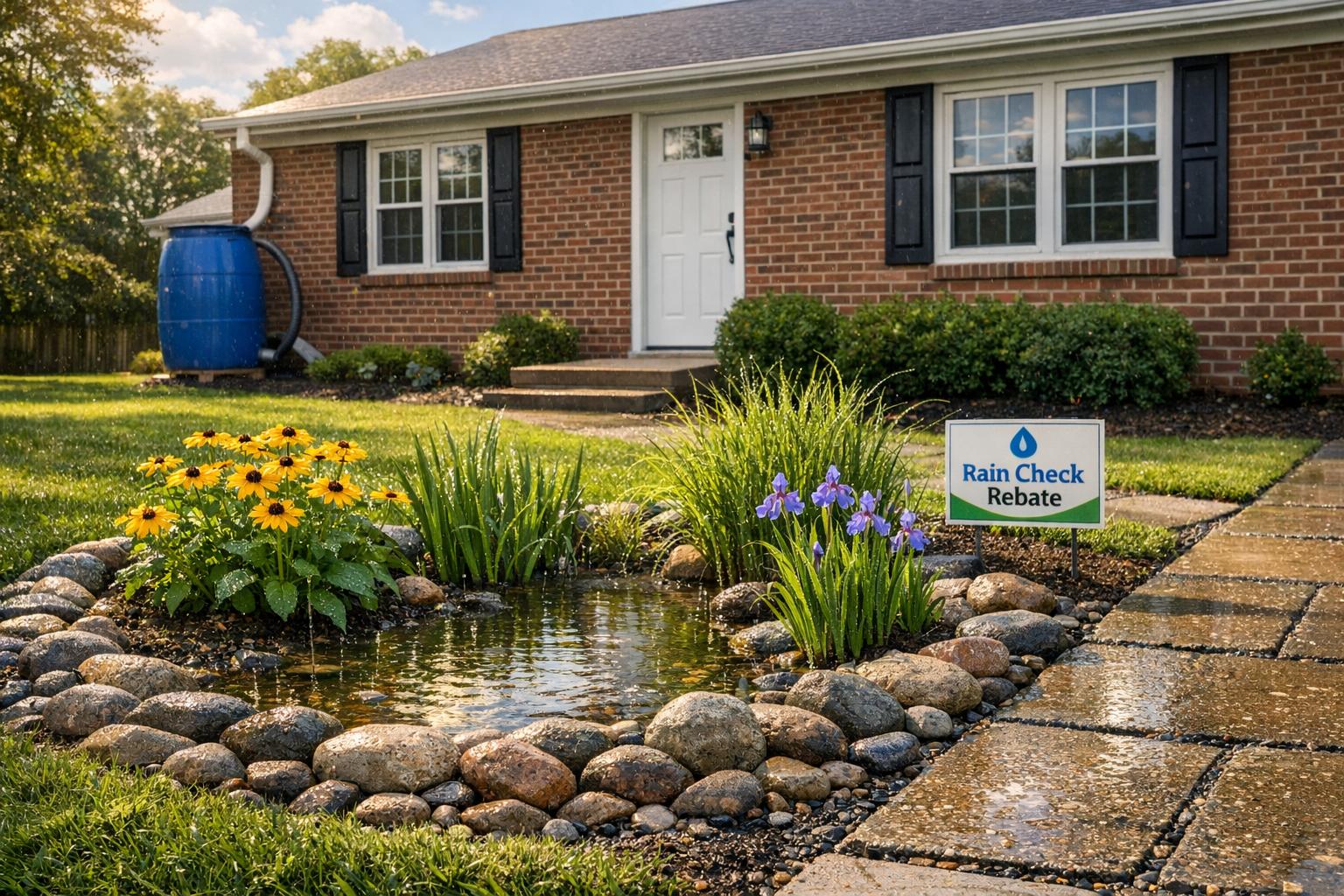
The Rain Check Rebate Program in Prince George’s County provides financial incentives for property owners to install stormwater management features. Here’s what you need to know:
- Who Can Apply? Homeowners, businesses, nonprofits, and other property owners in Prince George’s County (except City of Bowie residents) can qualify.
- Rebate Limits: Up to $6,000 for residential properties and $20,000 for commercial/nonprofit properties over a lifetime.
- Eligible Projects: Rain barrels, rain gardens, permeable pavement, urban tree planting, green roofs, and more. Projects must be voluntary and not required by permits for construction.
- How It Works: Projects, except rain barrels, require pre-approval. After installation, submit receipts and photos for reimbursement.
- Timeline: Applications are reviewed in 2–3 weeks, with rebates processed in 6–8 weeks after project completion.
This program helps reduce stormwater runoff, protect waterways, and lower fees for property owners. Apply early, as funds are limited and distributed on a first-come, first-served basis.
Who Qualifies for the Rain Check Rebate?
Homeowner Eligibility Requirements
To qualify, residential applicants must own the property. This includes individual homeowners, housing cooperatives, HOAs, condominium associations, and civic associations [4].
Eligible properties must be located in Prince George’s County. However, residents of the City of Bowie are excluded because their stormwater program operates independently. As stated by the Chesapeake Bay Trust, "City of Bowie residents do not pay into the same fee that Prince George’s County residents pay into, thus do not have access to the funds" [1].
Additionally, properties in Cheverly, University Park, and College Park qualify for most rebates but are not eligible for the Urban Tree Canopy rebate, as these areas already have local tree planting programs [4]. If your property falls under an HOA, you’ll need written approval from the HOA to move forward with your project [4].
Rebates are unavailable for projects required by permits related to new construction, additions, or renovations. Instead, eligible projects must be voluntary and exceed legal requirements. Residential property owners can receive a lifetime rebate of up to $6,000 for approved projects [4].
Business and Nonprofit Eligibility Requirements
The program also supports commercial and nonprofit applicants, offering rebates of up to $20,000 per property over a lifetime [4]. Eligible nonprofits include 501(c)[6] organizations, faith-based groups, and schools [4].
As with residential properties, eligibility is limited to those in Prince George’s County, excluding the City of Bowie [4]. Nonprofits may either own the property or have formal agreements to complete projects on private or public land [4]. For example, in 2022, the Windsor Green Homeowner’s Association in Greenbelt removed 12,812 square feet of pavement at their community center and received the maximum rebate of $20,000 [1].
Commercial and nonprofit applicants must sign agreements committing to the long-term maintenance of their stormwater projects. These agreements ensure that the benefits of their projects last well into the future. Additionally, all projects must be completed within 12 months of receiving pre-approval from the Chesapeake Bay Trust [4].
sbb-itb-843f8be
How to Get Paid for Environmental Renovations | WGCU News
Which Stormwater Projects Qualify for Rebates?
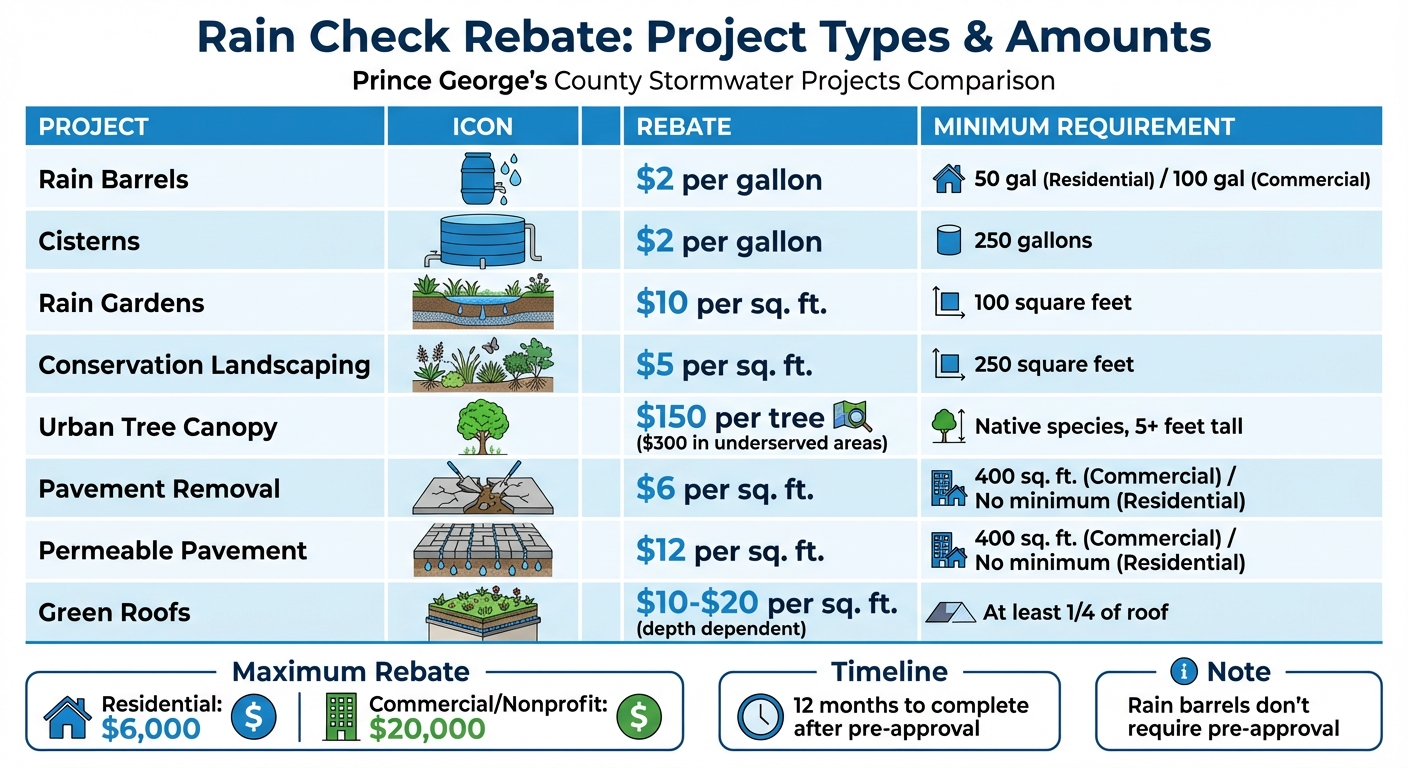
Prince George’s County Rain Check Rebate Amounts by Project Type
Approved Project Types
The rebate program supports eight types of stormwater management projects, including rain barrels, cisterns, rain gardens, conservation landscaping, urban tree canopy, pavement removal, permeable pavement, and green roofs [1][4].
Most projects require pre-approval from the Chesapeake Bay Trust before installation. The exception is rain barrels, which can be purchased first, as long as receipts are submitted within 12 months [1][4]. After approval, participants have 12 months to complete their project [4].
To qualify, projects must be voluntary and cannot be part of permit requirements for new construction, additions, or renovations [1][5]. For example, in fiscal year 2022, a Capitol Heights resident installed a 301-square-foot rain garden with native plants like swamp rose mallow and blue vervain, earning a rebate of $998.71 [1]. Similarly, a Hyattsville property owner planted 15 native trees, including Red maple and Sweetbay magnolia, and received $2,250 [1].
It’s important to note that rebates only cover stormwater management costs. Decorative elements like benches, boulders, or walkways not involved in stormwater treatment are not eligible for reimbursement [1].
Below are the rebate amounts and funding limits for each project type.
Rebate Amounts and Funding Limits
Rebates are calculated based on either the maximum allowed rate or the actual project cost, whichever is lower [1].
| Project Type | Rebate Amount | Minimum Size/Requirement |
|---|---|---|
| Rain Barrels | $2 per gallon | 50 gallons (Residential); 100 gallons (Commercial) |
| Cisterns | $2 per gallon | 250 gallons |
| Rain Gardens | $10 per sq. ft. | 100 square feet |
| Conservation Landscaping | $5 per sq. ft. | 250 square feet |
| Urban Tree Canopy | $150 per tree | Native species; minimum 5 feet tall |
| Pavement Removal | $6 per sq. ft. | 400 sq. ft. (Commercial only; no minimum for Residential) |
| Permeable Pavement | $12 per sq. ft. | 400 sq. ft. (Commercial only; no minimum for Residential) |
| Green Roofs | $10–$20 per sq. ft. | Must retrofit at least 1/4 of the roof |
For green roofs, residential projects are reimbursed at $10 per square foot. Commercial or nonprofit projects receive $10 per square foot for planting material under 6 inches deep, or $20 per square foot for deeper material [4]. Additionally, native trees planted in eligible underserved communities may qualify for doubled rebates of $300 per tree through the Urban Tree Program supplement [1].
In fiscal year 2022, a Fort Washington resident installed a 303-square-foot permeable pavement patio and earned a rebate of $3,703.50 [1]. Another resident in Upper Marlboro installed a 2,000-gallon cistern and received $3,925.64 [1]. You can complete multiple projects until you reach your property’s lifetime maximum. Since the program began in 2012, it has awarded over $992,000 for more than 2,200 projects [2].
How to Apply for the Rain Check Rebate
Application Process
Once you’ve reviewed the eligibility and project guidelines, here’s how to get started. The application process is managed by Prince George’s County and the Chesapeake Bay Trust. You can either apply online through the Chesapeake Bay Trust portal at grantrequest.com or download a paper application form [1].
For all projects except rain barrels, pre-approval is required. You can purchase rain barrels first and submit receipts within 12 months for reimbursement [1][4]. However, starting any other project before receiving pre-approval will disqualify you from the rebate program [1].
Only property owners are eligible to apply. The online application is quick, taking just 5 to 10 minutes to complete [1]. After submission, a program coordinator will visit your property to ensure it meets the necessary requirements before granting pre-approval [1].
You’ll need to provide all required documents, including owner and operation & maintenance agreements. For green roof projects, additional reports may be necessary [1][4]. Once your project is completed, submit invoices, receipts, and post-installation photos for verification. Keep in mind, the rebate amount cannot exceed your actual project costs [1][4].
Application Timeline and Processing
Once you’ve secured pre-approval, here’s what to expect. Initial application reviews typically take 2 to 3 weeks [1]. The entire process – from application submission to receiving your rebate – usually spans 2 to 4 months, though it could extend up to a year depending on factors like site visit scheduling and how quickly you complete your project [1].
After pre-approval, you’ll have 12 months to complete your project [1][4]. If more time is needed, you can request an extension of 1 to 3 months by contacting the program coordinator [1]. Once your project is finished and approved, you can expect to receive your rebate check within 6 to 8 weeks [1][4].
"The coordinator continued to act as a liaison with Prince George’s County regarding our rebate and we were reimbursed in full. We are very happy we found out about this program!" – Jessica and Franklin, Rebate Recipients [1]
"I was very impressed with the program coordinator, who paid a visit to my house, looked over the installation, and expertly answered all my questions." – Doug, Rebate Recipient [1]
It’s worth noting that funds are distributed on a first-come, first-served basis. To increase your chances of receiving funding, it’s best to apply early in the fiscal year [1][3]. Applications may be closed if projects remain incomplete beyond the one-year deadline [1]. This efficient process helps support the county’s efforts to improve stormwater management.
Working with Pro Landscapes MD for Your Rebate Project
Stormwater Management Services
Pro Landscapes MD specializes in designing and installing stormwater management features that qualify for Rain Check Rebates. Their expertise covers several approved project types, including rain gardens, permeable pavement installations, urban tree canopy planting, and pavement removal.
For rain gardens, they handle everything from site assessments to installation, ensuring the 100-square-foot minimum is met using native plants. With permeable paver installations, they replace impervious surfaces with environmentally friendly, water-filtering options that qualify for rebates at $12 per square foot. Their tree planting services focus on native species that meet the program’s 5-foot height minimum, earning property owners $150 per tree.
In addition, they assist with pavement removal projects, converting unused patios or driveways into permeable landscaping. These projects not only help reduce stormwater runoff but also qualify for rebates of $6 per square foot.
By offering these tailored services, Pro Landscapes MD ensures your project aligns seamlessly with program requirements.
Meeting Program Requirements
Hiring a qualified contractor is critical for success with Rain Check projects. Certain installations, such as permeable pavement and green roofs, must be completed by certified professionals to meet program standards. Pro Landscapes MD guarantees that all work complies with Prince George’s County’s strict guidelines, from size minimums to construction details.
They coordinate with the Chesapeake Bay Trust to secure pre-approval before starting installations (except for rain barrels). Their team also schedules both pre- and post-installation site visits to ensure compliance with the approved application, helping property owners stay within the program’s 12-month timeline and avoid disqualification.
To meet rebate requirements, Pro Landscapes MD provides detailed invoices that clearly separate stormwater-related costs from other landscaping expenses. Their deep understanding of local regulations ensures your project passes compliance inspections on the first try, saving time and effort.
Conclusion
Program Benefits Summary
The Rain Check Rebate Program offers both financial relief and environmental advantages. Since its launch in 2012, the program has provided significant funding to help property owners manage installation costs while contributing to the protection of local waterways [2]. These rebates can cover a large portion of expenses for qualifying projects, making them an appealing option for property improvements [1].
In addition to financial savings, the program promotes environmental health. These projects help minimize stormwater runoff, filter out pollutants, and even reduce Clean Water Act Fees [1]. Features like rain gardens and native plantings enhance local ecosystems by supporting biodiversity, while rain barrels help lower water bills by reducing the need for tap water in landscaping [2].
"We did not have to use our outside water faucets to water plants the whole growing season – the program covered over half the expenses and rewarded our environmental efforts." – Frances, Rebate Recipient [1]
Whether you’re planning to install a rain garden, permeable pavement, or a native tree canopy, these rebates provide meaningful support to help you achieve your stormwater management goals.
Getting Started with Your Project
Reinstated for FY 2026, the program operates on a first-come, first-served basis. To participate, ensure you meet eligibility requirements (note: the City of Bowie is excluded) and secure pre-approval from the Chesapeake Bay Trust [1][4].
Pro Landscapes MD can assist you every step of the way, from site assessments to compliance inspections. Their expertise in rain gardens, permeable pavement, native tree planting, and pavement removal ensures your project aligns with program guidelines while maximizing your rebate potential. Reach out to discuss your stormwater management plans and take advantage of this funding opportunity.
FAQs
Can I combine multiple projects to reach the lifetime rebate cap?
Yes, in Prince George’s County, you can combine different stormwater management projects to hit the lifetime rebate cap. The program permits multiple practices to be installed and qualify for rebates, with a total maximum rebate of $6,000 for residential properties.
What is the difference between ‘voluntary’ and permit-required work?
"Voluntary" efforts cover tasks such as setting up rain barrels, creating rain gardens, installing permeable pavement, or planting native trees. These activities don’t require any permits. On the other hand, "permit-required" projects refer to those connected to new construction, renovations, or specific practices that must receive prior approval through the Rain Check Rebate Program.
What documents do I need to submit for reimbursement?
To get reimbursed, you’ll need to provide receipts, a filled-out rebate request form, and any other required paperwork, like a property owner agreement. If it applies to your situation, don’t forget to include HOA approval too. Double-check that everything is complete and accurate before you send it in.
Chat with Us