









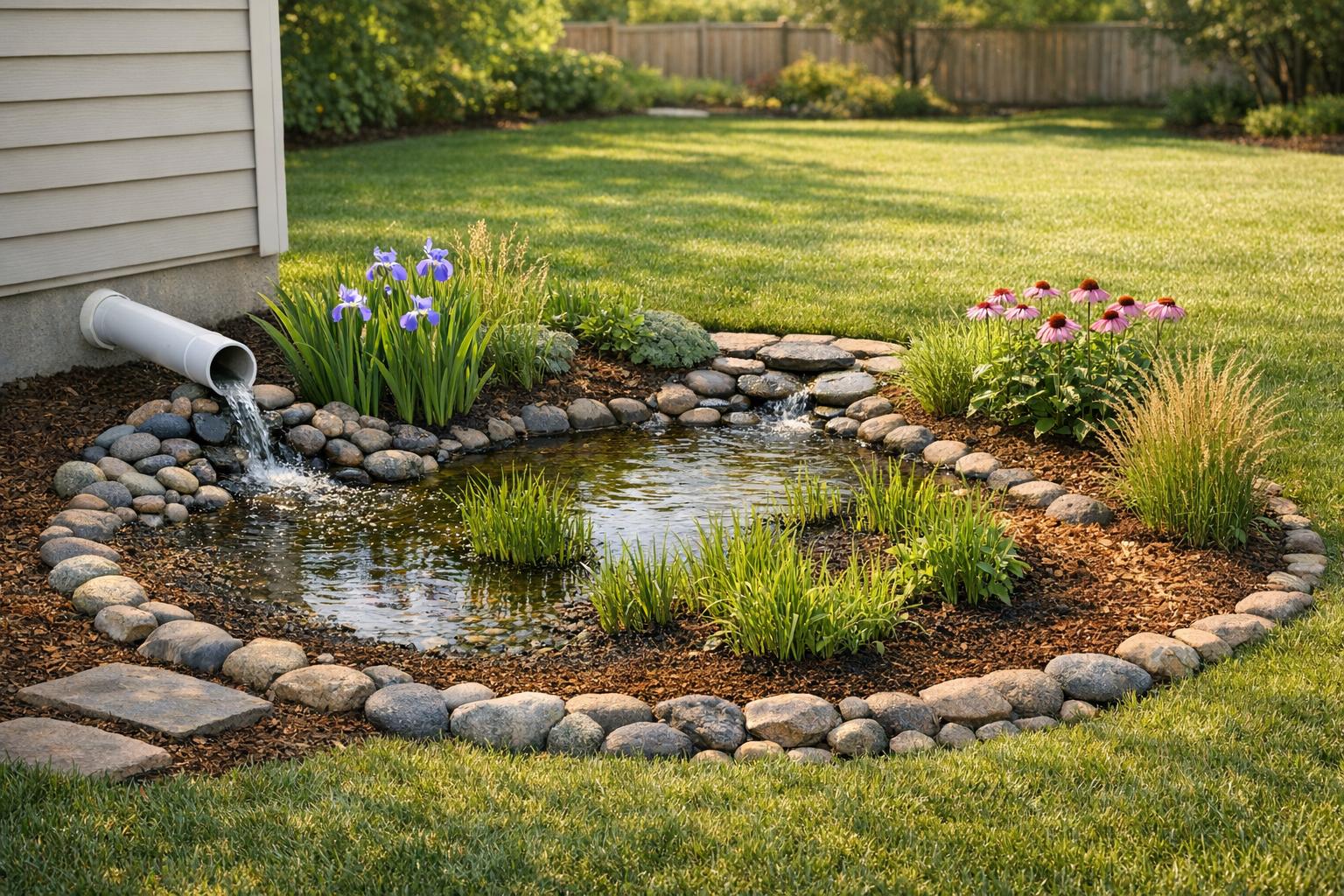
- bhavya gada
- No Comments
Struggling with soggy lawns or driveway streams from your sump pump? A rain garden can solve these issues while beautifying your yard and supporting local wildlife. Here’s what you need to know:
- What is it? A rain garden is a shallow, landscaped area designed to absorb and filter stormwater runoff, including sump pump discharge.
- Why use it? It prevents yard flooding, reduces pollution, recharges groundwater, and can even qualify for rebates (e.g., $10/sq. ft. in Montgomery County, MD).
- How to start: Choose a well-drained site, test soil (1–3 inches per hour absorption), and size it based on your drainage area (e.g., 200 sq. ft. for a 600 sq. ft. roof).
- Design tips: Route sump pump water with a pipe, ensure proper soil preparation, and include overflow solutions for heavy rains.
- Plant selection: Use native plants suited for wet, moist, and dry zones to create a balanced ecosystem.
A properly designed rain garden not only manages water efficiently but also enhances your outdoor space with minimal maintenance. Ready to transform your yard? Keep reading for step-by-step guidance.
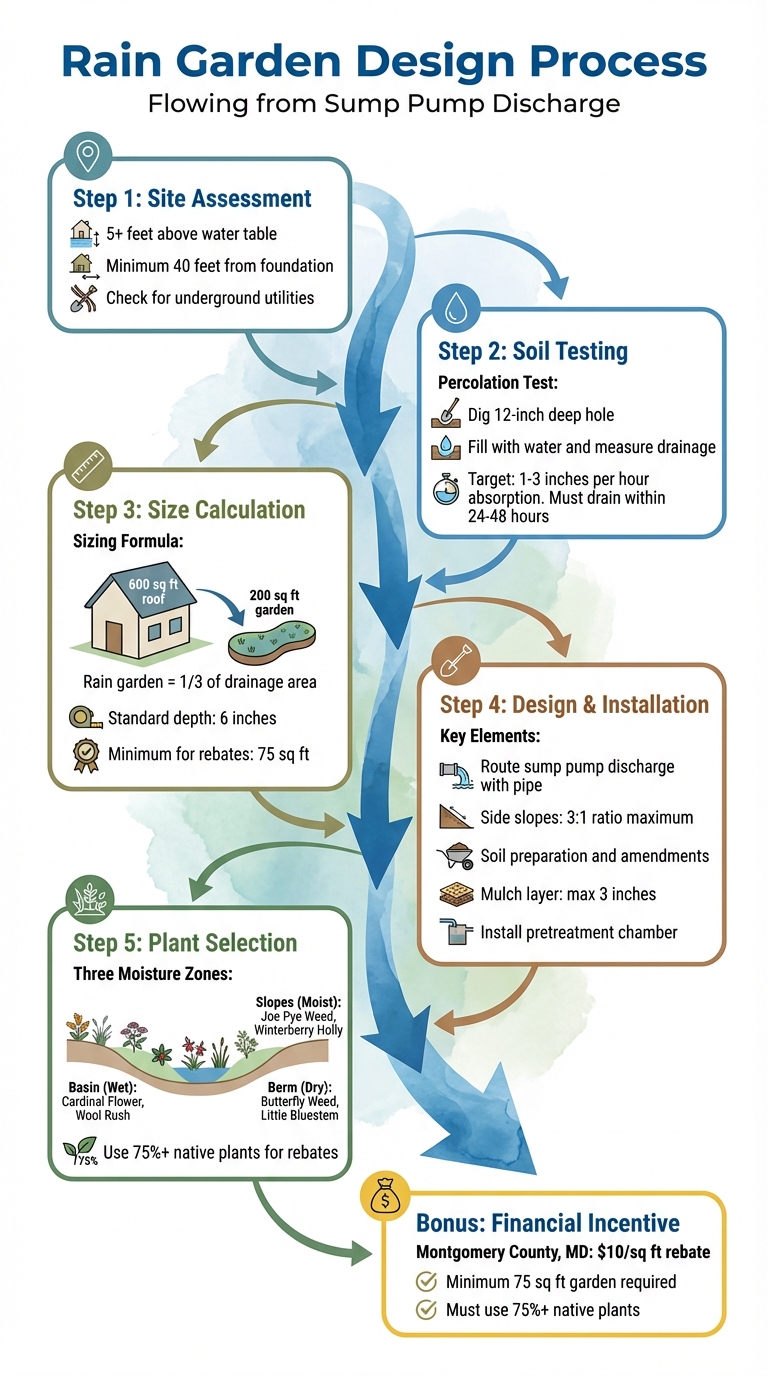
Rain Garden Design Process: 5 Steps from Assessment to Installation
Site Assessment and Planning
Before starting your rain garden project, it’s important to evaluate your site to ensure it has the right location, proper soil drainage, and an appropriate size.
Choosing the Right Location
Place your rain garden where it can efficiently capture sump pump discharge with minimal piping. Make sure the bottom of the garden is at least 5 feet above the local water table [3]. Before digging, check for underground utilities by contacting local services. Also, confirm that your sump pump discharges intermittently rather than constantly. Continuous discharge can lead to overly wet conditions, which may result in unpleasant odors and attract mosquitoes [3].
Testing Soil Drainage
To determine if the soil at your site can handle a rain garden, perform a percolation test (commonly called a "perc test"). Here’s how:
- Dig a hole about 12 inches deep in the proposed area.
- Fill the hole with water.
- Measure how quickly the water drains.
For a rain garden to function properly, the soil should absorb water at a rate of 1 to 3 inches per hour [3].
"A well-designed rain garden should drain within 24 to 48 hours and typically does not require engineered underdrains." – University of Maryland Extension [1]
If water remains stagnant longer than 48 hours, consider amending the soil with a more porous material or selecting a different site [1][2].
Once you’ve confirmed the soil’s drainage capabilities, you can move on to determining the size of your rain garden.
Sizing Your Rain Garden
The size of your rain garden depends on the volume of water it needs to manage. For sump pump discharge systems, the garden should be about one-third the size of the contributing drainage area [5]. For instance, if your sump pump collects water from a 600-square-foot roof, your rain garden should cover roughly 200 square feet.
Residential rain gardens typically use a 6-inch ponding depth, which allows temporary water storage that drains within 24 to 48 hours [2]. In Montgomery County, MD, gardens must be at least 75 square feet to qualify for the RainScapes Rewards Rebate, which offers $10 per square foot [2].
To calculate your drainage area, measure the square footage of roof sections connected to your sump pump via downspouts. If your sump pump primarily handles groundwater, observe the discharge volume during heavy rainfall to estimate the effective drainage area [5]. You can also use tools like Montgomery County’s "Rain Garden Sizing Estimator" to confirm your garden’s dimensions and ensure eligibility for rebates [2].
sbb-itb-843f8be
Rain Garden Design
Once you’ve chosen the right spot and size for your rain garden, it’s time to design it to handle water from your sump pump effectively. A rain garden is essentially a shallow, planted depression that captures and absorbs water, helping to reduce erosion and manage runoff. Below, we’ll dive into how to guide water into the garden, prepare the soil, and handle overflow to ensure everything works as it should.
Routing Water from Sump Pump to Rain Garden
To keep your rain garden functioning smoothly, water needs to flow into it in a controlled way. Start by running a discharge pipe from your sump pump outlet to the garden’s edge. Make sure the pipe is sized to handle the highest discharge rates. If your yard has a slope, use that natural grade to guide the water. Adding a retaining wall to the back of the garden not only looks good but also increases storage space. For every foot of wall height, you gain an extra three feet of garden bottom area, effectively doubling the storage compared to a simple slope.
In flat yards, you’ll need to create a gentle slope or use piping to channel water into the rain garden. Make sure the side slopes are no steeper than a 3:1 ratio to prevent erosion. Before connecting your sump pump discharge, install a pretreatment chamber to catch debris and avoid clogging the system [3].
Soil Preparation and Layering
Once water routing is sorted, the next step is preparing the soil. The type of soil in your rain garden has a big impact on how well it absorbs water and supports plants. If a percolation test shows that water infiltration is too slow, you’ll need to amend the soil. Loosening compacted soil can also improve water movement [3].
As noted by the University of Maryland Extension:
"The soil media can be amended to increase the garden’s water holding and infiltration capacity." [1]
After digging out the area, add amended soil to improve infiltration. Top it off with no more than 3 inches of mulch to help retain moisture and keep water flowing properly [3].
Managing Drainage and Overflow
Even with a great design, heavy rain or constant sump pump discharge can overwhelm your rain garden. If you’re dealing with a shallow water table or poor infiltration, consider installing an underdrain with a control system. This will help regulate how quickly water drains and prevent standing water, which can cause odors or attract mosquitoes.
For most gardens where the water table is at least five feet below the surface, natural infiltration should handle the majority of discharge. However, if your sump pump runs continuously, the garden might not have enough time to dry out. In that case, you might need to expand the garden or redirect some of the water to a secondary location to allow for occasional dry periods [3]. These adjustments will help your rain garden manage water efficiently while protecting your yard and improving water quality.
Plant Selection for Maryland Rain Gardens
Native Plants for Different Moisture Zones
When designing a rain garden, choosing the right plants for each moisture zone is key. The discharge from sump pumps or heavy rain can keep certain areas saturated longer, so it’s important to pick plants that can handle varying conditions[3].
"Rain gardens are planted with native plants that can tolerate both wet and dry conditions"[1].
Rain gardens typically have three moisture zones:
- Basin (Wet Zone): This is where water collects directly. Opt for obligate wetland plants like Cardinal Flower (Lobelia cardinalis) or Wool Rush (Scirpus cyperinus)[6].
- Slopes (Moist Zone): These areas are wet during heavy rains but drain quickly. Plants such as Joe Pye Weed (Eutrochium spp.) and Winterberry Holly (Ilex verticillata) work well here[6].
- Berm (Dry Zone): The driest part of the garden, where drought-tolerant species like Butterfly Weed (Asclepias tuberosa) and Little Bluestem (Schizachyrium scoparium) thrive[6].
Native plants are a smart choice because their deep roots enhance water infiltration, and many act as keystone species, providing food and habitat for pollinators and wildlife[3]. Selecting plants native to Maryland’s ecoregions, like the Piedmont, ensures they are well-suited to the local soil and climate[6].
Below is a quick comparison of native plants based on their moisture tolerance and other traits.
Native Plant Comparison Table
| Plant Name | Type | Water Tolerance | Height | Wildlife Value |
|---|---|---|---|---|
| Cardinal Flower (Lobelia cardinalis) | Wildflower | High (Wet Zone) | 2–4 feet | Hummingbirds, Butterflies |
| Wool Rush (Scirpus cyperinus) | Grass/Sedge | High (Wet Zone) | 3–5 feet | Bird and amphibian cover |
| Joe Pye Weed (Eutrochium spp.) | Wildflower | High (Moist Zone) | 4–7 feet | Bees, Butterflies |
| Rosemallow (Hibiscus moscheutos) | Wildflower | High (Wet Zone) | 3–6 feet | Specialist bees |
| Winterberry Holly (Ilex verticillata) | Shrub | Moderate (Moist Zone) | 6–10 feet | Critical winter bird food |
| Virginia Sweetspire (Itea virginica) | Shrub | Moderate (Moist Zone) | 3–5 feet | Pollinators, nesting habitat |
| Black-Eyed Susan (Rudbeckia hirta) | Wildflower | Moderate (Moist Zone) | 1–3 feet | Generalist pollinators |
| Wild Bergamot (Monarda fistulosa) | Wildflower | Moderate (Moist Zone) | 2–4 feet | Bees, Butterflies, Moths |
| Butterfly Weed (Asclepias tuberosa) | Wildflower | Low (Dry/Edge) | 1–2 feet | Monarch butterfly host |
| Little Bluestem (Schizachyrium scoparium) | Grass | Low (Dry/Edge) | 2–4 feet | Larval host for skippers |
Spring or early summer is the ideal time to plant your rain garden, giving the plants a chance to establish themselves before winter arrives[3]. For the best results, combine groundcovers, wildflowers, shrubs, and grasses to create a layered habitat that supports a wide range of wildlife. Avoid using invasive ornamental plants, as they can harm local ecosystems[7].
Installation and Maintenance
Installation Steps
Start by evaluating your site and conducting a percolation test to ensure the soil can absorb water within 24–48 hours [2]. This is a crucial step – if the soil fails the test, you’ll need to improve it or select a different location.
Excavate a 6-inch deep depression, but avoid using heavy machinery as it can compact the soil and reduce its ability to absorb water [2][3]. If the soil drains too slowly, try loosening it with a 4-foot auger [3].
To prepare the area, create a spongy, absorbent soil base capable of managing the water volume from your sump pump [2]. Once planting is complete, apply a mulch layer no thicker than 3 inches [3]. The ideal time to install your rain garden is in spring or early summer, giving plants a chance to establish strong roots before winter [3]. Make sure the sump pump discharge point is positioned at least 40 feet away from your home’s foundation to avoid water recycling back into your basement [4].
After installation, regular upkeep is necessary to keep your rain garden functioning properly.
Maintenance Requirements
A properly maintained rain garden should drain within 24–48 hours. If water lingers longer, it can attract mosquitoes and produce unpleasant odors [2]. After each rain, clean out the pretreatment chambers to ensure the garden is ready for the next storm [3]. Remove any sediment that makes it past the pretreatment area to avoid clogging [3].
"Stay on top of weeding. Err on the side of pulling too much."
Reapply the mulch layer every two years [3]. During the fall, clear away excess leaves – while a few can provide habitat, thick layers can slow water absorption [3]. After about a decade, consider hiring professionals to refresh the garden. This process might include removing built-up sediment, power washing hardscapes, and replacing or salvaging mature plants [3]. If you’re in Montgomery County, MD, maintaining a rain garden with at least 75 square feet and 75% native plants could earn you a rebate of $10 per square foot through the RainScapes Rewards program [2].
Conclusion
When designing a rain garden for sump pump discharge, ensure it drains within 24–48 hours to avoid mosquito breeding and unpleasant odors. A proper percolation test is key, confirming that the soil absorbs water at a rate of 1–3 inches per hour with a water table at least 5 feet below the surface.
In Maryland, incorporating at least 75% native plants into your rain garden has multiple benefits. These plants develop deep roots, improve water infiltration, support local pollinators, and help you qualify for Montgomery County’s RainScapes Rewards program, which offers $10 per square foot for projects covering 75 square feet or more [2].
The Anoka Conservation District explains, "Properly functioning rain gardens often go unnoticed because they blend in with other landscape amenities" [3]. Barbara adds, "While professionals can assess a property’s viability, only the homeowner can decide if they are ready for ongoing rain garden maintenance" [3].
For those who prefer expert assistance, professional services can ensure your rain garden is designed and executed with precision.
Working with Pro Landscapes MD

Pro Landscapes MD specializes in creating sustainable rain garden solutions throughout central Maryland, serving areas like Montgomery County, Howard County, Carroll County, Frederick County, Prince George’s County, and Baltimore County. Their expertise extends to stormwater management, grading, land leveling, and drainage installation to handle sump pump discharge effectively.
With a team of experienced horticulturists, Pro Landscapes MD can conduct detailed soil borings and percolation tests to determine site suitability. They handle every step, from soil preparation and layering to installing pretreatment chambers for debris filtration. Their selection of native plants ensures compatibility with Maryland’s ecosystem, while their landscape design services seamlessly integrate your rain garden into your outdoor space, meeting both aesthetic and functional needs.
FAQs
Will a rain garden work if my sump pump runs a lot?
A rain garden can be a helpful way to manage sump pump discharge when designed correctly. Its success, however, hinges on the amount of water being pumped and how often the pump runs. If your sump pump operates frequently or deals with large volumes of water, a rain garden by itself might not suffice. In such cases, you may need to explore additional drainage options to avoid overflow or soggy conditions.
How far should a rain garden be from my house?
Place your rain garden at least 10 feet away from your house. This distance helps protect your foundation from water damage and ensures the garden can handle sump pump discharge without causing drainage issues.
Do I need an underdrain for sump pump discharge?
When managing sump pump discharge with a rain garden, an underdrain is typically not needed – provided the garden drains within 24 to 48 hours. However, it’s important to include a pipe to ensure water doesn’t flow back into the system.
Chat with Us