









- bhavya gada
- No Comments
Rainwater tanks can last anywhere from 10 to over 30 years, depending on their material, installation, and maintenance. Here’s a quick breakdown:
- Concrete tanks: 20–30+ years, especially underground. Durable but heavy and costly to replace.
- Polyethylene tanks: 10–20 years, extendable to 25–30 years with UV-stabilized models and proper care.
- Stainless steel tanks: 20–30+ years. Resistant to corrosion and easy to repair.
- Corrugated steel tanks: Often exceed 30 years but require regular upkeep to prevent rust.
Key factors affecting lifespan include material choice, installation quality, environmental conditions, and regular maintenance. Proper care, such as keeping tanks shaded, inspecting for damage, and cleaning sediment, can significantly extend their usability. Choose the right tank for your needs and maintain it well to ensure decades of reliable service.
FAQs About Steel Water Tanks: Drinking Safety, Coastal Use & Best Practices
sbb-itb-843f8be
How Long Different Tank Materials Last
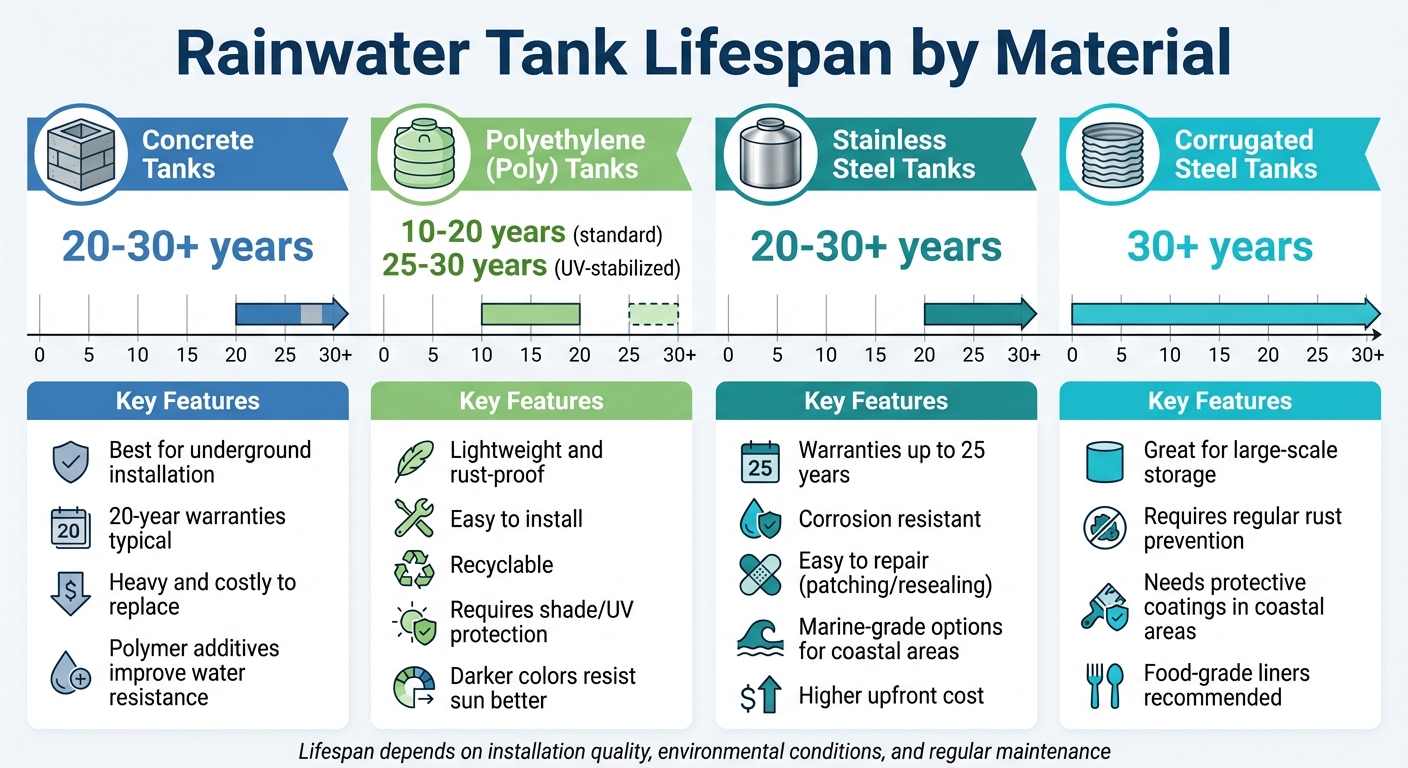
Rainwater Tank Lifespan Comparison by Material Type
The material your tank is made of plays a big role in how long it will last. Each type has its own strengths and weaknesses, making it better suited for certain uses.
Concrete Tanks
Concrete tanks can last 20 to 30 years or more, especially when installed underground due to their durability [1]. Their thick walls provide strong structural support, and many come with warranties of about 20 years. Modern versions often include polymer additives, which improve water resistance and extend their lifespan. However, they’re heavy, expensive, and challenging to replace once installed.
Polyethylene (Poly) Tanks
Poly tanks generally last 10 to 20 years, but UV-stabilized models can stretch that to 25 to 30 years under the right conditions [1][2]. These tanks are lightweight, rust-proof, and simple to install, making them a popular choice for residential use. To avoid UV damage, keep them out of direct sunlight or opt for darker colors that resist sun exposure better. At the end of their life, poly tanks are recyclable, adding an eco-friendly edge.
Stainless Steel Tanks
Stainless steel tanks are built to last 20 to 30+ years, with many warranties covering up to 25 years [1]. They resist corrosion and are easy to repair if leaks occur, often by patching or resealing. For areas near the coast, marine-grade components can help protect against salt-air corrosion. While they cost more upfront, their durability and minimal maintenance make them a solid long-term investment.
Corrugated Steel Tanks
Corrugated steel tanks often exceed 30 years of service life [2]. They’re a great choice for large-scale water storage but require regular upkeep to prevent rust, especially in coastal environments. Adding protective coatings or food-grade liners can help maintain water quality and shield the metal from corrosion.
What Affects Rainwater Tank Durability
Maximizing your rainwater tank’s lifespan involves understanding how installation, environmental factors, and maintenance play a role. Even the highest-quality tanks can fall short of their potential if these elements are overlooked. Knowing what to watch for can help you protect your investment and avoid unnecessary expenses.
Installation Quality
A full water tank is incredibly heavy, placing immense pressure on its base and walls. If the ground beneath it isn’t stable, the tank can sag or twist, creating stress points that may lead to cracks or leaks [1]. Underground tanks face additional challenges – poor drainage or unstable soil can exert external pressure, increasing the risk of collapse or cracking.
To avoid these issues, always set your tank on a level, compacted base, such as reinforced concrete or properly prepared crusher dust. For large or buried tanks, hiring experienced professionals is essential [1]. Beyond the initial setup, external factors also play a critical role in how long your tank lasts.
Environmental Conditions
The environment surrounding your tank can significantly impact its durability. For example, prolonged UV exposure can weaken polyethylene tanks, making them brittle over time [1]. Sunlight also promotes the growth of bacteria and algae inside the tank [2]. If you live near the coast, salt-laden air can speed up corrosion in steel tanks and degrade metal fittings faster than in inland areas [1][2].
To combat these risks, consider positioning your tank in shaded areas, such as behind buildings or fences, to limit UV exposure [1]. For coastal regions, using marine-grade stainless steel components or applying protective coatings to metal tanks can help. Opting for darker-colored tanks may also provide some added UV resistance [1].
Maintenance and Cleaning
Proper maintenance is just as important as good installation and environmental precautions. Regular inspections can help you catch small cracks or leaks before they escalate into major problems. Keeping gutters and leaf screens clean prevents sediment from accumulating in the tank, which helps maintain water quality and protects the tank’s interior surfaces [1].
It’s also crucial to ensure that the tank stays level. Uneven settling can cause twisting or sagging, eventually leading to structural damage. Smart monitoring systems that track water levels in real time can alert you to sudden drops, signaling potential leaks that need immediate attention. Additionally, inspect all pipework and fittings periodically to address any developing issues [1].
Water Quality
The quality of the water stored in your tank plays a big role in its longevity. Clean rainwater is far gentler on the tank and its fittings compared to saltwater or chemical-laden liquids, which can accelerate internal corrosion and wear [1][2]. Keeping debris out of your collection system ensures that the water entering the tank remains as clean as possible, reducing the likelihood of internal damage over time [1][2].
How to Extend Your Rainwater Tank’s Lifespan
Taking care of your rainwater tank through regular upkeep can make a big difference in how long it lasts.
Regular Inspections and Repairs
Make it a habit to inspect your tank at least once a year – better yet, every six months [4]. During these inspections, look closely at the tank walls for cracks or corrosion, check for leaks in the fittings, and ensure gutters and leaf screens are secure [1]. Don’t forget to clear vegetation around the foundation and inspect the area for stability [3]. To keep pests like insects, birds, and small animals out, confirm that vents and overflows are covered with fine mesh screens [3][4].
"Storage tank maintenance is like any other kind of maintenance. There are best practices you should follow and bad practices to avoid." – Pittsburg Tank & Tower Group [3]
Avoid makeshift solutions like wooden stakes or DIY fixes. For any necessary repairs, it’s best to call in a professional [3]. Keeping a detailed maintenance log, including blueprints, inspection notes, and repair records, can help you monitor your tank’s condition over time [3].
After completing your inspection, plan a cleaning session to remove any sediment buildup.
Cleaning and Sediment Removal
Coordinate cleaning with inspections to minimize the hassle of draining the tank multiple times [3]. Start by siphoning out any sediment that has built up at the bottom, then flush and disinfect the tank with a 20 mg/L chlorine solution. Let the solution sit for several hours or overnight to thoroughly clean the system [4]. This process not only helps prevent algae growth but also protects the tank’s interior surfaces and keeps your water quality intact.
In addition to cleaning, taking steps to shield your tank from environmental factors can help it last even longer.
Protecting Tanks from UV and Weather
If you have a polyethylene tank, keeping it out of direct sunlight is key. Place the tank in a shaded area and choose UV-resistant materials to minimize sun damage [1][2]. Some darker-colored tanks may offer extra UV protection, depending on their resin makeup [1]. For metal tanks in coastal regions, use marine-grade stainless steel fittings and apply protective coatings to guard against salt-laden air [1][2].
"Positioning the tank in a cool, shady place will reduce the problem and extend the lifespan of the tank." – Enduramaxx [2]
Summary
Choosing the Right Tank
Selecting the right tank material plays a big role in how long your tank will last. Concrete tanks are a solid choice for underground or large-scale permanent setups, often lasting 20–30 years or more[1]. Polyethylene tanks, while lighter and easier to handle, generally last 10–20 years, though in ideal conditions, they can reach up to 25–30 years[1][2]. Stainless steel tanks also offer durability, with a lifespan of 20–30+ years, and they’re easier to repair through patching and resealing[1].
Placement matters just as much as material. For polyethylene tanks, positioning them in natural shade – like next to buildings or fences – helps limit UV damage[1][2]. In coastal areas, where salt air can be harsh, using marine-grade stainless steel components and applying protective coatings can shield steel tanks from corrosion[1][2]. Always install your tank on a stable, level base to avoid stress cracks[1]. Adding smart tank level indicators can also help you detect leaks or unusual usage patterns early on[1].
While material and placement are key, proper upkeep is what ensures your tank performs well for decades.
Maintaining Tanks for Long-Term Use
Even the toughest tanks need regular care to stay in good shape. Scheduling professional cleanings every 1–3 years can help clear out sediment and organic debris that might harm the tank or its pump[5]. Keeping gutters clean every 2–3 months and trimming overhanging branches reduces the amount of debris entering your system[5][6]. Installing a first flush diverter is another great way to cut down on sediment and prevent corrosion[6].
"Investing a little time and effort now helps you enjoy a reliable supply of high-quality water and can extend your tank’s life by many years." – Chris Balogh, CCWT[6]
For steel tanks, hosing off leaves and debris is essential to stop moisture buildup and rust[6]. Fixing leaks as soon as they appear is also crucial – especially since stainless steel tanks can be patched and resealed to extend their lifespan[1]. By combining smart material choices, thoughtful placement, and consistent maintenance, your rainwater tank can provide reliable service for decades.
FAQs
How do I know when my rainwater tank needs replacing?
If your rainwater tank shows major problems like leaks, rust, or structural damage, it’s likely time for a replacement. The lifespan of a tank largely depends on its material. Polyethylene tanks usually last around 10-20 years, while concrete or stainless steel tanks can hold up for 20-30 years – provided they’re well-maintained and exposed to suitable environmental conditions.
What’s the best base to prevent a tank from cracking or settling?
A concrete base works best to prevent a tank from cracking or settling. It offers a stable, level surface that evenly distributes the tank’s weight, minimizing stress on the structure and promoting durability over time.
How often should I clean my rainwater tank?
To keep your rainwater tank in good shape and maintain water quality, it’s important to give it a thorough cleaning at least once a year. This routine helps prevent debris buildup and algae growth, ensuring the water remains safe for use. Regular maintenance like this goes a long way in preserving both the tank and the water inside.
Chat with Us