









- bhavya gada
- No Comments
Retaining walls can fail without proper drainage, especially in Maryland’s wet, clay-heavy soil and freeze-thaw conditions. Here’s what you need to know:
- Hydrostatic Pressure: Water buildup behind walls increases lateral force by 2-3x, leading to cracks or collapse.
- Drainage Solutions: French drains, weep holes, and geotextile fabric are essential to channel water away.
- Wall Types:
- Cantilever Walls: Use reinforced concrete, weep holes, and French drains for durability.
- Gravity Walls: Rely on mass and perforated pipes to resist pressure.
- Segmental Walls: Combine interlocking blocks, geogrid reinforcement, and drain strips for flexibility.
- Flood Walls: Use sheet pile cutoffs and water stops for maximum water resistance.
- Maintenance: Regularly clear debris from weep holes and drainage outlets to prevent clogs.
Proper design and upkeep ensure retaining walls last decades, even in Maryland’s challenging climate.
Essential Drainage Methods to Prevent Retaining Wall Failure
1. Cantilever Retaining Walls with Weep Holes and French Drains
Cantilever retaining walls are built with an inverted T-shape, relying on a reinforced concrete base to counteract the weight of soil pressing against the vertical section. Adding weep holes and French drains to this design is essential for managing the biggest challenge these walls face: water buildup behind the structure.
Drainage Integration
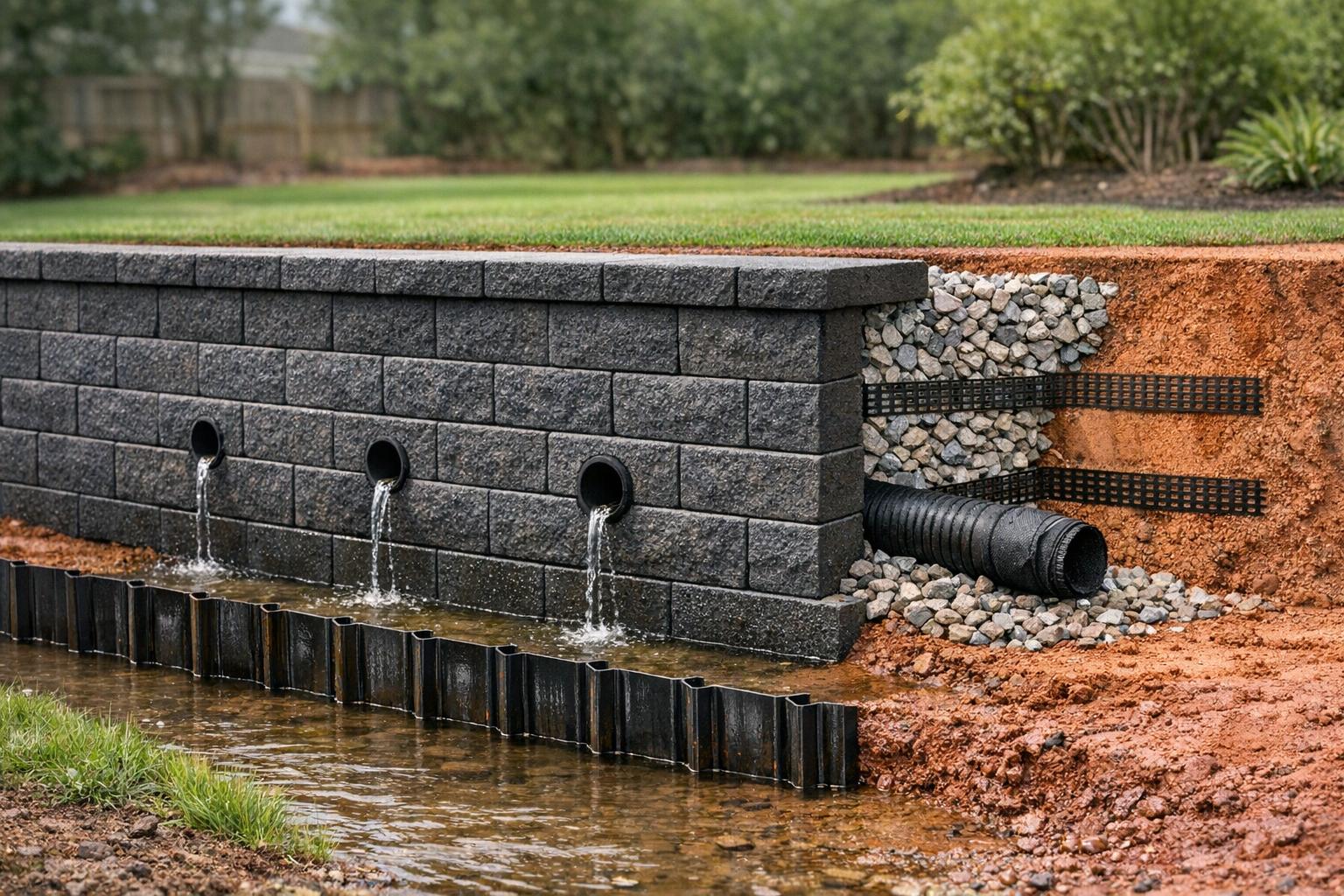
At the heart of this system is a French drain, which consists of a 4-inch perforated pipe buried in clean, angular gravel at the base of the wall. This pipe collects groundwater and directs it away, preventing the soil behind the wall from becoming oversaturated. To ensure proper water flow, the pipe must be installed with a 1–2% slope, guiding water to a safe outlet such as a storm drain, dry creek bed, or another low-lying area [1].
Weep holes complement the French drain by providing an outlet for water that accumulates directly behind the wall. Typically, these openings are 2 to 4 inches in diameter and spaced 6 to 10 feet apart, depending on the wall’s height [1]. To prevent clogging, a geotextile filter fabric is wrapped around the gravel backfill, keeping soil particles out of the drainage system. Together, these features are crucial for ensuring the wall’s durability, particularly in Maryland’s challenging weather.
Flood Resistance in Maryland Climate
During heavy storms, saturated soil can exert double or even triple the lateral pressure on a retaining wall [1]. French drains address this by channeling water away before it can build up and create excessive pressure.
By maintaining consistent drainage, these systems also reduce the risk of freeze-thaw damage, which can lead to cracks and other structural problems over time.
Cost and Maintenance
While installing French drains and weep holes may add to the initial cost, they prevent expensive repairs down the line. In fact, the International Building Code (IBC 2021, Section 1807) requires drainage systems for retaining walls, making them a necessity for code compliance [1].
Maintenance is simple but essential. After heavy storms, check for debris blocking weep holes and ensure water flows freely from drainage outlets. If water pools behind the wall or weep holes remain dry when they should be releasing moisture, the system may need professional cleaning to clear clogs. Regular upkeep not only keeps the drainage system functioning but also extends the wall’s lifespan.
Longevity and Durability
Proper drainage reduces hydrostatic pressure and prevents soil erosion, significantly increasing the wall’s durability. French drains and weep holes work together to stop erosion and prevent soil from acting like a liquid during intense rain.
In Maryland’s unpredictable weather, these systems shine by handling frequent storms and protecting against freeze-thaw cycles. The result? A wall that stays strong for decades instead of succumbing to damage in just a few years.
2. Gravity Retaining Walls with Perforated Pipe Drainage
Gravity retaining walls rely on their sheer mass to resist the pressure exerted by the soil they hold back. Unlike cantilever walls, which use reinforced concrete bases to provide stability, gravity walls achieve this through their weight alone. Typically constructed from stacked stone, concrete blocks, or poured concrete, these walls require effective drainage systems to reduce pressure build-up. A perforated pipe drainage system plays a crucial role in preventing hydrostatic pressure, which is one of the leading causes of retaining wall failure.
Drainage Integration
The drainage system for gravity walls includes familiar components like a 4-inch perforated pipe, angular gravel bed, a slight slope of 1–2%, and geotextile filter fabric. However, these elements are specifically tailored to meet the demands of gravity walls, which rely on mass-based resistance. Maryland’s clay-heavy soil, known for its slow drainage and water retention, increases backfill weight and pressure against the wall. Proper drainage collects and redirects subsurface water, preventing saturation that could compromise the wall’s stability [1]. This approach ensures that gravity walls perform reliably, even under Maryland’s challenging soil conditions.
Flood Resistance in Maryland Climate
Maryland’s frequent storms and freeze-thaw cycles present unique challenges for retaining walls. Saturated soil loses its shear strength, essentially behaving like liquid, which can double or even triple lateral loads beyond what the wall was designed to handle [1]. Additionally, water trapped behind the wall can freeze during winter, expanding and causing internal pressure that leads to cracking, bulging, or tilting [1][2]. A well-designed drainage system consistently diverts moisture away, protecting the wall from these seasonal stresses and reinforcing its ability to stand strong against Maryland’s climate.
Cost and Maintenance
While installing a perforated pipe drainage system adds to the initial expense, it prevents far greater costs associated with repairs or complete wall failure. Poor drainage is the most common reason retaining walls fail [1], and both the International Building Code (IBC 2021, Section 1807) and the American Concrete Institute (ACI 318) mandate drainage provisions [1]. Regular maintenance is key – after heavy rain, ensure water flows freely from the pipe outlet, check for debris at the discharge point, and confirm that downspout extensions direct roof water far from the backfill [2]. These simple steps can prevent immediate damage and extend the wall’s lifespan.
Longevity and Durability
By keeping soil saturation under control, gravity walls endure less stress, significantly increasing their longevity. When professionally installed and maintained, these walls – combined with perforated pipe drainage systems – can protect Maryland properties for decades [2]. By diverting water away from the wall’s base, the system prevents excessive lateral loads that could compromise its structural integrity [1].
3. Segmental Retaining Walls with Geogrid Reinforcement and Drain Strips
Segmental retaining walls are built using interlocking concrete blocks stacked without mortar, creating a flexible structure that can handle minor ground shifts. When paired with geogrid reinforcement – synthetic mesh layers placed within the backfill – the wall gains added strength to support more soil. Adding drain strips, or geocomposite drainage panels, completes the system by efficiently directing water away from the wall. This is especially important in Maryland, where clay-heavy soils and fluctuating weather conditions can pose significant challenges. Like cantilever and gravity walls, these systems rely on effective drainage to handle the state’s unique soil and weather conditions.
Drainage Integration
Drain strips combine a rigid drainage core with a permeable filter fabric, allowing water to flow while keeping fine soil particles from clogging the system. In tight spaces where traditional 12-inch gravel backfill layers are impractical, these strips ensure proper drainage without compromising the wall’s stability. This prevents voids from forming, which could otherwise weaken the wall’s base [1].
Flood Resistance in Maryland Climate
Maryland’s frequent storms can leave soil saturated, reducing its cohesion and causing it to behave almost like liquid. Integrated drainage systems help keep the backfill dry, preserving the wall’s stability even during intense freeze-thaw cycles. This is critical for minimizing damage caused by waterlogged soil and temperature fluctuations.
Cost and Maintenance
While geocomposite drain strips may come with a higher initial cost, they save money in the long run by preventing costly repairs. Proper drainage reduces hydrostatic pressure, which can otherwise weaken the wall over time. Additionally, building codes mandate drainage systems for retaining walls, making this an essential feature. To ensure continued performance, inspect the geocomposite panels after heavy rainfall to clear any debris that may block drainage paths.
Longevity and Durability
By managing moisture effectively, segmental retaining walls with integrated drainage systems combat issues like freeze-thaw damage, mold, and rust. This reduces soil movement and lateral pressure, protecting the wall from Maryland’s harsh freeze-thaw cycles. These systems are built to maintain soil stability and structural integrity for decades. Pro Landscapes MD installs these advanced solutions to deliver long-lasting protection and performance across Maryland.
sbb-itb-843f8be
4. Flood Walls with Sheet Pile Cutoffs and Water Stops
Flood walls with sheet pile cutoffs take a different approach compared to traditional retaining walls. Instead of just holding back water, they aim to completely block its penetration. This makes them especially effective in Maryland, where the soil – often heavy in clay – drains slowly and retains water like a sponge. The sheet pile cutoff forms a continuous underground barrier, stopping water from seeping beneath the wall. To enhance this system, water stops are installed at the joints, creating a watertight seal that prevents leaks during heavy storms[2].
Drainage Integration
An efficient drainage system is a critical part of these flood walls. A 4-inch perforated pipe, laid at a slope of 1–2% and surrounded by angular gravel wrapped in geotextile fabric, ensures quick removal of subsurface water. Additionally, weep holes spaced every 6–10 feet help reduce water buildup. This setup not only strengthens the wall but also prevents water from undermining its foundation, which is crucial in Maryland’s challenging weather conditions.
Flood Resistance in Maryland Climate
Maryland’s climate poses unique challenges, including frequent freeze-thaw cycles and slow-draining soils that increase lateral pressure on structures. Flood walls with sheet pile cutoffs and water stops are designed to handle these stresses, preventing water infiltration and hydrostatic pressure buildup. For instance, in Annapolis – where nuisance flooding occurs over 50 times a year – these systems provide essential protection against recurring water damage[6]. By minimizing water-related stress, they reduce both maintenance demands and long-term costs.
Cost and Maintenance
Building flood walls with sheet pile cutoffs is a major investment. For example, in July 2022, the U.S. Army Corps of Engineers proposed a $138 million plan to construct flood walls around the I-95 and I-895 tunnel openings to safeguard critical infrastructure in Baltimore[4]. Similarly, the Annapolis City Dock flood prevention project, which includes barriers and a pumping station, is estimated to cost around $88 million[6]. Federal funding typically covers 65% of the design and construction costs, while state or local governments handle the remaining 35%[4]. Regular maintenance, such as clearing debris from drainage systems after storms, is essential to keep these walls functioning effectively.
Longevity and Durability
With proper care, these flood wall systems can last for decades. However, neglecting maintenance poses serious risks, including structural failures. Over time, issues like burrowing animals or seismic activity can compromise the integrity of water stops and cutoff walls[3][5]. In Maryland, where sea levels are expected to rise by at least 2 feet by 2050, these structures are often designed with future conditions in mind[6]. Pro Landscapes MD incorporates these advanced systems into their flood prevention strategies, providing reliable protection for properties in Maryland’s most flood-prone areas.
Advantages and Disadvantages
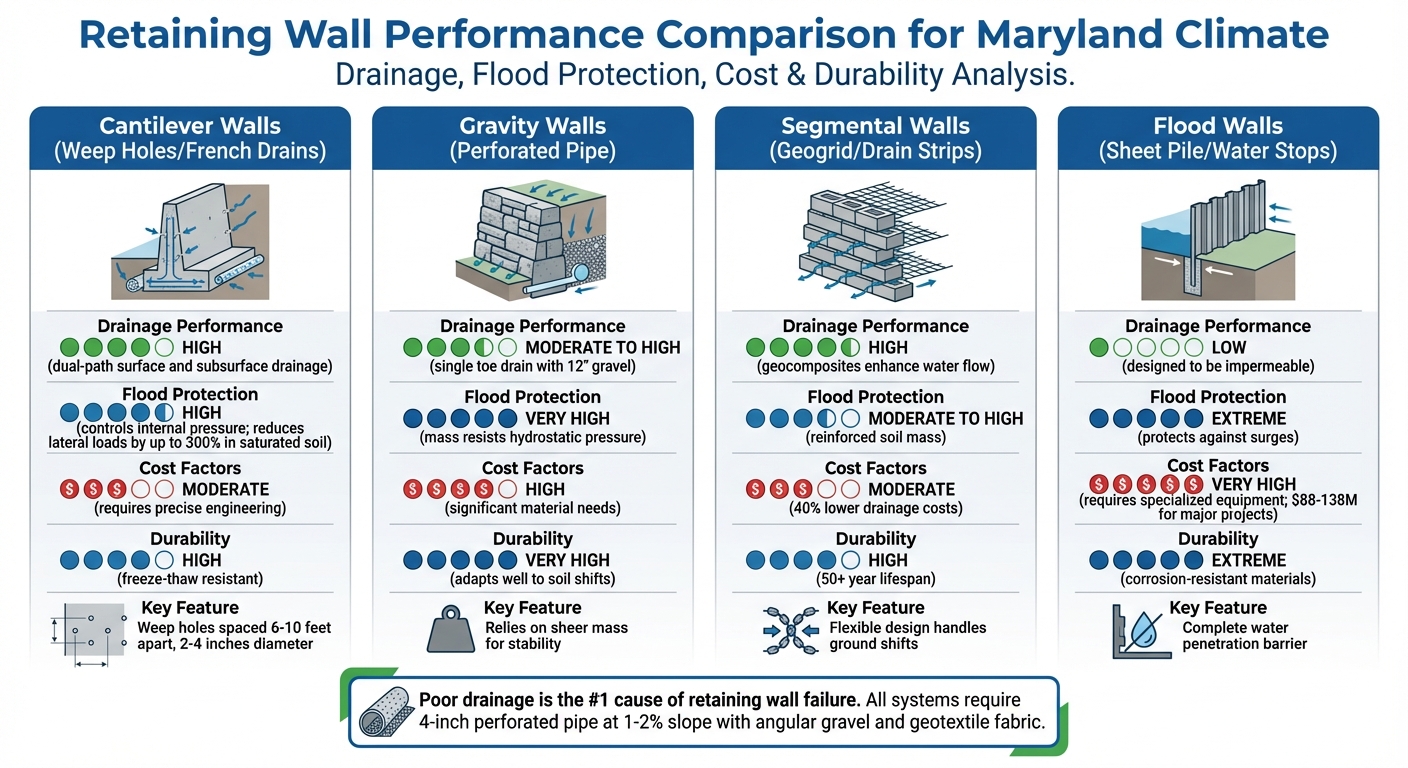
Retaining Wall Types Comparison: Drainage, Flood Protection, Cost & Durability
Here’s a breakdown of the performance of different retaining wall designs in Maryland’s challenging climate, emphasizing their drainage capabilities and other key factors.
Cantilever walls with French drains are excellent at handling hydrostatic pressure, which can increase lateral loads by as much as 300% in saturated soil [1]. However, their effectiveness depends heavily on regular maintenance – weep holes and drainage pipes must stay clear of debris to prevent dangerous pressure buildup [1].
Gravity walls rely on their sheer weight to counteract the high lateral pressures caused by Maryland’s dense, clay-heavy soils. They provide exceptional flood resistance without requiring intricate engineering. That said, their downside is the high cost of transporting and placing the large volumes of material they require.
Segmental retaining walls with geogrid reinforcement strike a middle ground. These systems use hollow core blocks filled with gravel, offering excellent vertical drainage and a reinforced soil structure that withstands freeze-thaw cycles effectively [9]. They’re also cost-effective, reducing drainage installation expenses by about 40% compared to traditional porous backfill methods [7], making them a popular choice for residential projects.
Flood walls with sheet pile cutoffs deliver top-tier flood protection but come with a hefty price tag. They need specialized equipment for installation and regular maintenance to ensure drainage systems remain functional after storms.
The table below provides a side-by-side comparison of these designs based on critical performance factors:
| Design Type | Drainage Performance | Flood Protection | Cost Factors | Durability |
|---|---|---|---|---|
| Cantilever (Weep Holes/French Drains) | High; dual-path surface and subsurface drainage | High; effectively controls internal pressure | Moderate; requires precise engineering | High; freeze-thaw resistant |
| Gravity (Perforated Pipe) | Moderate to High; single toe drain with 12" gravel | Very High; mass resists hydrostatic pressure | High; significant material needs | Very High; adapts well to soil shifts |
| Segmental (Geogrid/Drain Strips) | High; geocomposites enhance water flow | Moderate to High; reinforced soil mass | Moderate; 40% lower drainage costs with PCDS | High; 50+ year lifespan [8][9] |
| Flood Wall (Sheet Pile/Water Stops) | Low; designed to be impermeable | Extreme; protects against surges | Very High; requires specialized equipment | Extreme; uses corrosion-resistant materials |
Across all designs, drainage is the unsung hero. Experts agree that water is the leading cause of retaining wall failures, and without proper drainage – whether through weep holes, French drains, or perforated pipes – even the sturdiest walls can fail in Maryland’s harsh weather conditions [9].
Conclusion
The comparisons above highlight one clear takeaway: proper drainage is absolutely essential for the success of any retaining wall. In fact, poor drainage is the leading cause of retaining wall failure [1].
Both segmental walls with geogrid reinforcement and cantilever walls with French drains are effective solutions, provided they are designed to meet specific site requirements. Segmental walls are particularly useful in combating freeze–thaw cycles and managing drainage in clay-heavy soils. On the other hand, cantilever systems are better suited for sites where hydrostatic pressure is a major concern, though they require consistent upkeep to prevent debris from clogging weep holes and pipes. For areas at high risk of flooding, gravity and flood walls provide added protection, especially in regions like Maryland, where clay-heavy soils and freeze–thaw conditions demand extra durability.
Pro Landscapes MD offers expertise in retaining wall installation, drainage systems (including French drains), and maintenance tailored to Maryland’s unique climate and soil challenges. Serving areas across central Maryland, from Howard County to Baltimore County, they are well-versed in addressing the complications caused by clay-heavy soils and frequent storms.
The difference between a retaining wall that lasts and one that fails often comes down to proper installation. For example, using a 4-inch perforated pipe set at a 1–2% slope, combined with angular gravel and geotextile fabric, is a proven method for ensuring durability [1]. A professional assessment can help you design a retaining wall and drainage system that work together to protect your property from Maryland’s unpredictable weather.
FAQs
How can I tell if my retaining wall needs better drainage?
Signs of poor drainage in retaining walls include water pooling behind the wall, soil erosion, or cracks and bulging from hydrostatic pressure. These problems can compromise the wall’s strength over time. To address this, consider solutions like perforated pipes, weep holes, or gravel backfill. These methods help redirect water and keep the wall stable.
What type of retaining wall works best for clay soil and freeze-thaw cycles in Maryland?
Segmental block retaining walls are a solid choice for Maryland’s climate. They handle freeze-thaw cycles with ease and work well in clay soils, especially when combined with proper drainage systems. This pairing helps ensure the wall’s durability and long-term stability.
Do I need a permit or engineer for a flood-prevention retaining wall in Maryland?
Yes, in Maryland, you’ll likely need a permit – and possibly an engineer’s approval – to build a flood-prevention retaining wall. This is because local regulations prioritize proper drainage and structural stability to ensure the wall is both effective and safe.
Chat with Us