









- bhavya gada
- No Comments
Retrofitting stormwater filtration systems involves upgrading outdated or ineffective systems to improve water quality and manage runoff more effectively. This is especially important for properties in Maryland, where older systems often fail to meet modern standards, leading to flooding, erosion, and pollution. Here’s what you need to know:
- Why Retrofit?
Retrofitted systems reduce pollutants, improve drainage, and help meet Maryland’s strict stormwater regulations. Benefits include better water management, reduced property damage, and increased compliance. - Who Needs This?
Homeowners, property managers, and municipalities in urban/suburban Maryland with drainage issues or outdated systems. - Steps to Retrofit:
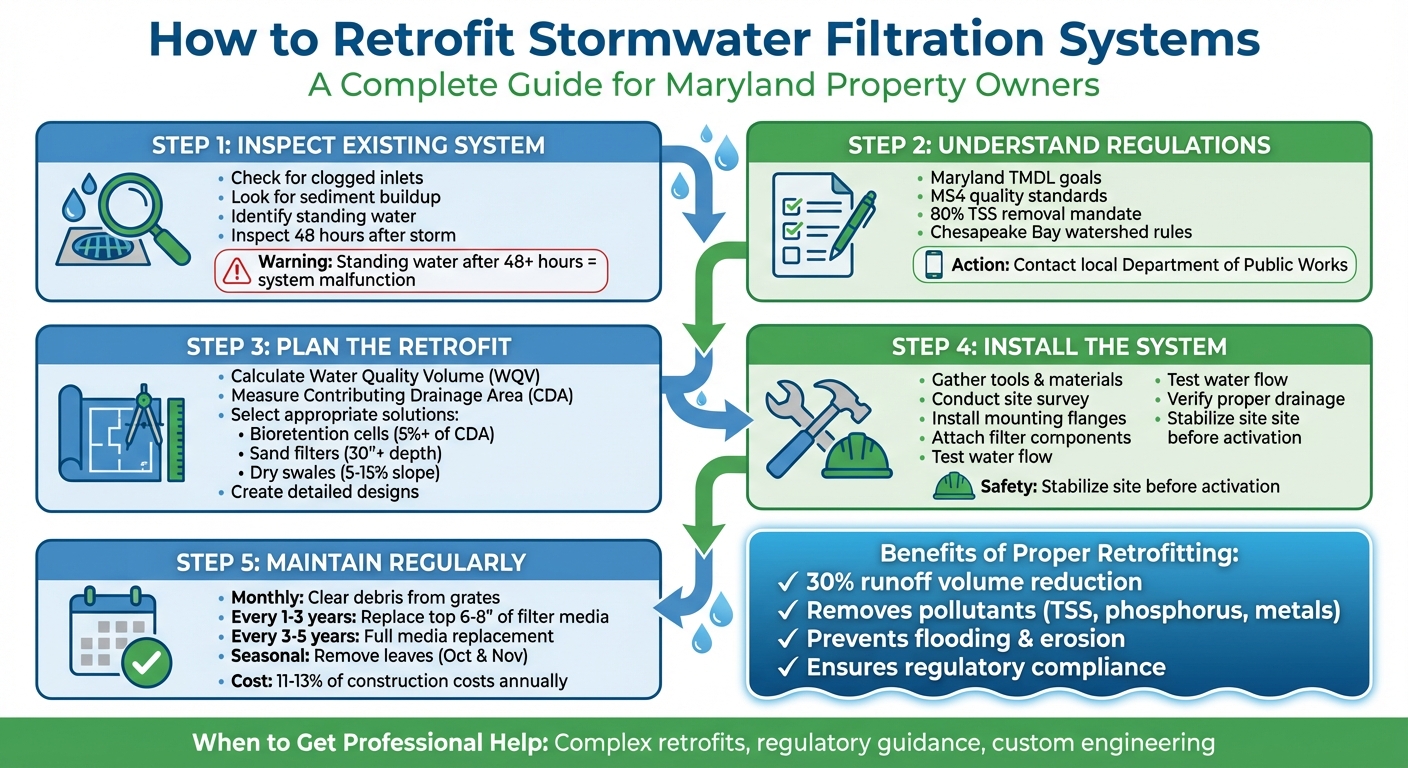
- Inspect Existing System: Look for clogged inlets, sediment buildup, or standing water.
- Understand Regulations: Ensure compliance with Maryland’s TMDL and MS4 standards.
- Plan the Retrofit: Calculate runoff volume, select appropriate solutions (e.g., bioretention cells, sand filters), and create detailed designs.
- Install the System: Follow proper installation steps, ensuring components are correctly placed and functional.
- Maintain Regularly: Clear debris, replace filter media, and monitor performance to avoid system failure.
- When to Seek Help:
For complex retrofits or regulatory guidance, professional services like Pro Landscapes MD can provide tailored solutions.
5 Steps to Retrofit Stormwater Filtration Systems in Maryland
Managing Stormwater with Basin Retrofits
sbb-itb-843f8be
Assessing Your Current Stormwater Filtration System
Evaluating your stormwater filtration system is a critical step in identifying failing components, addressing water quality issues, and ensuring compliance with regulations. A thorough assessment helps you focus on real problems, saving both time and money by avoiding unnecessary fixes.
Inspecting System Components
Begin with a detailed inspection of your system’s physical components. Pay close attention to filter media and cartridges, as these are key to pollutant removal. Look for signs of clogging, sediment buildup, or media that has lost its ability to absorb pollutants like hydrocarbons and nutrients[4]. Check catch basins, manholes, vaults, and curb inlets for cracks, settling, or visible deterioration.
Timing is important – inspect your system 48 hours after a significant storm. If water is still standing, it’s a clear sign of a malfunction. A.J. Erickson highlights this issue:
"If standing water is present in a filtration practice 48 or more hours after a storm event, the practice is not functioning as designed"[2].
A properly functioning system should filter its design volume within 48 hours or less[2].
Look for scum buildup inside structures, which can indicate frequent high-water levels and potential clogging[4]. If filter cartridges remain submerged between rain events, this suggests drainage issues[4]. For surface systems, check for fine sediment accumulation on the filter surface and assess vegetation health – areas with poor plant growth may signal prolonged water retention that exceeds what plants can tolerate[2]. Don’t forget to inspect internal peak flow conveyance components and emergency spillways to ensure they can handle storms larger than the system’s design capacity[2][4].
Understanding Maryland Regulatory Requirements
Once you’ve examined the physical components, confirm that your system complies with Maryland’s regulatory standards.
Maryland has tightened stormwater regulations, especially in the Chesapeake Bay watershed. Retrofitting projects must align with Total Maximum Daily Load (TMDL) goals and Municipal Separate Storm Sewer System (MS4) quality standards[3][1]. These rules aim to reduce pollutants like sediment, nitrogen, and phosphorus from entering local waterways.
Reach out to your local Department of Public Works or Environmental Resources to determine the specific requirements for your property. Many Maryland counties require permits for retrofits, and some may insist on professional engineering plans for larger projects. Understanding these requirements early can help you avoid delays and ensure your project meets legal standards. This step is especially important when assessing how deficiencies in your system impact compliance and overall performance.
Identifying Problem Areas
With both physical assessments and regulatory knowledge in hand, you can pinpoint areas where your system is underperforming.
Sediment buildup in basins and inlets often indicates inadequate upstream filtration. Standing water or ponding in areas that should drain within 48 hours suggests either clogged components or insufficient capacity.
Observe how water moves during and after rainfall. Identify where runoff collects, enters the system, and exits. Document problem areas with photos and measurements – this information will be invaluable when planning your retrofit and may also be required for permit applications.
Planning and Designing the Retrofit
Once you’ve pinpointed the problem areas, the next step is developing a tailored plan to address your system’s needs. This involves figuring out how much stormwater your system must manage, selecting the most effective filtration methods, and creating a detailed installation blueprint.
Calculating Water Quality Volume (WQV)
To determine how much runoff requires treatment, calculate the Water Quality Volume (WQV). This calculation is based on the first inch of rainfall over impervious surfaces.
Start by measuring your contributing drainage area (CDA) – the total impervious area feeding into your system. Use the formula: WQV = (CDA × 1 inch × Rv), where Rv (runoff coefficient) typically falls between 0.9 and 1.0 for impervious surfaces. Tools like site plans, surveys, or GIS can help you measure your CDA accurately. For example, a 2-acre parking lot that’s 90% impervious (78,408 square feet) would generate a WQV of about 6,534 cubic feet, or roughly 49,000 gallons [5][7].
Keep in mind that Maryland regulations often require treating the 1-year storm event, so ensure your calculations align with local MDE standards and TMDL goals [5][7]. Once you’ve determined your WQV, you can move on to selecting the retrofit solution that fits your site’s conditions.
Choosing the Right Retrofit Solutions
There are several retrofit options to consider, depending on your site’s characteristics:
- Sediment forebays: Ideal for areas with heavy sediment loads.
- Bioretention cells (rain gardens): Great for small urban spaces, but they should cover at least 5% of your CDA.
- Sand filters: Deep beds (over 30 inches) are effective for removing pollutants.
- Dry swales: Suitable for linear, sloped areas with grades between 5% and 15% [5][6].
Your choice should factor in your site’s slope, soil type, and available space. For example, infiltration systems like trenches work well in flat areas (0-5% slope) with permeable soils, while swales and filter strips are better suited for moderate slopes (5-15%) [5]. Space is another critical consideration – bioretention systems need adequate room to treat the full WQV. Trying to fit one into less than 5% of your CDA will compromise its effectiveness [5][6].
Creating a Retrofit Plan
Once you’ve selected the right treatment method, compile all your findings into a detailed retrofit plan.
Document the CDA, imperviousness, and the selected BMPs (Best Management Practices) in your blueprint. Make sure the BMPs align with your site’s slope, soil type, and space limitations. Include pretreatment elements like sediment forebays to protect primary filtration components and extend their lifespan [7][8].
List the materials you’ll need, such as amended soils, underdrains, and filter media. Estimate costs based on your chosen systems – rain gardens, for instance, tend to be more affordable than sand filters for smaller sites. If necessary, plan the installation in phases to minimize disruption to your property. For projects requiring permits, include engineering drawings and specifications that comply with Maryland’s MDE 2021 General Permit standards, which mandate 80% TSS (total suspended solids) removal for most BMPs [5][7].
For larger or more complex retrofits, consulting professionals like Pro Landscapes MD can help ensure your project meets Maryland’s regulations and delivers long-term performance.
Installing the Retrofit
With your retrofit plan ready, follow these steps to install the updated system effectively.
Gathering Tools and Materials
Start by assembling the necessary tools: wrenches, pipe cutters, Teflon tape, clean medium sand (washed and compliant with ASTM C-33 standards, typically an 18-inch layer), and mounting flanges (A, C, E, H, or Dovetail as required). Don’t forget safety gear like gloves, hard hats, and high-visibility vests – especially important if you’re working near traffic [11] [13].
Step-by-Step Installation Process
Begin with a site survey to verify the drain’s dimensions and determine the appropriate mounting flange style [9]. Prepare the area by shutting off the water supply or securing the storm drain to prevent accidents [11]. Carefully remove the existing grate or cover.
Next, install the mounting flange or support ledges onto the existing structure, ensuring they can hold the new filter unit securely [9]. Attach the filter component – whether it’s a StormBasin, StormSack, or sand filter cartridge – into the mounting system, aligning it properly to prevent water from bypassing the filter [9]. If the system includes tubing or drain lines, follow color-coded paths and check for any kinks that could lead to pressure buildup or failure [10]. For backwashing filters, make sure to install a physical air gap on indirect waste lines to comply with code requirements and prevent contaminated water from siphoning back into the system [10].
Once the components are in place, slowly restore water flow and inspect all connections for leaks [11]. Ensure the grate is securely reinstalled and verify that water flows through the filter as intended. Confirm proper installation before moving on to routine maintenance.
Safety Tips and Common Mistakes to Avoid
To ensure a smooth installation, keep these safety tips and common errors in mind.
One major mistake is failing to stabilize the drainage area before activating the system. If construction sediment is still present, it can clog the filter immediately [13]. Always stabilize the site first. Another frequent error is using the wrong flange type – flanges meant for flat grates won’t seal properly on combination drains, allowing water to bypass the filter [9].
In areas with high groundwater or tidal influence, perform a buoyancy check to ensure the structure stays secure [12]. For installations under heavy traffic or near retaining walls, consult a structural engineer to confirm the system can handle the load [12]. Finally, select a location that’s easy to access for future maintenance, as most filter elements need inspection or replacement every six months [11].
Maintaining and Monitoring Your Retrofitted System
Keeping your retrofitted system in top shape requires regular maintenance. Without it, even the best-designed systems can fail surprisingly quickly. Craig Ramsey, Managing Director of Maintenance and Services at Oldcastle Infrastructure, puts it plainly:
"Within a relatively short time frame – ranging from a few months to just a few years – products that aren’t properly maintained become clogged with sediment and cease to function, and the repair costs can be exorbitant" [17].
By sticking to routine tasks and monitoring performance, you can ensure your system runs efficiently and avoids costly breakdowns.
Routine Maintenance Tasks
Start with monthly visual inspections – they’re your first line of defense. The most common task? Clearing out trash, litter, and sediment from strainers, grates, and filter beds [14]. Tools like Vactor trucks, vacuum street sweepers, or even large shop vacs can make this job faster and more effective [15].
For sand or soil filters, you’ll want to till or rake the top six inches of media if drainage slows down. If sediment buildup is heavy, go ahead and replace the top 6–8 inches entirely [14]. Generally, surface sand filter media should be fully replaced every three to five years, while the top layer needs replacing every one to three years [14]. Vegetated systems require additional care, such as weeding, mulching, trimming, and replanting as needed [16]. Don’t forget to keep a detailed maintenance log – documenting dates and the amount of sediment removed is essential for both compliance and performance tracking [15].
Monitoring System Performance
Routine maintenance is only part of the equation – monitoring ensures your system keeps performing over time. Check that your system drains the design runoff volume within the specified timeframe. If it doesn’t, inspect the outlet or till the top layer of media [14]. Be on the lookout for large gaps in the filter media that might allow runoff to bypass filtration [14]. If you notice areas where water flows too quickly (hydraulic conductivity over 280 ft/day), it could signal short-circuiting [14].
In areas with heavy autumn leaf fall, you’ll need to replace filtration elements in early October and again in late November to avoid clogs from organic debris [15]. For a deeper check, water quality sampling and capacity testing using synthetic runoff can help you gauge system effectiveness [14].
Long-Term Benefits of Proper Maintenance
Consistent upkeep isn’t just about keeping your system running – it’s about protecting your investment and the environment. Regular maintenance ensures your retrofit continues delivering its intended benefits while staying compliant with Maryland’s regulatory standards. As the U.S. Environmental Protection Agency notes:
"appropriate operation and maintenance activities ensure that stormwater practices will continue to function properly and yield expected water quality and environmental benefits, protect public safety, meet legal standards, and protect communities’ financial investment" [15].
A well-maintained system effectively filters pollutants like Total Suspended Solids (TSS), phosphorus, oils, heavy metals, and bacteria before they reach nearby water bodies. Plus, proactive care helps control costs. Annual operating and maintenance expenses for sand filters typically fall between 11% and 13% of construction costs, though some studies suggest a range as low as 0.9% to 9.5% [14]. This preventive approach is far more affordable than dealing with a failed system and can help prevent flooding during intense storms, safeguarding both your property and surrounding infrastructure [17].
When to Contact Pro Landscapes MD for Help

Sometimes, routine upkeep just doesn’t cut it. When maintenance issues persist or your drainage system becomes too complex to handle, it’s time to bring in the pros. While tasks like clearing debris or swapping out filter media might be DIY-friendly, certain situations – like retrofitting older systems – require a higher level of expertise. Updating legacy systems often involves custom engineering, which can be more expensive than starting fresh. Properties in historic districts, aging urban neighborhoods, or areas with outdated infrastructure often need tailored solutions that go beyond standard fixes.
Stormwater Management Services
Pro Landscapes MD offers a full range of drainage solutions to tackle even the toughest water management challenges in central Maryland. Their services include:
- Installing French drains
- Constructing dry riverbeds
- Designing stormwater management systems
- Grading and land leveling
- Repairing yards
They also specialize in filtration best management practices (BMPs) that use underdrains. These include systems like iron-enhanced sand filters, biofiltration setups, and permeable pavements – all of which require proper installation and monitoring by professionals.
One unique approach they offer is an "Opportunistic Approach", where retrofits are integrated into existing construction or maintenance projects. This method can help significantly lower costs. Additionally, their "Planning Approach" ensures retrofits are prioritized to protect local water resources while meeting strict regulatory requirements, such as Total Maximum Daily Load (TMDL) and Maximum Extent Practicable (MEP) standards.
Serving Central Maryland Communities
Pro Landscapes MD provides stormwater management services across several counties in central Maryland, including Howard, Montgomery, Carroll, Frederick, Prince George’s, and Baltimore counties. Their ability to configure essential components – like filtering media and underdrains – to fit unique site constraints makes them a go-to choice for challenging retrofit projects.
Contact Pro Landscapes MD Today
Whether you’re dealing with drainage problems, need a custom retrofit for a small drainage area (filtration BMPs typically handle areas of 5 acres or less [18]), or require professional monitoring to measure your system’s efficiency in removing pollutants like total suspended solids, particulate phosphorus, and metals, Pro Landscapes MD is ready to help. Visit prolandscapesmd.com or call to discuss your stormwater filtration needs and get a customized quote.
Conclusion
Every stage of retrofitting, from assessment to ongoing maintenance, plays a crucial role in ensuring your stormwater filtration system operates effectively.
Key Takeaways
The retrofitting process begins with a comprehensive assessment. This includes inspecting current system components, understanding Maryland’s specific regulations, and pinpointing areas that need improvement. From there, success hinges on meticulous planning: calculating water quality volume, selecting the right solutions for your site’s unique conditions, and developing a detailed retrofit strategy. During installation, precision and adherence to safety protocols are non-negotiable. Important design elements – like deeper filter beds, two-cell configurations, and accurately sized bioretention cells – are vital for achieving the best results[5].
Consistent maintenance is equally critical. Tasks like vegetation management, erosion repair, routine inspections, and other timely upkeep measures ensure the system continues to perform efficiently. Properly designed and maintained retrofits can capture the first 0.2 inches of rainfall, reducing volume by about 30% while effectively removing dissolved contaminants[19]. These systems not only address flooding and erosion but also improve water quality and help meet Total Maximum Daily Load (TMDL) requirements for impaired waterways[6].
Next Steps
Given the complexity of retrofitting – from site evaluation to hydraulic calculations – professional expertise is invaluable. Attempting to tackle stormwater issues without proper guidance can lead to costly errors, regulatory complications, and increased risks of property damage and flooding.
Pro Landscapes MD specializes in stormwater filtration solutions tailored to Maryland’s regulatory framework. Serving Howard County, Montgomery County, Carroll County, Frederick County, Prince George’s County, and Baltimore County, their team delivers systems designed for compliance and long-term efficiency. Visit prolandscapesmd.com or call today to discuss your specific needs and get a customized quote. Let Pro Landscapes MD help you turn stormwater challenges into a reliable, compliant retrofit system.
FAQs
Do I need a permit to retrofit my stormwater system in Maryland?
Whether a permit is needed for your stormwater retrofit depends on the project’s scope and local rules. For instance, Maryland’s Stormwater Management Act of 2007 mandates compliance for infrastructure-related updates, such as roads or parking lots. Additionally, counties like Howard County may have their own permit processes. To avoid any missteps, it’s best to check with local authorities or consult a professional, as permit requirements can differ based on your location and the size of your project.
Which retrofit option works best for my site (bioretention, sand filter, swale, or forebay)?
The most effective retrofit option for stormwater management depends on your specific site needs and conditions:
- Bioretention systems (e.g., rain gardens): Perfect for areas where infiltration and pollution reduction are priorities, especially in vegetated spaces.
- Sand filters: Great for improving water quality by removing heavy metals and other contaminants.
- Swales: A budget-friendly choice for managing runoff while reducing pollutants.
- Forebays: Designed to capture sediment and debris, helping protect downstream systems.
It’s always a good idea to consult with a stormwater expert to determine the best fit for your site.
How often should I clean or replace the filter media?
The frequency of maintenance largely depends on the site’s conditions and how much sediment builds up over time. Monthly inspections are a good practice to spot any issues early. While filter media can last anywhere from 1 to 5 years, factors like heavy sediment loads or pollutants can shorten its lifespan.
Key things to watch for include sediment accumulation, reduced water flow, and external factors like nearby erosion or ongoing construction. Regular cleaning, removing sediment, and consistent monitoring are essential. These steps not only keep the system working efficiently but also help you figure out when it’s time for a replacement.
Chat with Us