









- bhavya gada
- No Comments
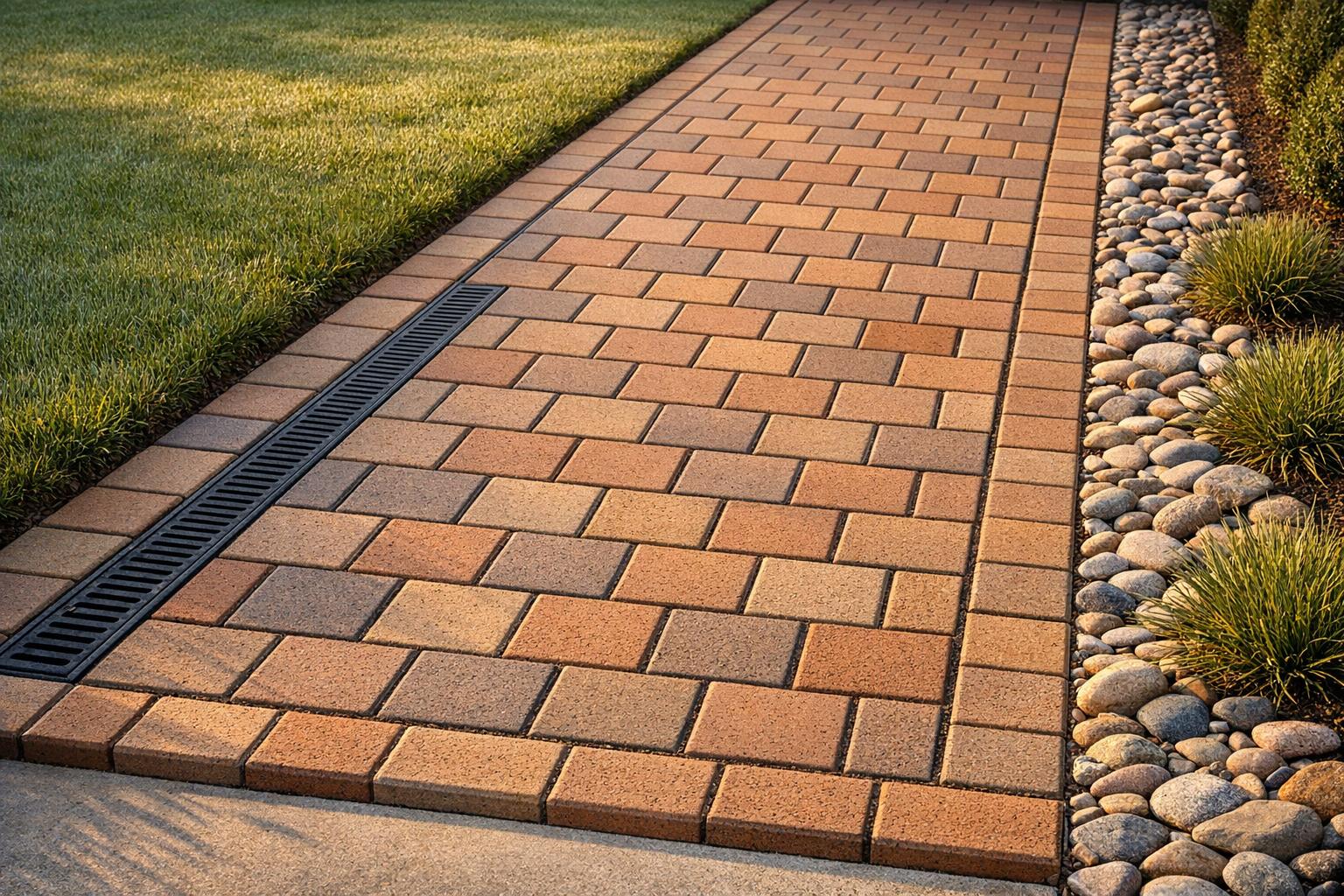
Running bond patterns are a popular and practical choice for walkways, blending strength and timeless design. This staggered layout, often seen in historic and modern settings alike, is known for its durability and efficiency. By offsetting each row of pavers, the pattern creates a strong, interlocking grid that evenly distributes weight, making it ideal for high-traffic areas. It also minimizes material waste during installation, reducing costs by 20–30%.
Key benefits include:
- Durability: Handles heavy foot traffic without shifting.
- Visual Appeal: Creates clean lines that guide the eye and enhance landscape design.
- Material Efficiency: Less cutting means lower waste and cost.
- Flexibility: Works well with straight, curved, or diagonal layouts.
This pattern is especially suited for central Maryland’s freeze-thaw cycles, ensuring long-lasting stability when installed correctly. Whether for garden paths, entrances, or side yards, running bond walkways offer a balanced mix of functionality and style.
How to Build a Concrete Paver Walkway | This Old House

sbb-itb-843f8be
What is a Running Bond Pattern?
The running bond pattern, often called a "stretcher bond", is a classic way to arrange pavers in straight rows with their longer sides aligned. What sets it apart is how each row is offset from the one above – usually by half the paver’s width (known as a half bond) or by one-third (a 1/3 bond). This staggered layout creates a seamless, flowing appearance while forming an interlocking grid that evenly spreads weight. Thanks to this design, it handles foot traffic well, unlike patterns with perfectly aligned joints (like the stack bond). Let’s dive into the qualities that make this pattern both functional and visually appealing.
Key Features of Running Bond Patterns
This pattern combines visual balance with practical advantages. The continuous, straight lines give an "illusion of length", which can make narrow pathways or tight spaces feel more open. Because the layout is straightforward, it minimizes the need for cutting pavers, which helps reduce material waste. It’s also incredibly flexible, working well with a variety of materials, from classic clay bricks to sleek concrete pavers and even natural stone.
Common Uses for Walkways
These qualities make the running bond pattern a popular choice for many walkways. It’s often used for front-door entrances, garden paths, side yards, and connecting pathways across a property. Its natural flow guides pedestrians, making it especially useful for directing foot traffic in both residential and commercial spaces. Plus, it adapts easily to curved paths, allowing it to fit around trees, garden beds, or other obstacles. For driveways, laying the pavers width-wise instead of lengthwise offers greater stability, especially when dealing with the forces of turning vehicles. Understanding these basics can help ensure a smooth and successful installation process.
Benefits of Running Bond Patterns for Walkways
Improved Durability and Stability
The staggered joint design of a running bond pattern isn’t just about aesthetics – it plays a key role in creating a durable and stable walkway. By offsetting each row (typically by half a paver), the stress and weight are distributed evenly across the surface. This interlocking grid prevents pavers from shifting over time, making it a much stronger choice compared to patterns like stack bond, which rely on continuous vertical and horizontal joints that can compromise the structure’s integrity [2].
This design ensures the pavers stay firmly in place, making it ideal for walkways that will endure heavy foot traffic. For wheeled movement – like wheelchairs, strollers, or wheelbarrows – running bond patterns laid in the direction of travel reduce vibrations, providing a smoother experience [3]. Plus, if a paver gets damaged, the straightforward layout makes replacing individual pieces a breeze without disrupting the rest of the pattern [1]. Beyond its practical strength, this pattern also brings aesthetic appeal, as explored below.
Classic and Timeless Appearance
The running bond pattern’s clean, linear design complements virtually any architectural style, from charming historic homes to sleek modern builds. Its straight rows naturally guide the eye forward, creating a sense of direction and flow – perfect for leading visitors to a front door or garden feature [2]. This balance of functionality and elegance enhances the overall landscape design while maintaining a polished, organized look.
Its simplicity works in harmony with surrounding decorative elements rather than overshadowing them. To elevate the design, you can add a border using a soldier course (upright pavers laid side-by-side) or a sailor course (pavers laid lengthwise). Choosing a contrasting color for the border can further define the edges and frame the walkway beautifully [2]. This timeless aesthetic blends effortlessly with various layouts, making it a versatile choice for any space.
Flexible Design Options
The running bond pattern is incredibly adaptable, making it suitable for a wide range of walkway shapes. Whether your path is straight, gently curved around garden beds, or laid out diagonally, this pattern handles it with ease. Aligning the pavers with the direction of travel creates a sense of forward movement, while laying them across the path can evoke a more relaxed vibe [3]. For narrower walkways, a diagonal running bond (angled at 45 degrees) can create the illusion of a wider space [2].
This straightforward layout not only minimizes material waste – cutting it by 20% to 30% [2] – but also offers flexibility with materials. Whether you prefer the classic look of clay bricks, the modern feel of large concrete slabs, or the rustic charm of tumbled stones, the running bond pattern can accommodate your vision while keeping installation efficient.
How to Install a Running Bond Walkway
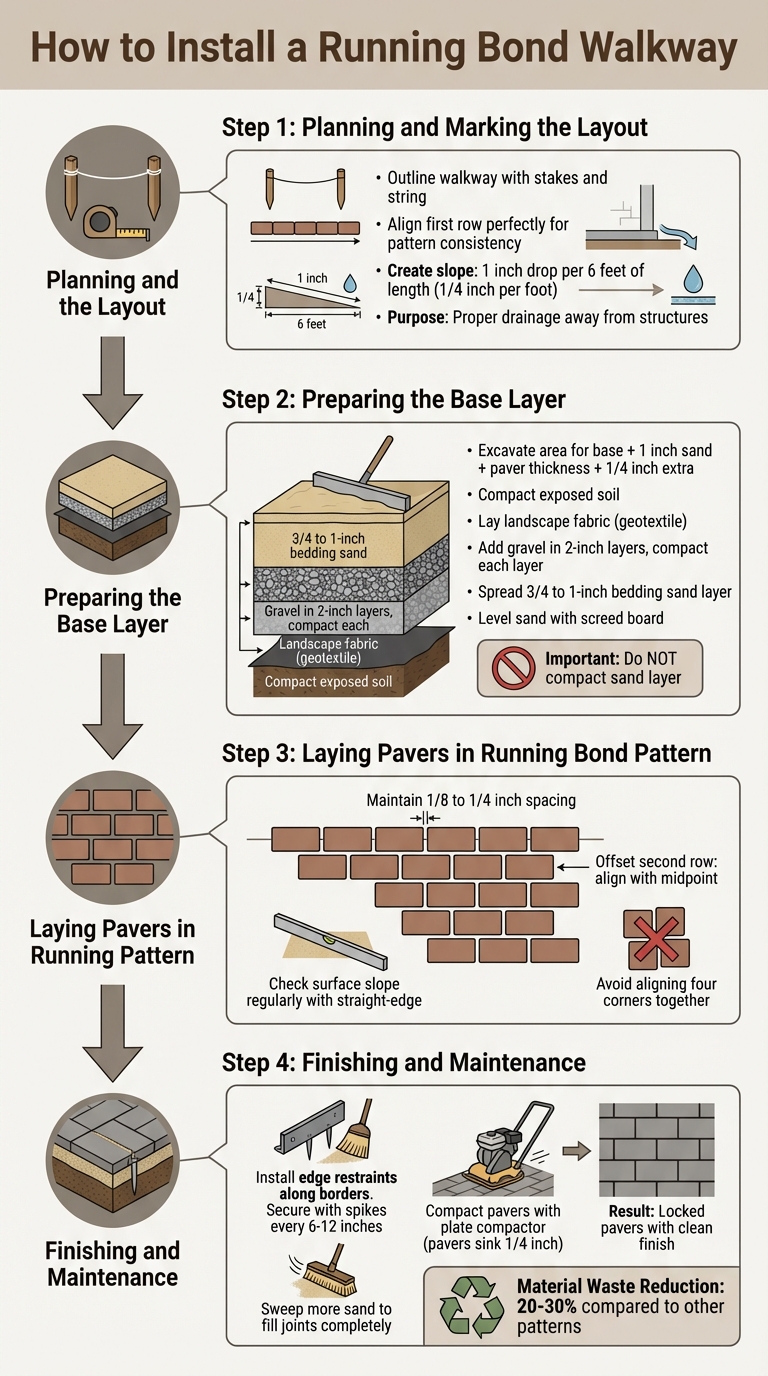
Running Bond Walkway Installation Process: 4 Key Steps
Planning and Marking the Layout
Begin by outlining your walkway with stakes and string. It’s crucial to align the first row perfectly to keep the pattern consistent throughout the project [1][6]. To ensure proper drainage, slope the walkway away from structures at a rate of about 1 inch of drop for every 6 feet of length (or roughly 1/4 inch per foot) [5][6]. This helps prevent water from pooling, which could damage both the walkway and nearby foundations.
Preparing the Base Layer
Excavate the area to accommodate the base material, 1 inch of bedding sand, and the paver thickness, leaving an extra 1/4 inch for compaction [5]. Start by compacting the exposed soil, then lay down a layer of landscape fabric (geotextile) to keep the soil and base material from mixing over time [7][5]. Add gravel in 2-inch layers, compacting each one thoroughly with a plate compactor [7][5]. This step-by-step approach ensures a stable foundation that won’t settle unevenly later.
After compacting the base, spread a 3/4 to 1-inch layer of coarse, washed bedding sand. Use 1-inch PVC pipes or metal conduit as guides, and level the sand with a straight 2×4 screed board [7][5]. Do not compact this layer – it needs to stay loose to allow the pavers to settle properly during tamping [5]. Once the base is ready, you can start laying the pavers in a running bond pattern.
Laying Pavers in a Running Bond Pattern
Lay the first row of pavers along your reference line, keeping 1/8 to 1/4 inch spacing between each one [3][8]. For the second row, offset the first paver so that it aligns with the midpoint of the paver below it – this creates the staggered look that makes the running bond pattern so strong [2][3]. Continue laying pavers in this pattern, using a straight-edge regularly to confirm the surface maintains the planned slope [6]. Avoid aligning four paver corners together, as this disrupts the staggered effect [4].
Finishing and Maintenance
Install edge restraints along the borders, securing them with spikes every 6–12 inches to keep the pavers from shifting over time [6][5][3]. Sweep polymeric or coarse sand into the joints between the pavers, then use a plate compactor or hand tamper to settle the pavers into the bedding sand. This process will cause the pavers to sink about 1/4 inch into the sand [5]. After compacting, sweep more sand into the joints to fill them completely. This step locks the pavers in place and gives your walkway a clean, finished look.
Why Choose Pro Landscapes MD for Your Walkway Installation

Expertise in Running Bond Walkways
Pro Landscapes MD brings a sharp eye for detail to every running bond walkway project. Their team ensures each installation starts with a precise and consistent baseline, maintaining proper joint spacing to minimize issues like buckling or weed growth [8]. By leveraging the staggered pattern of the running bond design, they evenly distribute weight for both aesthetic and structural integrity [2]. To secure the edges, they use 10-inch stakes spaced every 6–12 inches along the borders [5]. This meticulous approach ensures not just a flawless walkway but also a seamless foundation for other hardscaping services.
Comprehensive Landscaping and Hardscaping Solutions
Pro Landscapes MD doesn’t stop at walkways – they bring the same level of expertise to all aspects of hardscaping and landscaping. From initial design to ongoing maintenance, they handle every step of the process. Their hardscaping services include creating flagstone and paver walkways, patios, driveways, retaining walls, and natural stone steps. They also address critical drainage needs by incorporating proper grading and stormwater management into their designs, ensuring walkways slope away from structures at a rate of about 1 inch per 6 feet [5]. This attention to detail ensures durability, particularly in central Maryland’s challenging freeze-thaw conditions. Additionally, they emphasize eco-friendly practices by using pavers made from up to 95% recycled materials [5].
Dedicated to Central Maryland Communities
Pro Landscapes MD proudly serves a wide range of communities across central Maryland, including Howard, Montgomery, Carroll, Frederick, Prince George’s, and Baltimore counties. Their reach also extends to cities like Ellicott City, Bethesda, Columbia, Gaithersburg, Rockville, Silver Spring, Towson, Annapolis, and Washington, DC. With their deep understanding of the region’s soil and climate, they tailor their hardscaping techniques to withstand local conditions, such as freeze-thaw cycles, by focusing on proper base preparation and durable materials. This regional expertise ensures their projects stand the test of time.
Conclusion
Running bond patterns offer a combination of strength and timeless charm, making them a popular choice for walkways. The staggered joints form an interlocking grid that evenly spreads weight, reducing the chances of pavers shifting over time [2]. Plus, this layout creates an illusion of added length, making narrow garden paths feel more spacious and inviting.
What makes this pattern even more appealing is its flexibility. It works seamlessly for curved walkways without requiring excessive cutting, making it an excellent option for winding garden paths [3]. Whether you prefer the warm, historic vibe of clay bricks or the sleek, modern touch of large concrete pavers, the running bond pattern complements nearly any architectural style, offering both aesthetic and practical benefits.
Pro Landscapes MD brings this expertise to life for homeowners across central Maryland. Their team handles every detail, from the initial design consultation and 3D renderings to precise excavation, proper grading for drainage, and careful paver installation. They focus on essentials like base compaction and edge restraints to ensure your walkway stands the test of time.
If you’re in central Maryland and considering a new walkway, the running bond pattern strikes a perfect balance between beauty, durability, and value. Pro Landscapes MD’s full-service approach ensures your outdoor space is not only functional but also built to last.
Interested in upgrading your property with a professionally crafted running bond walkway? Reach out to Pro Landscapes MD to explore designs tailored to your style and budget.
FAQs
Which paver sizes work best for running bond walkways?
The ideal paver sizes for running bond walkways are standard rectangular pavers, usually measuring about 4×8 inches. These dimensions make it simple to stagger and align the pavers, resulting in a stable and visually pleasing pattern.
Do I need a border with a running bond walkway?
A border isn’t absolutely necessary for a running bond walkway, but it can definitely elevate its appearance and make it sturdier. Borders not only create a polished, finished edge but also help keep the pavers in place, reducing the chance of shifting over time.
How do I prevent shifting in freeze-thaw areas?
To keep running bond paver patterns stable in areas prone to freeze-thaw cycles, it’s essential to choose materials that can handle temperature fluctuations. Start with a well-prepared, solid base and pay close attention to maintaining proper joint spacing during installation. These precautions help minimize movement caused by freezing and thawing, ensuring your pavers stay secure over time, even in colder climates.
Chat with Us