









- bhavya gada
- No Comments
When rain hits shaded slopes, erosion can cause serious problems – damaging foundations, creating runoff, and destabilizing soil. Managing erosion on these slopes involves balancing natural tree root protection, selecting the right plants, and using structural solutions like retaining walls. Here’s how you can stabilize your shady slope effectively:
- Evaluate the Slope: Check soil texture, moisture, and shade levels. A soil test helps determine if amendments are needed.
- Choose the Right Plants: Use native, shade-tolerant ground covers like Creeping Phlox, Golden Groundsel, or Christmas Fern. Avoid aggressive species like Vinca minor.
- Plant Carefully: Opt for smaller plants or seeds to minimize root disturbance. Add mulch or leaf litter to protect soil.
- Use Bioengineering: Place sticks or barriers on the slope to reduce soil movement while plants establish.
- Consider Retaining Walls: For steep slopes, terracing or retaining walls can help control water flow and prevent erosion.
- Maintain Regularly: Water new plants consistently, control weeds, and monitor for bare spots after heavy rain.
Combining these methods ensures your slope remains stable, visually appealing, and protected from further erosion.
Slope Landscaping for Erosion Control | Green Jay Landscape Design

Assessing Your Shady Slope Conditions
Before you dive into planting or adding supports, take a close look at your slope’s soil texture, pH levels, and moisture content. A professional soil test, which you can get through your local University Extension office, will give you the insights you need to make informed decisions about plant selection. As Becky, an Ask Extension Expert, explains:
A soil test would allow you to consider if any soil amendments might be needed to optimize your site for new planting [8].
Don’t overlook the existing root systems. Even if the soil looks bare, it may still be stabilized by hidden tree roots. The University of Maryland Extension emphasizes:
in the forest, even soil that seems devoid of vegetation is likely to be full of tree roots [1].
Disturbing these roots too much can lead to increased erosion, so tread carefully.
Keep an eye on your slope during heavy rainstorms. This is when you’ll notice where water collects and where it’s washing soil away. Look for areas where water cascades down, especially near driveways or from neighboring uphill properties. These patterns will help you pinpoint the spots where erosion is most severe and where your efforts should be focused [3][8].
Testing Soil Stability
Soil stability isn’t just about what you see on the surface. Tree canopies and leaf litter play a big role in minimizing the impact of raindrops on the soil [1]. While professional soil tests are invaluable, simple observations and hands-on tests can also provide useful insights.
Pay attention to the slope’s orientation, soil depth, and moisture levels. For instance, soil at the base of a slope is often wetter than at the top, which will influence how erosion occurs and which plants will thrive. If the erosion issues seem complex, consider reaching out to your local Soil & Water Conservation District or a Watershed Specialist for expert advice [1][3].
Measuring Shade Levels and Microclimates
Shade conditions can vary significantly across your slope. The density of the tree canopy will determine how much rain reaches the soil and how much moisture is available for new plants. While tree roots help stabilize the soil, they also compete with new plantings for water [1][4].
Take photos of your slope and consult with local gardening experts to get tailored advice on microclimates and plant placement [1][8]. Different sections of your slope may have distinct combinations of sun exposure, soil moisture, and root competition. Understanding these variations will help you make smart decisions about which plants to use and where to place them. These steps ensure you choose the right ground covers and planting techniques for each specific area.
Best Shade-Tolerant Ground Covers for Erosion Control
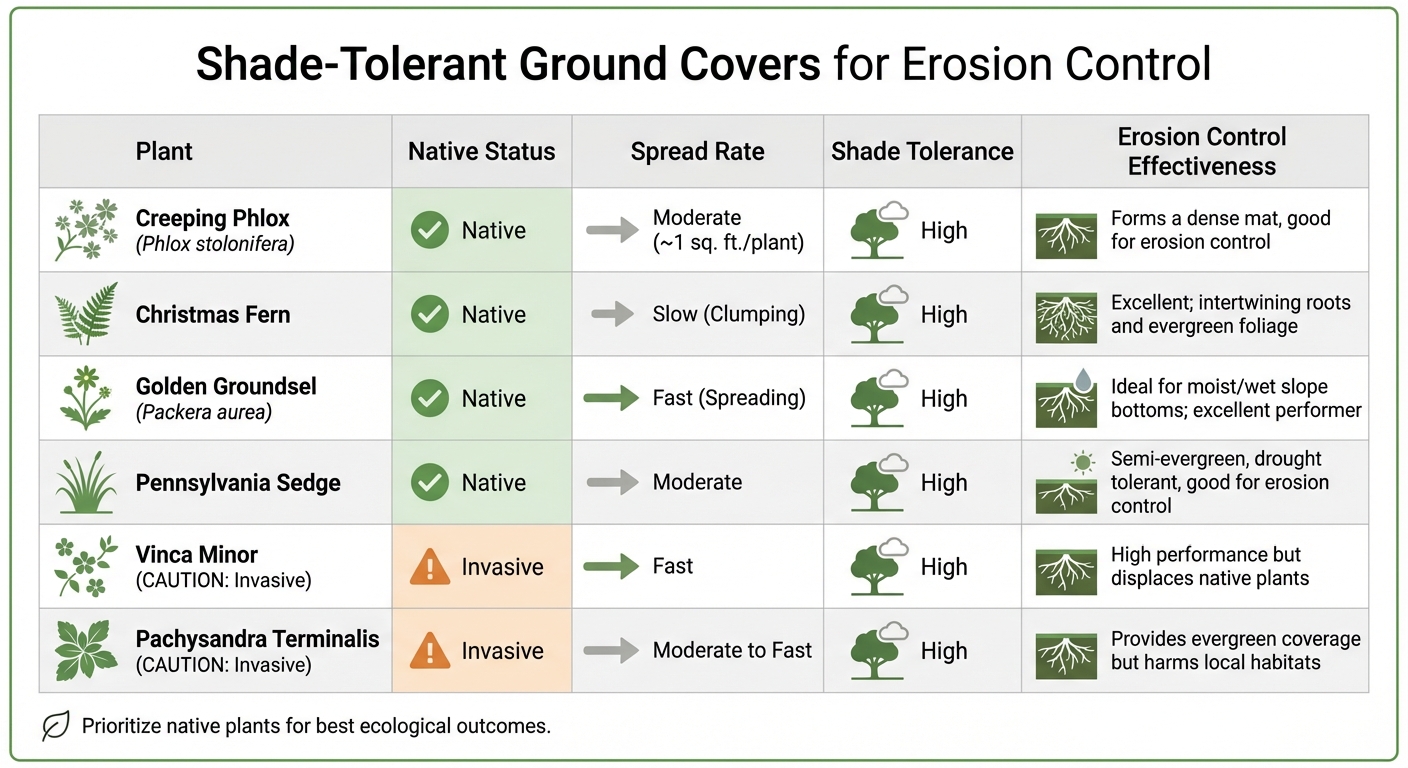
Shade-Tolerant Ground Cover Plants for Erosion Control Comparison
When dealing with shaded areas prone to erosion, selecting the right ground covers is essential. The goal is to create a dense layer of foliage and interwoven roots that stabilize the soil and slow down rainfall impact. Interestingly, plants don’t need deep roots to be effective as long as they provide sufficient ground coverage [5].
Native plants are particularly well-suited for shaded slopes because they naturally integrate into the local environment. They offer a long-lasting, low-maintenance solution while also supporting local pollinators. However, be cautious with fast-spreading non-native options like Vinca minor and Japanese Pachysandra. While these evergreen plants may seem appealing, their invasive tendencies can disrupt native ecosystems [7].
For a balanced approach, consider combining spreading species like Creeping Phlox (Phlox stolonifera) and Golden Groundsel (Packera aurea) with clumping plants such as Christmas Fern. Spreading plants quickly cover exposed soil, while clumping varieties provide dense, year-round root support [1][7]. On larger slopes, planting small plugs can be a cost-effective way to establish vegetation while minimizing soil disturbance [7].
Plant Comparison Table
Here’s a quick guide to some effective shade-tolerant ground covers:
| Plant Name | Native Status | Spread Rate | Shade Tolerance | Erosion Control Performance |
|---|---|---|---|---|
| Creeping Phlox (Phlox stolonifera) | Native | Moderate (~1 sq. ft. per plant) | High | Forms a dense mat, good for erosion control [7] |
| Christmas Fern | Native | Slow (Clumping) | High | Excellent; intertwining roots and evergreen foliage [1][7][5] |
| Golden Groundsel (Packera aurea) | Native | Fast (Spreading) | High | Ideal for moist or wet slope bottoms; excellent performer [1] |
| Pennsylvania Sedge | Native | Moderate | High | Semi-evergreen, drought tolerant, good for erosion control [6] |
| Vinca Minor | Invasive | Fast | High | High performance but displaces native plants [7] |
| Pachysandra Terminalis | Invasive | Moderate to Fast | High | Provides evergreen coverage but harms local habitats [7] |
For year-round protection, prioritize plants that remain active during winter. For example, Christmas Fern retains its evergreen foliage throughout the dormant season, continuing to shield the soil when other plants die back [1]. To further enhance slope stability, avoid planting a single species. Mixing various plants not only strengthens the root network but also improves resistance to pests, diseases, and unpredictable weather conditions [7]. These strategies lay the groundwork for more advanced erosion control techniques, such as bioengineering.
Planting and Soil Bioengineering Methods
Planting Techniques for Shaded Slopes
When planting on shaded slopes, it’s crucial to protect the tree roots that naturally stabilize the soil. Too much digging can harm these roots and speed up erosion. To avoid this, opt for smaller plants like plugs or quarts, or simply sow seeds directly. As the University of Maryland Extension advises:
To minimize damage to tree roots, sow seeds or plant the smallest potted plants available (usually plugs or quarts) rather than planting larger specimens. [1]
Create level planting pockets to catch rainfall effectively, and cover the area around your plants with about 2 inches of leaf litter or mulch. Be careful not to pile mulch on the crowns of the plants, as this can cause damage. Regular watering is essential for the first two years, especially from spring through fall until the ground freezes. Choosing native, rhizomatous plants like White Wood Aster or Woodland Sunflower can help establish a dense root system underground, which is key to long-term slope stability [1][4].
Bioengineering Approaches for Erosion Control
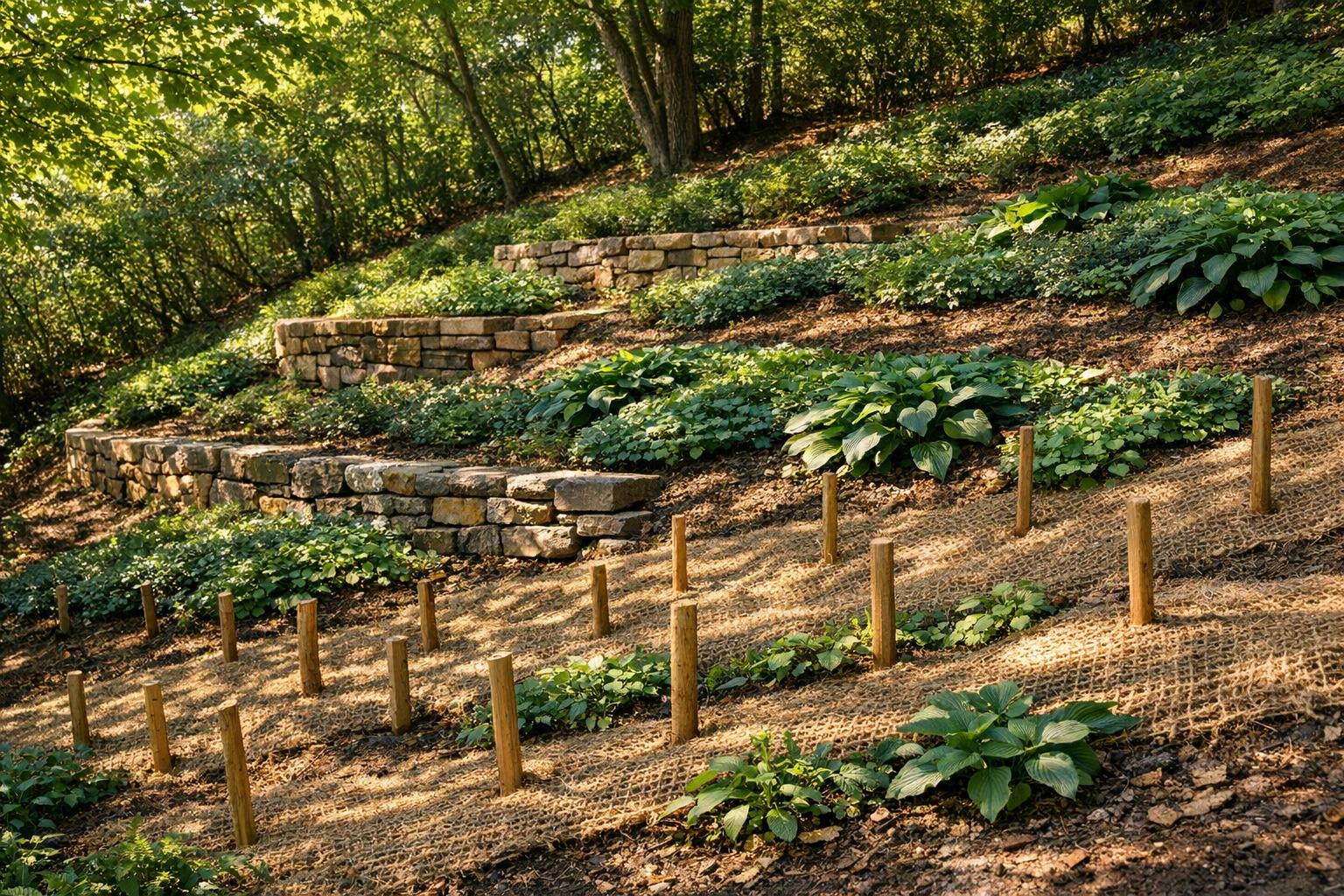
To enhance planting efforts, simple bioengineering methods can provide additional slope stability. A practical approach is to place horizontal sticks across the slope and secure them with stakes. This creates small, temporary terraces that reduce soil movement while ground cover plants establish themselves [4].
The best erosion control strategies rely on dense root systems and thick vegetation that can absorb and slow down rainfall [5]. The existing tree canopy also plays a role by breaking the force of raindrops before they hit the ground [1]. For added resilience, mix native plant species to guard against pests, diseases, and changing weather conditions [7].
sbb-itb-843f8be
Using Retaining Walls and Terracing
When planting and bioengineering methods aren’t enough, retaining walls and terracing can step in to create level planting pockets that control water flow and slow erosion [4]. By breaking a steep slope into flat, manageable tiers, these structures help reduce the speed of surface water and give the soil more time to absorb rainfall instead of letting it wash away.
These structural solutions work hand-in-hand with thoughtful planting, tackling water flow issues directly.
On slopes with shade, it’s important to minimize digging to avoid damaging tree roots that naturally stabilize the soil [1]. Traditional masonry walls with deep foundations can disrupt these roots, potentially doing more harm than good [1].
For slopes dealing with heavy runoff from nearby properties, it’s wise to consult local Soil Conservation or Watershed specialists before committing to major structural changes [3]. Once terraces are built, adding a few inches of leaf litter or wood mulch to the flat areas can provide an extra layer of protection, shielding the soil and softening the impact of raindrops.
In more complicated situations, where professional help is needed for retaining wall installation, Pro Landscapes MD offers services across central Maryland. They specialize in designing and installing retaining walls, garden walls, and drainage systems, ensuring these hardscaping elements integrate seamlessly with your existing trees and landscape. Their expertise can help you create stable, functional terraces that balance structure with natural surroundings.
Maintaining Your Shady Slope Over Time
Once your shady slope is established, keeping it in good condition requires regular attention. After heavy rain, take a walk around the area to check for signs of erosion, such as soil or mulch being washed away [3][4]. Bare spots where soil is exposed are a red flag. Ideally, the slope should be covered by a mix of tree canopy, leaf litter, and plant roots to help hold everything together [1]. Also, make sure your new plantings are getting the care they need to thrive.
For new plants, consistent watering is key during the first two years until they’re firmly established [4]. If animals disturb or uproot young plants, use bird netting to protect them until their roots take hold [4]. Continue watering through the fall until the ground freezes to support healthy growth.
Weed control is another critical task. Invasive vines like Honeyvine Milkweed and Bindweed can choke out your ground covers if left unchecked [7]. It’s best to hand-pull these weeds regularly instead of using chemical herbicides, which can pollute nearby waterways [7]. Over time, as your ground cover matures and thickens, it will naturally suppress weed growth, reducing the amount of weeding you’ll need to do [7].
To keep the soil healthy, spread a 2-inch layer of mulch or fallen leaves. This layer not only protects the soil but also adds nutrients as it breaks down. Just be sure to keep mulch away from the crowns of your plants to avoid rot [4][7]. If you notice bare patches or struggling plants, spring is the best time to replant perennials and ground covers [4]. When replanting, dig flat pockets instead of sloped ones to help rainwater soak in rather than run off [4].
If erosion continues to be a problem despite your efforts, it might be time to call in the experts. Reach out to your local Soil & Water Conservation District or a Watershed Specialist for advice tailored to your situation [1][3]. In cases where slopes are dealing with heavy runoff from neighboring properties, you may need to restore them two to four times a year [3]. This could indicate the need for more advanced drainage solutions.
Conclusion
Controlling erosion on shady slopes calls for a well-rounded approach. Using shade-tolerant ground covers alongside bioengineering methods – like placing sticks along the slope for temporary support – provides a strong defense during heavy rainfall [4]. To complement these efforts, structural solutions such as retaining walls or French drains help manage water runoff and stabilize the slope [2]. By combining multiple strategies, you create a safety net where, if one measure falls short, others step in to protect the soil [2]. This layered approach not only addresses immediate erosion concerns but also promotes long-term slope stability.
As Miri from the Home and Garden Information Center (HGIC) at the University of Maryland Extension points out:
Deep roots aren’t necessary for erosion control as long as the planting helps to cover exposed ground (both with foliage to intercept rain and with roots intertwined with their neighbors) [5].
Prioritizing a mix of native plant species over monocultures strengthens the slope’s resilience against extreme weather, pests, and diseases. It also avoids disrupting existing tree roots, which naturally contribute to slope stability [7][1]. Keep in mind that new plantings need about two years of consistent watering to establish strong roots. During this period, bioengineering techniques offer essential temporary support [4].
FAQs
What are the best native plants to prevent erosion on shaded slopes?
To manage erosion on shaded slopes, planting native species with robust, interwoven root systems is crucial. In Maryland’s climate, shrubs like Arrowwood viburnum, Red chokeberry, Virginia sweetspire, Inkberry holly, and Winterberry excel in low-light conditions while effectively stabilizing soil.
For ground cover, options such as Eastern columbine, Eastern bottlebrush grass, and ferns like Christmas fern, Hay-scented fern, and Maidenhair fern are excellent choices. These plants spread rapidly, forming a dense layer that helps minimize runoff. Additionally, low-growing perennials like Tiarella, Canadian ginger, and Creeping phlox are ideal for filling in gaps and providing extra soil protection.
Blending shrubs for structure, grasses for quick coverage, and ferns or perennials for ground cover creates a layered and durable planting design. Pro Landscapes MD specializes in designing and installing these native plant combinations while incorporating erosion-control methods such as proper grading and drainage solutions to promote long-term stability.
What are the best ways to prevent erosion on a shaded slope using plants and structures?
To stabilize a shaded slope effectively, you’ll need a mix of shade-friendly vegetation and structural solutions to control erosion over time. Start by planting deep-rooted native shrubs such as Virginia Sweetspire, Arrowwood Viburnum, Red Chokeberry, or Inkberry Holly. These shrubs not only anchor the soil with their roots but also shield it from heavy rain with their leafy canopies. To give young plants a strong start, use erosion-control blankets or mulch during the first 4 to 6 weeks. This protects the soil and helps roots establish without disrupting the existing tree canopy.
Next, add groundcover plants like Christmas Fern, Eastern Bottlebrush Grass, or spreading perennials such as Tiarella. These thrive in the shaded, moist conditions typical of slopes and work together to create a dense root system that slows water runoff.
For added stability, integrate structural elements like retaining walls, stone terraces, or gabion baskets. These features provide immediate support and can double as planting areas. Enhance their effectiveness by including drainage solutions like French drains or dry riverbeds to manage water flow and prevent the soil from becoming oversaturated. By combining vegetation with these structural components, you’ll achieve a slope that’s not only stable but also functional and visually pleasing.
When should I use retaining walls to control erosion on steep slopes?
Retaining walls play a critical role in controlling erosion on steep slopes, especially when vegetation alone can’t keep the soil in place. If a slope has an incline of around 30 degrees (about 6 feet of rise for every 10 feet of run) or more, a retaining wall might be necessary – particularly when the soil is loose, water-saturated, or prone to sliding during heavy rains. These walls provide the strength needed to counteract soil pressure while also managing water runoff effectively.
They’re also worth considering if you’re looking to create flat planting areas, safeguard nearby structures, or address visible erosion problems like exposed roots, gullies, or areas where soil has been washed away. For slopes exceeding 4–5 feet in height or regions that experience frequent heavy rainfall, proper engineering is essential. This means incorporating adequate drainage and reinforcement to withstand the extra pressure. A well-built retaining wall doesn’t just stop erosion – it also improves the usability and stability of your outdoor space.
Chat with Us