









- bhavya gada
- No Comments
Silt fences are essential for controlling sediment and stormwater runoff during construction projects in Maryland. Depending on the type and project requirements, installation costs range from $3 to $7 per linear foot, with a 400-foot fence costing between $1,200 and $2,800. Labor accounts for 70% to 80% of the expense, and regional pricing in Maryland is 30% to 45% higher than the national average due to stricter regulations and terrain challenges.
Here’s a breakdown of the three main silt fence types in Maryland:
- Type A: Standard geotextile fabric; suitable for short-term, residential, or light commercial projects.
- Type B: UV-stabilized fabric for better durability; ideal for longer-term projects or moderate site challenges.
- Type C: Wire-backed for maximum strength; designed for steep slopes, heavy rainfall, or high-risk areas.
Choosing the right type ensures compliance with Maryland’s strict sediment control standards and minimizes risks like fines or project delays.
1. Type A Silt Fence
Cost per Linear Foot
In Maryland, the cost of Type A silt fences ranges from $3 to $7 per linear foot [2]. For a typical 400-foot perimeter, expenses can fall between $1,200 and $2,800 [2]. Smaller projects often have a minimum charge of $500 [2]. Labor makes up a significant portion of the cost, accounting for 70% to 80% of the total installation price [2].
Durability
Type A silt fences are designed for short-term projects. While standard geotextile fabric is sufficient for temporary use, opting for UV-stabilized fabric can help extend the fence’s lifespan [2]. These fences are not meant for long-term applications.
Installation Complexity
Proper installation of a Type A silt fence requires trenching and secure backfilling to effectively block sediment flow [1][2]. However, challenges like rocky terrain, steep slopes, or dense vegetation can make the process more complicated and may require specialized tools or equipment [2]. Additionally, limited site access and strict municipal regulations can add further complexity to the installation process, affecting the suitability of this option for certain projects [2][3].
Best Use Cases
Type A silt fences are ideal for residential construction, commercial perimeters, road shoulders, and as buffers for streams and wetlands [3][6]. They work particularly well in construction zones, landscaping projects, and areas vulnerable to soil erosion near water bodies [1][5]. For expert installation that complies with local erosion control standards, services like Pro Landscapes MD are a reliable choice [1][4].
sbb-itb-843f8be
2. Type B Silt Fence
Cost per Linear Foot
In Maryland, Type B silt fences generally range between $3 and $7 per linear foot [2]. For a typical 400-foot perimeter, you can expect to spend between $1,200 and $2,800 [2]. However, most contractors impose a minimum charge of $500, even for smaller projects [2]. Labor costs dominate the budget, accounting for 70% to 80% of the total expense [2]. Unlike Type A, Type B fences offer options like UV-stabilized fabric and wire backing, which make them better suited for long-term applications.
Durability
Durability sets Type B apart from other silt fence types. For projects lasting several months or more, UV-stabilized fabric rated for 2,000 hours is a smart choice. Standard polypropylene fabric can lose up to 40% of its tensile strength after 4–5 months of exposure to intense UV rays. Wire-backed versions further enhance strength, particularly on steep or challenging slopes [2][7].
Installation Complexity
Installing a Type B silt fence requires proper trenching, securing posts, and backfilling to ensure it holds up during heavy rain [2]. Conditions like rocky terrain, uneven surfaces, or dense vegetation can complicate the process and increase labor costs [2]. Maryland’s erosion control regulations also require compliance with strict environmental standards, making professional installation critical to avoid fines or delays [3][5]. Thanks to its balance of durability and adaptability, Type B works well for projects with moderate site challenges.
Best Use Cases
Type B silt fences, while comparable in cost to Type A, shine in residential construction by offering better soil retention during excavation and grading [3]. They are perfect for landscaping and small-scale grading projects, particularly when managing materials like mulch, topsoil, or debris over several months [3]. Additionally, they help protect newly planted areas until vegetation fully stabilizes the soil [6]. For Maryland-based projects, Pro Landscapes MD specializes in professional installations that meet local erosion control requirements for both residential and commercial sites [3].
3. Type C Silt Fence
Cost per Linear Foot
Type C silt fences are built for tough conditions, offering a heavy-duty solution for erosion control. With reinforced fabric and superior durability, these fences typically cost between $3 and $7 per linear foot. The higher price reflects their ability to handle demanding environments effectively [2].
Durability
Thanks to reinforced fabric and sturdy supports, Type C silt fences are designed to endure harsh weather and heavy-duty projects. They stand up well to challenges like heavy rainfall and excavation activities, making them a reliable choice for challenging conditions [3].
Installation Complexity
Installing a Type C silt fence requires attention to detail. Proper trenching, anchoring, and backfilling are essential to ensure stability and compliance with Maryland’s strict environmental regulations [1]. These rules are particularly important in areas near Chesapeake Bay tributaries, where non-compliance can lead to fines or project delays. Pro Landscapes MD provides professional installation services in Baltimore, Montgomery, Howard, and Harford counties, addressing site-specific challenges such as uneven terrain and proximity to sensitive ecological zones [1][3][4]. The detailed installation process makes Type C fences a great choice for projects with complex site conditions.
Best Use Cases
Type C silt fences are ideal for commercial construction zones requiring robust erosion control. They are particularly effective in road construction and transportation projects, where they keep debris out of stormwater drains along ditches, hillsides, and road shoulders [3]. These fences are also well-suited for projects near streams, wetlands, and other fragile ecosystems, serving as a critical buffer. On sloped terrain, they help slow water flow, allowing sediment to settle and reducing the risk of landslides [3][5].
Silt Fence and Construction Entrance Basics
Advantages and Disadvantages
Maryland Silt Fence Types Comparison: Costs, Durability and Best Uses
Choosing the right silt fence type can greatly influence both the cost and timeline of your project. Let’s break down the key trade-offs of each option so you can make the best decision for your needs.
Type A balances affordability and durability, with costs ranging from $3 to $7 per linear foot. It works well for standard residential and light commercial projects. However, it may struggle in harsh weather or on steep slopes, making it less reliable in those conditions [2].
Type B incorporates UV-stabilized fabric, offering increased durability while maintaining the same price range of $3 to $7 per linear foot. It’s a good fit for short-term projects on stable sites with low rainfall. That said, its lighter construction can lead to sagging or tearing, which might increase replacement costs [2].
Type C stands out for its wire-backed design, delivering maximum strength and stability. Priced similarly at $3 to $7 per linear foot, it’s ideal for long-term projects in rainy areas or on difficult terrain. Its reinforced construction reduces the likelihood of failure, though it requires heavier-duty installation methods [2].
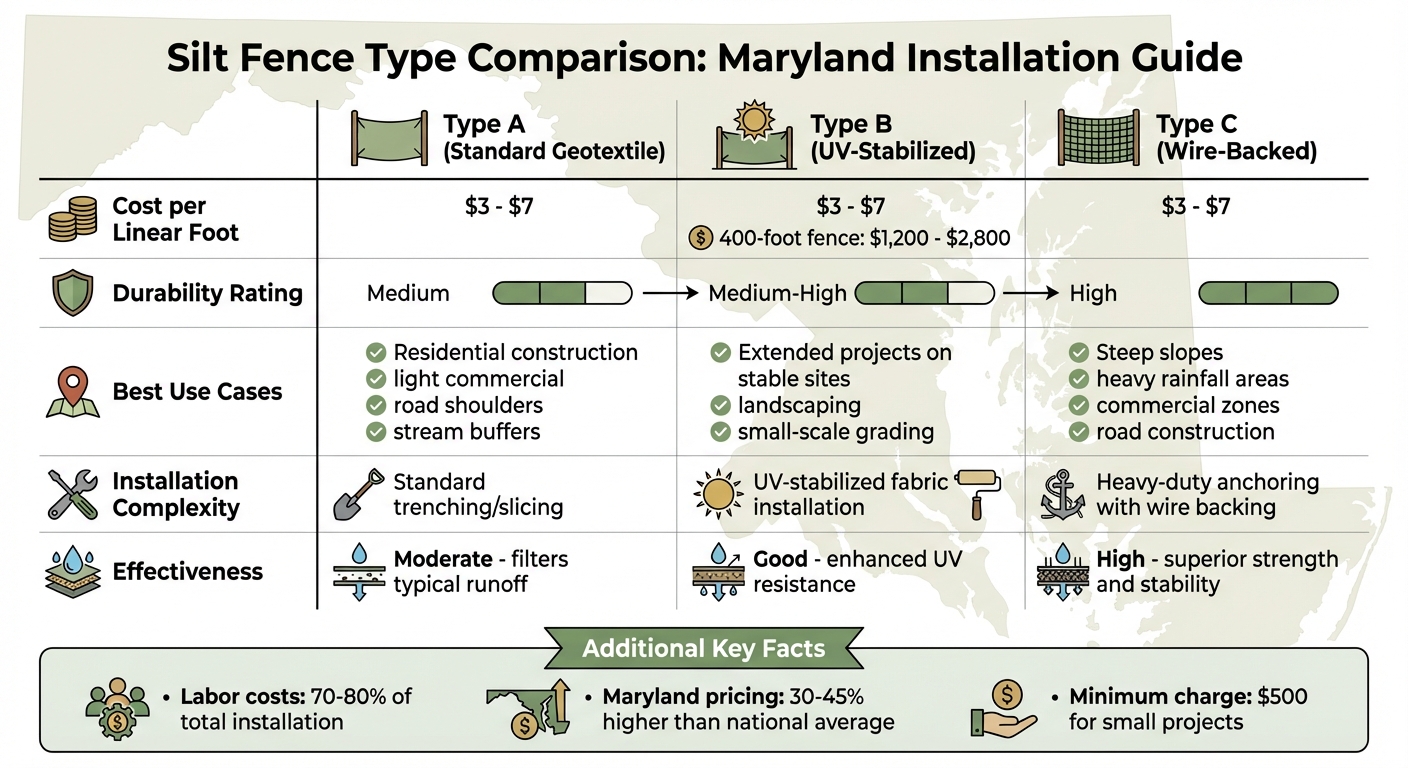
In Maryland, these differences are particularly relevant due to strict environmental regulations. Selecting the appropriate silt fence can help you avoid fines and delays while ensuring compliance. Here’s a quick comparison to summarize the critical factors:
| Silt Fence Type | Durability | Average Cost (per LF) | Best Use Case | Installation Requirement | Effectiveness |
|---|---|---|---|---|---|
| Type A | Medium | $3 – $7 | Standard residential projects | Standard trenching/slicing | Moderate; filters typical runoff |
| Type B | Medium-High | $3 – $7 | Extended projects on stable sites | UV-stabilized fabric installation | Good; enhanced UV resistance |
| Type C | High | $3 – $7 | Long-term projects in rainy regions or on steep slopes | Requires heavy-duty anchoring/wire backing | High; superior strength and stability |
For projects in Maryland, professional installation is key to meeting environmental standards, helping you avoid costly setbacks and ensuring long-term success [2][5].
Conclusion
Selecting the right silt fence can make a big difference in meeting regulatory requirements and ensuring your project stands the test of time. The choice largely depends on the nature of your site – flatter, residential areas may only need basic designs, while steep or rainy locations often demand reinforced options for added durability.
Budgeting is equally important. Labor is typically the biggest cost factor, with a 400-linear-foot fence installation ranging from $1,200 to $2,800 on average [2]. Regional factors, like local terrain or regulations, can push these costs higher.
In Maryland, the unique combination of challenging terrain and strict regulations, especially near the Chesapeake Bay watershed, requires careful planning. Projects disturbing more than one acre or located in sensitive areas often need specific silt fence designs and professional installation to comply with erosion control standards [2][3]. Proper anchoring is particularly critical to withstand the region’s heavy rainfalls and prevent washouts [2][4].
Partnering with local professionals ensures your installation meets Maryland’s codes, passes inspections, and avoids costly issues like work delays, fines, or failed fencing. Whether you’re overseeing a small residential project or a large commercial development, choosing the right fence type and installation team upfront can save you time, money, and frustration.
For expert installation and compliance with Maryland’s environmental standards, Pro Landscapes MD provides top-notch drainage and erosion control services throughout central Maryland, covering areas like Howard County, Montgomery County, Carroll County, and beyond.
FAQs
Why does silt fence installation cost more in Maryland than in other states?
Silt fence installation in Maryland tends to cost more because of several factors. The state’s unique terrain and varied site conditions play a big role in driving up expenses. Additionally, the quality of materials used for these fences can further impact the overall price, making it different from what you might see in other states.
How do I choose between Type A, Type B, and Type C for my site?
When choosing between Type A, Type B, and Type C silt fences, it’s important to match the fence type to your specific project needs. For sites with heavy mud or frequent rain, Type B and Type C offer greater durability. On the other hand, Type A is a good fit for cleaner sites and shorter projects. Consider your site’s conditions, expected rainfall, and the project timeline to make the best choice.
What factors can increase the labor cost for installing a silt fence?
Labor costs for installing silt fences can rise for several reasons. Limited access to the site often means more effort is needed, driving up expenses. Similarly, larger projects naturally require more labor hours, increasing costs. Difficult site conditions, like uneven ground or the need for trenching and added reinforcements, also add to the workload. These complexities often call for specialized techniques, which further contribute to higher labor costs.
Chat with Us