









- bhavya gada
- No Comments
Silt fences and erosion blankets are two widely used methods for controlling soil erosion on Maryland construction sites. Here’s how they compare:
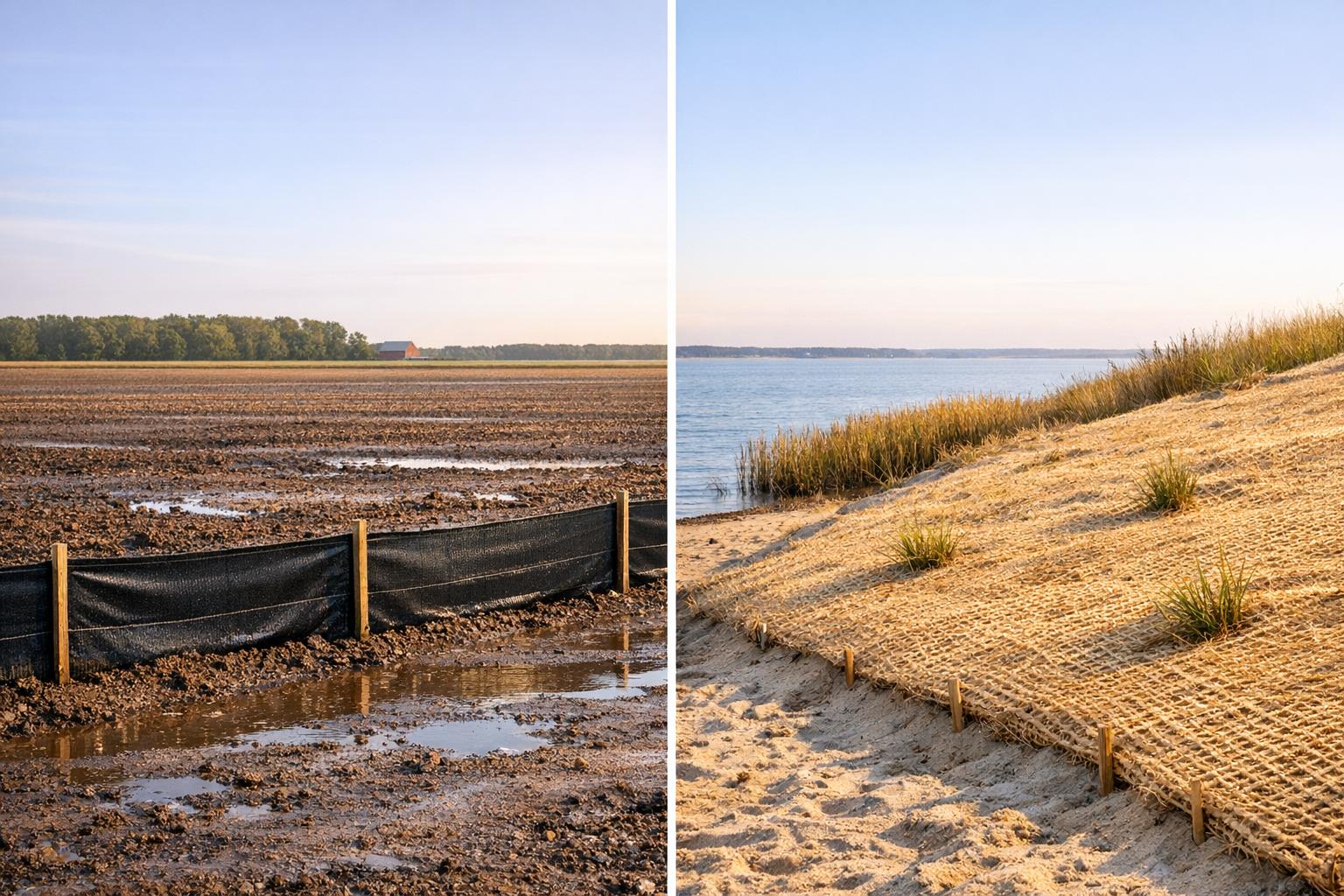
- Silt fences: Temporary barriers that filter sediment from runoff, ideal for flat terrain and perimeter control. They work best in silt-heavy or loam soils but struggle with steep slopes or concentrated water flow.
- Erosion blankets: Surface covers that stabilize soil and prevent erosion at the source. They excel on slopes and sandy soils, aiding vegetation growth, but require smooth installation surfaces and may need replacement over time.
Quick Comparison
| Feature | Silt Fences | Erosion Blankets |
|---|---|---|
| Primary Function | Filters runoff and traps sediment | Stabilizes soil and prevents erosion |
| Best Use | Flat terrain, perimeter control | Slopes, uneven terrain |
| Soil Suitability | Silt-heavy, loam | Sandy, clay-heavy |
| Durability | Temporary, reinforced options | Biodegradable, semi-permanent |
| Maintenance | Regular inspections required | Minimal once installed |
Both methods have strengths and limitations, and the choice depends on site conditions like soil type, slope, and water flow. Proper installation and compliance with Maryland’s sediment control standards are critical for success.
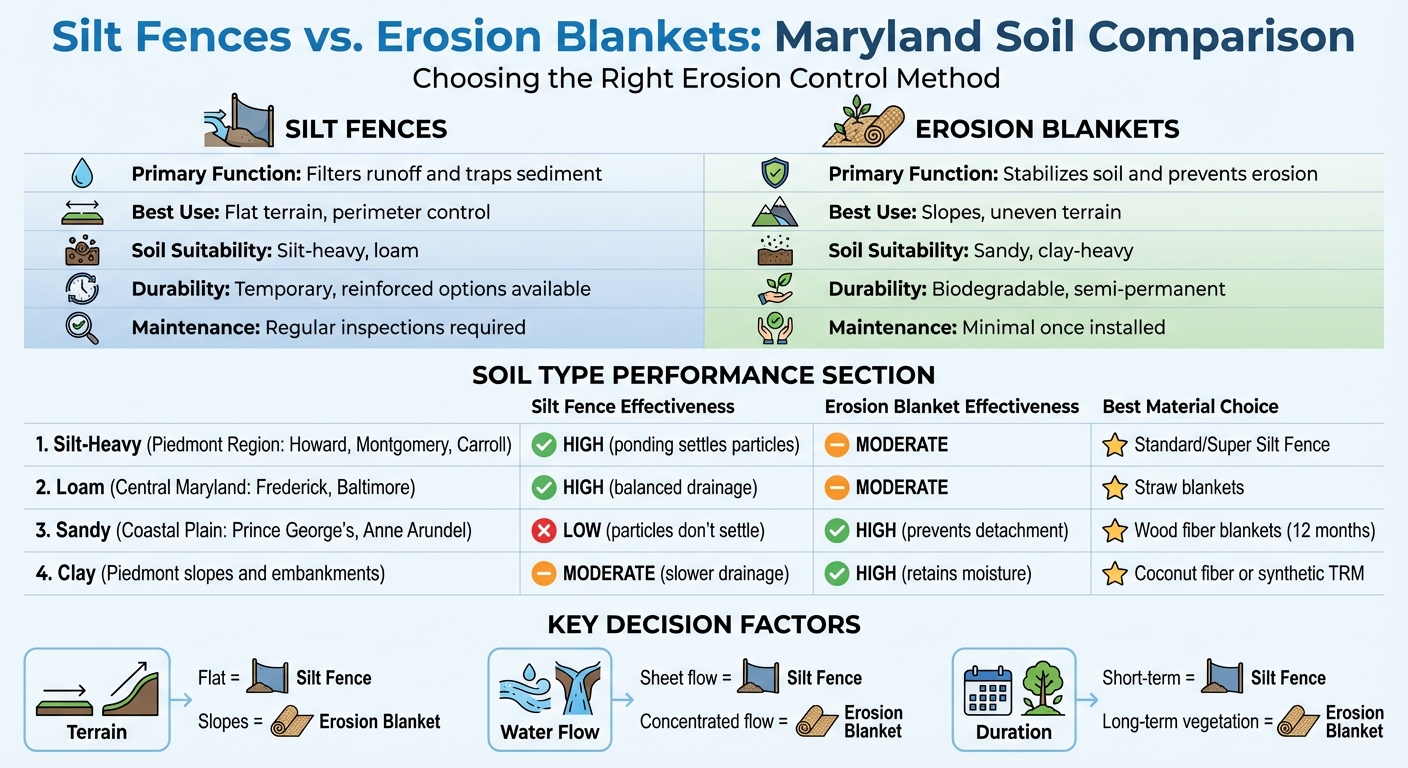
Silt Fences vs Erosion Blankets: Maryland Soil Comparison Chart
Erosion Control and Silt Fence
sbb-itb-843f8be
Silt Fences Explained
In Maryland’s varied soil conditions, silt fences are a key tool for controlling sediment runoff. These temporary barriers are placed around construction sites to filter sediment-laden water before it can reach nearby waterways or properties. By intercepting surface water, silt fences trap sediment while allowing water to drain in a controlled manner. This simple yet effective method has been a staple in Maryland’s sediment control efforts for decades[1].
The fabric used in silt fences acts as a filter, capturing soil particles while letting water pass through at a manageable rate. Standard silt fences are suitable for general use on residential and commercial sites. However, areas with high water flow require stronger options. Super Silt Fences, reinforced with chain-link backing, are designed for durability in heavy runoff conditions or long-term projects. For cases where water needs to be redirected, diversion fences are used to guide runoff to specific areas.
Understanding proper installation methods is crucial to ensure these fences work effectively in Maryland’s diverse environments.
How Silt Fences Are Installed
Installing a silt fence involves digging a narrow trench, placing the fabric into the trench, and backfilling it with compacted soil to prevent water from seeping underneath. Posts, made of either wood or metal, are driven into the ground at regular intervals to support the fabric, which is secured with wire ties or staples. Maryland Department of Transportation (DOT) standards outline specific trench depths and post spacing to meet state sediment control regulations.
In urban areas, where pavement or concrete makes trenching impossible, alternative methods are used. Silt Fence on Pavement installations rely on surface-mounted brackets and weights to secure the barrier directly onto hard surfaces. This allows for effective sediment control while avoiding damage to existing infrastructure.
Where Silt Fences Work Best and Their Limits
The effectiveness of silt fences depends on proper installation and the conditions of the site. They perform best on relatively flat terrain with sheet flow runoff, making them ideal for enclosing graded lots and areas with disturbed soil. When installed and maintained correctly, they excel at trapping sediment from fine, silt-heavy soils.
However, silt fences have limitations. They struggle in areas with concentrated water flow or steep slopes, where fast-moving water can overwhelm the fabric or cause erosion beneath it. Rocky terrain can also pose challenges, as trenching and anchoring are more difficult without specialized tools. In high-flow zones, Super Silt Fences are necessary to prevent tearing or post failure. Regular inspections and maintenance are also critical to ensure the fence remains effective over time.
Erosion Blankets Explained
Erosion blankets, also called Erosion Control Blankets (ECBs), are rolled woven covers designed to protect disturbed soil. Unlike silt fences, which act as barriers to filter runoff, these blankets work as source controls, stopping soil movement at its origin. In Maryland, erosion blankets are commonly used on highway embankments, residential developments, and stream bank restoration projects to comply with sediment control standards.
These blankets tackle erosion by absorbing the impact of raindrops, reducing splash erosion, and slowing surface water flow. They also anchor soil on steep slopes and help retain moisture while regulating ground temperature – ideal for seed germination. This ensures young grass sprouts are less likely to be washed away or eaten by wildlife before their roots take hold. Proper installation is key: the top edge should be anchored in a 6-inch trench to prevent "tenting", and the blanket must be secured with 1.5–2.5 staples per square yard after grading away rocks and clumps for full soil contact.
Common Erosion Blanket Materials
Erosion blankets come in various materials, each suited to specific conditions:
- Straw blankets: These are the most budget-friendly option, lasting about 6 to 12 months. They perform well on the clay-heavy slopes of Maryland’s Piedmont region, where soils naturally retain moisture.
- Coconut fiber (coir) blankets: More durable, these blankets last 24 to 36 months and are ideal for Maryland’s coastal areas, where strong winds and frequent moisture demand tougher materials.
- Wood fiber blankets: Offering a middle ground, these blankets typically last between 12 and 24 months.
For steeper slopes or areas with high-flow drainage channels, synthetic turf reinforcement mats (TRMs) are a durable choice. These permanent or semi-permanent options can handle intense water flow, making them suitable when vegetation alone isn’t enough to stabilize the soil. The best material depends on factors like slope steepness, soil type, and how long protection is needed before vegetation takes over.
Where Erosion Blankets Work Best and Their Limits
Erosion blankets shine on steep slopes where silt fences may struggle. They are especially effective in Maryland’s sandy soils, which erode quickly and can overwhelm traditional barriers. By providing continuous surface coverage, erosion blankets prevent soil from detaching, even in areas with concentrated water flow or uneven terrain.
That said, they’re not without drawbacks. Biodegradable materials like straw and wood fiber will naturally break down over time, meaning replacements might be necessary if vegetation doesn’t establish quickly. Installation requires smooth, well-prepared soil – gaps between the blanket and the ground can drastically reduce effectiveness. Additionally, rocky or uneven surfaces may require significant grading to ensure proper contact, adding to labor and time requirements.
How Maryland Soil Types Affect Performance
Maryland’s diverse geography creates distinct soil zones, each influencing how well erosion control measures like silt fences and erosion blankets perform. For example, the Piedmont region – which includes counties like Howard, Montgomery, and Carroll – features moisture-retaining soils rich in silt and loam. On the other hand, the Coastal Plain, covering areas such as Prince George’s and Anne Arundel Counties, has sandy soils that drain quickly and are more erosion-prone. Understanding these differences is key to selecting the right erosion control method for each area.
Performance by Soil Type
Silt fences perform best in silt and loam soils found in the Piedmont. These soils are fine-grained and tend to stay suspended in water longer. When runoff occurs, it creates ponding behind the silt fences, slowing the water flow and allowing fine particles to settle[1]. This makes them especially effective in areas with clay-loam soils.
Erosion blankets shine in sandy soils, which are more common in the Coastal Plain. Sandy soils erode quickly because their larger particles don’t stay suspended as easily. Instead of filtering sediment after it moves, erosion blankets work by covering the soil surface, preventing particles from detaching in the first place. For sandy areas, wood fiber blankets can protect the soil for up to 12 months while vegetation establishes itself[3]. Meanwhile, in the clay-heavy slopes of the Piedmont, coconut fiber blankets are a better choice, offering 2 to 3 years of protection and retaining moisture more effectively[3].
Soil Type Comparison Table
| Soil Type | Dominant Maryland Region | Silt Fence Effectiveness | Erosion Blanket Effectiveness | Best Material Choice |
|---|---|---|---|---|
| Silt-Heavy | Piedmont (Howard, Montgomery, Carroll) | High – ponding settles fine particles[1] | Moderate – not always necessary | Standard or Super Silt Fence[1] |
| Loam | Central Maryland (Frederick, Baltimore) | High – supports balanced drainage[1] | Moderate – straw blankets work well | Straw blankets (~3 months)[3] |
| Sandy | Coastal Plain (Prince George’s, Anne Arundel) | Low – particles don’t settle easily | High – prevents surface detachment | Wood fiber blankets (12 months)[3] |
| Clay | Piedmont slopes and embankments | Moderate – slower drainage may overflow | High – retains moisture effectively | Coconut fiber or synthetic TRM[3] |
These insights help in choosing the right products for Maryland’s varied soil conditions. For high-flow or long-term needs, synthetic Turf Reinforcement Mats (TRMs) like Landlok 435 provide up to 10 years of protection across different regions[2]. These mats, priced at about $508.55 per 8′ x 140′ roll, meet MDOT Type B SSM specifications, making them ideal for demanding applications[2]. When traditional solutions are insufficient, TRMs offer a reliable alternative, complementing both silt fences and erosion blankets.
Silt Fences vs. Erosion Blankets: Side-by-Side Comparison
When working on construction sites in Maryland, choosing between silt fences and erosion blankets depends on the specific type of protection your site needs. Silt fences are designed to filter runoff and capture sediment along the edges of a site. In contrast, erosion blankets focus on stabilizing slopes by stopping soil from eroding at its source.
Each option serves a distinct purpose. Silt fences are ideal for managing sediment at site perimeters, while erosion blankets are better suited for stabilizing slopes and dealing with challenging terrain. Here’s a closer look at their defining features:
Feature Comparison Table
| Feature | Silt Fences | Erosion Blankets / Filter Logs |
|---|---|---|
| Primary Function | Controls sediment at site perimeters and filters runoff | Protects slopes and traps sediment directly |
| Installation Method | Trenched, anchored, or mounted on pavement | Surface-mounted on slopes or used as check dams |
| Reinforcement | Can include chain-link reinforcement for high-flow areas | Uses natural barriers like filter or mulch logs |
| Maintenance | Needs regular checks to avoid undercutting | Requires little upkeep once installed |
| Durability | Temporary or extended-use options with reinforcement | Made from biodegradable, natural materials |
| Best Maryland Use | Perimeter control for residential, commercial, and DOT projects | Slope stabilization and handling tough terrain |
| Compliance | Must meet Maryland ESC and DOT standards | Must adhere to local and state sediment control codes |
When to Use Each Solution
The choice between these two solutions often comes down to your site’s specific needs and conditions.
- Silt Fences: Use these when your primary goal is to stop sediment from leaving the construction site. Standard silt fences work well for general use. For high-flow areas or projects needing more durability, reinforced options like Super Silt Fences are better. If your site is near sensitive Maryland waterways, Smart Fences with built-in filtration can provide extra protection. Diversion Fences are another option, redirecting runoff to approved containment areas.
- Erosion Blankets: These are the go-to solution for stabilizing slopes and stopping soil erosion. They’re particularly helpful on steep embankments and graded areas where silt fences might fall short. Depending on the terrain and the specific soil characteristics in Maryland, erosion blankets or filter logs can provide effective slope protection. While silt fences act as vertical barriers to control sediment, erosion blankets and filter logs serve as natural, surface-level defenses.
(Source: Maryland sediment control guidelines [1])
Pro Landscapes MD: Erosion Control Services

Pro Landscapes MD brings nearly 40 years of hands-on experience in sediment control and landscaping, making it a trusted name for construction projects across central Maryland. Operating under Erosion Control and Landscape Services, their skilled teams are well-versed in state and DOT sediment control standards, ensuring every project meets the necessary guidelines.
This deep knowledge allows them to blend various erosion control techniques effortlessly.
"With nearly 40 years of experience, we understand the importance of precision, durability, and regulatory compliance when it comes to protecting job sites and surrounding environments."
- Erosion Control and Landscape Services [1]
From residential landscaping to large-scale commercial and DOT infrastructure projects, Pro Landscapes MD provides tailored solutions for any challenge.
Combining Erosion Control Solutions
Pro Landscapes MD uses a mix of erosion control methods alongside expert drainage and grading services. Their offerings include Standard Silt Fences for general perimeter control and Super Silt Fences, which feature chain-link reinforcement for areas with heavy water flow or projects requiring extra durability. For sites near sensitive waterways in Maryland, they install Smart Fences equipped with filtration systems to enhance runoff protection.
For managing runoff, they use Diversion Fences to channel water toward approved containment areas, often pairing these with French drains and stormwater systems. On slopes, natural barriers like Filter Logs and Mulch Logs are used as check dams and sediment traps, providing effective solutions where traditional fencing may not work as well.
These comprehensive approaches ensure effective erosion control across various Maryland locations.
Service Areas in Maryland
Pro Landscapes MD serves a wide range of communities, including Howard County, Montgomery County, Carroll County, Frederick County, Prince George’s County, and Baltimore County, as well as Washington, DC.
Their in-depth understanding of Maryland’s diverse soil conditions – ranging from the heavy clay soils found in central Maryland to the sandy loam of coastal areas – enables them to customize solutions for each site. Whether tackling the steep slopes of Carroll County or navigating urban construction in Montgomery County, Pro Landscapes MD ensures every erosion control strategy aligns with local soil characteristics and regulatory demands.
Conclusion
Choosing the right erosion control method depends on factors like soil type, slope, and potential environmental risks. For instance, silt fences are highly effective as physical barriers in areas with a high risk of sediment discharge. On the other hand, erosion blankets are better suited for steep slopes, as they offer excellent stabilization and promote vegetation growth, providing crucial surface protection.
Maryland’s diverse soil types – ranging from dense clays to sandy loams – present unique challenges. A solution that works well in Baltimore’s urban settings might not perform as effectively on the steep slopes of Carroll County. Soil characteristics, such as how they handle water flow, compaction, and vegetation, play a significant role in determining the success of any erosion control measure.
Erosion Control and Stormwater Engineer David Jenkins, CPESC, emphasizes the importance of innovation:
"Engineers and contractors must always assess risk and address it appropriately, but they are encouraged to think out of the box that currently favors silt fencing" [4].
This underscores the importance of a customized, site-specific approach. Consulting professionals familiar with Maryland’s regulations and soil conditions is essential to ensure compliance with DOT standards and protect local waterways. Additionally, proper installation is critical to avoid failures during severe weather events.
The best erosion control strategies combine immediate actions to manage sediment with long-term solutions to stabilize soil. This dual approach minimizes environmental impacts and ensures lasting success in Maryland’s varied landscapes.
FAQs
Can I use silt fences and erosion blankets together?
Yes, silt fences and erosion blankets work well together to manage erosion effectively. While silt fences are designed to filter stormwater runoff and trap sediment, erosion blankets help stabilize exposed surfaces, promote vegetation growth, and shield soil from erosion. Using both methods together is particularly effective in Maryland’s varied landscapes, providing stronger sediment control, improved soil stability, and ensuring adherence to local regulations.
What’s the biggest cause of silt fence failure in Maryland storms?
The main reason silt fences fail during storms in Maryland is improper installation paired with lack of maintenance. When these issues occur, the fence can’t do its job of controlling sediment effectively. To keep silt fences working as they should, it’s essential to focus on correct installation and carry out regular inspections.
How do I choose the right erosion blanket material for my soil?
When choosing an erosion blanket, focus on three key factors: soil type, slope, and project duration. If you need temporary stabilization, natural fiber options like straw or coconut are a great fit, offering durability for anywhere between 3 months and 5 years. For longer-lasting solutions, synthetic geotextiles made from materials like polypropylene or polyester can endure for several years. Make sure your selection complies with Maryland’s regulations and effectively handles your soil stability and water flow needs.
Chat with Us