









- bhavya gada
- No Comments
Erosion on sunny slopes can cause serious damage to soil, plants, and nearby structures. Sun exposure dries out soil, making it less stable, while rainwater runoff carries away topsoil. This problem is common in areas like central Maryland, where steep slopes, clay-heavy soils, and heavy rainfall worsen erosion.
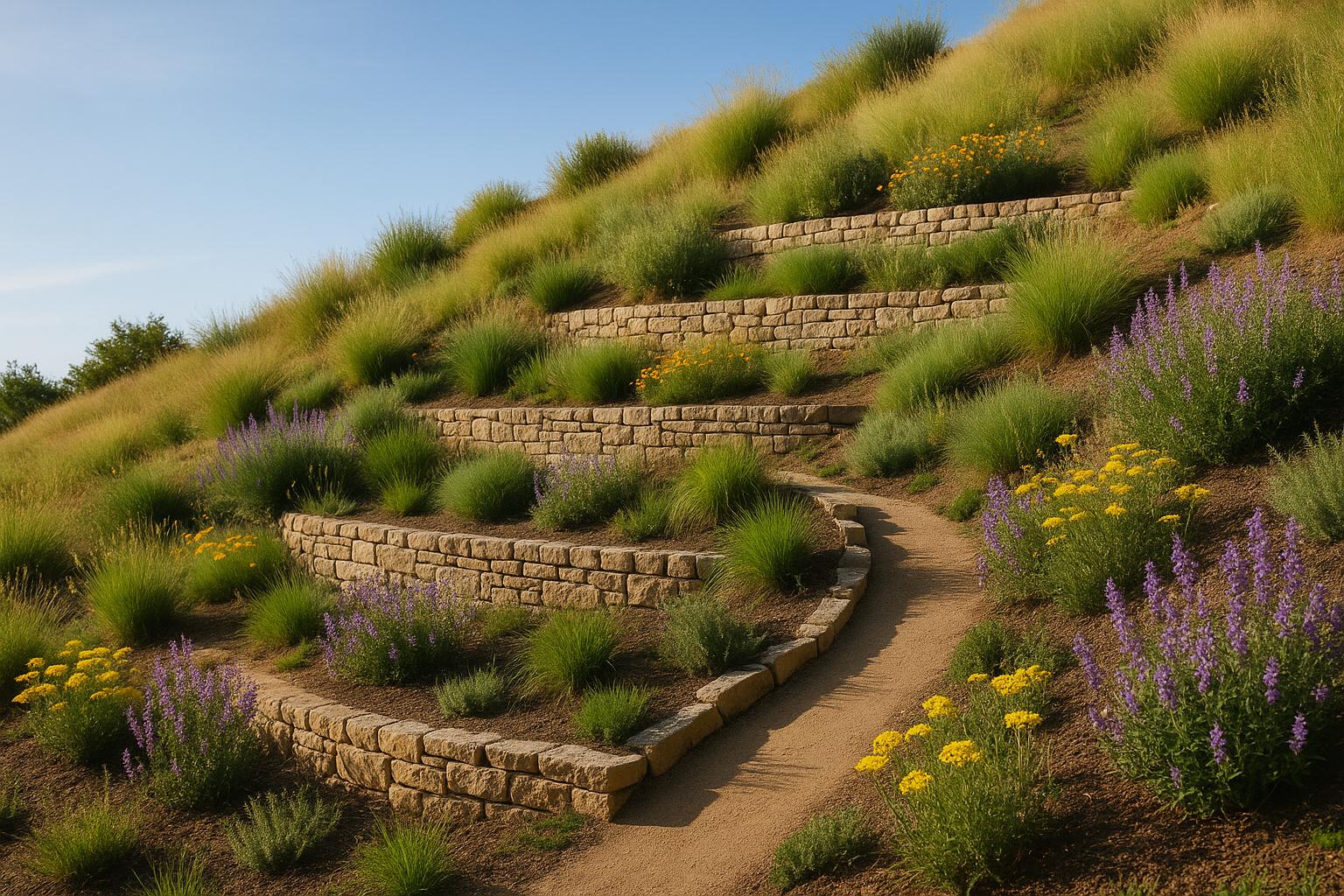
The solution? Combine plants with strong root systems and hardscaping techniques to stabilize slopes and prevent soil loss. Deep-rooted grasses, native shrubs, and groundcovers work together to anchor soil, slow water flow, and protect against erosion. Adding retaining walls, terraces, or drainage systems can further reinforce steep or challenging slopes.
Key strategies include:
- Deep-rooted plants (e.g., Switchgrass) for anchoring soil layers.
- Layered planting with groundcovers, shrubs, and trees for maximum protection.
- Hardscaping (e.g., retaining walls, terraces) for immediate structural support.
- Maintenance like watering, mulching, and monitoring for long-term stability.
For Maryland properties, native plants like Gray Dogwood, Creeping St. John’s Wort, and Butterfly Milkweed are excellent choices. These plants thrive in local conditions while preventing erosion. Pairing plants with professional hardscaping ensures a durable, low-maintenance solution.
Erosion control isn’t just about protecting your property – it also improves water management and soil health while creating a more stable landscape.
HILLSIDE STABILITY USING PLANT MATERIAL | HOW TO and What Plants to Use
How Erosion Works on Sunny Slopes
To grasp why sunny slopes are especially prone to erosion, it’s important to understand the forces at play. Erosion on these slopes is a combination of natural elements working together in a cycle that’s tough to interrupt without taking action.
How Sun Exposure Makes Erosion Worse
Prolonged sunlight dries out soil, making it fragile and prone to erosion. Daily exposure to intense sunlight removes moisture and breaks down the bonds between soil particles. Over time, this drying effect leaves the soil loose, crumbly, and unable to retain water effectively.
The impact of sun exposure doesn’t stop at the soil – it also weakens vegetation. Plants that would normally anchor the soil with their roots often struggle under harsh sunlight. As vegetation thins out or dies, the ground loses its natural protection. Without this coverage, rain hits bare soil directly, dislodging particles and setting the erosion process in motion.
Once vegetation is gone, surface runoff takes over. Sun-hardened, compacted soil becomes resistant to absorbing water. Rainwater rushes downhill instead, carrying topsoil with it. This leads to different types of erosion:
- Sheet erosion removes soil in thin, even layers.
- Rill erosion carves small channels that grow deeper over time.
- Gully erosion creates large channels, destabilizing entire slopes.
Studies reveal that slopes with less than 70% plant cover can lose up to 100 times more soil compared to fully vegetated areas[4]. This demonstrates just how vital vegetation is in preventing erosion, especially on sunny slopes. The problem is even more pronounced under Maryland’s specific soil and weather conditions.
Local Maryland Factors That Cause Erosion
Maryland’s environment creates an ideal setting for slope erosion. The region’s soil types – sandy loam and clay – are naturally prone to runoff. Sandy loam lacks the cohesion needed to hold particles together, while clay compacts easily, shedding water rather than absorbing it. Both conditions lead to increased surface water flow.
Maryland’s weather patterns add to the problem. Intense summer storms, common in the state, often dump large amounts of rain in a short time. When this rain hits sun-dried slopes, the soil can’t absorb it quickly enough, leading to rapid runoff. This runoff carries away loose soil and creates visible channels along the slope.
Winters in Maryland also play a role through freeze-thaw cycles. As water in soil cracks freezes and expands, it loosens the soil structure. When spring rains arrive, this loosened soil becomes even more vulnerable to erosion. The heavy spring downpours characteristic of the region wash away soil that has already been weakened by winter conditions.
In central Maryland, south-facing slopes in areas like Columbia, Ellicott City, and Gaithersburg are particularly vulnerable. After heavy summer storms, homeowners often notice soil washed onto patios or driveways, rills forming on slopes, and mulch piling up at the base[8]. This pattern is widespread, exacerbated by the combination of clay-heavy soils and intense heat.
Maryland’s steep terrain further amplifies erosion risks. Water flows faster on steep slopes, increasing its erosive power. Studies show that erosion rates rise exponentially as slope steepness exceeds 15 degrees[2][5]. This makes managing erosion on Maryland’s rolling hills especially challenging.
Plant-Based Solutions for Erosion Control
When it comes to managing erosion, plant-based strategies provide a long-lasting and environmentally friendly solution. By strategically planting vegetation, you can stabilize soil and control water flow on slopes exposed to sunlight, creating a system that becomes stronger over time.
Unlike quick fixes, vegetation offers a living solution that evolves and adapts. According to research from the USDA Forest Service, vegetative cover can reduce soil loss by as much as 90% compared to bare ground [9]. This impressive result is why professional landscapers often use plants as a cornerstone of their erosion control plans.
The Role of Root Systems in Stabilization
Root systems play a critical role in erosion control, with different types of roots offering unique benefits depending on the slope’s conditions.
- Deep roots anchor the soil layers and tie the topsoil to the underlying rock, reducing the chance of landslides and other major soil shifts. Switchgrass, for example, has deep roots that enhance vertical stability, especially during heavy rainfall.
- Fibrous roots create dense networks near the surface, holding soil particles together and minimizing surface runoff. Ornamental grasses are a great example, with their fine, spreading roots that grip the topsoil and help prevent erosion.
- Spreading roots interconnect with neighboring plants to form a web-like structure, stabilizing large areas and resisting erosion caused by water flow [1]. When roots from one plant link with another, they create a continuous underground barrier that distributes the force of flowing water.
One standout plant for erosion control is the Gro-low Sumac (Rhus aromatica). This native shrub features deep, dense roots that are ideal for stabilizing steep, sun-drenched hillsides [7].
Layered Planting for Better Erosion Control
Layered planting mimics natural ecosystems, creating a multi-level network that intercepts rainfall, slows water runoff, and provides comprehensive soil coverage. This method combines groundcovers, shrubs, and trees to deliver maximum protection.
- Groundcovers act as a protective carpet, absorbing the impact of raindrops and securing the topsoil. Creeping phlox, for instance, forms a mat of shallow, intertwining roots that hold the soil in place while offering year-round coverage.
- Shrubs provide mid-level stability and help disrupt water flow patterns. When strategically placed, shrubs slow water as it moves downhill, encouraging it to soak into the soil rather than run off. Their branches and stems also trap sediment and organic matter, gradually enriching the soil.
- Trees contribute deep anchoring and shade, reducing evaporation and heat stress on the slope. While trees take longer to establish, their extensive root systems eventually provide robust stabilization. Additionally, their shade protects lower-level plants from the harsh sun, ensuring the overall health of the slope’s vegetation.
This layered approach works as a team: water passing through the tree canopy is slowed by shrub branches and then absorbed by groundcover roots. Even if one layer is stressed, the others continue to provide protection. For slopes where plants alone aren’t enough, structural measures can complement this strategy.
Combining Plants with Hardscaping
Plant-based erosion control is most effective on moderately steep slopes with stable soil. However, in more challenging situations – such as steep slopes or areas with heavy runoff – combining vegetation with hardscaping elements can improve results.
- Retaining walls provide structural support on slopes steeper than 30 degrees. Vegetation planted above and below these walls enhances natural stabilization.
- Dry riverbeds are excellent for managing heavy runoff. Lining these channels with drought-tolerant grasses and bordering them with native shrubs creates a solution that’s both functional and visually appealing.
- Terraced retaining walls reduce the slope’s steepness, making it easier for plants to establish themselves. The walls offer immediate support while plant roots secure the soil behind and along water channels.
Determining whether plants alone can handle the job – or if hardscaping is necessary – requires a professional evaluation. Factors like slope angle, soil type, drainage patterns, and erosion history all play a role in this decision. For complex landscapes, experienced landscapers can design a plan that combines the best of both worlds, ensuring long-term stability and effectiveness.
Best Plants for Sun-Exposed Slopes in Maryland
When tackling sun-drenched slopes in Maryland, it’s crucial to choose plants that can handle intense sunlight, dry conditions, and steep terrain – all while keeping erosion in check. Native plants are ideal for this purpose, as they’re naturally adapted to the local climate and come equipped with strong root systems. Below are some great options that combine sturdy roots with diverse growth habits to protect and stabilize sunny slopes.
Ornamental Grasses and Shrubs
Switchgrass (Panicum virgatum) is a standout option for sunny slopes. This native grass develops deep roots that grip the soil, reducing both surface and subsurface erosion. It thrives in full sun, tolerates drought, and requires minimal maintenance.
Gray Dogwood (Cornus racemosa) is a reliable shrub for slope stabilization. Its hardy nature allows it to form dense thickets that anchor the soil, even in Maryland’s hot summers and fluctuating rainfall. Its spreading growth pattern also helps cover bare patches effectively.
Broomsedge (Andropogon virginicus) is another excellent choice, particularly for nutrient-poor soils. Its dense, fibrous roots are highly effective at stabilizing the ground.
For larger slopes, Arrowwood Viburnum (Viburnum dentatum ‘Blue Muffin’) provides additional support. Growing 5–10 feet tall, it thrives in various soil conditions, offering both erosion control and habitat value for wildlife.
To complement these grasses and shrubs, consider adding groundcovers and wildflowers for a layered approach to slope protection.
Groundcovers and Wildflowers
Creeping St. John’s Wort (Hypericum calycinum) is a fantastic groundcover that forms dense, fast-spreading mats. It not only suppresses weeds but also holds topsoil securely in place.
Native wildflowers like Butterfly Milkweed (Asclepias tuberosa) and Black-eyed Susan (Rudbeckia hirta) add both beauty and function. Butterfly Milkweed’s deep taproots anchor the soil while attracting pollinators with its vivid orange flowers. Black-eyed Susan, with its cheerful yellow blooms, helps prevent soil loss throughout the growing season.
Moss Phlox is perfect for early-season coverage. Its spreading habit and vibrant spring blooms form tight mats that shield the soil during heavy rains. Other great options include Clustered Mountain Mint and Green and Gold, both of which spread easily to create consistent, low-maintenance coverage.
Plant Combinations for Best Coverage
The most effective erosion control comes from combining plants with different root structures and growth habits. For example, pairing Switchgrass for deep soil anchoring with Black-eyed Susan for mid-level coverage and Moss Phlox for surface protection ensures comprehensive coverage and minimizes bare spots.
Another winning combination includes Gray Dogwood as a structural anchor, Butterfly Milkweed for deep-rooted stability, and Creeping St. John’s Wort for dense surface coverage. This mix creates a layered root network that disperses water flow and resists both surface runoff and deeper soil movement.
| Plant Type | Species | Root System | Stabilization Benefit |
|---|---|---|---|
| Deep Grass | Switchgrass | Deep, penetrating | Vertical soil anchoring |
| Spreading Shrub | Gray Dogwood | Dense, fibrous | Thicket formation |
| Surface Cover | Creeping St. John’s Wort | Shallow, mat-forming | Surface protection |
| Wildflower | Black-eyed Susan | Taproot with laterals | Multi-level stability |
When arranging these plants, stagger them in overlapping patterns to create a continuous root network. This approach spreads the force of water flow across multiple plant types, enhancing overall slope stability compared to single-species plantings.
The secret to long-term success lies in matching each plant’s strengths to the specific challenges of your slope while ensuring year-round coverage. Native species are a dependable choice for erosion control in Maryland’s climate, offering resilience and reliability for years to come.
sbb-itb-843f8be
Planting and Maintenance Methods for Slopes
When it comes to using plants for erosion control, preparation and ongoing care are non-negotiable for ensuring long-term slope stability. Establishing vegetation on sun-exposed slopes takes thoughtful planning and consistent effort. The difference between thriving plants that protect the soil and struggling ones that fail to prevent erosion often lies in the details.
Preparing the Site for Planting
Start by clearing the area of weeds, debris, and invasive plants. To improve soil quality, mix in compost or manure for added organic matter. For clay-heavy soils, adding sand or gypsum can improve drainage, while sandy soils benefit from extra organic material. Don’t skip soil testing – aim for a pH level between 6.0 and 7.0 to create the ideal environment for plant growth [10].
Erosion control blankets are a great first step to stabilize the soil while plants take root. These biodegradable fiber mats not only hold the soil in place but also enrich it as they decompose. Choose the right blanket for your slope: single-net blankets work for slopes up to 3:1, double-net blankets are better for slopes up to 2:1, and slowly degrading options are ideal for steeper slopes nearing 1.5:1 [11].
If the terrain is especially steep, consider building terraces or small benches to create flat planting zones. These structures help slow water runoff and make planting easier. After planting, apply 2–4 inches of coarse mulch – like shredded bark or leaf mold – around plants to retain moisture, block weeds, and shield the soil. For newly seeded areas, spreading 2–3 bales of straw per 1,000 square feet provides effective coverage [11]. Always plant along contour lines to naturally slow water flow.
Once the site is prepared and planted, maintaining the area is crucial to ensure the plants thrive and the soil stays stable.
Maintenance for Sun-Exposed Areas
After planting, consistent care is essential to protect your efforts. Watering is a top priority. Drip irrigation or soaker hoses are ideal because they deliver water directly to the roots without causing runoff. Water early in the morning, and remember that new plantings need frequent watering during their first two growing seasons [6].
Weed management is another key task. Regularly remove weeds by hand to conserve water and nutrients for your plants. Reapply mulch as needed to keep weeds at bay and protect the soil.
Pruning shrubs and groundcovers encourages dense growth, which improves soil retention. Keep an eye on your plants for signs of stress, such as wilting or discoloration – these could indicate watering problems or nutrient deficiencies.
Monitoring the slope is essential, especially after heavy rains. Look for issues like washouts, exposed roots, or bare patches. Address these problems quickly by replanting, adding mulch, or adjusting drainage to ensure the soil remains covered. Seasonal upkeep, like replenishing mulch, repairing irrigation systems, and checking for pests or diseases, is also important. Fall is a great time to evaluate plant health and plan for any replacements or additions in the spring.
For challenging slopes or areas with severe erosion, professional help can make all the difference. Companies like Pro Landscapes MD specialize in services such as soil improvement, erosion control blanket installation, and tailored planting plans designed for central Maryland’s specific climate and soil conditions.
Complete Solutions with Pro Landscapes MD

Pro Landscapes MD takes erosion control to the next level by combining plant-based strategies with professional, integrated solutions. If you’re dealing with erosion on steep, sun-drenched slopes, the best results come from using multiple strategies together. Pro Landscapes MD specializes in creating tailored solutions that blend vegetation, structural features, and water management systems to handle even the toughest slope challenges across central Maryland.
Combining Planting and Hardscaping for Lasting Results
The secret to effective erosion control lies in layering protection methods. Pro Landscapes MD starts with durable hardscape elements for immediate stability, then enhances them with carefully chosen plants for long-term soil reinforcement.
Their services include installing natural stone retaining walls, effective drainage systems like French drains and dry riverbeds, and native plantings to stabilize slopes. Retaining walls are particularly effective, as they create terraced areas that slow water runoff and hold soil in place. On gentler slopes, garden and seat walls provide similar benefits while also adding functional outdoor spaces.
Strategic plantings work hand-in-hand with these hardscapes. Deep-rooted native shrubs, such as Virginia Sweetspire and Buttonbush, anchor the soil between terraces. Meanwhile, ornamental grasses and groundcovers fill in gaps, creating a natural network of protection. This dual approach ensures erosion is tackled from every angle: walls physically secure the soil, while plant root systems provide a living layer of defense.
Drainage systems play a key role, too. Integrated solutions manage water flow and enhance soil stability, making the entire system more resilient and easier to maintain.
"Retaining walls add both structural support and visual appeal, managing slopes and preventing erosion", says Pro Landscapes MD.
Tailored Solutions for Central Maryland Properties
Every property comes with its own set of challenges, and Pro Landscapes MD brings the expertise needed to address them. Their team of trained landscape designers and horticulturists understands the unique conditions of central Maryland, from Montgomery County’s clay-heavy soils to the sandy terrain found in parts of Baltimore County. This local knowledge ensures solutions that stand the test of time.
"Very few other landscapers will have gone to college for landscape design/horticulture, which puts our business and skill set ahead of the competition", notes Pro Landscapes MD.
The process begins with a detailed site assessment. Factors such as soil type, slope angle, sun exposure, and drainage patterns all shape the final design. For example, a steep slope with heavy clay soil might require extensive terracing, well-placed drainage systems, and drought-tolerant native plants. A gentler slope with sandy, well-draining soil might only need selective hardscaping and deep-rooted groundcovers.
Local climate is another essential consideration. Maryland’s hot, humid summers and unpredictable winters demand plants and materials that can handle these extremes. Pro Landscapes MD prioritizes native species that thrive naturally in the area, reducing maintenance and increasing long-term success.
The company also emphasizes environmentally friendly practices. This includes using eco-conscious pavers and drainage solutions that not only combat erosion but also support local ecosystems and minimize environmental impact.
"Each property has unique challenges. We provide personalized designs that fit your specific needs, preferences, and landscape", Pro Landscapes MD emphasizes.
To ensure these solutions remain effective, Pro Landscapes MD offers ongoing maintenance services, including landscape restoration, drainage upkeep, and plant care. This commitment helps keep erosion control systems performing at their best.
Customer feedback highlights the success of this approach. One client shared:
"They came through with everything promised. I love the stacked stones we placed around our trees and flowerbed."
From the initial design to installation and ongoing care, Pro Landscapes MD delivers comprehensive solutions that not only protect your property but also enhance its natural beauty.
Conclusion: Solving Erosion Through Smart Design
Erosion on sun-drenched slopes isn’t just an eyesore – it can seriously threaten the stability and value of your property. The combination of intense sunlight, fast-moving water runoff, and weakened soil creates a recipe for landscape trouble. But with thoughtful design, blending strategic planting and hardscaping, even the trickiest slopes can become both practical and visually appealing.
As discussed earlier, effective erosion control requires a mix of natural and structural solutions. Deep-rooted native plants paired with structural tools like retaining walls and proper drainage systems can reduce soil erosion by as much as 90% compared to untreated slopes[12]. These approaches not only stop soil loss but also turn problem areas into low-maintenance, attractive features that add value to your property.
Eco-conscious methods provide a smart, long-term solution. Native plants, perfectly adapted to Maryland’s climate, need less water and upkeep while supporting local wildlife. Features like environmental pavers and dry riverbeds work with natural processes to create durable landscapes that can handle harsh weather conditions.
Pro Landscapes MD takes a comprehensive approach to erosion control. From initial soil assessments to integrated planting and hardscaping, every element is designed to work together seamlessly. Their expertise ensures long-lasting stability and beauty, with maintenance plans to keep your landscape thriving.
Investing in proper erosion control pays off in the long run. Retaining walls and terraces can slow runoff by over 50%[3][9], while established plant root systems continually stabilize the soil, reducing repair needs and maintenance costs. Over time, these landscapes mature into stunning, resilient spaces.
Smart design transforms sun-exposed slopes from a problem into a feature. By combining plants, hardscaping, and drainage solutions tailored to Maryland’s conditions, these challenging areas become essential parts of a beautiful and functional outdoor space – one that protects your property and enhances its value for years to come.
FAQs
Why are native plants a good choice for controlling erosion on sunny slopes in Maryland?
Native plants are a smart option for controlling erosion on sunny slopes in Maryland. They thrive naturally in the region’s climate and soil, and their deep root systems do a great job of anchoring soil. This helps minimize runoff and keeps erosion in check, even on steep or tricky landscapes.
Beyond their practical uses, native plants play a key role in supporting local ecosystems. They provide food and shelter for pollinators and wildlife, helping to maintain biodiversity. Plus, they’re low-maintenance – they need less water, fertilizer, and care than non-native plants, making them an economical and environmentally friendly choice for sunny slopes.
How do retaining walls and terracing help control soil erosion on sunny slopes?
Retaining walls and terracing are practical ways to tackle soil erosion on steep, sun-soaked slopes. Retaining walls act as a sturdy barrier, keeping soil in place and reducing the risk of it being swept away during heavy rainfall. Terracing works differently – it reshapes steep slopes into flat, stepped sections. This slows down water runoff and helps the ground absorb moisture more effectively.
Beyond controlling erosion, these techniques open up space for planting hardy, erosion-resistant plants, adding both utility and visual appeal to your outdoor area.
What are the key maintenance steps to keep erosion control effective on sunny slopes?
To keep erosion control effective on sunlit slopes, regular maintenance is key. Begin by inspecting the area for signs of soil movement or damage to plants and structures, particularly after heavy rainfall. Addressing these problems quickly can help stop minor issues from escalating.
Keep plants healthy by watering them as needed, especially during dry spells, and use mulch to conserve soil moisture and minimize surface runoff. Trim back overgrown vegetation occasionally to ensure the ground remains covered without overcrowding. For features like retaining walls or drainage systems, check for cracks, blockages, or general wear and tear. Make any necessary repairs to keep these systems working properly.
Taking these steps consistently will help maintain the slope’s stability and appearance for years to come.
Chat with Us