









- bhavya gada
- No Comments
Maryland homeowners face costly stormwater problems like flooding, erosion, and polluted runoff. Grant and rebate programs in counties like Prince George’s, Montgomery, and Howard help offset these expenses by funding solutions such as rain gardens, permeable pavement, and tree planting. For example, residents in Prince George’s County can receive up to $6,000 in rebates, while Montgomery County offers up to $7,500 for RainScapes projects. Larger organizations, such as HOAs, may qualify for even more funding. These programs also provide technical support to ensure projects are effective and compliant.
Key Highlights:
- Common Issues: Flooding, erosion, and pollution from runoff.
- Available Grants: Up to $7,500 for homeowners; $20,000+ for organizations.
- Eligible Projects: Rain gardens, permeable pavement, native trees, and more.
- Support: Site assessments and professional assistance available.
Reimagining Watershed Management – Creative Funding Models and Partnerships for an Inclusive Future
sbb-itb-843f8be
Stormwater Problems Maryland Homeowners Face
Maryland homeowners are grappling with increasing stormwater issues. When rain hits rooftops, driveways, and sidewalks, it flows over these hard surfaces, carrying pollutants and excess water into nearby streams and rivers [1]. This process creates a chain reaction of problems, impacting individual properties and the Chesapeake Bay watershed. These challenges highlight the importance of targeted grant funding to address costly stormwater management needs.
Flooding and Poor Drainage
Heavy rains often overwhelm Maryland’s drainage systems, leaving pools of standing water that harm lawns and landscapes [3]. Some homeowners face fast-moving runoff cutting through their yards during storms, displacing soil and forming unwanted channels [3]. The problem worsens when runoff from neighboring properties flows onto their land, adding to the drainage burden [3]. Poor drainage not only leads to higher repair costs but can also reduce property values.
Large paved areas exacerbate the issue by funneling untreated stormwater off-site. In Howard County, the problem is so severe that non-residential properties are charged a Watershed Protection Fee of $40 per 500 square feet of impervious surface to help fund stormwater treatment efforts [2]. To put it into perspective, just one inch of rain on a single acre of hard surface generates 27,000 gallons of stormwater runoff [7][9][10].
Erosion and Landscape Damage
Uncontrolled stormwater runoff erodes topsoil and damages landscapes [3]. This erosion not only disrupts the appearance of yards but also destabilizes the land, potentially threatening home foundations or requiring structural retaining walls. Fast-moving runoff also contributes to severe streambank erosion across Maryland, filling waterways with silt that destroys aquatic habitats [8][10].
A compelling example comes from the Windsor Green Homeowner’s Association in Greenbelt. In 2025, they removed 12,812 square feet of pavement around their community center after runoff caused significant damage to the area. By replacing the impervious surface with green space, they not only addressed the issue but also earned a $20,000 rebate for the project [4].
Impact on Local Waterways
Stormwater runoff from residential areas heavily pollutes local waterways. As rainwater flows across streets and yards, it collects harmful substances like petroleum products, heavy metals (such as copper and zinc), pesticides, and road salts, which then wash into nearby creeks [7][10].
"Polluted runoff is one of the fastest growing and most harmful sources of pollution threatening the Chesapeake Bay and its rivers and streams." – Chesapeake Bay Foundation [7]
The numbers are alarming: approximately 300 million pounds of nitrogen flow into the Chesapeake Bay annually – six times more than in the 1600s [7]. Copper, a toxic metal for aquatic life, is found in 92% of urban runoff samples, with levels reaching toxic thresholds 53% of the time [7]. This pollution has devastated the Chesapeake Bay’s ecosystem, leaving 80% of its oyster bars unproductive [10]. As a result, Maryland officials now advise against swimming in local waterways for 48 hours after heavy rainfall due to elevated bacteria levels from stormwater runoff [7].
Grant Programs for Stormwater Projects in Maryland
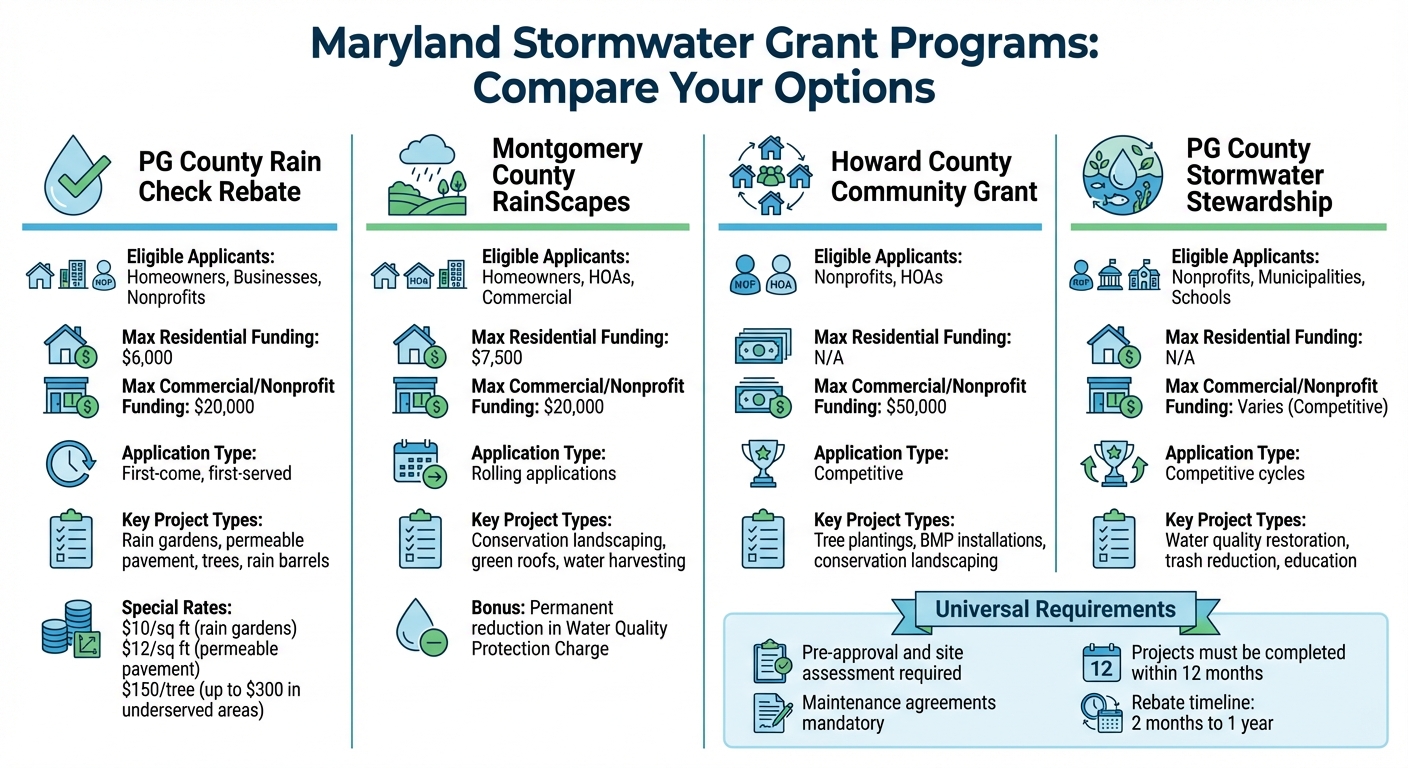
Maryland Stormwater Grant Programs Comparison: Funding Amounts and Eligibility
Maryland has developed several grant programs to help property owners manage stormwater issues. These initiatives aim to reduce costs for implementing green infrastructure, while also addressing pollution, flooding, and erosion. Knowing what programs are available and how they differ can help you secure the funding you need.
State and County Grant Programs
Prince George’s County offers two main funding options. The Rain Check Rebate Program, reinstated for fiscal year 2026, operates on a first-come, first-served basis. It reimburses property owners for approved projects like rain gardens, permeable pavement, and rain barrels [4]. Another option is the Stormwater Stewardship Grant Program, managed by the Chesapeake Bay Trust. This program uses a competitive application process and focuses on larger-scale water quality restoration projects for nonprofits, municipalities, and community groups [5].
In Montgomery County, the RainScapes Rewards Rebate provides funding for green infrastructure projects such as conservation landscaping, green roofs, and water harvesting systems [3]. This program excludes properties in Rockville, Gaithersburg, and Takoma Park, as these municipalities have their own programs [3]. Completing a RainScapes project can also lead to a permanent reduction in your annual Water Quality Protection Charge [3].
Howard County offers the Community Stormwater Partnership Grant, which is designed for nonprofits and homeowner associations. This program provides up to $50,000 for larger community projects like tree plantings and stormwater best management practices [2].
While these programs vary in details, understanding their eligibility requirements is key to accessing funds.
Who Qualifies for Grants
Eligible applicants include homeowners, businesses, nonprofits, homeowner associations (HOAs), and condo associations [5][4][1]. However, geographic restrictions apply, so it’s important to review specific program guidelines.
All programs require pre-approval and a site assessment before installation [1][3]. Projects that are mandated by permits for new construction, additions, or renovations typically do not qualify [4][1]. Additionally, applicants must sign maintenance agreements to ensure the long-term care of installed practices [1][3]. If you live in an HOA, written approval from the association is required before applying [1].
The table below summarizes the key differences between these programs.
Grant Comparison Table
| Program | Eligible Applicants | Max Residential Funding | Max Commercial/Nonprofit Funding | Application Type | Key Project Types |
|---|---|---|---|---|---|
| PG County Rain Check Rebate | Homeowners, Businesses, Nonprofits | $6,000 | $20,000 | First-come, first-served | Rain gardens, permeable pavement, trees, rain barrels |
| Montgomery County RainScapes | Homeowners, HOAs, Commercial | $7,500 | $20,000 | Rolling applications | Conservation landscaping, green roofs, water harvesting |
| Howard County Community Grant | Nonprofits, HOAs | N/A | $50,000 | Competitive | Tree plantings, BMP installations, conservation landscaping |
| PG County Stormwater Stewardship | Nonprofits, Municipalities, Schools | N/A | Varies (Competitive) | Competitive cycles | Water quality restoration, trash reduction, education |
Prince George’s County offers specific rebate rates: $10 per square foot for rain gardens (minimum 100 sq. ft.), $12 per square foot for permeable pavement, and $150 per native tree (minimum 5 feet tall) [1][4]. In underserved communities, tree canopy rebates can double to $300 per tree [4]. Montgomery County offers similar rates for comparable projects [3]. The timeline for receiving rebate checks can range from 2 months to a year, depending on site visits and construction timelines [4].
This table highlights the differences between programs, helping you make an informed decision for your stormwater project.
Stormwater Projects That Qualify for Grant Funding
Expanding on earlier grant strategies, these projects focus on reducing stormwater runoff and improving landscapes with eco-friendly solutions. Understanding which projects qualify can help homeowners and organizations secure rebates while improving water quality and promoting native plant use.
Rain Gardens and Bioretention Systems
Rain gardens are shallow, plant-filled areas designed to collect and filter runoff from hard surfaces. To qualify for rebates in Prince George’s County, these gardens must cover at least 100 square feet, with rebates offering $10 per square foot [4]. Native plants like creeping phlox and golden ragwort are essential for their water-absorbing and filtering abilities.
For example, a Greenbelt resident installed a 200-square-foot rain garden, earning a rebate of $1,057.80 through the Prince George’s County Rain Check Rebate Program [4]. Similarly, a Hyattsville homeowner planted 15 native trees, including Red Maple and Sweetbay Magnolia, to curb runoff and received a $2,250 rebate [4]. Bioretention systems, which operate on a larger scale, are ideal for commercial properties and homeowner associations.
Stream and Habitat Restoration
Stream restoration and erosion control projects are eligible for competitive funding through programs like the Prince George’s County Stormwater Stewardship Grant [5]. These initiatives aim to stabilize stream banks, restore wetlands, and install regenerative systems to slow water flow and prevent soil erosion.
Often led by nonprofits, municipalities, or community groups, these larger restoration projects must show clear water quality improvements and often involve public education or volunteer participation [5][11].
Green Infrastructure Options
In addition to rain gardens, other green infrastructure projects also qualify for funding. Permeable pavement, which allows water to seep through rather than run off, earns $12 per square foot in rebates in Prince George’s County [4]. For instance, a homeowner in Fort Washington replaced 303 square feet of traditional patio with permeable pavement, receiving a rebate of $3,703.50 [4].
Replacing impervious surfaces with native plants or grass can qualify for pavement removal rebates of $6 per square foot [4]. The Windsor Green Homeowner’s Association in Greenbelt removed 12,812 square feet of pavement to create green space and received the maximum institutional rebate of $20,000 [4]. Other eligible projects include conservation landscaping (250-1,000 square feet minimum), green roofs, French drains, and water harvesting systems like rain barrels and cisterns [4][3]. These options not only help reduce runoff but also enable Maryland residents to enhance their properties while earning meaningful rebates.
Working with Professionals for Grant-Funded Projects
Pro Landscapes MD‘s Drainage and Stormwater Services
Pro Landscapes MD delivers trusted drainage solutions throughout central Maryland, specializing in French drains, regrading, erosion control, and stormwater management systems. Their services cover Howard County, Montgomery County, Prince George’s County, Carroll County, Frederick County, and Baltimore County, ensuring comprehensive support across the region.
The company stands out with its expertise in environmental pavers and permeable paving systems that qualify for grant rebates, along with rain gardens featuring native plants. Their team of professional horticulturists ensures all plantings strictly adhere to native species requirements outlined by programs like the Prince George’s County Rain Check Rebate and Gaithersburg RainScapes.
Meeting Grant Requirements
Maryland’s grant programs come with strict compliance standards that require skilled professionals to navigate. Pro Landscapes MD, a certified contractor licensed through the MHIC and fully insured, handles all aspects of these requirements. This includes managing pre-approvals, coordinating site visits, and obtaining necessary permits for grant-funded projects. They also work with organizations like the Chesapeake Bay Trust, providing detailed project designs and cost estimates for review by Technical Review Committees. For larger projects – those disturbing more than 5,000 square feet of ground, moving over 100 cubic yards of earth, or creating grade changes over 12 inches – they take care of all permitting needs [4].
"The rebate amount will be the maximum rebate allowed or the actual costs, whichever is lower. A rebate request cannot exceed the cost of the project." – Chesapeake Bay Trust [4]
Once compliance is ensured, Pro Landscapes MD focuses on delivering solutions tailored to each property’s specific needs.
Custom Solutions for Maryland Properties
Pro Landscapes MD develops customized stormwater management plans that address individual property challenges while meeting strict grant requirements. Their approach blends technical know-how with a deep understanding of Chesapeake Bay watershed guidelines. This ensures property owners not only tackle stormwater issues but also make the most of available financial incentives.
The company also provides comprehensive documentation to help homeowners maximize rebate claims. Projects must be completed within 12 months of pre-approval to remain eligible [1]. Pro Landscapes MD manages project timelines to meet these deadlines and coordinates post-installation site visits for verification by grant agencies, ensuring a smooth process from start to finish.
Conclusion
Maryland’s grant programs provide a practical way to tackle stormwater issues while easing the financial burden on property owners. Through rebate programs, residents can significantly offset the costs of installing rain gardens, permeable pavement, and native tree plantings, all of which help protect their properties and improve local waterways [4].
Having expert assistance is key to making the most of these benefits. Licensed professionals ensure projects meet all compliance standards and pass inspections smoothly. From handling paperwork to coordinating pre-approval site visits and managing timelines, trained contractors help maximize rebate eligibility while delivering long-term solutions for flooding and erosion.
When properly installed, stormwater practices not only reduce annual fees but also improve property aesthetics and prevent expensive damage [6][2]. On a broader scale, these efforts benefit the Chesapeake Bay by filtering pollutants and minimizing harmful runoff.
"This program is a no-brainer if you are considering any of the green initiatives they cover… The process of applying for a rebate was so much easier and more straightforward than we expected." – Val and Daniel, Rebate Recipients [4]
With financial and ecological perks clearly outlined, Pro Landscapes MD leverages its expertise in Maryland’s grant requirements to turn drainage problems into lasting, compliant, and environmentally friendly solutions. These grant-supported projects not only address stormwater challenges but also boost property value and contribute to a healthier environment.
FAQs
Which Maryland stormwater grant or rebate program fits my property and county?
Finding the right stormwater grant or rebate program in Maryland depends on where you live. For instance, Montgomery County offers RainScapes Rewards, which provides rebates of up to $7,500. Prince George’s County runs the Rain Check Rebate Program, covering a variety of stormwater management practices. Meanwhile, Rockville has its own RainScapes program, with rebates capped at $5,000. Eligibility requirements and rebate limits differ by county and municipality, so it’s essential to review your local guidelines for specific details.
What steps do I need to complete before installing a grant-funded project?
Before moving forward with a grant-funded stormwater project, it’s crucial to carefully review the grant requirements. This includes thoroughly reading the application forms and guidance documents provided. Make sure to attend any informational sessions offered – these can help clarify the process and answer key questions.
Most grant programs require pre-approval before you can begin. This often means submitting a detailed plan that includes project designs, estimated costs with receipts, and a clear timeline. Double-check that your project aligns with the grant criteria, and be sure to obtain all required permissions from the appropriate authorities before starting installation. Skipping these steps could lead to delays or even disqualification from the funding.
How can I estimate my rebate amount and when will I receive it?
To figure out your rebate, start by identifying which stormwater management practices qualify and check the program limits. For example, Montgomery County offers up to $7,500, while Prince George’s County caps it at $6,000. Once you’ve reviewed the details, submit your application for pre-approval. After completing the project and passing verification, you can expect to receive your rebate check within approximately 12 months, depending on the program’s timeline.
Chat with Us