









- bhavya gada
- No Comments
When deciding between stone veneer and natural stone for your project, the choice hinges on factors like cost, weight, durability, and installation. Here’s a quick breakdown:
- Stone Veneer: A lightweight, manufactured material made to resemble natural stone. It’s more affordable, easier to install, and suitable for both interior and exterior applications. However, it may fade over time and isn’t ideal for areas with constant water exposure.
- Natural Stone: Quarried directly from the earth, it offers unmatched durability, longevity, and a one-of-a-kind look. While it’s heavier, more expensive, and requires skilled labor for installation, it withstands harsh weather and lasts for centuries.
Quick Comparison
| Feature | Stone Veneer | Natural Stone |
|---|---|---|
| Material Cost (sq. ft.) | $6–$12.50 | $35–$50 |
| Installation Cost (sq. ft.) | $5.50–$10.75 | $20–$30 |
| Weight | ~7–8 lbs/sq. ft. | ~13 lbs/sq. ft. |
| Durability | 25–50 years, may fade | 100+ years, colorfast |
| Maintenance | Requires gentle care | Low-maintenance, resists chemicals |
| Applications | Decorative, non-load-bearing | Load-bearing, harsh environments |
| Waste Factor | 5–8% | 15–20% |
| Structural Support | Rarely needed | Often required |
For budget-friendly, lightweight solutions, stone veneer is a great option. For durability and timeless appeal, natural stone is worth the investment. Consider your project’s goals, environment, and budget to make the best choice.
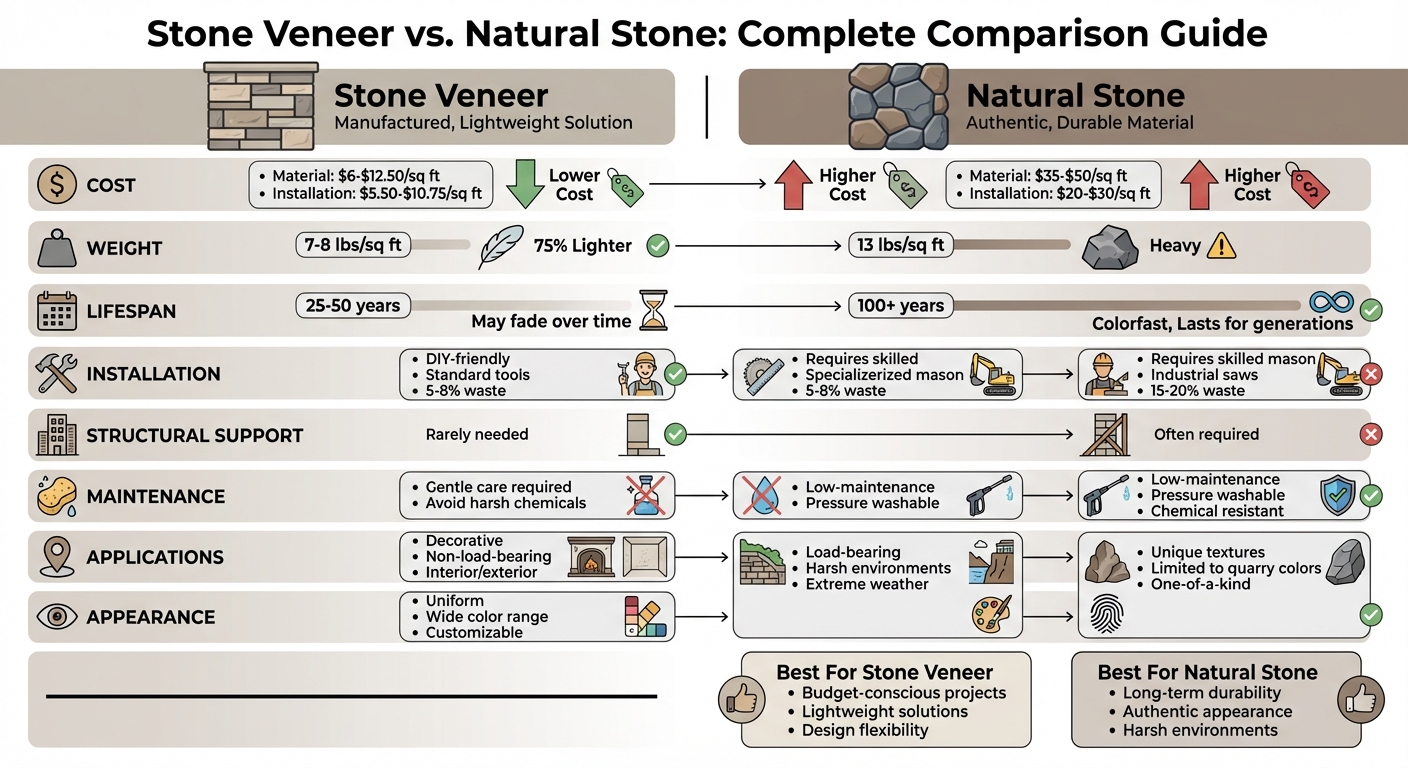
Stone Veneer vs Natural Stone Comparison Chart
Stone Veneer: Why Builders Prefer It Over Natural Stone
What is Stone Veneer?
Stone veneer is a lightweight, decorative material designed to replicate the look of full-thickness stone without the added weight or structural requirements. It comes in two main forms: natural stone veneer, made from real stone, and manufactured stone veneer (MSV), a concrete-based alternative. This versatility makes it a popular choice for a wide range of applications.
Natural stone veneer is created by slicing quarried stone into thin sheets, typically between 3/4 of an inch and 1.5 inches thick. On the other hand, manufactured stone veneer – also known as cultured or architectural stone – is made by blending Portland cement, lightweight aggregates, and iron oxide pigments. This mixture is poured into molds that replicate the textures and details of natural stone [1][2]. Each type offers distinct aesthetic and functional qualities, which are explored further in later sections.
"Manufactured stone veneer (or MSV) is a man-made exterior building product chosen by builders to mimic the aesthetic of natural stone without natural stone’s limitations." – StoneWorks [2]
One of the standout features of MSV is its weight – about 75% lighter than natural stone, averaging 7–8 pounds per square foot [7]. This lightness removes the need for costly structural reinforcements like extra footings or wall ties, which are often necessary for natural stone installations.
Stone veneer is versatile enough for both interior and exterior use. You’ll find it enhancing facades, accent walls, fireplaces, chimneys, columns, outdoor kitchens, fire pits, and even landscape walls [6][9]. It can be installed on various surfaces, including drywall and plywood, as long as the surface can support its weight. Additionally, MSV generates less waste during installation – only about 5–8% compared to the 15–20% waste typically associated with natural stone due to its irregular shapes and flaws [7].
"One of the biggest advantages of MSV is its design flexibility. Because it’s manufactured, it’s available in a wide range of colors, textures, shapes and sizes – making it easier to achieve almost any look." – Sarah Lograsso, Director of Marketing, Westlake Royal Building Products [5]
What is Natural Stone?
Natural stone is rock that comes straight from the earth, obtained through quarrying or collecting fieldstone from various sites like fields or old walls [5][10]. Unlike manufactured materials, natural stone is solid rock that has preserved its original physical properties, shaped over thousands of years.
The process of sourcing natural stone often involves heavy machinery to quarry the rock or manually gathering fieldstone. This local sourcing can play a big role in defining the architectural style of a region. For instance, you might see New England dry stone walls or Michigan fieldstone used in local designs [3][10][11]. These regional characteristics also determine how well the material suits specific design needs.
"Natural stone is simply that – rock that has been cut into a veneer ¾ inch to 1¼ inches thick and has all the shading, color, and flaws that come with eons of geologic pressure." – This Old House [10]
Some of the most commonly used types of natural stone in landscaping and hardscaping include granite, limestone, travertine, sandstone, fieldstone, and flagstone [1][11][7]. Each piece is one of a kind, offering unique shapes, patterns, colors, and textures [1]. Its dense makeup means it weighs about 13 lbs per square foot, which is nearly twice the weight of manufactured stone [1].
Natural stone has been a go-to material for retaining walls, stone pillars, chimney refacing, exterior house siding, patios, walkways, columns, and fireplaces [10]. Its durability is unmatched – it naturally resists harsh chemicals, extreme weather, freeze-thaw cycles, and UV exposure without fading. This means it can last for centuries with very little wear [1][5][10]. These qualities make it ideal for long-lasting applications like retaining walls, patios, and facades, which will be explored further in later sections.
Cost Comparison: Stone Veneer vs. Natural Stone
When deciding between stone veneer and natural stone, understanding how costs break down can make a big difference. The price gap isn’t just about the materials – it also involves labor, waste, and long-term upkeep.
Material Costs
Natural stone is pricey because of the labor-intensive quarrying and transportation processes. Full-thickness natural stone costs around $35 to $50 per square foot for materials alone [12][13]. If you’re looking for a more affordable option that still looks authentic, natural stone veneer (a thinner cut of real stone) costs about $15 to $30 per square foot [12][7].
Manufactured stone veneer (MSV), made from cement, aggregates, and pigments, is the most budget-friendly choice, with prices ranging from $6 to $12.50 per square foot [12][13][7]. As Powerhouse Mason Supply puts it:
"Manufactured stone veneer typically costs 50-75% less than natural stone when you factor in materials and installation." [7]
Its lighter weight – about 75% less than natural stone [7] – further reduces costs by cutting down on structural requirements.
Installation Expenses
Labor is another area where costs diverge. Natural stone installation demands skilled masons to cut and fit irregular pieces, with labor costs averaging $20 to $30 per square foot [12][13]. This intricate work can extend project timelines, and total installed costs for natural stone siding can climb to $48 per square foot [14].
Manufactured stone veneer, on the other hand, is much easier to work with. Its uniform dimensions and interlocking designs speed up installation, bringing total installed costs to about $5.50 to $10.75 per square foot [14]. Plus, its lighter weight often eliminates the need for additional structural support, which can otherwise drive up costs.
| Feature | Natural Stone (Full) | Natural Stone Veneer | Manufactured Stone Veneer |
|---|---|---|---|
| Material Cost (sq. ft.) | $35–$50 [12][13] | $15–$30 [12][7] | $6–$12.50 [7] |
| Installation Cost (sq. ft.) | $20–$30 [13] | Moderate | Lower [14] |
| Waste Factor | 15%–20% [7] | Moderate | 5%–8% [7] |
| Weight | Heaviest | Moderate | Approximately 75% lighter [7] |
| Structural Support | Often required | Sometimes required | Rarely required |
These differences in material and labor costs highlight why MSV is often the more economical choice.
Maintenance Costs
The story doesn’t end with installation – maintenance is another factor to consider. Natural stone is incredibly durable, often lasting for centuries with minimal wear. However, repairs for cracked stones or damaged mortar can be expensive, and resealing may be needed every 1 to 3 years, depending on the stone’s porosity [3][5][13].
Manufactured stone veneer, while low-maintenance, has its vulnerabilities. It usually comes with a 50-year warranty [2][5], but it’s susceptible to damage from de-icing salts, chlorine, and harsh cleaning chemicals, which can cause fading or surface damage [2][6][5]. It’s also not ideal for areas with constant water exposure, like fountains or pools, as noted by Sarah Angelo of Eldorado Stone:
"We do not recommend manufactured stone with water applications such as fountains and pools because chemicals will cause it to deteriorate, as will the constant moisture." [11]
Despite these limitations, manufactured stone veneer offers an impressive 153% ROI in 2024, the highest of any siding option [2]. That makes it a compelling choice for homeowners looking to save upfront while still boosting resale value.
Installation Differences
The way you install stone veneer versus natural stone can vary quite a bit, and knowing these differences can help you better plan your project in terms of time and money.
Ease of Installation
Natural stone is heavy – around 13 lbs per square foot – compared to manufactured stone veneer, which comes in at about 7–8 lbs per square foot [1]. This added weight, along with the irregular shapes of natural stone, means each piece needs to be carefully measured, cut, and fitted by experienced masons. Plus, working with natural stone requires specialized tools like industrial saws to handle its density [1][2].
Manufactured stone veneer, on the other hand, is designed to be much easier to work with. Its lighter weight and consistent dimensions make it more manageable. It can be cut using standard tools, and features like interlocking pieces and pre-formed corners simplify the installation process [7]. As Lee Wallender from The Spruce puts it:
"Manufactured stone is far easier to handle and to cut than natural stone because it is porous and lightweight." [4]
Additionally, Powerhouse Mason Supply notes:
"The fitting process alone can double your installation timeline." [7]
Natural stone installation can generate 15–20% waste, compared to just 5–8% with manufactured stone veneer [7]. These factors often make manufactured stone veneer a more practical choice for DIY enthusiasts. The differences in installation also tie into structural needs, which we’ll cover next.
Structural Requirements
The weight of the material plays a big role in determining the type of structural support needed. Natural stone’s heft often requires extra reinforcement, such as engineering assessments or foundation work, to ensure walls can handle the load [7]. Sarah Lograsso from Westlake Royal Building Products explains:
"Installers may need structural reinforcements to handle the stone’s weight, which can add both time and cost to a project." [5]
Natural stone also needs to be installed on porous surfaces like concrete, stone, or block [1]. If you’re working with smoother surfaces, additional steps like applying metal lath and a masonry scratch coat are necessary to ensure proper adhesion.
Manufactured stone veneer is much more versatile. Its lighter weight usually eliminates the need for structural reinforcements, and it can be installed on a variety of substrates, including drywall [1]. However, it’s worth noting that manufactured stone veneer is purely decorative and not suitable for load-bearing applications [2][6].
| Feature | Natural Stone | Manufactured Stone Veneer |
|---|---|---|
| Weight | ~13 lbs/sq. ft. [1] | ~7–8 lbs/sq. ft. [1] |
| Required Cutting Tools | Industrial saws [1][2] | Standard tools [1][4] |
| Substrate Options | Porous surfaces like concrete, stone, or block [1] | Works on drywall, masonry, etc. [1] |
| Structural Support | Often requires reinforcement [7] | Rarely needed [5] |
| Waste Factor | 15–20% waste [7] | 5–8% waste [7] |
| DIY-Friendly | Needs professional skills [1] | Easier for DIY projects [1][4] |
The differences in installation and structural requirements can significantly shape how long your project takes and how much it costs.
sbb-itb-843f8be
Durability and Maintenance
Durability is a key factor when choosing materials, as it directly affects long-term costs, performance, and overall value. Let’s delve into how natural stone and manufactured stone veneer compare in terms of lifespan, weather resistance, and maintenance.
Lifespan
Natural stone is renowned for its longevity – often lasting a lifetime or even longer. Its dense structure makes it incredibly durable, sometimes outliving the very buildings it adorns [1]. Jon Smiley, Owner of Stone Center, puts it best:
"Natural stone is exceptionally durable due to its dense composition and natural resistance to harsh chemicals, extreme weather conditions, and normal wear patterns." [1]
On the other hand, manufactured stone veneer typically lasts between 25–50 years and often comes with a 50-year warranty [2]. However, there’s a key difference in how these materials retain their appearance. Natural stone is colorfast, meaning its color runs through the entire material. While it may fade slightly after decades of exposure to sunlight, the change is so subtle it’s barely noticeable over a human lifetime [4]. Manufactured stone, however, relies on surface pigments that can fade over time due to UV rays and harsh weather conditions [4].
In addition to durability, these materials also differ in how they handle environmental challenges.
Weather Resistance
The density of natural stone gives it an edge when it comes to withstanding extreme weather. It resists freezing, heavy rain, intense heat, and UV exposure, making it a solid choice for regions with harsh or fluctuating climates [15]. Its natural tolerance for humidity further adds to its resilience.
Manufactured stone veneer, while capable of handling a range of temperatures, is more prone to environmental wear. It’s particularly sensitive to harsh chemicals like de-icing salts, cleaning solvents, and chlorine, which can stain or damage its surface [2]. Sarah Angelo of Eldorado Stone highlights this limitation:
"We do not recommend manufactured stone with water applications such as fountains and pools because chemicals will cause it to deteriorate, as will the constant moisture." [11]
If you’re considering stone for areas near pools or where de-icing salts are frequently used, natural stone is the more durable option.
These differences in weather resistance also influence how much maintenance each material requires.
Maintenance Needs
Natural stone is low-maintenance, holding its color well over time and standing up to pressure washing [1]. In contrast, manufactured stone veneer requires more delicate care. Its surface pigments and textures can be damaged by pressure washing or heavy scrubbing, so it’s best cleaned with mild soap and water. Harsh chemicals, such as de-icing salts or paint thinners, should be avoided [2].
| Feature | Natural Stone | Manufactured Stone Veneer |
|---|---|---|
| Lifespan | 100+ years / Lifetime [15] | 25–50 years [2] |
| Color Longevity | Colorfast throughout [4] | Surface pigments may fade [4] |
| Weather Resistance | High; resists freeze/thaw, UV, moisture [15] | Moderate; vulnerable to chemicals [2] |
| Cleaning | Can be pressure washed [1] | Requires gentle cleaning [1] |
| Chemical Resistance | High; resists salts and solvents [1] | Low; susceptible to de-icing salts and chlorine [2] |
Natural stone stands out for its durability and minimal maintenance, making it a long-term, hassle-free investment. Manufactured stone veneer, while less robust, can still deliver appealing results with careful upkeep.
Aesthetics and Appearance
When comparing natural stone and manufactured stone veneer, their visual appeal introduces another layer of distinction. Natural stone boasts a genuine, one-of-a-kind texture, while manufactured stone veneer offers a consistent and customizable appearance.
Texture and Finish
Natural stone stands out for its organic and tactile qualities. Each piece carries unique irregularities, rugged edges, and textures shaped by nature over millennia. As Jon Smiley, Owner of Stone Center, puts it:
"Natural stone is undeniably beautiful, with a natural, appealing texture you can’t help but reach out and touch. No two stones are exactly the same, so your walls won’t have a repetitive pattern." [1]
Manufactured stone veneer, on the other hand, uses advanced molds to replicate these natural details. Concrete is poured into molds that capture intricate features like sediment lines and fossil-like markings [5]. While the results can be impressively lifelike, repetitive patterns may become noticeable upon close inspection due to the reuse of molds [1]. However, for larger installations, this uniformity can create a cohesive and controlled aesthetic that natural stone’s variation may not achieve [5].
Color Options
Natural stone offers authentic color variations that permeate the material, ensuring resistance to fading over time [4]. The downside? Your options are limited to the colors available from local quarries [5].
Manufactured stone veneer, in contrast, uses iron oxide pigments to achieve a wide range of colors, from earthy tones to sleek, modern shades like neutral whites and grays [2][4]. This versatility makes it easier to match architectural styles or keep up with current design trends. However, the pigments are surface-applied, meaning they can fade over time when exposed to sunlight or harsh chemicals [1][2]. Natural stone, by comparison, retains its color naturally without these concerns.
| Feature | Natural Stone | Manufactured Stone Veneer |
|---|---|---|
| Texture | Unique, irregular, organic [5] | Uniform, molded, can be repetitive [1] |
| Color Range | Limited to quarry availability [5] | Wide variety; customizable [2][4] |
| Color Stability | Colorfast throughout material [4] | Surface pigments may fade [1] |
| Pattern Consistency | Low; every piece is different [1] | High; batch-to-batch uniformity [7] |
If you’re aiming for authenticity and timeless charm, natural stone’s unique character makes it a standout choice, especially for projects that integrate with natural landscapes. On the other hand, if your priority is design flexibility and uniformity, manufactured stone veneer offers the control needed for large-scale applications. These aesthetic considerations naturally lead to a discussion of each material’s environmental impact.
Environmental Impact
When choosing between natural stone and manufactured stone veneer, the environmental impact is a critical factor to consider. These materials differ significantly in how they’re sourced, produced, and their long-term effects on the planet.
Sourcing and Production
Natural stone is extracted directly from quarries, a process that involves heavy machinery and often the use of harsh chemicals for cleaning before installation [2][6]. Quarrying can be highly disruptive to the environment, generating substantial waste due to irregular shapes and flaws in the material [7].
Manufactured stone veneer, on the other hand, is created in controlled facilities using a mix of Portland cement, sand, aggregates, pigments, and chemical additives like plasticizers and driers [16]. While this process incorporates synthetic materials and water, it generally requires fewer resources than quarrying [2][6]. The controlled production also reduces waste significantly [7]. Additionally, its lighter weight makes transportation more efficient and eliminates the need for extensive structural reinforcements [11].
One advantage of natural stone is its purity – it contains no added dyes, chemicals, or volatile organic compounds (VOCs) [16]. As Polycor Inc. highlights:
"Natural stone takes less water to process, doesn’t release VOCs, and lasts longer than concrete, glass, or quartz" [16].
Natural stone’s lifespan – exceeding 100 years – far surpasses that of manufactured stone, which typically lasts between 25 and 75 years. This longevity reduces the need for replacements and the energy associated with manufacturing over time [15][16].
Eco-Friendly Practices
The environmental impact of these materials can also be influenced by eco-friendly sourcing and usage practices. For natural stone, sourcing locally is an effective way to cut down on transportation emissions while ensuring the material blends with the regional environment. As Matt Schmuke, a landscape architect with Apex Landscaping, explains:
"Our Michigan field stone or granite is locally sourced stone that looks more appropriate… we want our projects to look local. Plus, the durability of natural stone is always better" [11].
Manufactured stone veneer supports sustainability through its efficiency. Its lighter weight reduces fuel consumption during transportation and minimizes waste, leading to fewer materials ending up in landfills [7]. However, the use of pigments and chemical additives during production can be a drawback, as surface-applied colors may fade when exposed to chemicals like pool chlorine or de-icing salts [2][11].
For projects prioritizing longevity, natural stone’s durability and extended lifespan make it a more sustainable option over time [15][16]. On the other hand, manufactured stone veneer is ideal for situations where reducing structural impact is critical, as its lightweight nature avoids the environmental costs of additional reinforcements like concrete or steel [11].
Pro Landscapes MD Expertise in Stone Veneer and Natural Stone

Pro Landscapes MD takes the unique qualities of stone veneer and natural stone and uses them to create stunning outdoor transformations. Operating across central Maryland, they handle everything from the initial design to the final installation, offering a seamless, single-point-of-contact experience. This approach ensures every project maintains high standards, from choosing the right materials to completing construction [6][2].
Landscaping and Hardscaping Services
Their expertise turns the practical benefits of stone veneer and natural stone into visually striking and functional designs. Whether it’s patios, retaining walls, outdoor kitchens, fire pits, or pool decks, Pro Landscapes MD showcases their hardscaping skills in every project [8][14]. They also excel in masonry work, tackling features like front entryways, porch columns, chimneys, garage fronts, and wainscoting (lower exterior walls) [15]. For those wanting to bring stone indoors, the team can install interior accent walls and fireplace surrounds using both natural and manufactured stone [15].
A key aspect of their work lies in matching materials to structural requirements. Natural stone, with its weight, demands solid footings and proper ties, while stone veneer is better suited for wood-frame walls without the need for heavy reinforcement [6][2]. Their commitment to reducing waste is evident in their use of task-specific products and repurposing leftover stone clippings, reflecting a thoughtful approach to their craft [6].
Customer Testimonials
Pro Landscapes MD has earned glowing reviews from clients in areas like Ellicott City, Columbia, Bethesda, and Potomac, with many highlighting their exceptional craftsmanship and dedication to customer satisfaction.
Conclusion: Choosing the Right Material for Your Project
Deciding between stone veneer and natural stone comes down to your budget, structural needs, and design goals. Manufactured stone veneer is a more affordable option, often costing 50-75% less than natural stone when factoring in both materials and installation costs [7]. Its lighter weight makes it easier to install on standard wood-frame walls without needing extra reinforcement, which can save both time and money during construction.
Natural stone, on the other hand, is ideal for projects where durability and authenticity are key. It can endure for centuries without fading, withstands harsh chemicals and extreme weather, and offers textures and patterns that are truly one of a kind [1][5]. However, its weight – around 13 lbs per square foot compared to 7-8 lbs for manufactured stone – often requires additional structural support and skilled labor to manage its irregular shapes [1][7].
The choice also depends on the environment. For areas exposed to constant moisture, like pool decks or fountains, natural stone is the better option. As Sarah Angelo from Eldorado Stone explains:
"We do not recommend manufactured stone with water applications such as fountains and pools because chemicals will cause it to deteriorate, as will the constant moisture" [11].
On the flip side, manufactured stone veneer shines in interior spaces or on large exterior walls, where its consistent color and lightweight nature make it a practical choice.
If you’re unsure which material suits your project, Pro Landscapes MD can help. Serving central Maryland, they guide homeowners through every step – from choosing materials that meet structural needs and environmental conditions to ensuring proper installation. Whether you’re planning a retaining wall in Columbia, a fire pit in Bethesda, or an outdoor kitchen in Ellicott City, their team ensures your project is built to last and meets local building codes.
For expert advice and a professional assessment, reach out to Pro Landscapes MD. Their experience ensures your project achieves the perfect balance of value, durability, and style.
FAQs
Which option adds more home value?
Natural stone often brings greater long-term value to a home because of its genuine appearance, durability, and classic charm. Its premium look, ability to withstand harsh weather, and long lifespan can boost both curb appeal and property value. On the other hand, while stone veneer is less expensive and simpler to install, it doesn’t typically offer the same enduring benefits, making natural stone the smarter choice for those focused on lasting value.
Do I need structural support for natural stone?
When using natural stone as a veneer or for decorative purposes, you usually don’t need heavy-duty structural support. However, a full-depth stone veneer might require a footing or ledge to ensure proper installation. For stone pavings, support layers like mortar are typically sufficient. On the other hand, stone walls involve more specific requirements, such as a foundation trench and smaller stones, but these are generally limited to wall construction rather than decorative uses.
What’s best for pools or wet areas?
Stone veneer works well for pools or other wet areas, provided it’s installed with a proper waterproof barrier. This barrier is essential to block moisture from seeping through. While natural stone is tough, its porous nature means it needs regular sealing and upkeep to prevent moisture problems. In high-moisture spaces like pools or showers, stone veneer is a popular option because, when installed correctly, it offers reliable water resistance.
Chat with Us