









- bhavya gada
- No Comments
Stormwater detention systems are essential for managing runoff, reducing flooding, and protecting property. Choosing the right system depends on several factors that directly affect performance, cost, and compliance. Here are the five main considerations:
- Soil Conditions: Soil permeability and infiltration rates determine the system’s design and efficiency. Sites with clay soils or low infiltration rates may require alternative solutions.
- Site Constraints: Property size, slope, and proximity to structures impact system placement and design. Steep slopes and high water tables can complicate installation.
- Regulatory Compliance: Permits are required, and local regulations vary. Maryland’s permitting process can take weeks and includes specific design and inspection requirements.
- Costs: Installation costs range from $15 to $45 per square foot, depending on materials and site complexity. Long-term maintenance costs are lower for underground systems.
- Community and Environmental Impact: Properly designed systems filter pollutants, reduce erosion, and improve groundwater recharge while preserving property aesthetics.
Careful planning and professional assessments are critical to avoid costly mistakes and ensure the system meets both technical and regulatory needs.
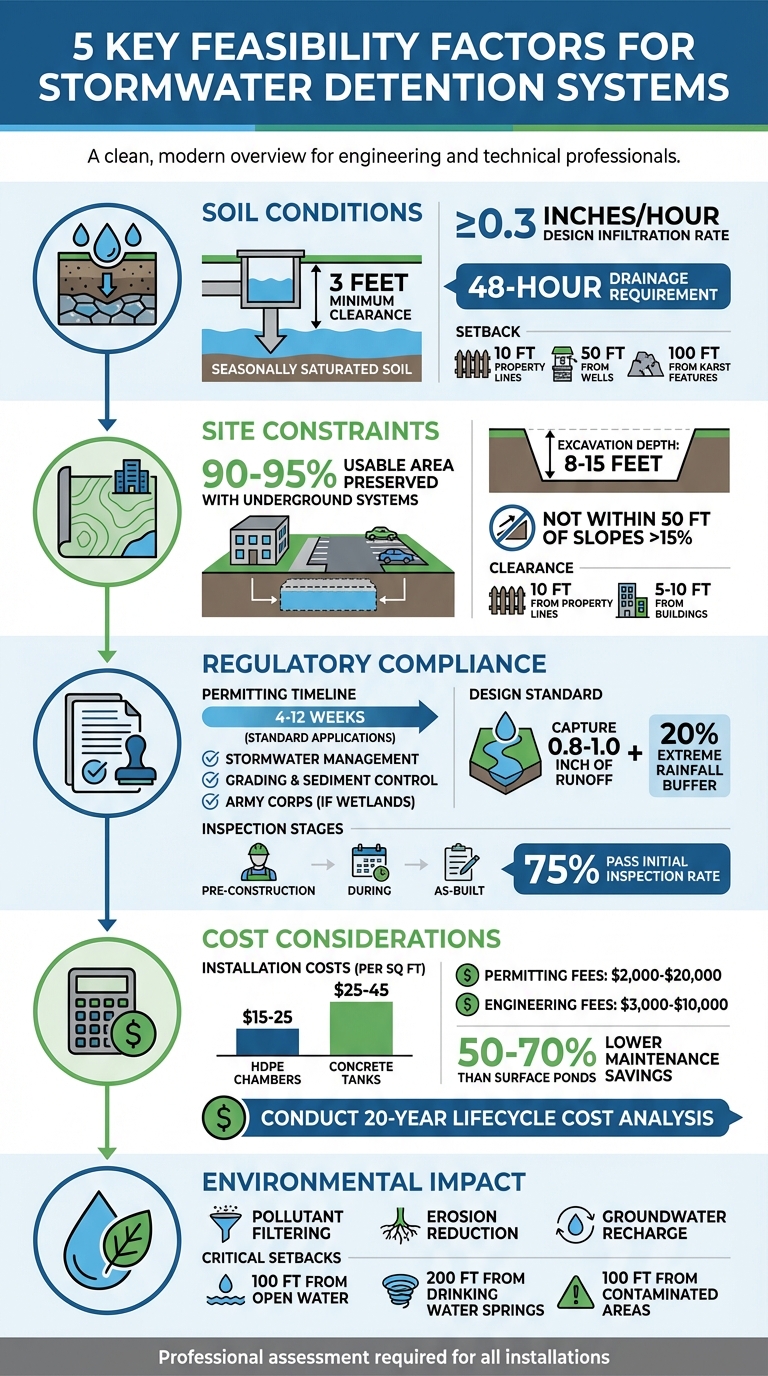
5 Key Feasibility Factors for Stormwater Detention Systems
Mastering the Design of Underground Detention & Infiltration Systems
sbb-itb-843f8be
1. Soil Conditions and Infiltration Rates
The performance of an underground detention system depends heavily on soil conditions. Specifically, soil permeability – or how quickly water can pass through the ground – plays a key role in determining the system’s size, design, and long-term efficiency. Before breaking ground, it’s critical to conduct professional soil testing to measure the infiltration rate. Engineers then adjust this rate using correction factors to account for potential silt and organic material buildup, resulting in the design infiltration rate [2]. This adjusted rate becomes the foundation for all subsequent design decisions.
If the design infiltration rate is below 0.3 inches per hour, the site is generally unsuitable for an infiltration system [2]. Soils like sand or gravel typically meet the requirements, while heavy clay soils often fall short [2]. Testing is most effective during the wet season – December through March in Maryland – when groundwater levels are at their peak. This timing ensures that seasonal saturation isn’t underestimated [2]. Soil specialists also look for redoximorphic features, such as rust-colored mottling, which signal water accumulation during wetter periods [4].
"Seasonally saturated soil is defined as the highest seasonal elevation in the soil that is evidenced by the presence of redoximorphic features or other parameters as assessed by a soils specialist." – Minnesota Stormwater Manual [4]
To ensure proper functionality, the detention system’s base must be at least 3 feet above the seasonally saturated soil or bedrock [4]. Additionally, the system must fully drain within 48 hours, allowing all captured water to infiltrate within two days. This quick drawdown prevents mosquito breeding and ensures the system is ready for back-to-back storm events [3]. Proper horizontal setbacks are also crucial: the system should be at least 10 feet from property lines, 50 feet from water supply wells, and 100 feet from active karst features (like sinkholes or limestone cavities) located down-gradient [2][4].
In some cases, a licensed professional might recommend deep infiltration systems that bypass less permeable upper layers to reach more suitable zones [2]. A thorough soil evaluation is vital to ensure the system meets both performance and regulatory standards.
For specialized advice on assessing soil conditions and designing stormwater detention systems, reach out to Pro Landscapes MD.
2. Physical Site Constraints and Topography
When planning underground detention systems, physical site constraints play a major role in determining feasibility. Factors like property size, slope, water table depth, and existing structures all affect where the system can be installed and how complex the process will be.
For smaller or irregularly shaped properties, underground systems are a smart choice, as they preserve about 90–95% of the usable area. However, excavation depths ranging from 8 to 15 feet require early coordination with utility companies to avoid conflicts [1]. These physical limitations, paired with the unique topography of the site, demand careful and precise design planning.
Slope Challenges
Slopes can make installation trickier. For instance, infiltration systems shouldn’t be installed within 50 feet of slopes with gradients steeper than 15%. In areas prone to landslides, the setback distance might extend up to 500 feet, or an engineer may need to conduct a stability analysis [1][2]. A good example of tackling slope challenges is the Austin Tech Campus in Central Texas. Developers dealt with steep terrain across a 10-acre drainage area and opted for a terraced detention system integrated with green infrastructure. This solution cost $425,000 and improved water quality by 40% [1].
Proximity to Structures
Existing structures also limit where systems can go. It’s recommended to maintain at least 10 feet of clearance from property lines and 5–10 feet from buildings. Systems installed under pavement must meet H-20 load ratings and include inspection ports every 50 linear feet to ensure proper maintenance [1][2]. Balancing these requirements with the overall project goals is essential.
High Water Table and Soil Conditions
In areas like the Gulf Coast, where high water tables and clay soils are common, engineers often design elevated systems to prevent buoyancy issues. For example, a Houston distribution center located on a 25-acre, 100-year floodplain achieved 95% site utilization and saved $350,000 by implementing an underground chamber system [1].
For tailored solutions that address your site’s unique constraints and topography, reach out to Pro Landscapes MD.
3. Regulatory Compliance and Permitting
Maryland enforces its stormwater regulations under the 2011 Maryland Stormwater Management Act, which mandates permits for nearly all development projects involving detention systems [5]. The Maryland Department of the Environment (MDE) provides the framework through its Stormwater Design Manual, but local counties – such as Howard, Montgomery, Baltimore, Carroll, Frederick, and Prince George’s – layer on their own specific requirements. This patchwork of regulations means that a system approved in one county might not meet the standards in another, highlighting the need for a carefully tailored permitting approach. Just as site-specific factors influence design, regulatory compliance directly impacts the feasibility of a system.
Permitting Requirements
Before construction can begin, multiple permits are required. These typically include a Stormwater Management Permit from the local Department of Permitting Services, a Grading and Sediment Control Permit, and, for projects affecting wetlands, an Army Corps of Engineers permit. Permitting timelines for standard applications range from 4 to 12 weeks, with more complex projects often taking longer [6]. Over 90% of new development projects in Maryland require stormwater permits, and counties like Montgomery average 4–6 weeks for concept plan approvals [6].
Design Standards and Documentation
Engineering plans must align with MDE’s standards, including capturing 0.8–1.0 inch of runoff and meeting specific infiltration rates as outlined in Chapter 3 of the MDE Manual [7]. Recent updates also require a 20% buffer for extreme rainfall, which impacts system sizing and increases engineering service costs, typically ranging from $3,000 to $10,000 depending on the project’s complexity [5].
Inspection Process
Maryland mandates inspections at three key stages: pre-construction, during construction (with checks on inlets and outlets), and as-built certification by certified professionals [8]. Statewide data shows that 75% of sites pass initial inspections, while 20% fail due to issues like improperly sized outlet pipes [8]. To avoid delays, coordinating joint site inspections with local inspectors and contractors can ensure compliance from the start.
For projects near tidal waters, such as those in Annapolis or Severna Park, the Chesapeake Bay Critical Area Act imposes stricter water quality and buffer standards, often extending permitting timelines. With these complexities in mind, Pro Landscapes MD provides stormwater management services across central Maryland counties, offering guidance through the intricate permitting process. Up next, we’ll dive into the financial considerations to help complete your feasibility analysis.
4. Cost Considerations and Budgeting
Planning for underground detention systems involves a substantial financial commitment, requiring careful attention to both upfront installation costs and ongoing operational expenses [1].
Installation costs can vary significantly depending on the type of system and the complexity of the site. For instance, HDPE chambers typically cost between $15 and $25 per square foot of detention capacity and are relatively simpler to install. On the other hand, concrete tanks, known for their durability and ability to handle heavy vehicular loads, can cost between $25 and $45 per square foot [1]. Excavation depth, which often ranges from 8 to 15 feet, plays a major role in labor and hauling expenses. Additionally, using specialized backfill materials, such as controlled density fill, ensures structural stability but adds to the overall cost. Surface restoration is another factor, with heavy-duty pavement for parking lots being far more expensive than basic landscaping.
Beyond construction, permitting and regulatory fees in Maryland counties can range from $2,000 to $20,000. Pair that with engineering service fees, which typically fall between $3,000 and $10,000, and these costs become a notable part of the initial budget [1]. If utility lines – such as water, gas, or electricity – need to be relocated, unforeseen expenses can arise, further impacting your budget.
When it comes to long-term maintenance, underground systems are more economical than traditional surface ponds. Maintenance costs are typically 50–70% lower because surface ponds require regular vegetation management and sediment removal every 3–5 years. Underground systems also maximize land use, keeping 90–95% of your site available for development [1]. For property owners in central Maryland, companies like Pro Landscapes MD offer tailored stormwater management solutions that address both technical and budgetary needs.
Conducting a 20-year lifecycle cost analysis during the design phase can help balance upfront expenses with operational savings. Value engineering strategies, such as opting for HDPE chambers instead of concrete boxes or purchasing aggregates in bulk, can significantly reduce material costs without sacrificing performance [1]. Making informed design choices not only helps stay within budget but also contributes to broader environmental and community benefits. For a deeper dive into these impacts, refer to the next section.
5. Community and Environmental Impact
When evaluating stormwater detention systems, it’s not just about technical specs or costs – considering their effects on the community and environment is just as important.
Underground detention systems play a key role in filtering pollutants, reducing erosion, and replenishing groundwater supplies [2]. Systems designed for infiltration filter out pollutants from stormwater before it reaches critical water sources like rivers, streams, or drinking water supplies. By managing the volume and speed of runoff, these systems help prevent erosion in wetlands and open water areas. Plus, they encourage groundwater recharge by channeling stormwater into soil layers that drain well [2].
Placement matters. Strategic positioning ensures compliance with regulations while protecting vital resources like aquifers and sensitive water bodies [2]. For instance, these systems should be installed at least 100 feet away from open water features, 200 feet from drinking water springs, and no closer than 100 feet to contaminated areas or landfills [2]. Such precautions help safeguard both the environment and public health.
The underground setup of these systems also preserves the look of a property while meeting safety standards. Typically, they are placed no less than 10 feet from property lines and 5 to 10 feet from buildings, depending on whether basements are present. This spacing helps prevent issues like groundwater mounding or seepage, which could damage nearby foundations [2].
Before installation, subsurface investigations are essential to ensure there’s enough vertical separation from the water table for effective pollutant filtration [2]. For areas with low-permeability surface soils, deep infiltration techniques can be used to direct water into deeper, more absorbent layers, improving the system’s environmental performance [2].
In central Maryland, property owners can collaborate with Pro Landscapes MD to create stormwater management plans that align with regulations while supporting environmental health and integrating seamlessly with the neighborhood.
To enhance these systems further, combining them with features like permeable pavers or vegetated buffers can reduce pollutant loads even more – while also contributing to a visually appealing landscape [2].
Conclusion
Implementing a stormwater detention system successfully means carefully addressing five key factors: soil conditions and infiltration rates, physical site constraints and topography, regulatory compliance and permitting, cost considerations and budgeting, and community and environmental impact. These elements are interconnected, and together they determine whether a surface, underground, or hybrid system will work best for your property. This comprehensive approach ensures both effective technical design and sound financial planning.
Planning is critical. Conducting a 20-year lifecycle cost analysis can help you fine-tune the system’s size and minimize expenses over time. Skipping proper evaluations could lead to costly mistakes, regulatory headaches, and systems that don’t perform as needed.
A well-thought-out design not only maximizes your site’s potential but also keeps maintenance costs manageable. Underground systems, in particular, can optimize land use while requiring less upkeep in the long run. Ensuring proper vertical separation and setbacks during the design process safeguards both your investment and the surrounding environment.
For property owners in Maryland, tailored stormwater solutions are essential to protecting your assets and community. Pro Landscapes MD specializes in stormwater management across central Maryland, serving areas like Howard County, Montgomery County, Carroll County, Frederick County, Prince George’s County, and Baltimore County. Their services include drainage installation, grading, land leveling, and custom solutions designed to meet your site’s unique conditions and local regulations. Whether you’re dealing with challenging clay soils, tight urban spaces, or complex permitting, professional expertise ensures your system will perform reliably for years to come.
Start with a detailed assessment and professional design to transform stormwater management into a strategic advantage that protects your property, maintains land value, and supports environmental well-being.
FAQs
Is my soil suitable for an underground infiltration system?
If the groundwater table is less than 4 feet from the surface or geotechnical tests reveal poor soil permeability, your soil might not be suitable for an underground infiltration system. These factors can greatly reduce the system’s effectiveness.
How long does stormwater permitting take in Maryland?
The stormwater permitting process in Maryland requires a detailed review, which can vary depending on the specifics of each site. Though there’s no fixed timeline, the duration often hinges on factors like the complexity of the project and the need to meet compliance standards.
What’s the total cost to install and maintain a detention system?
The cost of installing and maintaining a detention system can vary significantly, depending on factors such as site conditions, system design, and the complexity of the project. Typical expenses include site analysis, construction, and ongoing maintenance. Local regulations can also play a role in shaping these costs. Since these variables differ from one project to another, exact figures are difficult to pin down.
Chat with Us