









- bhavya gada
- No Comments
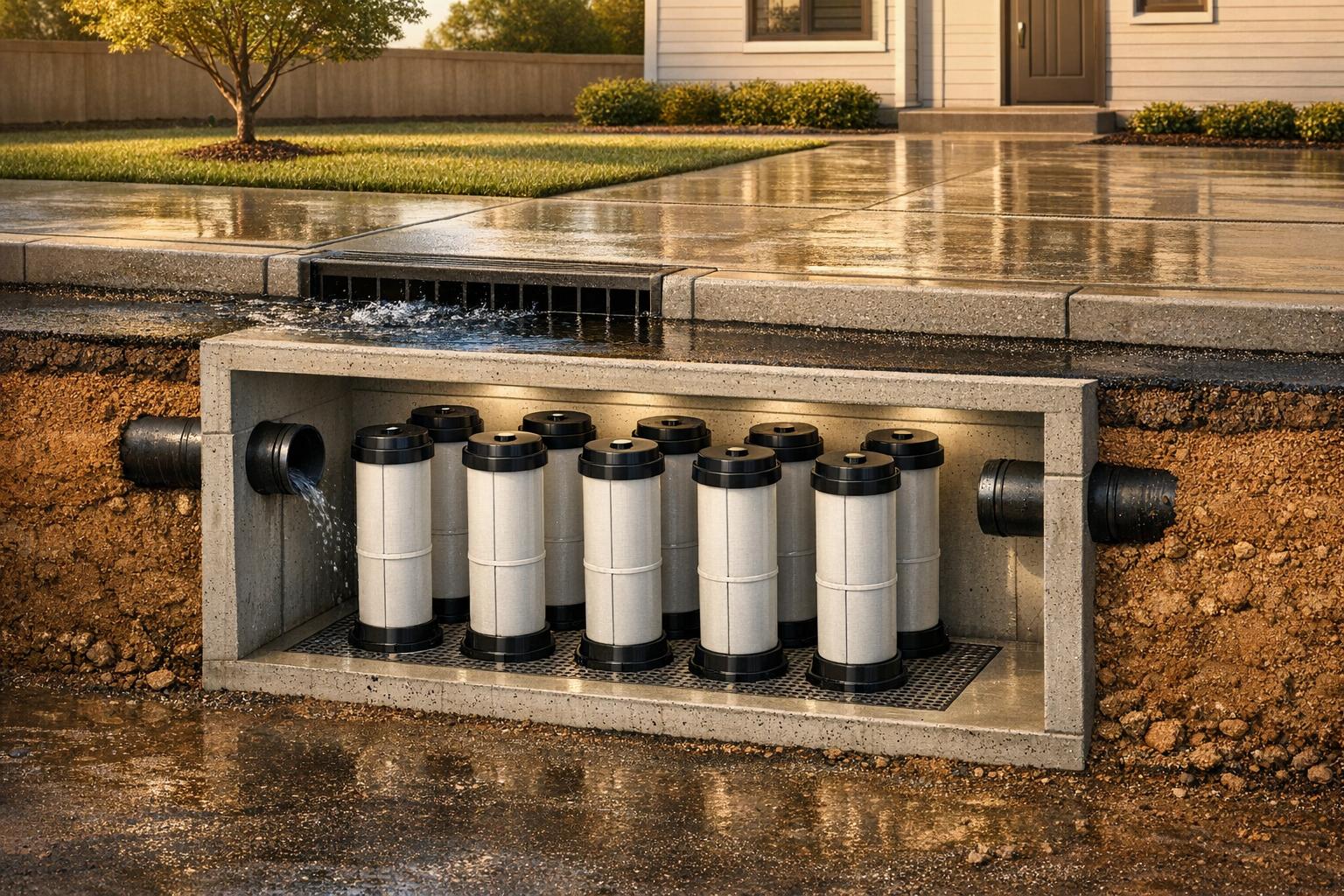
Stormwater filtration systems using cartridges are an effective way to manage runoff pollution. These systems are installed underground and use replaceable cartridges filled with specialized media to filter out debris, sediment, oils, chemicals, and heavy metals. They meet Maryland’s strict environmental standards and are designed for both residential and commercial properties.
Key Points:
- How It Works: Combines mechanical filtration and chemical adsorption to clean runoff.
- Customizable Media: Options like Perlite (oils, sediment), Zeolite (metals), and Activated Carbon (pesticides).
- Efficiency: Removes pollutants like TSS, phosphorus, and hydrocarbons with high success rates (e.g., 85% TSS removal in studies).
- Maintenance: Requires cartridge replacement every 1–5 years, depending on use.
- Design Considerations: Proper flow rate, contact time, and system sizing are crucial for optimal performance.
Cartridge systems, such as Contech’s StormFilter, are widely approved and used in Maryland for managing stormwater while preserving property aesthetics. They’re a practical solution for reducing runoff pollution and protecting water quality.
Types of Cartridge-Based Filtration Systems
StormFilter by Contech
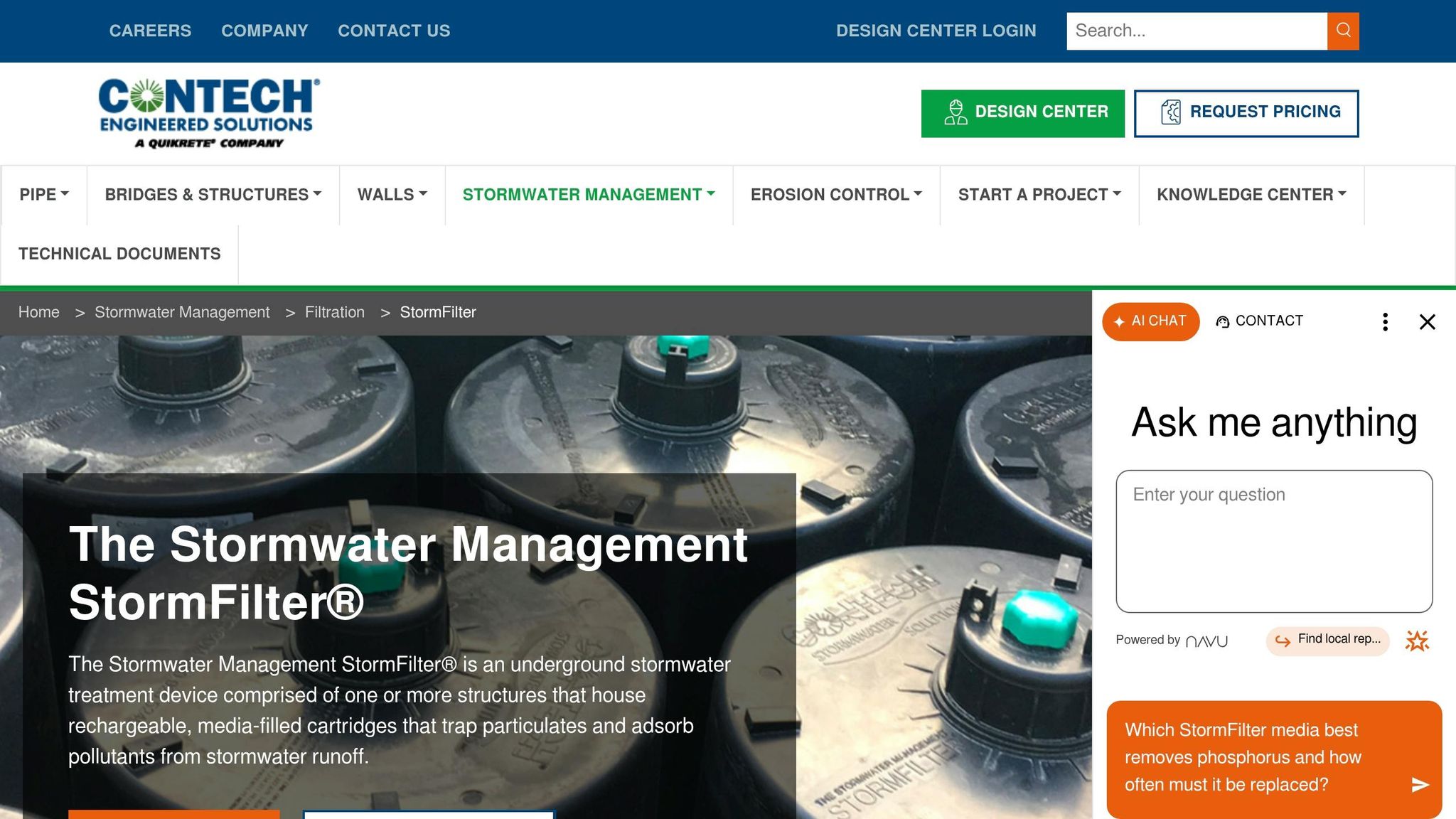
StormFilter stands out in recent performance studies for its design that improves stormwater pollutant removal. Its siphon-actuated system ensures water flows evenly across the media bed, which not only boosts pollutant removal but also extends the life of the filtration media. A one-way check valve in the cartridge hood expels air as water rises, keeping the entire filter surface functional.
This system comes in three configurations: 27-inch, 18-inch, and a Low Drop option. The Low Drop model operates with just 1.8 feet of head loss, while the 27-inch version requires a minimum of 3.05 feet of water pressure. Meeting MD DOE standards, StormFilter offers a variety of media options tailored to specific pollutants: PhosphoSorb for phosphorus, Perlite for total suspended solids and oil, Zeolite for soluble metals, and granular activated carbon (GAC) for oil, grease, herbicides, and pesticides. It can be installed in various structures like catch basins, manholes, vaults, curb inlets, and linear grates.
Maintenance is needed every 1–5 years, depending on use, and involves replacing cartridges. To reduce costs and minimize environmental impact, the system uses refurbished cartridges [3].
Next, we’ll take a closer look at another top system, StormKleener by Lane Enterprises.
sbb-itb-843f8be
How the Stormwater Management StormFilter Works – Contech Engineered Solutions
Pollutant Removal Performance
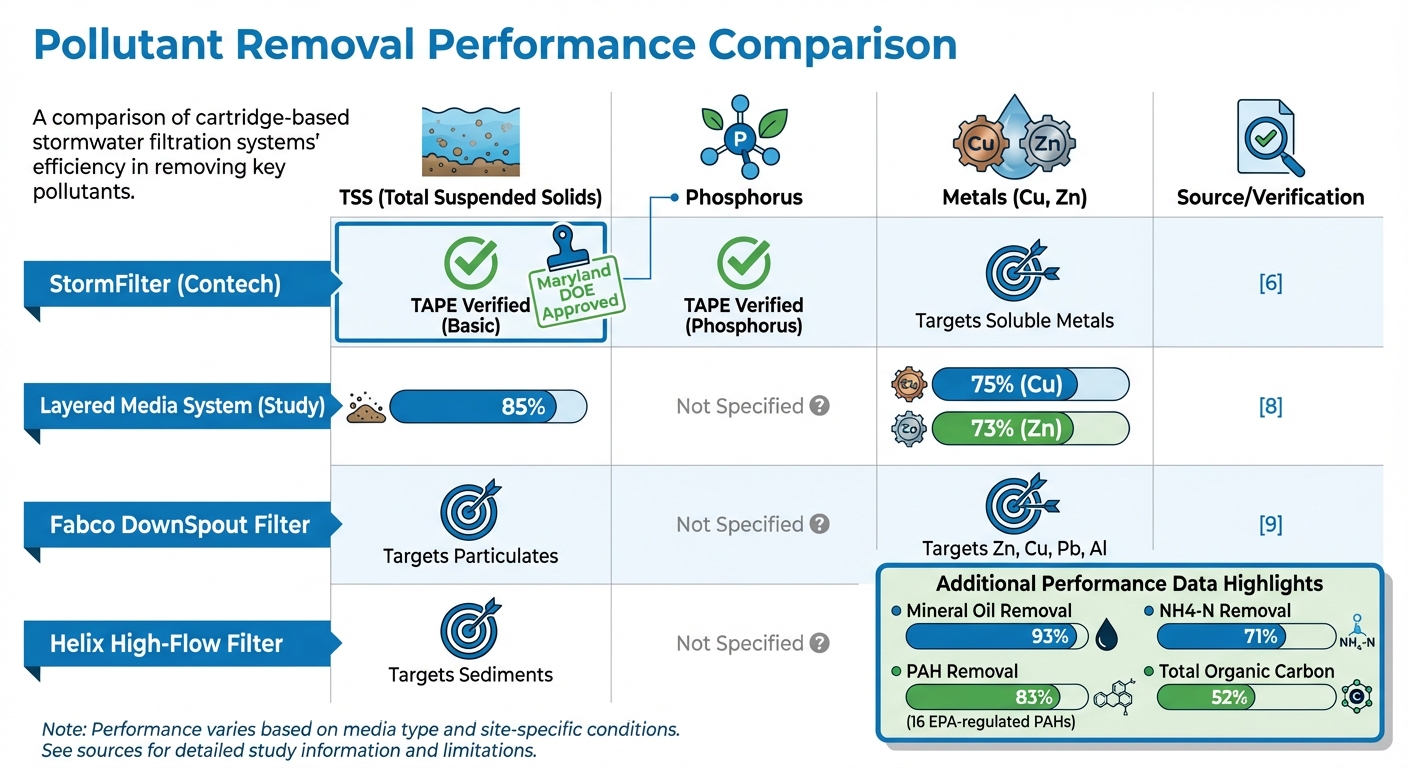
Stormwater Cartridge Filtration Systems: Pollutant Removal Performance Comparison
Cartridge-based filtration systems are highly effective at removing pollutants like TSS (Total Suspended Solids), nutrients, heavy metals, and hydrocarbons. These systems rely on two key processes: physical filtration, which traps particulates, and chemical adsorption, which binds dissolved contaminants to the filtration media [4].
A study published in the Desalination Journal in 2011 examined a layered media filtration system made of activated carbon, vermiculite, and zeolite. This system was tested over 18 months using runoff samples from a parking lot. The results were impressive: 85% removal of TSS, 75% for Copper, 73% for Zinc, 93% for mineral oil, and 83% for 16 EPA-regulated PAHs (polycyclic aromatic hydrocarbons) [5].
Specialized filtration systems show even higher individual PAH removal rates, ranging from 70% to 98%. For nutrient removal, certain media-based systems achieved 71% removal of NH4-N and 52% removal of Total Organic Carbon (TOC) [5]. The StormFilter system, for instance, has received verification from the Washington State Department of Ecology‘s TAPE (Technology Assessment Protocol – Ecology) program for both Basic (TSS) and Phosphorus treatment categories [3].
Performance Comparison Table
| System | TSS % | Phosphorus % | Metals % | Source |
|---|---|---|---|---|
| StormFilter (Contech) | Verified (TAPE GULD – Basic) | Verified (TAPE GULD – Phosphorus) | Targets Soluble Metals | [3] |
| Layered Media System (Study) | 85% | Not Specified | 75% (Cu), 73% (Zn) | [5] |
| Fabco DownSpout Filter | Targets Particulates | Not Specified | Targets Zn, Cu, Pb, Al | [6] |
| Helix High-Flow Filter | Targets Sediments | Not Specified | Not Specified | [6] |
These performance metrics play a critical role in selecting the right media and planning maintenance to comply with Maryland’s strict standards. Results can vary based on media type and site-specific conditions. For example, PhosphoSorb media is designed to capture phosphorus by simultaneously adsorbing dissolved forms and filtering particulate forms, while Perlite is particularly effective for removing TSS and oil [1]. Maintenance is typically triggered by sediment buildup long before the media’s chemical adsorption capacity is fully used up [4].
Design and Operation Factors
When it comes to filtration systems, design is just as crucial as selecting the right media. A key player here is the flow rate – it dictates how long water interacts with the filter media and whether pollutants are effectively trapped. If the flow is too slow, contaminants may bypass proper filtration. On the flip side, excessive flow or sudden pressure spikes can dislodge previously captured particles, sending them right back into the water stream [8].
Another major factor is contact time, which hinges on how water moves through the cartridge. Most systems rely on a siphon mechanism to evenly draw water across the entire media bed. This avoids "short-circuiting", where water takes the path of least resistance, bypassing much of the filter [3].
"A siphon is established within each cartridge that draws water uniformly across the full height of the media bed ensuring even distribution of pollutants and prolonged media longevity." – Contech Engineered Solutions [3]
This thoughtful design ensures pollutants are evenly captured, extending the media’s lifespan and maintaining the system’s performance as outlined earlier.
Proper system sizing is also a must, especially to handle fluctuating runoff volumes. An undersized system can’t manage the flow, leading to untreated runoff [7]. For example, in a typical household with 2-4 residents and 2-3 bathrooms, a filtration system rated for 10 gallons per minute (GPM) is generally sufficient to ensure effective treatment [7].
Regular monitoring of differential pressure can help identify issues early. High pressure often signals clogging, while a sudden pressure drop might indicate filter damage or dislodged particles [8]. Adding coarser pre-filters upstream can also help by catching larger debris before it reaches the cartridges, which helps maintain optimal flow rates for longer periods [8].
Pros and Cons of Cartridge Systems
Cartridge systems bring a mix of advantages and challenges, particularly when used in Maryland residential stormwater management. One of their standout benefits is their passive operation, which uses a siphon mechanism to treat water without the need for power, keeping costs lower [3]. These systems also offer design flexibility, with options like the StormFilter providing multiple cartridge heights (18", 27", and Low Drop). This makes them adaptable for sites with varying elevation constraints, as Low Drop cartridges can function with as little as 1.8 feet of headloss, while 27-inch cartridges need a minimum of 3.05 feet of head [1][3].
Maryland’s regulatory approval simplifies the permitting process for local residential developments, speeding up project timelines [1][3]. Additionally, the ability to customize filter media is a major plus, allowing targeted removal of specific pollutants. For instance, PhosphoSorb® tackles phosphorus, Zeolite handles metals, and GAC addresses herbicides and pesticides. Many units are delivered preassembled in precast structures, which reduces onsite labor needs and ensures consistent quality during installation [3]. Despite these benefits, there are notable challenges.
Maintenance and site-specific requirements can complicate their use. Cartridge replacement, which occurs every 1–5 years, demands specialized equipment like vacuum trucks [3]. These systems aren’t universal solutions – they must be custom-engineered to match the site’s hydraulic conditions, pollutant types, and available space [3]. Using the wrong filter media can severely impact performance, emphasizing the need for careful planning. Long-term costs can also add up due to ongoing media replacement and disposal. Furthermore, underground vaults must be designed to handle specific conditions, like vehicle traffic or buoyancy in areas with high groundwater, which is common in coastal Maryland [2].
Benefits and Drawbacks Comparison
| Feature/Factor | Benefits | Drawbacks/Challenges |
|---|---|---|
| Operation | Passive, siphon-driven treatment; no power required [3]. | Needs specific hydraulic head (1.8–3.05 ft) to operate [3]. |
| Maintenance | Predictable intervals (1–5 years). | Requires vacuum trucks and incurs media replacement costs [3]. |
| Design | Configurations for tight spaces (manholes, vaults, catch basins) [3]. | Not universal; requires site-specific engineering [3]. |
| Efficacy | Approved by MD DOE; targets TSS, phosphorus, and metals [3]. | Media-dependent; wrong selection reduces performance [3]. |
| Installation | Often preassembled for quicker installation [3]. | Needs precast or cast-in-place structures, which may not easily fit existing landscaping [3]. |
Use in Maryland Residential Landscaping
Homeowners in Maryland often face stormwater challenges, especially when it comes to safeguarding the Chesapeake Bay watershed from urban runoff. Cartridge filtration systems provide a practical solution for residential properties, offering effective runoff treatment while preserving yard aesthetics. These systems are installed underground in precast vaults, manholes, or catch basins, ensuring they remain out of sight and don’t disrupt the overall look of a property’s landscaping[1][9].
The Maryland Department of the Environment (MD DOE) has approved the Contech StormFilter, making it a popular choice in central Maryland communities like Bethesda, Potomac, Columbia, and Gaithersburg[1][9]. Pro Landscapes MD integrates these systems into comprehensive drainage plans to tackle common issues like standing water, erosion, and failing infrastructure. Homeowners can also customize the system’s filter media to target specific pollutants. For instance, PhosphoSorb® is ideal for phosphorus removal, Perlite handles sediment and oil, and Zeolite is effective for metals. This customization allows homeowners to adapt the system to their property’s unique needs, enhancing pollutant removal as outlined earlier[1].
Statewide retrofit projects further demonstrate the effectiveness of these systems. In fall 2017, Carroll County and New Windsor upgraded Blue Ridge Manor, replacing an overgrown detention basin with a surface filter system that treats runoff from a 31-acre drainage area. The $531,558 project utilized experimental media, including biochar and alum, to improve nitrogen and phosphorus removal while managing peak flows from 10-year storms[11].
Beyond their technical benefits, these systems can also improve property aesthetics and value. By replacing overgrown vegetation and inefficient grading with well-planned drainage solutions, engineered filtration systems not only manage runoff but also enhance the overall appearance and worth of a home[11]. Pro Landscapes MD often pairs cartridge-based filtration with other measures like French drains, dry riverbeds, grading, and land leveling. This comprehensive approach protects homeowners’ investments while addressing stormwater management and promoting environmental responsibility. Regular maintenance, whether annual or post-storm, ensures these systems continue to perform effectively over time[9].
Conclusion
Cartridge-based systems offer an effective way to manage residential stormwater by tackling both particulate and soluble pollutants. These systems use a combination of cake and depth filtration to achieve impressive results. For instance, coarser media like perlite can capture around 6 pounds of sediment per cubic foot, far outpacing the 1.1 pounds per cubic foot capacity of standard sand[10]. Plus, the ability to use customizable media – targeting nutrients, sediment, oil, or metals – makes these systems especially appealing to homeowners.
Design precision is critical for ensuring success. As James H. Lenhart, P.E., D.WRE, Chief Technology Officer at Contech Engineered Solutions, explains:
"Variable-media systems have the versatility to fine-tune media to site-specific pollutants as well as adapt to future improvements in media effectiveness."[10]
During Maryland’s NRCS Type II and III storm events, offline configurations redirect peak flows, ensuring optimal loading rates of 1–2 gpm/ft²[10]. This thoughtful design approach supports consistent, long-term performance.
However, even the best designs require upkeep. Routine maintenance is key to keeping these systems functioning efficiently. Lenhart underscores this point:
"It is a fact that effective filters will eventually clog with sediments; the only question is how long that will take."[10]
Regular inspections and timely cartridge replacements are essential to avoid clogs and ensure the system continues to operate smoothly, preventing costly issues down the line.
FAQs
Which cartridge media should I choose for my site’s pollutants?
Activated carbon, aluminum oxide, and zeolite are popular choices for cartridge media due to their ability to adsorb gases, volatile organic compounds (VOCs), and vapors. The right option for your needs will depend on the specific pollutants present at your location.
How do I know what size cartridge system my property needs?
To determine the right cartridge system for your property, focus on factors like flow rate and the specific pollutants you need to address. Important considerations include the size of the drainage area, the volume of water during peak flow events, and the level of filtration required. Working with a filtration specialist or engineer can help ensure the system is properly sized to manage your property’s stormwater and pollutant control effectively.
What are the signs my cartridges need replacement or service?
If you notice changes in the color, taste, or odor of your water, a reduced flow rate, an increase in pressure differentials, or a decline in filtration performance, it might be time to replace or service your cartridge system. Taking care of these problems quickly helps maintain top-notch performance and ensures your water stays clean and safe.
Chat with Us