









- bhavya gada
- No Comments
Managing stormwater runoff in Maryland is challenging but essential for protecting the Chesapeake Bay and reducing local flooding. Federal grants can help fund projects like rain gardens, permeable pavement, and stream restoration. Key programs include:
- EPA Sewer Overflow and Stormwater Reuse Grants: Focused on sewer and stormwater infrastructure, with rural and disadvantaged areas receiving priority.
- Clean Water State Revolving Fund (CWSRF): Broad financial support for water quality improvements, managed by Maryland’s Department of the Environment.
- WIFIA Program: Offers low-cost financing for large-scale projects, covering up to 49% of eligible costs.
Eligible applicants include nonprofits, municipalities, and community groups, but not individual homeowners. Projects must align with Chesapeake Bay restoration goals, and applications require detailed plans, budgets, and permits. Deadlines vary, with some programs encouraging matching funds.
To improve your chances, conduct site assessments, collaborate with local experts, and focus on measurable pollution reduction. Successful past projects, like green alleyways and living shorelines, show the importance of well-planned designs and partnerships. Missing deadlines or incomplete documentation can derail efforts, so plan carefully and seek feedback when possible.
Federal Grant Programs for Maryland Stormwater Projects
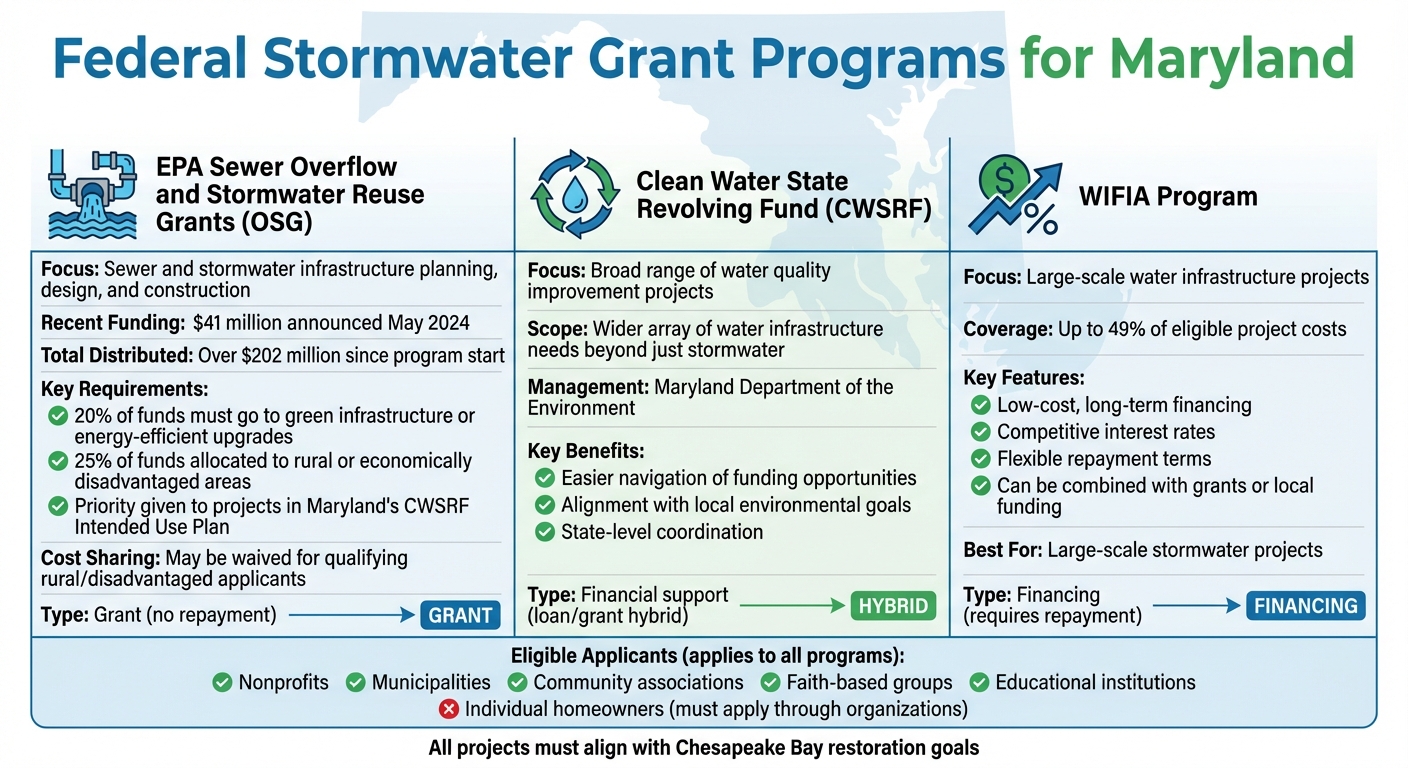
Maryland Federal Stormwater Grant Programs Comparison Guide
Maryland property owners have access to federal funding aimed at addressing stormwater runoff issues. Each program has specific goals and eligibility criteria, making it essential to understand their unique features.
EPA Sewer Overflow and Stormwater Reuse Grants
The EPA’s Sewer Overflow and Stormwater Reuse Municipal Grant (OSG) Program supports projects focused on planning, designing, and building infrastructure to address combined sewer overflows, sanitary sewer overflows, and stormwater management. In May 2024, the EPA announced around $41 million in grants through this program, which has distributed over $202 million since its start. Federal law requires that 20% of OSG funds go toward green infrastructure, energy-efficient upgrades, or similar advancements. Additionally, at least 25% of the funds must be allocated to projects in rural or economically disadvantaged areas, potentially waiving cost-sharing requirements for qualifying applicants.
Priority is given to projects included in Maryland’s Clean Water State Revolving Fund (CWSRF) Intended Use Plan. State-level funding allocations are based on data from the Clean Watersheds Needs Survey, precipitation patterns, and census information [4].
Clean Water State Revolving Fund
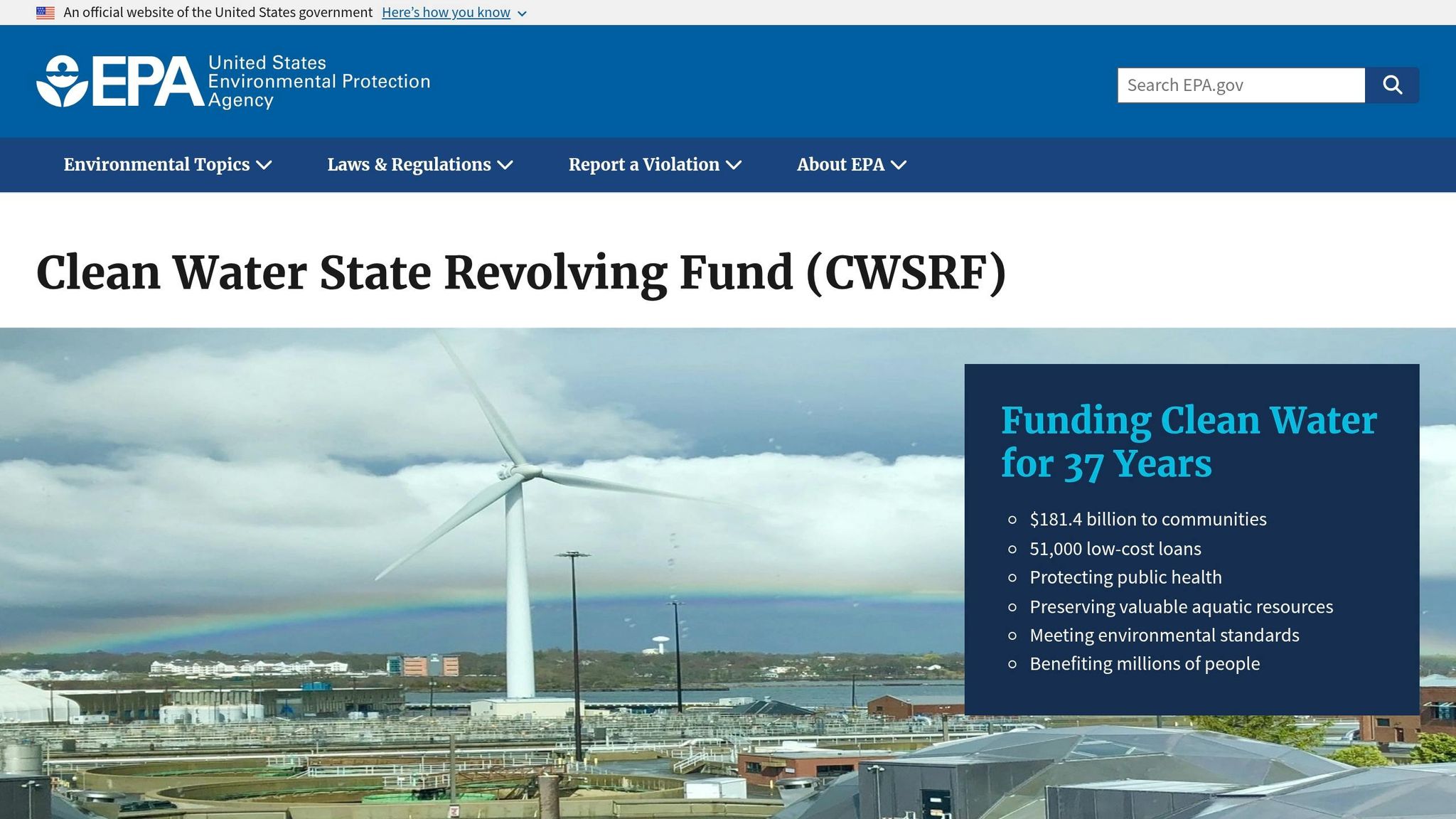
The Clean Water State Revolving Fund (CWSRF) provides financial support for a broad range of water quality improvement projects in Maryland. While the OSG program specifically targets sewer and stormwater issues, the CWSRF addresses a wider array of water infrastructure needs. Managed by the Maryland Department of the Environment, this program allows applicants to navigate funding opportunities more easily while ensuring alignment with local environmental goals [2].
WIFIA Program Financing
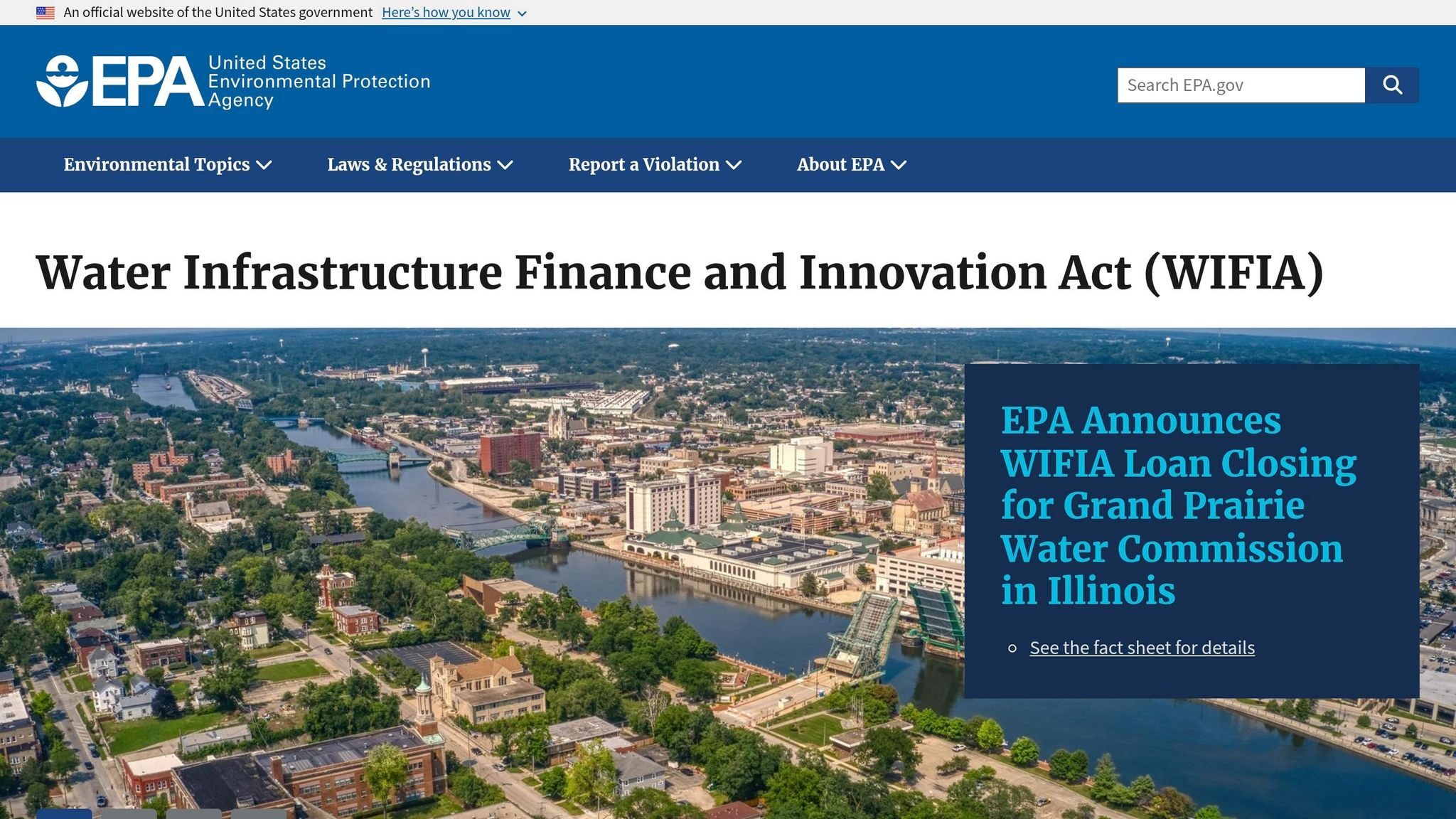
The Water Infrastructure Finance and Innovation Act (WIFIA) Program offers low-cost, long-term credit options for large-scale water infrastructure projects. Unlike grant programs that provide funds without repayment requirements, WIFIA focuses on financing. It can cover up to 49% of eligible project costs and can be combined with grants or local funding sources. This makes it an attractive option for large-scale stormwater projects, offering competitive rates and flexible repayment terms [4].
Knowing how these programs work is key to determining which projects qualify and the steps needed to secure funding.
sbb-itb-843f8be
Who Qualifies and What You Need to Apply
Getting familiar with eligibility requirements and assembling the right paperwork can make or break your application. In Maryland, stormwater grants are open to nonprofits, community associations, faith-based groups, educational institutions, and municipalities [5][7]. While individual homeowners usually don’t qualify for most federal stormwater grants, they can often get involved through community organizations or homeowners associations. Below is a breakdown of which projects qualify and the key documents you’ll need to apply.
Qualifying Projects
Federal and state funds focus on hands-on restoration efforts that tackle stormwater runoff and improve water quality. Eligible projects include solutions like bioretention systems, rain gardens, permeable pavement, cisterns, French drains, and expanding tree canopies [5][7]. Funding also covers stream restoration and litter reduction systems, such as Bandalong Litter Traps. A notable example: in 2016, Anacostia Riverkeeper secured $200,000 to install a Bandalong Litter Trap in Mount Rainier, showing the variety of projects that can receive support [5].
Keep in mind, geographic restrictions apply to many programs. For instance, Prince George’s County grants don’t extend to the City of Bowie, while Montgomery County grants exclude Rockville, Gaithersburg, and Takoma Park [5][7]. Also, if your project involves disturbing one acre or more of land, you’ll need a state permit from the Maryland Department of Environment [6].
Required Documentation and Permits
Your application must include detailed plans that outline the project’s scope, such as designs, cost estimates, and maintenance strategies [2]. Nonprofits will also need to provide proof of their 501(c) status [8]. A budget spreadsheet is critical – it must align with the written narrative and clearly show how the funds will be allocated [8].
For projects that require state permits, applicants should use the Maryland OneStop portal to submit applications online. The fee for a General Permit for Storm Water Associated with Construction Activity ranges from $100.00 to $2,500.00, and approvals typically take about 45 days [6]. Be cautious of scams – legitimate federal grants never charge “application” or “processing” fees [1]. Once your paperwork is ready, check for matching fund opportunities and make note of program deadlines.
Matching Funds and Application Deadlines
After locking down your project details and permits, confirm any matching fund requirements and pay close attention to deadlines. While some programs encourage matching funds, they’re not always required. For instance, Prince George’s County’s Stormwater Stewardship Grant Program, which has awarded over $14.8 million across 172 projects, welcomes matching contributions but doesn’t mandate them [5]. Montgomery County’s Clean Water grants, which increased funding to $900,000 for the 2025-2026 cycle, offer awards ranging from $40,000 to $100,000 [7].
Deadlines vary by program. Prince George’s County’s Stormwater Stewardship Grant has a deadline of April 30, 2026, while Montgomery County’s Clean Water grants closed on November 13, 2025 and follow annual cycles [5][7]. Missing a deadline means waiting another year, so plan ahead. Prince George’s County even offers virtual workshops and weekly office hours to help applicants fine-tune their submissions [5].
How to Prepare a Strong Grant Application
Once you’ve confirmed eligibility, the next step is to create an application that highlights the strengths of your project. A solid application includes a detailed site assessment, partnerships with knowledgeable professionals, and a clear alignment with the larger restoration efforts within the Chesapeake Bay watershed.
Conducting a Site Assessment
Start by mapping your property’s watershed (natural drainage pathways) and sewershed (boundaries defined by infrastructure). This helps determine applicable regulations and any rate control requirements. Pay special attention to features like vegetation, wetlands, waterways, and slopes over 15%, as these factors help identify the best locations for stormwater solutions.
Understanding your soil is also essential. Analyze soil permeability, hydrologic soil groups, and the depth of the seasonal high groundwater or bedrock. Field tests can confirm infiltration potential, even on sites with industrial histories. Historical maps might also reveal hidden risks, such as buried or infilled streams, that FEMA maps may not capture.
Once you’ve completed your assessment, consider reaching out to local experts to refine your project plans further.
Working with Local Experts and Organizations
Teaming up with professionals who are familiar with Maryland’s stormwater regulations can make your application stronger. For example, Pro Landscapes MD offers expertise in designing and installing compliant stormwater solutions like French drains, dry riverbeds, bioretention systems, and permeable pavement. Their knowledge can ensure your project meets regulatory standards while addressing the unique conditions of your site.
Collaborating with local nonprofits or academic institutions can also enhance your proposal. These partnerships add credibility, especially if the organizations have a track record of successful grant applications in your area.
Aligning with Chesapeake Bay Restoration Goals
Your project should clearly support the Chesapeake Bay restoration goals by focusing on measurable pollution reductions. Grant reviewers prioritize initiatives that align with the Chesapeake Bay Watershed Agreement, which guides restoration work throughout the region. Specifically, aim for reductions in nitrogen, phosphorus, and sediment levels, as these are the primary pollutants targeted by the Chesapeake Bay Total Maximum Daily Load (TMDL) [3]. Projects involving green infrastructure – like tree planting or stormwater retrofits – are particularly valued for their ability to manage runoff and improve habitats [3][9].
"Funding provided through the Chesapeake Bay Program is a key factor in leveraging funds from a variety of sources and facilitates the efforts of many partners." [3]
Engaging the community is another way to strengthen your application. Public education and citizen involvement demonstrate stewardship and help build support for your project. The Chesapeake Bay Trust, created by the Maryland General Assembly in 1985, emphasizes the role of all residents in protecting natural resources [9]. Applications that actively involve underrepresented groups – such as communities of color, faith-based organizations, and health-focused sectors – are particularly well-regarded. Finally, highlight how your project can serve as a model for other communities, showcasing its broader impact and potential for replication.
Lessons from Successful Maryland Grant Recipients
Looking at successful grant recipients in Maryland can provide valuable insights into crafting a strong application and designing impactful projects.
Demonstrating Community and Environmental Benefits
Winning grant applications stand out by presenting measurable, tangible outcomes. Funders are increasingly interested in projects that deliver clear environmental benefits and act as catalysts for broader progress [8]. For example, detailing specific goals like reducing runoff by a certain percentage can make your application more compelling.
In Fiscal Year 2023, the Maryland Department of Natural Resources awarded over $2 million to 12 projects focused on climate resilience and stormwater management [10]. What made these projects successful? They not only showcased measurable impact but also highlighted benefits that extended well beyond stormwater management. Projects that promoted healthier ecosystems, strengthened community resilience, and created outdoor learning opportunities were prioritized [10].
Using Modern Stormwater Solutions
Many recent grant recipients have embraced nature-based solutions to address flooding and improve ecosystems. For instance, the Arundel Rivers Federation received funding for a 600-linear-foot living shoreline that included dunal and headland structures. Similarly, the Town of Highland Beach was awarded funding for a living shoreline featuring breakwater and tombolo structures to safeguard critical infrastructure [10].
Urban areas are also adopting innovative approaches. The Church of the Guardian Angel secured funding to revamp urban alleys by replacing pavement with permeable surfaces [10]. In another example, Calvert County enhanced its application by using advanced climate data to model precipitation-induced flood risks [10]. These forward-thinking designs show how integrating modern techniques can address both current and future challenges. Together, these examples highlight the importance of leveraging cutting-edge solutions to make projects more effective and resilient.
Working with Professional Stormwater Management Services
Collaborating with experienced professionals can transform your stormwater management ideas into actionable, fundable projects. Sonya Page of Page Consulting LLC captures this idea perfectly:
With the right investments in the right organizations at the right time, foundations seek to be the levers that move the world [8].
By relying on expert services, you gain access to the technical know-how and supporting documentation necessary to turn your proposal into a compelling project. This expertise ensures accurate designs and smooth compliance with regulations, creating a solid foundation for success.
Design and Installation of Stormwater Features
Professional teams can craft solutions tailored to Maryland’s priorities for Low Impact Development (LID) and Environmental Site Design (ESD). Take Pro Landscapes MD, for example – they specialize in implementing stormwater features like French drains, dry riverbeds, grading and land leveling, and permeable paver systems. These installations not only tackle water management challenges but also meet stringent regulatory demands. Technical assessments provide precise data, such as the volume of runoff a bioretention system can handle or the area of impervious surface managed by permeable pavers. As The Bolger Foundation wisely advises:
It’s always better to under-promise and over-deliver [8].
Meeting Regulatory Standards
Every budget detail should align with your technical plans. As The Bolger Foundation points out:
Think of the budget as another opportunity to tell your story [8].
Professional services also ensure your designs comply with Maryland’s specific requirements, like those set by programs such as the Rain Check Rebate Program. This thorough attention to regulatory standards not only addresses potential concerns from grant reviewers but also strengthens your overall application. By meeting every technical and regulatory expectation, your proposal becomes more credible and appealing to grant evaluators. Precise budgeting and compliance are essential steps in increasing your chances of grant approval, supporting the strategies discussed earlier in this guide.
Conclusion: Improving Your Chances of Grant Approval
Securing stormwater grants in Maryland takes a combination of strategic preparation and understanding what matters most to reviewers. Your application needs to align with Chesapeake Bay restoration goals, include detailed technical data, and present a budget that supports your project’s story. For proposals exceeding $5,000, an external Technical Review Committee evaluates submissions based on factors like cost-effectiveness, long-term benefits, and feasibility [9].
Building relationships with funders can give you an edge. Take advantage of virtual information sessions and weekly "Office Hours" hosted by organizations like the Chesapeake Bay Trust to discuss your project and clarify application details [5]. As Ana Milena Quito Gomez from GIPHI wisely points out:
Treat funders as partners, not just ATM machines.
When crafting your proposal, use the specific terminology from the Request for Proposals (RFP) and steer clear of overused buzzwords like "innovative", which can detract from your project’s unique value [8][11]. Real-world examples reinforce these strategies.
For instance, in 2021, the City of Hyattsville received $36,702 to create a professionally designed green alleyway. This project treated stormwater from 33,541 square feet of impervious surface using permeable pavers and conservation landscaping. Similarly, in 2018, the City of Mount Rainier was awarded $166,707 for bioretention stormwater retrofits that incorporated environmental site design practices [5]. These examples highlight how well-planned designs and engineering can turn ideas into successful, fundable projects.
Maryland applicants should also tap into local tools like the DoE Clean Water Map for project planning and work with County Supplier Development and Diversity Divisions to involve certified small businesses [5]. After submitting your application, don’t miss the chance to request feedback from the Technical Review Committee – it’s a valuable way to enhance future proposals [9].
Lastly, ensure your internal systems are as prepared as your external efforts. Organized financial records, a clear strategic plan, and the capacity to manage and report on grant funds are just as important as a compelling project idea [11]. With the right preparation, local partnerships, and alignment with Maryland’s water quality goals, your stormwater project will stand out.
Consider collaborating with Pro Landscapes MD to benefit from local expertise and proven solutions.
FAQs
Which grant program fits my stormwater project best?
When choosing a grant program, the best fit will depend on where your project is based and its specific goals. If your project is in Prince George’s County, Maryland, the Stormwater Stewardship Grant Program could be a strong choice. This program focuses on restoration efforts and community-driven initiatives. For projects covering a larger area within Maryland, you might want to explore the Maryland Department of the Environment’s §319(h) grants, which are designed to support water quality improvement projects.
Keep in mind that federal grants are typically not available for individual stormwater projects, making state and county-level programs your primary funding sources.
What permits do I need before I apply in Maryland?
Before seeking stormwater grants in Maryland, make sure you’ve secured the required permits. Depending on your project, this could include permits like the NPDES MS4 permit or construction stormwater permits. These are issued by the Maryland Department of the Environment and must align with both federal and state regulations. Reviewing the specific requirements for your project type is crucial to prevent any unnecessary delays.
How do I prove measurable pollution reduction in my application?
To show clear pollution reduction in your stormwater grant application, you’ll need to present data that highlights the improvements your project has achieved. Start by establishing baseline pollution levels before any work begins. Then, conduct follow-up testing to measure decreases in contaminants such as sediment or nutrients. Techniques like water quality sampling, laboratory analysis, and comparative data studies can provide solid evidence of your project’s impact.
Make sure your documentation aligns with the grant’s specific requirements. Including visuals like charts, graphs, or detailed reports can help make your results more compelling and easier to understand.
Chat with Us