









- bhavya gada
- No Comments
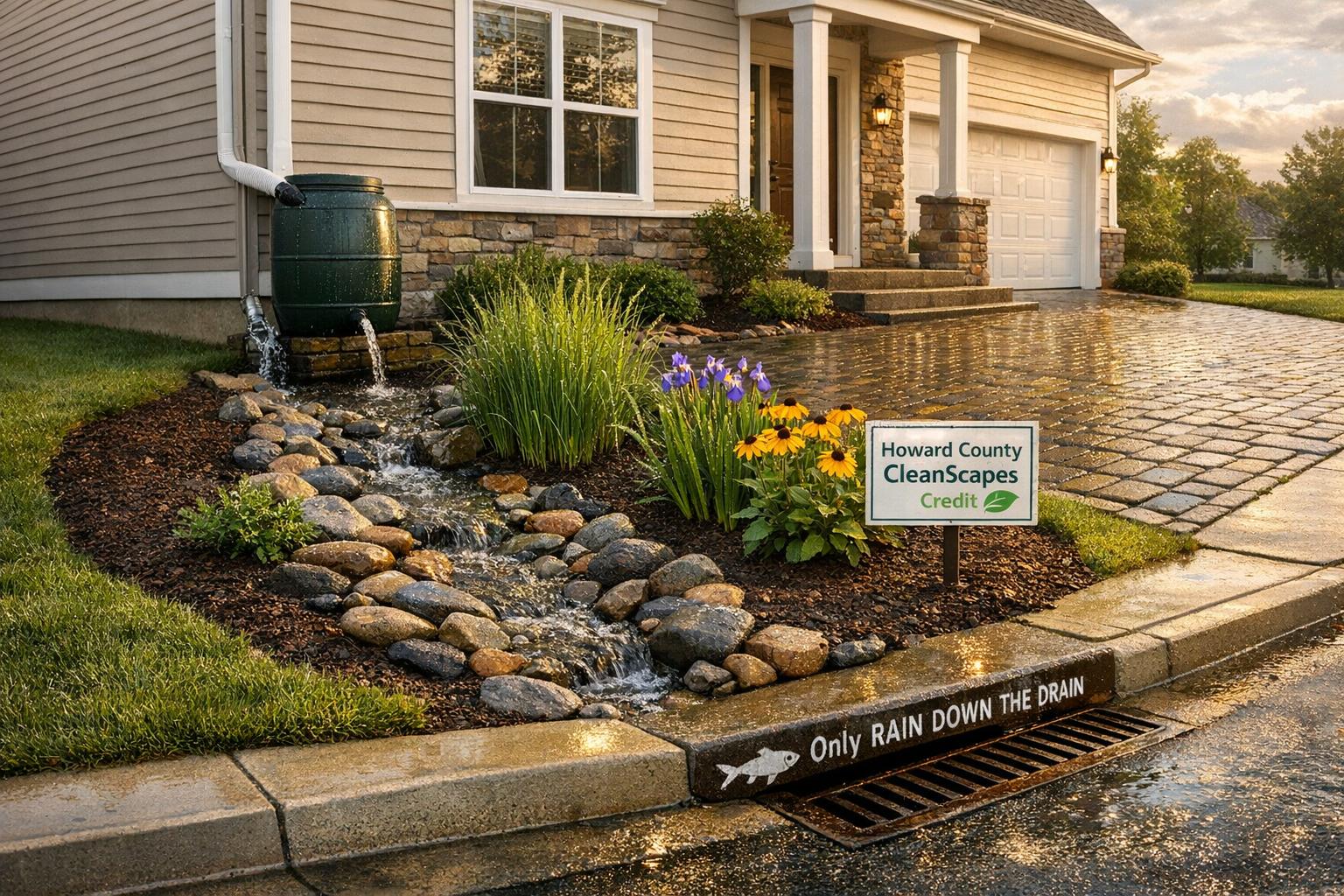
Howard County enforces strict stormwater regulations to manage runoff, protect waterways, and meet federal and state standards. These rules require property owners and developers to use natural designs like rain gardens and permeable pavers to reduce pollution and mimic predevelopment water absorption. Homeowners pay a Watershed Protection Fee, but programs like CleanScapes offer credits and reimbursements for installing stormwater management systems. Compliance is essential to protect local streams and the Chesapeake Bay while avoiding penalties. Below, we break down the key requirements, fees, and solutions.
- Key Requirements: Use Environmental Site Design (ESD) methods like green roofs and rain gardens before relying on engineered solutions.
- Fees: Residential properties pay an annual Watershed Protection Fee, which varies based on property type and size.
- Programs: CleanScapes provides reimbursements and fee credits for stormwater management projects.
- Submission Process: Use the ProjectDox portal for digital BMP and storm drain data submissions.
These efforts ensure cleaner waterways and better stormwater management across Howard County.
Howard County Stormwater Management: Fees, BMPs, and CleanScapes Credits Guide
Understanding the NPDES MS4 Permit and Howard County Requirements
What Is the NPDES MS4 Permit?
The NPDES MS4 Permit, issued by the EPA and MDE, requires Howard County to manage and treat stormwater runoff from urban areas before it flows into local waterways. This ensures cleaner water and aligns with federal and state environmental standards.
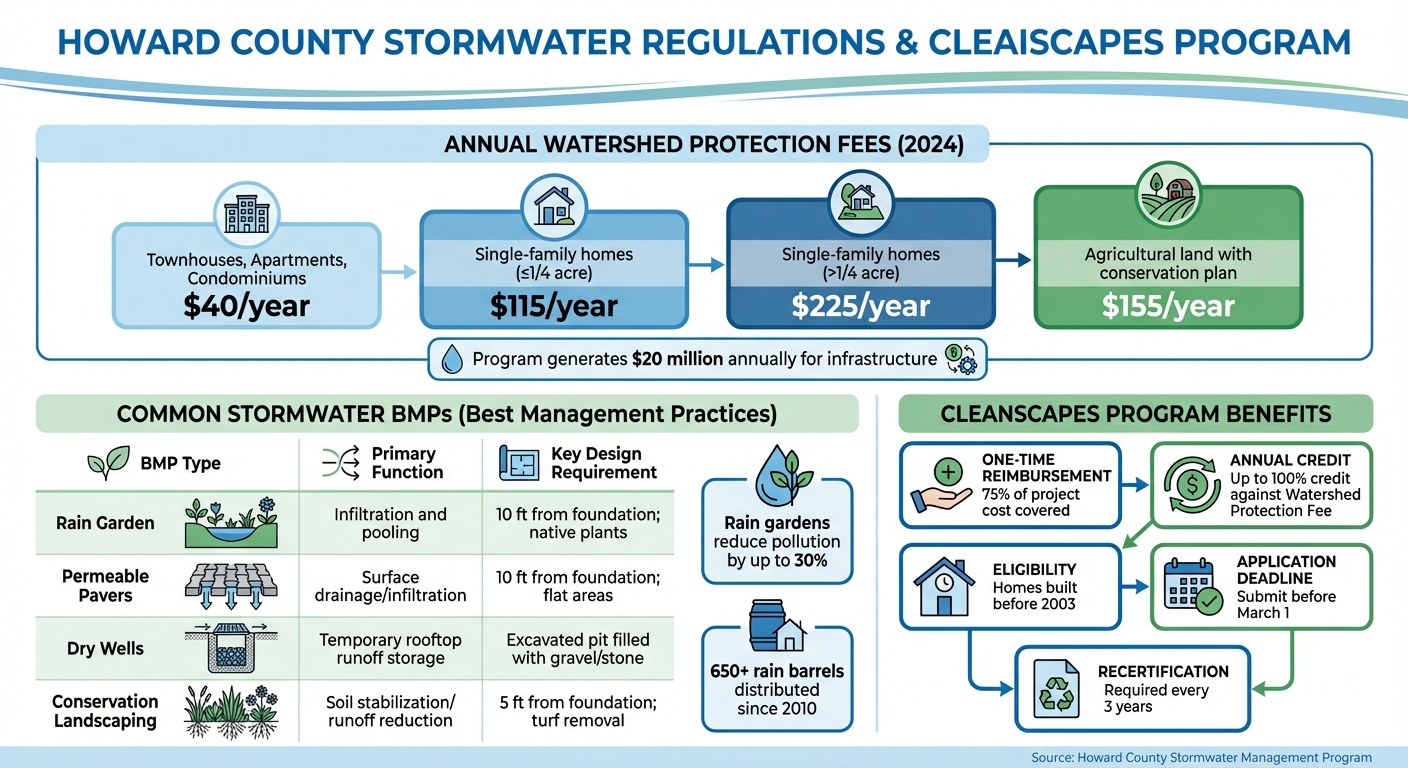
Howard County addresses these requirements through a Countywide Implementation Strategy, which sets clear water quality goals. The program is funded by a Watershed Protection Fee, which helps maintain vital infrastructure like storm drains, underground pipes, ponds, and streams. Since 2010, over 650 rain barrels have been distributed to local residents to help reduce runoff and meet compliance goals [4].
Let’s dive into how these federal guidelines shape the county’s detailed stormwater management policies.
Howard County’s Stormwater Policies
Howard County has built a robust framework to meet the NPDES MS4 Permit requirements, focusing on effective stormwater management at the community level.
Property owners and developers must implement Environmental Site Design (ESD) to the Maximum Extent Practicable (MEP) before turning to structural Best Management Practices (BMPs). This ensures developments minimize impervious surfaces and allow for natural groundwater recharge, mimicking predevelopment conditions. Techniques like preserving natural landscapes, installing green roofs, and using permeable pavements are emphasized to maintain water quality and reduce pollution downstream.
To fund these efforts, all property owners pay a Watershed Protection Fee. This fee, determined by property size or the extent of impervious surfaces, supports necessary infrastructure improvements. Additionally, property owners are responsible for maintaining BMPs on their land, with any modifications requiring approval from relevant county agencies [2][4].
Enforcement of these policies is handled by the Department of Inspections, Licenses & Permits and the Department of Planning & Zoning. These departments conduct regular inspections to ensure compliance. Residents can also contribute to monitoring efforts by reporting issues through the Water Reporter app or submitting a Zoning Complaint Form [3][4][5].
sbb-itb-843f8be
From the Field: Building rain gardens with youth in Howard County, Md.
Design Standards from the Howard County Design Manual
Howard County follows the guidelines outlined in the Maryland Stormwater Design Manual, which prioritizes managing runoff in a way that works with natural systems. The main directive is clear: developers and property owners must use Environmental Site Design (ESD) to the Maximum Extent Practicable (MEP) before turning to structural Best Management Practices (BMPs) like stormwater ponds [2]. This philosophy aims to maintain the land’s natural capacity to absorb water rather than relying heavily on engineered solutions. These principles lay the groundwork for the specific BMPs described below.
Common Stormwater BMPs
Using these design principles, several BMPs provide effective ways to meet stormwater regulations. Take rain gardens, for example – they’re a go-to solution for residential areas, capable of reducing pollution entering local streams by as much as 30% [4]. These shallow, vegetated depressions capture and filter runoff. To function properly, they need native plants, must be placed at least 10 feet from building foundations, and are best suited for flat areas away from tree roots [6].
Another option is permeable pavers, ideal for driveways, patios, and walkways. These surfaces allow water to seep into the ground instead of flowing into storm drains. They perform best in areas with sandy or silty soils and also need to be installed at least 10 feet from foundations [6]. For properties with less space, dry wells offer a compact solution. These gravel- or stone-filled pits temporarily store rooftop runoff collected via downspouts [6].
| BMP Type | Primary Function | Key Design Requirement |
|---|---|---|
| Rain Garden | Infiltration and pooling | 10 ft from foundation; native plants [6] |
| Permeable Pavers | Surface drainage/infiltration | 10 ft from foundation; flat areas [6] |
| Dry Wells | Temporary rooftop runoff storage | Excavated pit filled with gravel/stone [6] |
| Conservation Landscaping | Soil stabilization/runoff reduction | 5 ft from foundation; turf removal [6] |
Eco-Friendly Drainage Solutions
In addition to individual BMPs, Howard County promotes drainage strategies that take advantage of the natural landscape. Techniques like grading and land leveling are used to direct water away from buildings while preserving the land’s natural flow. The county also encourages the use of sheetflow to conservation areas, where runoff spreads thinly across vegetation, allowing pollutants to filter out before reaching storm drains [2].
When implementing any drainage solution, minimizing soil disturbance and compaction is essential [2]. Compacted soil loses its ability to absorb water, so if you’re replacing old patios or walkways with permeable materials, it’s a good idea to till the underlying soil to restore its infiltration ability [6]. Using native Chesapeake Bay plants in these systems not only helps stabilize soil but also supports carbon storage, offering more benefits than non-native species [6].
How to Submit Digital Storm Drain and BMP Data
Once you’ve designed your BMPs according to Howard County’s guidelines, the next step is submitting your plans digitally. This process ensures your storm drain and BMP data aligns with the county’s requirements. All digital submissions must be uploaded through the ProjectDox Plan Submission Portal [5][3]. Managed by the Development Engineering Division within the Department of Planning and Zoning (DPZ), this portal is the hub for reviewing all stormwater-related plans [5][3].
Your submission should include detailed representations of storm drain systems and BMPs, such as rain gardens, permeable pavers, dry wells, or rainwater harvesting systems [1][4]. This step is essential for compliance with NPDES MS4 regulations and directly impacts your Watershed Protection Fee [4]. For non-residential properties, it’s especially critical to provide precise calculations of your property’s impervious area, as this determines your fee [4].
Here’s how to prepare and submit your digital data effectively.
Preparing and Submitting Your Digital Data
Start by verifying your site conditions using the Howard County Interactive Map. This tool helps ensure your storm drain and BMP maps are formatted correctly [5]. Combine this with resources like the DPZ’s Professional Resources and Business Processes guides to ensure your submission meets all requirements [5].
Each BMP must be labeled accurately – whether it’s an infiltration system, permeable pavers, or a rainwater harvesting setup. Proper labeling is key to receiving the correct fee credits and staying compliant [1]. Additionally, consult the Howard County Design Manual and the Sustainable Landscape Maintenance Manual to confirm that your plans adhere to the necessary technical standards [5][1].
With your data ready, avoid these common pitfalls during the submission process.
Common Submission Errors to Avoid
One of the biggest mistakes is submitting incomplete or incorrect impervious area calculations. Errors in these figures can lead to inaccurate fee assessments and delays in project approval. Double-check your calculations before uploading your data. Another frequent issue is mislabeling BMPs – for instance, classifying a dry well as a rain garden. Such mistakes can result in incorrect fee credits or compliance problems later.
Also, remember that all submissions must go through the ProjectDox portal. Some applicants mistakenly try to send plans via email or other methods, but the Development Engineering Division only processes submissions made through ProjectDox [5][7]. If your project is complex, consider hiring certified professionals, such as Chesapeake Bay Landscape Professionals or those with National Green Infrastructure Certification (NGCIP). These experts are well-versed in the county’s technical standards and can help you avoid costly errors or resubmissions [1].
Residential Compliance: Stormwater Remediation Fee and CleanScapes Program
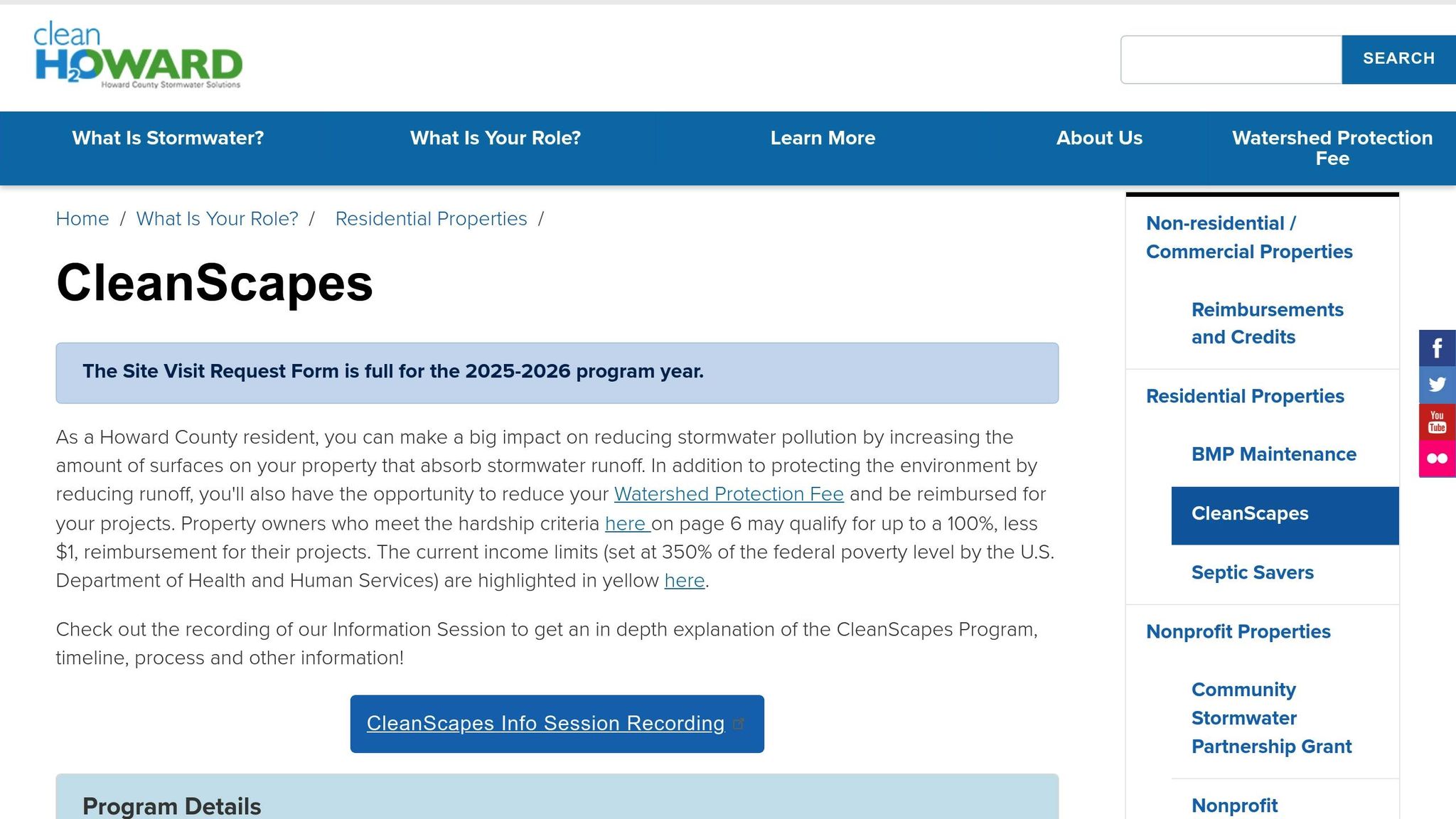
For homeowners in Howard County, compliance involves paying the Watershed Protection Fee (WPF) – a service fee tied to your property’s impact on the stormwater system. Think of it like your water or sewer bill, not a tax. This fee appears on your property tax bill each year on July 1 [8]. However, you can lower – or even eliminate – this fee by taking part in the CleanScapes Program, which rewards efforts to manage stormwater on your property.
Understanding the Stormwater Remediation Fee
The WPF brings in about $20 million annually to fund the operation, maintenance, and improvements of Howard County’s stormwater infrastructure [8]. While commercial properties are charged based on their actual impervious surface area, residential properties pay a flat rate determined by property type and lot size [8][9]. Fee rates were updated in 2024 to reflect rising costs of materials and infrastructure needs [8].
| Residential Property Type | Annual Fee (as of 2024) |
|---|---|
| Townhouses, Apartments, and Condominiums | $40 |
| Single-family detached homes (1/4 acre or less) | $115 |
| Single-family detached homes (Greater than 1/4 acre) | $225 |
| Agricultural land with a conservation plan | $155 |
If you’re unsure about your lot size, you can check the Maryland State Department of Assessments and Taxation (SDAT) website [9]. Residential common areas in townhouse or condo developments are exempt from this fee [8]. For those facing financial difficulties, the hardship program offers assistance through the Department of Finance, using the same criteria as the trash fee hardship program [8].
You can also reduce or eliminate this fee by installing stormwater management solutions through the CleanScapes Program.
How to Use the CleanScapes Program
The CleanScapes Program helps homeowners offset the WPF by encouraging the installation of Best Management Practices (BMPs) like rain gardens, permeable pavers, or rain barrels. By participating, you can receive both a one-time reimbursement and an ongoing annual credit toward your WPF [8]. This program is available only for homes built before 2003 [9].
- Reimbursement: The county covers 75% of the project cost for most BMPs.
- Annual Credit: You can earn up to 100% credit against your WPF [8].
To qualify for the credit, you must install an approved BMP and submit your application before March 1 to see the credit reflected on your current tax bill [9]. Once approved, you’ll need to recertify every three years through a simple self-certification process to keep the credit active [8].
Proper maintenance of your BMP is crucial. You can refer to resources like the Sustainable Landscape Maintenance Manual for the Chesapeake Bay Watershed or hire certified professionals, such as Chesapeake Bay Landscape Professionals or those with National Green Infrastructure Certification (NGCIP), to ensure your installation remains effective [1].
Professional Stormwater Management Solutions with Pro Landscapes MD

Professional stormwater management services can simplify compliance and boost property value. By installing and maintaining drainage systems that meet local codes, you can not only protect your property but also lower your Watershed Protection Fee through programs like CleanScapes.
Drainage and Stormwater Solutions
Pro Landscapes MD delivers a range of drainage services designed to meet county regulations. Their offerings include everything from French drains to grading, land leveling, and yard repair, all tailored to manage runoff from impervious surfaces like roofs and driveways. These solutions help prevent common issues like erosion and flooding, which can wreak havoc on your landscape.
Their team conducts professional assessments to identify the best Best Management Practices (BMPs) for your specific property. Whether it’s drain pipe installations to divert water away from your home or integrated systems that align with CleanScapes requirements, their installations are built to last. These drainage solutions are also designed to blend seamlessly with environmentally conscious landscaping, ensuring both functionality and a polished appearance.
Eco-Friendly Design and Materials
Pro Landscapes MD takes pride in offering sustainable options like permeable pavers for driveways, patios, and walkways. Unlike traditional concrete or asphalt, these interlocking systems allow water to seep into the ground instead of overwhelming storm drains [4]. The result? Practical outdoor spaces that are both attractive and environmentally friendly.
They also specialize in dry riverbed installations, which combine effective drainage with natural beauty. Using native plants and natural stone, these features filter runoff while enhancing your outdoor space. Additionally, rain gardens – planted depressions that collect water from surfaces like rooftops and sidewalks – can cut pollution entering local waterways by up to 30% [4]. By incorporating native plants, these gardens not only provide ecological benefits but may also qualify for fee reductions through the CleanScapes Program.
Conclusion and Key Takeaways
Understanding and complying with Howard County’s stormwater regulations doesn’t have to be overwhelming. The main steps are straightforward: pay your Watershed Protection Fee, use Environmental Site Design (ESD) methods as much as possible, and keep up with the maintenance of any Best Management Practices (BMPs) on your property. Even small actions, like mowing your lawn to at least 3 inches, can make a big difference in protecting local waterways [4].
For long-term success, professional maintenance is key. Stormwater BMPs need regular care and occasional updates to stay effective. When hiring contractors, look for certifications like the National Green Infrastructure Certification Program (NGICP) or Chesapeake Bay Landscape Professional (CBLP) to ensure your systems meet compliance standards and function properly [1].
The environmental impact is undeniable. With the Chesapeake Bay facing serious challenges, every property owner has an important role to play [4]. Features like rain gardens and permeable pavers are proven tools for managing runoff, reducing flooding, and controlling erosion effectively.
FAQs
Do I need a permit to add a rain garden or permeable pavers?
In Howard County, Maryland, you’ll need a permit to install a rain garden or permeable pavers. These installations fall under stormwater Best Management Practices (BMPs) and must align with county regulations. To ensure your project meets the required stormwater management standards, it’s a good idea to review the local permitting requirements beforehand. Checking the county’s guidelines before starting your project can help you avoid potential issues.
How do I calculate impervious area for my Watershed Protection Fee?
To figure out the impervious area for your Watershed Protection Fee in Howard County, you’ll need to measure the surfaces on your property that don’t let water soak through. This includes areas like roofs, driveways, and parking lots. You can use tools like property records, site plans, or GIS data to pinpoint these spaces. Since the fee is determined by the amount of impervious surface, it’s a good idea to check Howard County’s specific guidelines or work with a professional who knows the local rules to ensure your calculations are accurate.
What maintenance is required to keep my CleanScapes credit?
To keep your CleanScapes credit active, it’s important to stay on top of regular maintenance for your stormwater Best Management Practices (BMPs). This involves seasonal care and monitoring for systems like rain gardens, dry wells, and permeable pavers. Key tasks include:
- Checking for sediment buildup.
- Cleaning infiltration systems.
- Ensuring permeable surfaces are functioning as intended.
Make sure to follow Howard County’s guidelines or reach out to certified professionals to ensure your BMPs remain effective and compliant.
Chat with Us