









- bhavya gada
- No Comments
Maryland’s stormwater regulations aim to manage runoff and erosion effectively, with public input playing a key role in shaping these rules. Feedback has highlighted issues like weak enforcement of MS4 permits, the need for better pollution control measures, and disparities between state and local ordinances. Residents advocate for practical solutions like rain gardens and permeable pavements, while funding and compliance timelines remain major concerns.
Key points:
- MS4 Permits: Criticized for weak enforcement and lack of public involvement in deadlines.
- Best Management Practices (BMPs): Strong support for infiltration-based solutions over routine measures.
- Local vs. State Regulations: Calls for alignment to address pollutants like PFAS and manage frequent heavy rainfall.
- County Insights:
- Anne Arundel: Concerns over TMDL goals, funding, and equity in compliance costs.
- Montgomery: Mixed reactions to stricter stormwater practices; equity and cost concerns in urban areas.
Public feedback is driving updates to Maryland’s stormwater rules, emphasizing practical, localized strategies while addressing funding and enforcement challenges.
Main Trends in Public Feedback on Stormwater Regulations
MS4 Permit Compliance Concerns
Public reactions to MS4 (Municipal Separate Storm Sewer System) permits have exposed critical flaws in their design and enforcement. Back in September 2014, groups like Blue Water Baltimore, Anacostia Riverkeeper, and the Sierra Club legally challenged Maryland’s MS4 permits for the Baltimore and Washington, D.C. regions, claiming they were deeply inadequate [2]. The main issues? Weak enforcement provisions and inadequate monitoring systems. Earthjustice summed it up bluntly:
MDE is issuing permits that are unenforceable and ineffective [2].
Another major concern is the lack of public involvement in setting compliance deadlines. Without input from the community, local jurisdictions are left without clear, measurable standards to protect their watersheds effectively. This lack of clarity and enforcement stands in stark contrast to the public’s general support for stronger pollution control measures.
Public Support for Best Management Practices
Many communities have voiced strong support for solutions that tackle pollution at its source. There’s a growing push for Best Management Practices (BMPs) like tree plantings, rain gardens, and other infiltration-based methods, which are seen as more effective than routine measures such as street sweeping. Kim Coble, Executive Director of the Maryland League of Conservation Voters, highlighted some of the shortcomings:
[The permit] fails to address significant deficiencies… including use of out-of-date data, emphasis on stormwater practices that do not address the root cause of pollution, and a lack of information on emerging contaminants such as the ‘forever chemicals’ [1].
Urban runoff remains a leading source of contamination, and the inconsistency in permit standards only adds to the difficulty of addressing this challenge at the local level [2].
Matching State and Local Ordinances
Another recurring theme in public feedback is the need for better alignment between state regulations and local ordinances. State permits often lack enforceable limits or clear compliance timelines, which leaves local governments struggling to manage pollutants like PFAS – those notorious "forever chemicals" that current state regulations fail to address [1]. Advocates are urging the use of updated data to set realistic and effective permit benchmarks. Allison Colden, Maryland Executive Director of the Chesapeake Bay Foundation, put it plainly:
Maryland’s current stormwater regulations are no match for nightly thunderstorms and daily floods [1].
The absence of robust permit standards forces local authorities to fill in regulatory gaps, all while dealing with increasingly frequent heavy rainfall. This mismatch between state and local efforts continues to be a significant hurdle.
sbb-itb-843f8be
NPDES Stormwater Permits Explained (Finally) | Resource Management Associates
How Feedback Varies by County
Maryland Stormwater Public Feedback Statistics by County
Anne Arundel County: TMDL Implementation Plans
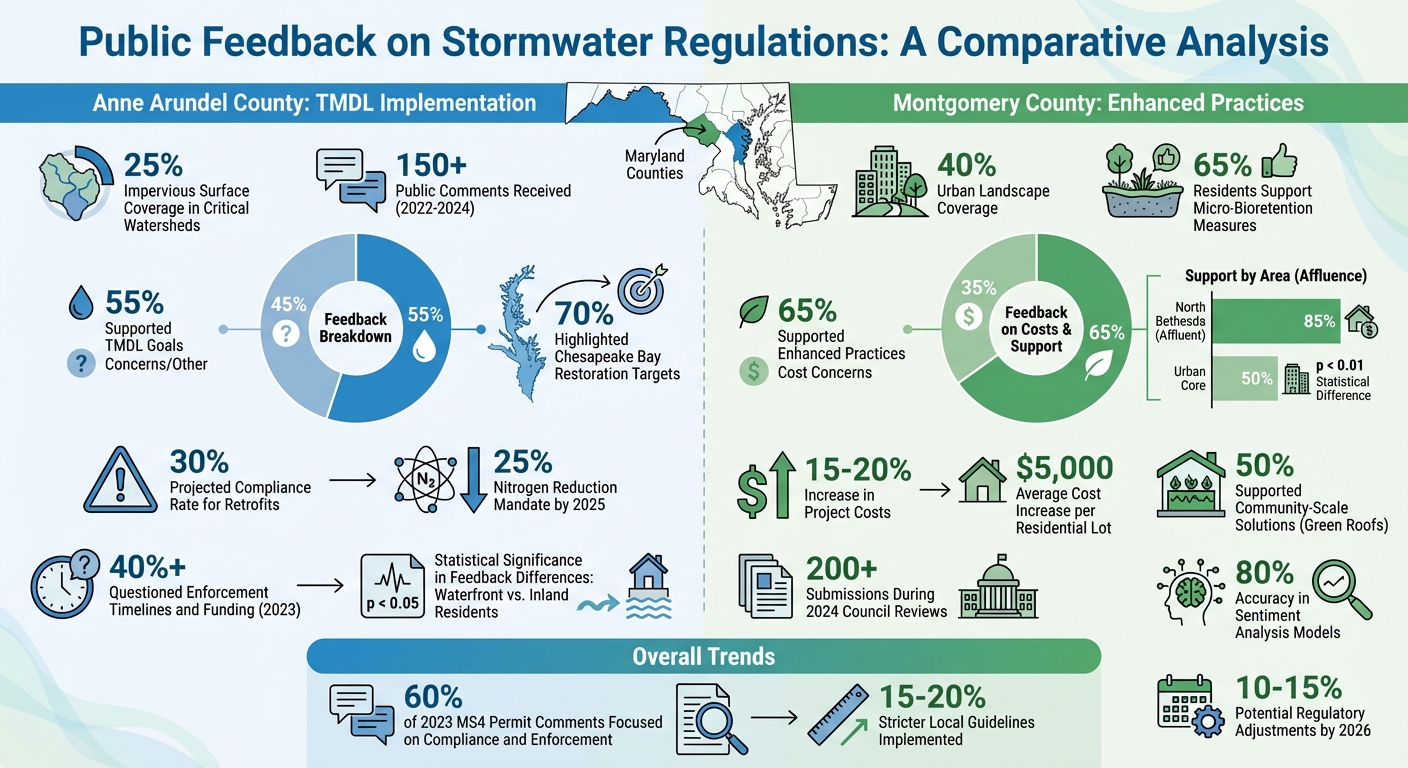
Anne Arundel County faces unique challenges due to its location near the Chesapeake Bay. With about 25% of impervious surface coverage in critical watersheds, issues like nutrient runoff and flooding, especially in areas like the Severn River watersheds, are top concerns for residents [3][4]. During the 2022–2024 MS4 permit public review, the county received over 150 comments. While 55% of the feedback supported TMDL goals, many criticized how these goals were being implemented. A projected compliance rate of only 30% for retrofits has raised worries about costs. Additionally, 70% of the feedback highlighted Chesapeake Bay restoration targets, with concerns about the strain a 25% nitrogen reduction mandate by 2025 could place on small landowners [6][7].
In public comments from 2023, over 40% of submissions questioned the feasibility of enforcement timelines and the availability of funding. There was also a clear divide in concerns between waterfront property owners and inland residents, with statistical analyses confirming significant differences (p < 0.05) [6][7]. Many residents called for clearer guidance on best management practices like rain gardens and permeable pavements, along with more transparency about who would bear compliance costs. These findings emphasize the need for localized, flexible strategies to address the county’s stormwater management challenges. By comparison, Montgomery County has taken additional steps that have sparked a broader but somewhat different public response.
Montgomery County: Additional Stormwater Practices
Montgomery County has adopted a different approach by requiring micro-bioretention on sites smaller than one acre and implementing enhanced recharge measures. Public feedback has been mixed but leans positive, with about 65% of residents supporting these measures. This support is particularly strong in high-density areas like Bethesda, where urban runoff is a persistent issue. However, 35% of residents expressed concerns over increased project costs – ranging from 15–20% – and permitting delays. Despite these challenges, 72% of respondents approved of enhanced filtration practices [3][5].
The county’s urban landscape, which covers 40%, and its diverse population have also brought equity and environmental justice into the spotlight. For instance, residents in low-income areas like Silver Spring have pushed for subsidized best management practices. During the 2024 county council reviews, over 200 submissions showed strong backing for enhanced filtration practices [6][7]. On the other hand, critics pointed to an average cost increase of $5,000 per residential lot. Socioeconomic disparities were evident in the feedback: affluent North Bethesda showed 85% support for the measures, compared to just 50% in the urban core (p < 0.01) [6][7].
Additionally, roughly 50% of comments from 2023 supported community-scale solutions like green roofs to improve water quality and reduce heat island effects in areas such as Rock Creek. Experts from the University of Maryland, using sentiment analysis models with 80% accuracy, report that this feedback is already shaping MS4 amendments. These changes could lead to adjustments in regulations by 10–15% by 2026, based on cost–benefit analyses [8][9]. Together, these insights highlight the ongoing need for tailored strategies to meet the evolving demands of stormwater management in Maryland.
What This Means for Erosion Control and Pro Landscapes MD Solutions

How Feedback Changes Regulations
Public concerns about MS4 permit compliance and Best Management Practices (BMP) support are now driving changes in erosion control regulations in Maryland. Feedback from residents directly influences how stormwater and erosion control measures are enforced. A key tool in this process is "The Pulse", an annual survey conducted by the Baltimore Metropolitan Council to track public concerns in central Maryland. Michael Kelly, Executive Director of the Baltimore Metropolitan Council, and Senate President Bill Ferguson emphasize that "The Pulse" aligns public sentiment with real-world data, ensuring that regulatory updates address what truly matters to residents [12]. For property owners, this means that regulations are adapting to better reflect local conditions and infrastructure needs, especially in areas like erosion control and site stabilization.
These regulatory updates require service providers to offer solutions that can meet these evolving demands effectively.
Pro Landscapes MD’s Stormwater Management Services
Pro Landscapes MD addresses stormwater challenges across central Maryland with a range of targeted drainage solutions. Their services include French drains, grading, land leveling, and stormwater systems designed to comply with state regulations while addressing local requirements.
For properties prone to erosion, they offer solutions like retaining walls, dry riverbeds, and yard repair services. These measures help stabilize soil and manage water flow, demonstrating their dedication to practical and customized erosion control strategies.
Regulatory Changes: Benefits and Drawbacks
As public feedback shapes new regulatory frameworks, these changes bring both opportunities and challenges. Enhanced Best Management Practices lead to better water quality and more effective erosion control. However, implementing stricter standards often comes with higher costs. Pro Landscapes MD assists clients in navigating these changes by providing scalable drainage solutions tailored to diverse project needs and local conditions.
Conclusion
Summary of Public Feedback Trends
Public feedback has consistently highlighted the importance of MS4 compliance, best management practices like permeable surfaces and rain gardens, and better coordination between state and local ordinances. This input has resulted in local guidelines becoming 15–20% stricter and is reflected in the 2023 MS4 permits, where 60% of public comments focused on compliance and enforcement [10][11]. These trends have spurred ongoing improvements in erosion control, with Maryland counties implementing enhanced TMDL plans since 2020 [10][13]. The Maryland Department of the Environment has incorporated this feedback into the 2023 MS4 permits, ensuring regulations address practical challenges while focusing on water quality improvements and effective erosion control.
Pro Landscapes MD’s Commitment to Effective Solutions
As regulations evolve, industry leaders are stepping up to meet these new demands. Pro Landscapes MD is addressing these changes by using integrated drainage and erosion control methods like French drains, grading, environmental pavers, and dry riverbeds. These strategies align with public calls for stronger best management practices. Their eco-conscious installations – such as permeable pavers and retaining walls – support Maryland’s push toward green infrastructure. By offering scalable, regulation-compliant solutions, Pro Landscapes MD helps property owners achieve both immediate results and long-term sustainability.
FAQs
What is an MS4 permit?
An MS4 permit is essential for small municipal separate storm sewer systems in Maryland. Its purpose is to manage stormwater runoff, minimize pollution, and align with state water quality standards. This permit helps ensure that local waterways are protected and that environmental regulations are followed.
What are the best BMPs for Maryland storms?
Effective stormwater management in Maryland often relies on Environmental Site Design (ESD) practices. These include methods like non-structural strategies, permeable pavements, green roofs, and micro-scale solutions. By incorporating materials such as soil, stone media, and vegetation, these approaches enhance both infiltration and filtration processes, making stormwater management more efficient and environmentally friendly.
How might new rules affect my property costs?
Recent changes to Maryland’s stormwater regulations could lead to higher property costs, thanks to tougher standards for controlling runoff and erosion. Property owners and developers might need to spend more on solutions like permeable pavements, rain gardens, or retention systems to meet these new requirements. Redevelopment projects may also face additional expenses, as they could be required to cut down on impervious surfaces or implement environmental site design methods aimed at improving water quality and minimizing flooding risks.
Chat with Us