









- bhavya gada
- No Comments
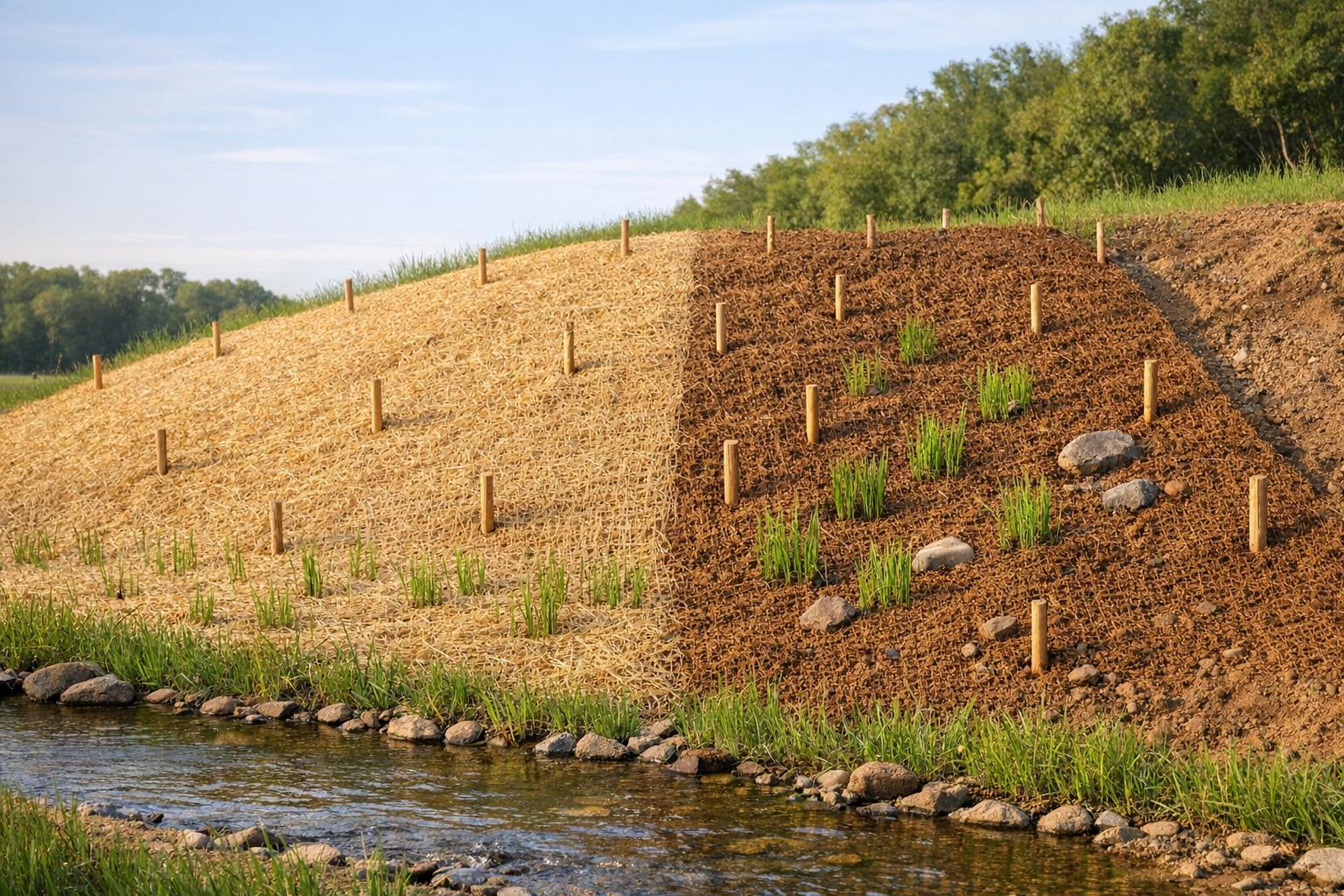
Straw and coconut erosion control blankets are used to manage soil erosion effectively, but they serve different purposes based on project needs. Here’s a quick breakdown:
- Straw blankets are a short-term, budget-friendly option lasting 3–12 months. They’re ideal for gentle slopes (2:1 to 4:1) and areas with low to moderate water flow. They cost about $0.35–$0.50 per square yard.
- Coconut blankets are longer-lasting, durable solutions with a lifespan of 2–5 years. They work best for steep slopes (1:1 or greater) and high-flow areas. These cost approximately $0.80–$1.05 per square yard.
Both options are biodegradable and support vegetation growth, but their suitability depends on factors like slope steepness, water flow, soil type, and project duration. For short-term stabilization, straw blankets are a cost-effective choice. For long-term protection, coconut blankets provide the strength needed for challenging conditions.
Quick Comparison
| Feature | Straw Blankets | Coconut Blankets |
|---|---|---|
| Lifespan | 3–12 months | 2–5 years |
| Cost | $0.35–$0.50/sq. yard | $0.80–$1.05/sq. yard |
| Slope Suitability | Gentle (2:1 to 4:1) | Steep (1:1 or greater) |
| Water Flow | Low to moderate | High to very high |
| Vegetation Goals | Fast-growing plants | Slow-growing plants |
The right choice depends on your specific site conditions and project goals.
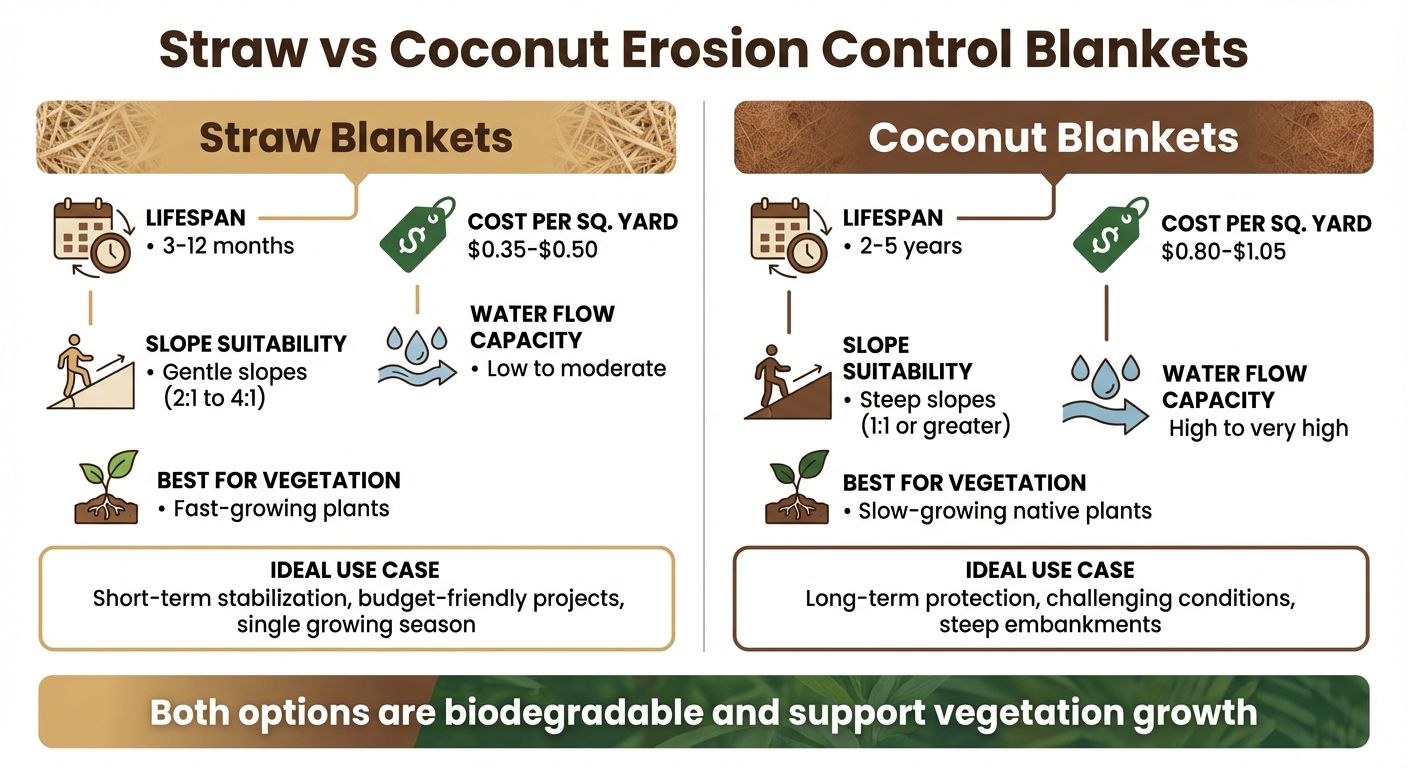
Straw vs Coconut Erosion Control Blankets Comparison Chart
Comparison of Erosion Control Blanket Fibers
sbb-itb-843f8be
What Are Straw Erosion Control Blankets?
Straw erosion control blankets are made from wheat straw, secured with netting and thread, forming a protective layer over exposed soil. This layer shields the ground from being displaced by wind or water while creating a nurturing environment for vegetation to grow [1][2]. Essentially, these blankets help stabilize the soil and kickstart the natural process of plant establishment.
They work by keeping the soil moist and safeguarding young plant roots from environmental stress. This creates ideal conditions for seeds to germinate and grow. Over time, as the straw fibers break down, they add organic matter to the soil, further enhancing its ability to support vegetation [2].
Since straw blankets are biodegradable, they’re intended for short-term use, typically lasting between 45 days and 12 months, depending on the product. This makes them a great choice for projects where soil stabilization is only needed for a single growing season [1][2]. Their design works best for gentle slopes and areas with low to moderate water flow.
These blankets are most effective on slopes with a gradient between 2:1 and 4:1, particularly in sandy soils where their ability to retain moisture is highly beneficial. However, they aren’t strong enough for steep slopes or areas prone to heavy rainfall, where more durable solutions are required [1][2].
For projects that don’t need long-term reinforcement, straw blankets provide a cost-effective way to stabilize soil just long enough for vegetation to establish itself.
What Are Coconut Erosion Control Blankets?
Coconut erosion control blankets are made from 100% natural coconut coir fibers, which are extracted from coconut husks. These fibers are woven into a mat-like structure using netting, creating a protective layer that prevents soil erosion while encouraging vegetation growth. Thanks to their high tensile strength and durability, they outperform straw blankets, especially in tough conditions.
Their unique mesh design allows water to flow freely, making them highly effective in areas prone to heavy rainfall or strong winds [2]. The coir fibers provide a stable base for plant roots, enabling them to establish and thrive over several growing seasons.
With a lifespan ranging from 2 to 5 years, these blankets are perfect for environments that require long-term stabilization [2]. As the coconut fibers decompose, they naturally improve the soil’s organic content, enhancing its quality over time [2].
Coconut blankets are especially suited for steep slopes with gradients of 1:1 or greater, where straw blankets fall short [1]. They’re also ideal for heavy soils like clay, which demand sturdier solutions compared to lighter, sandy soils [2]. Since they are made entirely from biodegradable materials, they are an excellent choice for environmentally sensitive areas that need durable, eco-friendly protection.
Their combination of strength, longevity, and natural materials makes coconut blankets a top-tier solution for erosion control projects requiring reliable performance over several growing seasons.
How Durable Are Straw and Coconut Blankets?
When it comes to durability, straw and coconut blankets serve different purposes based on their lifespans and resilience.
Straw blankets are a short-term solution, lasting 3 to 12 months before decomposing completely[2]. Made from agricultural straw fibers, these blankets work best for projects where vegetation can establish within a single growing season. However, their quick breakdown makes them less effective in areas with harsh weather or high water flow.
Coconut blankets, on the other hand, are built to last significantly longer, with a lifespan of 2 to 5 years[2]. Thanks to the higher tensile strength of coconut coir fibers, these blankets hold up well under heavy rainfall and fast-moving water. This makes them a better choice for steep embankments and high-velocity drainage channels where straw blankets might fail.
The durability of both types depends heavily on construction quality. Factors like the fiber matrix, netting type, and thread material play a crucial role in determining how long they last. As Everett J. Prescott puts it:
The longevity of each product varies based on the mix of the fiber matrix, netting that contains the matrix and thread type[1].
Environmental conditions also matter. Straw blankets are more vulnerable to tearing and soil washout in areas with heavy rain or fast water flow. Coconut blankets, with their mesh design, are better equipped to channel water while keeping soil in place. The table below highlights these differences in durability.
Durability Comparison Table
| Material | Lifespan | Degradation Factors | Slope Suitability |
|---|---|---|---|
| Straw | 3–12 months[2] | Weather, soil composition, water flow | Gentle slopes (2:1 to 4:1)[1] |
| Coconut | 2–5 years[2] | Weather, soil composition, water flow | Steep slopes (1:1 or greater)[1] |
Cost Differences Between Straw and Coconut Blankets
When it comes to choosing between straw and coconut blankets, cost is a major consideration. Straw blankets are typically much cheaper, costing around $0.35 to $0.50 per square yard, while coconut blankets are priced at about $0.80 to $1.05 per square yard – roughly double the cost [2]. This price gap stems from the materials used: straw is an agricultural byproduct, which keeps costs low, whereas coconut coir is made from durable, high-tensile natural fibers that are more expensive to produce and transport [2].
Transportation costs also play a role. Straw is often sourced locally, minimizing shipping expenses. On the other hand, coconut fibers may need to be shipped over longer distances, which can add significantly to the total cost [2]. For large-scale projects, bulk purchasing may help reduce the per-unit price, but the heavier weight of coconut materials means shipping fees remain a factor [3].
The lifespan of these materials directly impacts their long-term value. Straw, with its shorter lifespan of 45 days to 12 months, requires frequent replacements, leading to recurring material and labor costs. In contrast, coconut blankets last 2 to 5 years, reducing the need for replacements. As Sandbaggy points out [2]:
Long-lasting options like coconut fiber erosion control blankets reduce the need for frequent replacements, saving time and resources.
Another cost factor is the type of netting used. Standard polypropylene netting is more affordable, while biodegradable jute netting – ideal for environmentally sensitive areas – comes at a higher price. For sites requiring regular vegetation management, rapid-degrade netting may be a better fit, as it breaks down more quickly [3].
Cost Comparison Table
| Material | Price per Square Yard | Factors Affecting Cost | Value for Duration |
|---|---|---|---|
| Straw | $0.35–$0.50 | Local availability, quantity needed | Short-term solution |
| Coconut | $0.80–$1.05 | Shipping costs, material strength | Long-term solution |
When to Use Straw vs Coconut Blankets
Choosing the right erosion control blanket depends heavily on the site’s conditions. The steepness of the slope is a key factor. Straw blankets are a solid choice for gentle slopes with a gradient between 2:1 and 4:1, where the incline is moderate. On the other hand, coconut blankets are better suited for steeper slopes of 1:1 or greater, such as those found on steep embankments or drainage channels. Their high tensile strength ensures they stay in place under challenging conditions. Water flow also plays a big role. For areas with low to moderate rainfall or runoff, straw blankets provide effective and economical protection. However, in regions prone to heavy storms or high-velocity water flow – like Maryland, where winter storms and spring rains often lead to significant runoff – coconut blankets are more reliable for long-term stabilization [1][4].
Beyond physical site conditions, vegetation goals also influence blanket selection. Straw blankets are ideal for projects requiring fast-growing plants for a single season, such as new lawns or temporary construction areas. In contrast, coconut blankets are better suited for slow-growing native plants that need extended protection, making them a great choice for stream banks, shorelines, or other sensitive environments [1].
Soil type is another important consideration. Sandy soils generally perform well with either material, though straw is often sufficient. For heavy clay soils or highly erodible areas, the robust stabilization provided by coconut blankets is essential. For slopes that fall in the mid-range (1:1 to 2:1), a blend of straw and coconut offers a balanced solution, providing immediate protection and lasting up to 18 months [1].
Use Case Comparison Table
| Site Condition | Straw Pros/Cons | Coconut Pros/Cons |
|---|---|---|
| Flat/Gentle Slopes | Affordable and supports fast vegetation; short lifespan | Extremely durable but more expensive than needed for flats |
| Steep Slopes | Less effective in heavy rainfall; prone to washout | Ideal for steep, challenging sites; offers high strength |
| Vegetation Goals | Suits fast-growing plants; degrades before slow plants mature | Best for slow-growing native plants; provides years of support |
| Heavy Rainfall | Degrades quickly; less effective against sheet flow | Highly durable; resists detachment from heavy rain impact [4] |
How to Choose Between Straw and Coconut Blankets
When deciding between straw and coconut blankets, it’s essential to consider factors like your project’s timeline, slope, water flow, and budget. Start by calculating the slope ratio (rise divided by run) to identify the best fit. For gentler slopes, straw blankets are effective at stabilizing soil. On the other hand, for steeper slopes approaching 1:1 or greater, coconut blankets provide the necessary strength to prevent washout [1].
Water flow is another critical factor. Straw blankets perform well in areas with low-to-moderate rainfall, but if your site experiences heavy storms or high-velocity runoff, coconut blankets offer the durability needed to handle these conditions [5]. Additionally, align the blanket’s lifespan with your plant growth timeline. Fast-growing grasses that establish within six months are well-suited to straw blankets. However, if you’re working with native plants that take two or more growing seasons, coconut blankets’ extended durability is a better match [2].
Budget considerations also play a role. Straw blankets typically cost around $26 per roll, while coconut blankets average $70. For projects lasting less than a year, straw’s lower upfront cost is a practical choice. However, for multi-year stabilization, coconut blankets can save money in the long run by reducing the need for replacements and additional labor, despite the higher initial cost [6].
Soil type is equally important. Sandy soils that require moisture retention can work with either material, though straw is often sufficient. In contrast, heavy clay or highly erodible soils demand the stronger stabilization that coconut blankets provide [2]. For moderate slopes with medium water flow, a straw/coconut blend – priced at about $60 per roll – offers around 18 months of protection, striking a balance between cost and performance [6].
Quick Reference Table
| Factor | Straw | Coconut |
|---|---|---|
| Lifespan | 3–12 months | 2–5 years |
| Cost per Roll | $25.99–$34.99 | $69.99 |
| Slope Suitability | 2:1 to 4:1 (gentle) | 1:1 or steeper |
| Vegetation Type | Fast-growing grass | Slow-growing native plants |
| Environmental Need | Short-term stabilization | Long-term erosion control |
| Flow Capacity | Low to moderate | High to very high |
Conclusion
Selecting between straw and coconut erosion control blankets depends on factors like slope, water flow, and soil type. Straw blankets are a practical choice for gentle slopes (typically 2:1 to 4:1) with low to moderate water flow, offering a cost-effective, short-term solution during vegetation growth. On the other hand, coconut blankets excel on steep slopes (1:1 or greater) and in high-flow areas, providing durability that can last 2 to 5 years.
The price difference reflects their performance. Straw blankets generally cost between $0.35 and $0.50 per square yard, while coconut blankets range from $0.80 to $1.05 per square yard. These distinctions in cost and functionality are key to making the best decision for your needs.
"Choosing the right erosion control blanket is crucial for long-term soil stabilization, vegetation support, and environmental protection." – Sandbaggy [2]
Straw blankets are best for temporary solutions, while coconut blankets provide long-term stability. Sandy soils benefit from either option due to improved moisture retention, but heavy clay soils often require the stronger stabilization coconut blankets offer. In regions with heavy rainfall or fast-moving runoff, the higher tensile strength of coconut blankets prevents washouts that might undermine straw alternatives.
For property owners in Maryland dealing with erosion issues, Pro Landscapes MD delivers expert drainage and stormwater management services across Howard County, Montgomery County, Carroll County, Frederick County, Prince George’s County, and Baltimore County. Their services include grading, land leveling, French drain installation, and erosion control, ensuring the right blanket is chosen and installed based on your property’s unique conditions. By opting for a professional site evaluation, you can avoid costly short-term fixes and address long-term erosion challenges effectively.
FAQs
How do I measure my slope ratio?
To figure out your slope ratio, you’ll need to compare the vertical rise to the horizontal run of the slope. It’s typically expressed as a ratio, such as 2:1 or 3:1.
- Step 1: Measure the vertical rise – the height from the base to the top of the slope.
- Step 2: Measure the horizontal run – the distance from the base to the point where the slope ends horizontally.
- Step 3: Calculate the ratio by dividing the horizontal run by the vertical rise. For example, if the horizontal run is 3 feet and the vertical rise is 1 foot, the slope ratio would be 3:1.
This simple calculation gives you a clear way to understand the steepness of the slope.
Which blanket is better for clay soil?
Coconut erosion control blankets tend to work better for clay soil because of their strength and ability to resist erosion. Clay soils are especially vulnerable during heavy storms, and coconut blankets offer durable, long-term protection. While straw blankets are an affordable and biodegradable option, they don’t hold up as well over time, making coconut blankets the more dependable solution for stabilizing clay soils.
Do I need professional installation?
Proper installation of erosion control blankets, such as straw and coconut varieties, is best handled by professionals. Expert installation ensures these blankets can effectively stabilize soil, reduce erosion, and aid vegetation growth. Professionals evaluate site-specific factors like slope and soil type and secure the blankets properly. This is especially critical for steep or difficult terrains, where correct placement boosts both durability and performance.
Chat with Us