









- bhavya gada
- No Comments
When deciding between synthetic and natural rink flooring, durability and maintenance are key factors. Synthetic flooring, made from high-density polymer panels, offers year-round usability, lasting 6–20 years depending on thickness and quality. It requires minimal upkeep and performs well in all weather conditions. Natural ice, while offering a smoother glide with less friction, is temporary and heavily reliant on refrigeration and constant maintenance. It melts in warm weather and requires significant resources like water and electricity.
Key Takeaways:
- Synthetic Flooring: Lasts longer (6–20 years), works in any climate, minimal maintenance, but higher upfront cost.
- Natural Ice: Seasonal, smooth glide, but needs refrigeration, frequent resurfacing, and higher ongoing costs.
Quick Comparison
| Feature | Synthetic Flooring | Natural Ice |
|---|---|---|
| Lifespan | 6–20 years | Temporary (seasonal) |
| Weather Resistance | Usable year-round | Melts above freezing |
| Maintenance | Minimal cleaning | Regular resurfacing |
| Upfront Cost | Higher | Lower |
| Ongoing Costs | Low | High (electricity, water) |
| Friction | 10–15% more than ice | Low |
Choosing the right option depends on your budget, location, and intended use. Synthetic is ideal for long-term, all-weather use, while natural ice works best for traditional skating experiences in cold climates or with refrigeration.
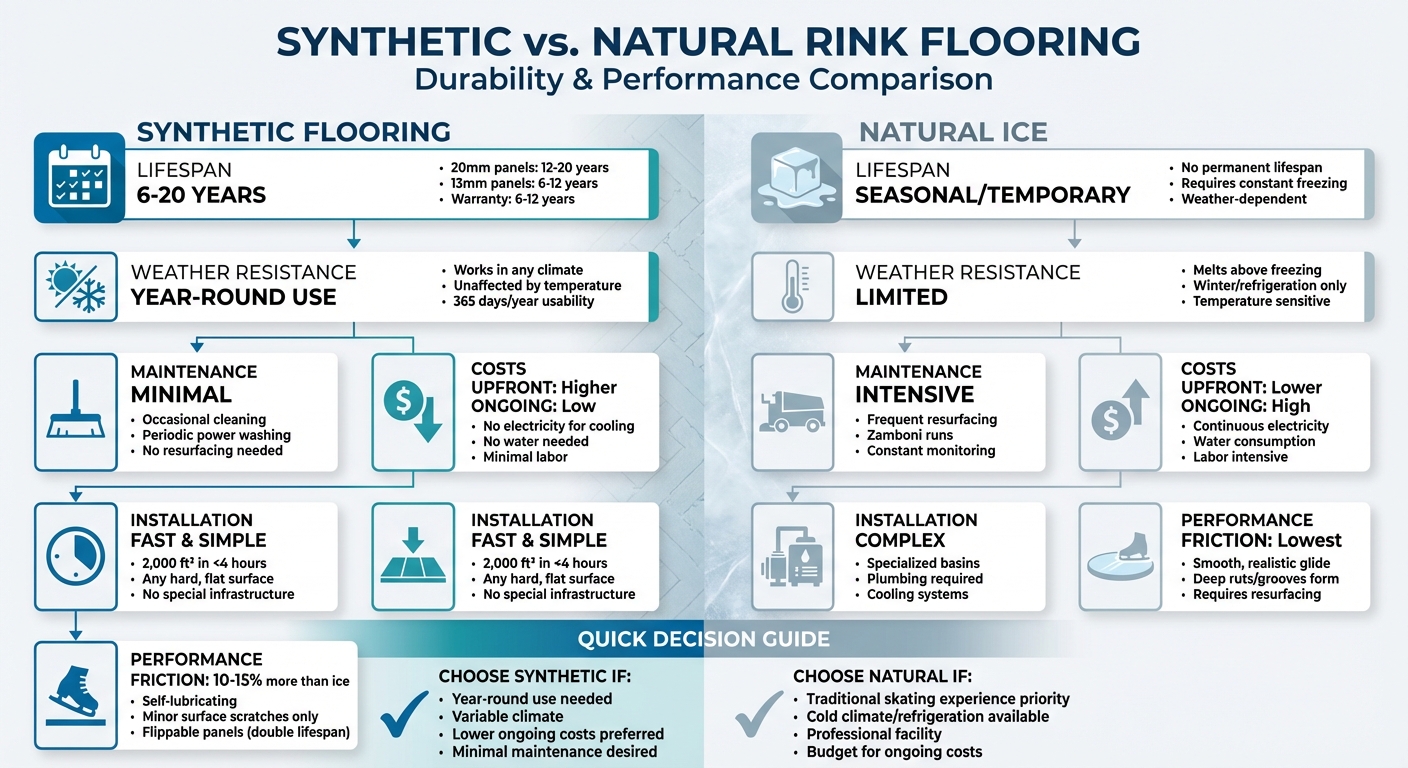
Synthetic vs Natural Ice Rink Flooring Durability Comparison Chart
SKATING ON TILES | Revolution Synthetic Ice
sbb-itb-843f8be
Synthetic Rink Flooring Explained
Synthetic rink flooring is made from high-density polymer panels designed for skating without the need for water or refrigeration. These panels are tough enough to resist deep cuts from skate blades, ensuring only minor surface marks that don’t require resurfacing. The material is also infused with self-lubricating agents that activate during use, eliminating the need for additional lubricants.
The panels use precision tongue-and-groove connections reinforced with plugs to create a smooth, stable surface that won’t shift during use. High-quality systems can even be flipped to extend their lifespan. For instance, a standard ¾-inch (20 mm) panel weighs about 86 lbs and can last 12 to 20 years, while thinner ½-inch (13 mm) panels typically last 6 to 12 years. These features ensure long-term durability and reliable performance across a range of conditions [1].
Main Characteristics of Synthetic Rink Flooring
Synthetic rink flooring is built to withstand all kinds of weather, performing equally well in summer heat or winter cold. Installation requires a hard, flat surface such as concrete, wood, or gym flooring, with a foam layer of at least 1/6 inch (4 mm) recommended for the best results [1].
"Glice is a revolutionary game changing surface that will elevate your skating & skills like no other." – Steve Serdachny, Professional NHL Skating and Skills Coach [1]
Some advanced systems include Crease Embedded Technology, where hockey lines and creases are permanently embedded into the material. This makes them resistant to fading and scratches, unlike painted lines. Additionally, a 2,000 ft² synthetic rink can be installed in less than half a day. These rinks are versatile, being used in places like backyards, garages, and basements, as well as commercial spaces such as hotels, malls, training centers, and municipal facilities [1]. Beyond indoor use, synthetic flooring also thrives outdoors.
Benefits of Synthetic Flooring in Outdoor Conditions
For outdoor setups, synthetic flooring works year-round, regardless of temperature, and doesn’t need water or electricity for refrigeration. Its moisture-resistant and self-lubricating properties remain consistent in all weather, contributing to its long lifespan and minimal maintenance needs. Installing the panels with a slight incline allows for natural water drainage [1].
"Unaffected by temperature, it’s perfect for a backyard hockey rink in the summer or a basement hockey setup in the winter." – HockeyShot [2]
Outdoor maintenance is simple and helps preserve the surface. Clearing puddles with a rubber mop and using a power washer with hot water to remove ice buildup are usually sufficient. Covering the rink with a tarp when not in use also helps keep it clean [2].
Natural Rink Flooring Explained
Natural rink flooring refers to refrigerated ice surfaces made from water [1][2]. These are the standard in professional sports facilities, hockey training centers, and commercial venues [1]. Natural ice is prized for its low friction and smooth, realistic glide [2]. To put it into perspective, synthetic ice surfaces usually have 10% to 15% more friction compared to freshly resurfaced natural ice [2].
However, unlike synthetic alternatives, natural ice requires a steady supply of water and electricity to maintain its frozen surface [1][2]. Its performance and longevity hinge on climate control systems and consistent maintenance [2]. While it’s the classic choice for skating, it comes with significant challenges in terms of upkeep and environmental demands.
Drawbacks of Natural Rink Flooring
Natural ice has its fair share of challenges, particularly when it comes to durability and usability. It heavily relies on precise climate control and refrigeration systems to prevent melting, making it highly sensitive to temperature fluctuations [2]. Without constant refrigeration, the surface quickly becomes unsuitable for skating [1][2].
Additionally, frequent resurfacing is necessary to keep the ice smooth and repair ruts or grooves left by skates [2]. This adds to labor and operational costs. Outdoor rinks face even more hurdles, as weather conditions can lead to melting or surface degradation [1]. In short, maintaining the quality and lifespan of natural ice requires consistent refrigeration and rigorous upkeep [2].
Maintenance Requirements for Natural Flooring
Natural ice demands significant resources to stay in top condition. Refrigeration systems consume large amounts of electricity to keep the ice frozen, and substantial volumes of water are needed for both creating and resurfacing the ice [1][2]. These factors contribute to a higher environmental impact compared to synthetic options, prompting some organizations to explore more eco-friendly alternatives [1].
For outdoor rinks, immediate snow removal using shovels or rubber mops is crucial to keep the surface playable [1]. Persistent ice buildup may require power washing with hot water [1]. Regular resurfacing is also essential to maintain the smooth, low-friction glide that skaters expect [2]. On the plus side, natural ice is gentler on skate blades, meaning they dull more slowly compared to synthetic surfaces, though regular sharpening is still necessary [1].
Durability Comparison: Synthetic vs. Natural Rink Flooring
Taking a closer look at long-term durability, synthetic and natural rink flooring stand apart in many ways. Synthetic panels are designed to last between 6 and 20 years, depending on their thickness and upkeep [1]. For instance, thicker panels (20 mm or ¾ inch) tend to last 12–20 years, while thinner ones (13 mm or ½ inch) generally hold up for 6–12 years [1]. Some manufacturers back their products with warranties – up to 12 years for thicker panels and 6 years for thinner ones [1]. On the other hand, natural ice doesn’t have a set lifespan since it’s inherently seasonal and temporary, requiring freezing temperatures or refrigeration to remain intact [1][2].
One key difference is how each type handles weather. Synthetic flooring is climate-resistant, making it usable year-round, regardless of temperature [1][2]. Natural ice, however, melts as soon as temperatures rise above freezing, restricting outdoor use to colder months unless costly refrigeration systems are in place [2]. Synthetic panels are also unaffected by rain or snow – you just need to clear them off with a shovel or power washer [1].
When it comes to wear and tear, synthetic materials hold up better. Skate blades may leave minor scratches on synthetic surfaces, but these are shallow and don’t affect performance or require repairs [1]. Natural ice, in contrast, develops deep ruts and grooves that demand frequent smoothing with a Zamboni [1]. Some high-end synthetic tiles even offer a double-sided design, allowing you to flip them for extended use, effectively doubling their lifespan [1]. These differences in durability also influence maintenance routines and overall value over time.
Durability Factors Comparison Table
| Durability Factor | Synthetic Rink Flooring | Natural Ice Rink |
|---|---|---|
| Expected Lifespan | 6–20 years (permanent installation) [1] | Seasonal/Temporary (requires freezing) [1] |
| Weather Tolerance | High; usable in any climate [1] | Low; melts above freezing [2] |
| Resistance to Damage | High; scratches are minor [1] | Low; grooves need resurfacing [1] |
| Maintenance Frequency | Occasional cleaning/polishing [1] | Frequent resurfacing, water, electricity [1] |
| Year-Round Usage | 365 days a year [2] | Limited to winter or refrigerated rinks [2] |
Cost and Maintenance Analysis
When considering durability, it’s equally important to weigh long-term costs and upkeep requirements.
Initial Installation Costs vs. Ongoing Expenses
Synthetic rink flooring comes with a higher upfront cost, positioning it as a premium option. However, it offsets these expenses by eliminating the need for the complex infrastructure associated with natural ice. There’s no need for refrigeration systems, specialized plumbing, or the water and electricity that natural ice demands[1][2]. Installing a 200 m² (about 2,000 ft²) synthetic rink is straightforward – it can be set up in under half a day on any hard, flat surface like concrete or wood, without requiring special tools[1].
"Unlike a real rink, synthetic ice requires no electricity for cooling and no water, making it a practical and cost-effective solution." – HockeyShot[2]
The real savings become apparent over time. Natural ice requires ongoing refrigeration, resurfacing, and water usage, while synthetic ice eliminates these recurring costs[1][2]. However, it’s worth noting that not all synthetic panels are created equal. Cheaper panels may wear out faster and increase skate sharpening expenses due to quicker blade dulling[1]. On the other hand, high-quality 20 mm panels often come with a 12-year limited warranty, while 13 mm panels typically offer a 6-year warranty[1].
These cost distinctions are also reflected in the maintenance requirements over the rink’s lifespan.
Maintenance Effort Required
Synthetic flooring offers a clear advantage in maintenance, requiring less labor and lower operational costs over time. Its upkeep involves minimal daily cleaning, occasional polishing, and periodic power washing[1]. For outdoor setups, covering the rink with a tarp when not in use can cut down cleaning time significantly[1].
Natural ice, on the other hand, demands far more attention. It requires constant refrigeration monitoring, regular water resurfacing, and Zamboni runs to smooth out grooves and ruts[1]. While synthetic surfaces are much less labor-intensive, they do result in faster skate blade dulling, which means more frequent sharpening is necessary[1].
Choosing Between Synthetic and Natural Rink Flooring
When deciding on rink flooring, it’s important to consider how the surface will meet your needs, fit your budget, and perform in various conditions.
Synthetic ice is a strong contender for those who want a reliable surface year-round. It doesn’t rely on freezing temperatures or refrigeration, which makes it ideal for areas like Maryland, where the weather can be unpredictable. Natural ice, on the other hand, either requires consistently cold weather or expensive cooling systems to maintain its usability.
The installation process also differs significantly. Synthetic panels are versatile and can be set up on almost any hard, flat surface – think concrete patios or asphalt driveways – without the need for water lines or cooling equipment. Natural ice, however, demands more infrastructure, including specialized basins, plumbing, and constant temperature monitoring. These factors can influence not only the upfront cost but also the long-term usability of your rink.
For those focused on intense on-skate training, synthetic ice provides a durable surface that holds up under heavy use. It mimics the feel of real ice while offering slightly more friction, which can help skaters build strength and explosive speed. If your training leans more toward off-skate skills like shooting and stickhandling, you might opt for more affordable dryland tiles. However, keep in mind that dryland tiles often wear out faster and may require more frequent replacements compared to high-quality synthetic options.
"Practicing year-round, regardless of weather or scheduling constraints, transforms skill development." – HockeyShot [2]
If your budget is tight, starting small could be a smart move. Interlocking tile systems let you create a basic shooting area and expand gradually into a full rink as funds allow. Just make sure your subfloor is level before installation – uneven surfaces can cause seams to shift, leading to potential tripping hazards, especially outdoors where ground movement is more likely.
FAQs
How do I choose the right synthetic panel thickness?
When it comes to choosing the right synthetic panel thickness for rink flooring, there’s no one-size-fits-all answer. The best approach is to reach out to manufacturers or check industry standards for guidance. Key factors to weigh include how durable the panels need to be, how well they handle weather conditions, and what the panels will be used for. These considerations will help you pinpoint the thickness that fits your specific requirements.
Can synthetic rink panels be installed on my driveway or patio?
Synthetic rink panels are created exclusively for skating surfaces and aren’t meant for driveways or patios. Driveways and patios demand tougher materials like concrete, pavers, or natural stone to handle weather exposure and frequent use.
Which option is cheaper over the long run?
Natural rink flooring often proves to be a smarter financial choice over time compared to synthetic options. While synthetic surfaces like dryland tiles might seem appealing due to their lower upfront costs, the ongoing expenses can pile up. Maintenance, replacements, and energy requirements for synthetic materials can significantly increase overall costs. On the other hand, natural materials like stone, concrete, or wood may require a bigger initial investment, but their durability and minimal maintenance needs make them a more budget-friendly option in the long run.
Chat with Us