









- bhavya gada
- No Comments
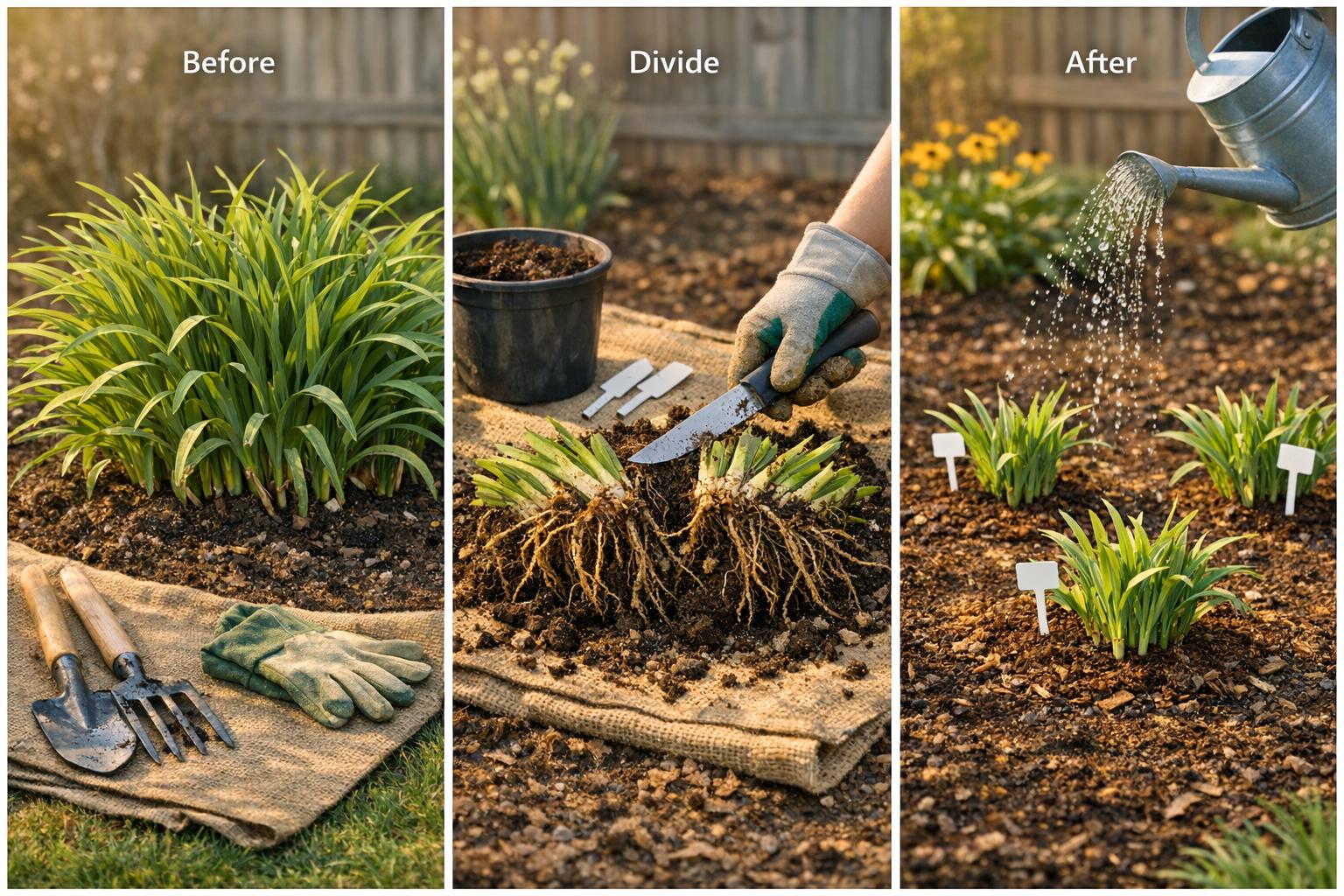
Dividing perennials is an effective way to maintain healthy plants, improve blooms, and prevent overcrowding in your Maryland garden. It involves splitting mature plants into smaller sections, encouraging better growth and reducing the risk of diseases like powdery mildew. Here’s what you need to know:
- Why Divide?
- Prevents overcrowding and the "doughnut" effect (dead centers in plants).
- Improves air circulation, reducing disease risks.
- Encourages stronger growth and more flowers.
- Saves money by propagating new plants from existing ones.
- When to Divide?
- Spring-blooming perennials: Late summer or early fall after flowering.
- Summer bloomers: Early spring before new growth.
- Fall bloomers: Early spring to avoid interrupting their blooms.
- How to Divide?
- Water plants 1–2 days before dividing.
- Dig around the plant’s drip line and lift the root ball.
- Separate roots into smaller clumps (3–5 healthy shoots each).
- Replant divisions at the same depth, water thoroughly, and mulch.
- Tools You’ll Need:
- Shovel, garden forks, pruners, and a garden knife.
- Compost or organic matter for soil preparation.
Dividing every 3–5 years keeps your garden thriving while ensuring your plants remain healthy and vibrant. Timing and proper care during the process are key to success.
How to divide garden perennials | The RHS

sbb-itb-843f8be
Benefits of Dividing Perennials in Maryland
Dividing perennials regularly keeps your garden healthier and more productive. When perennials grow too crowded, they can develop a "doughnut" shape, where the center of the plant deteriorates. Splitting these clumps removes dead material and gives each new section the space it needs to grow strong roots. This process also helps manage plant size, ensuring every perennial has the conditions it needs to thrive.
Another advantage is controlling overly aggressive perennials, which can take over and crowd out nearby plants. Dividing them every 3 to 5 years helps maintain proper spacing, allowing each plant to grow without competing for resources like sunlight, water, and nutrients [2].
Maryland’s humid climate adds another layer of importance to division. Crowded plants often suffer from poor air circulation, making them more prone to diseases like powdery mildew and rot. Plants such as phlox, asters, and monarda are especially vulnerable. Thinning clumps through division improves airflow around stems and leaves, helping foliage dry faster after rain or dew. This creates an environment less suitable for fungal diseases. Plus, dividing gives you a chance to check for pests like grubs or larvae hiding in the roots, so you can address any problems before replanting.
On top of the health benefits, dividing perennials can save you money. By propagating new plants from existing ones, you can expand your garden without spending extra on replacements, or you can hire professional landscaping services to handle the heavy lifting for you.
Best Times to Divide Perennials in Maryland
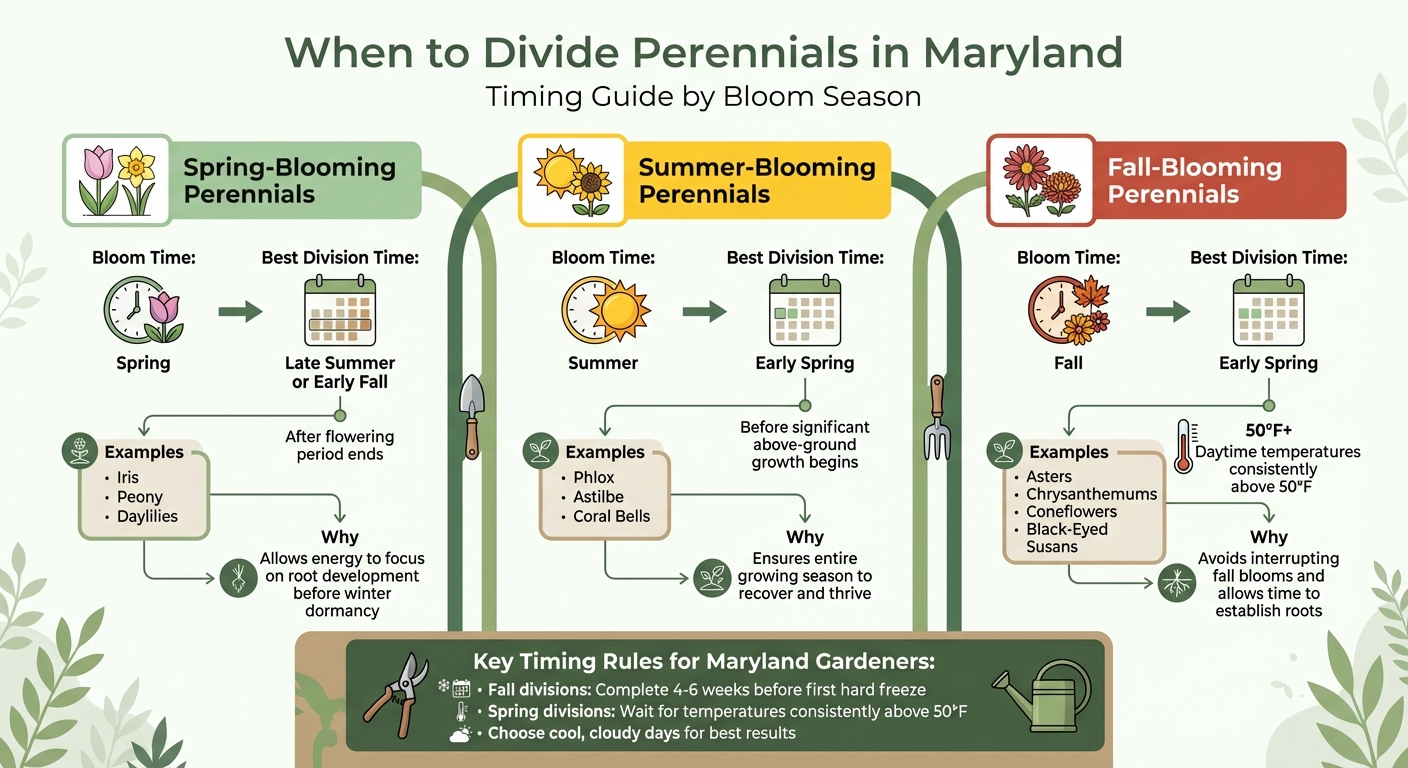
When to Divide Perennials in Maryland: Timing Guide by Bloom Season
Timing is everything when it comes to dividing perennials. The best results come from dividing them during their dormant phase or after they’ve finished blooming. This ensures the plant shifts its energy from flowering to root development. According to the University of Maryland Extension:
In Maryland, divide spring and summer bloomers after they bloom, either in late summer or fall as the foliage dies down. Fall-blooming herbaceous perennials are usually divided in early spring, giving the plants an entire growing season to recover [1].
If dividing in the fall, aim for at least 4–6 weeks before the first hard freeze to give roots time to anchor. For spring division, wait until daytime temperatures are consistently above 50°F, ideally during cool and cloudy conditions [1] [4] [6]. Let’s break down the best timing for different blooming periods in Maryland.
Spring-Blooming Perennials
Spring bloomers, such as iris, peony, and daylilies, are best divided in late summer or early fall, once their flowering period is over [1]. This timing allows the plant to focus its energy on developing strong roots before winter dormancy sets in.
Summer-Blooming Perennials
For summer bloomers like phlox, astilbe, and coral bells, early spring is the optimal time to divide. Dividing them before significant above-ground growth begins ensures they have the entire growing season to recover and thrive [1] [7].
Fall-Blooming Perennials
Fall bloomers, including asters, chrysanthemums, coneflowers, and black-eyed Susans, should be divided in early spring. This avoids interrupting their fall blooms and gives them plenty of time to establish healthy roots. As Garden Goods Direct notes:
Perennial plants that bloom in the spring should be divided in the fall. Conversely, fall-blooming perennials have to be separated in spring. That’s because of energy conservation [6].
Tools and Preparation for Dividing Perennials
Getting your perennials ready for division is much easier with the right tools and a bit of preparation. Here’s what you’ll need:
- A pointed shovel or spade to dig around the plant’s drip line and lift the root ball.
- Two garden forks, used back-to-back, to gently separate dense roots.
- A garden knife or hori hori for cutting through thicker or woody root masses.
- Pruners or shears to trim foliage and remove dead material.
- A folding garden saw for tackling extremely dense roots, like those in mature ornamental grasses [2][5][7].
- A tarp or containers to hold divisions if you can’t replant them right away [2][7].
Once your tools are ready, focus on preparing the plant itself. Start by watering your perennials thoroughly 24 to 48 hours before dividing. This ensures the plant is well-hydrated and makes the soil easier to work with [1][2][7]. As Lorna Kring from Gardener’s Path points out:
Regardless of when you split a clump, your task will go much easier if the soil is well-moistened [2].
Next, dig the new planting holes before lifting the parent plant. Each hole should be twice as wide as the root ball but no deeper than the original planting depth to avoid crown rot. Mix in about 25% organic matter – like compost or well-rotted manure – with the removed soil before backfilling [1][2]. The University of Maryland Extension advises:
Dig the new hole first, amending the soil with organic matter if possible. Fill it with water and let it drain [1].
This step helps minimize the time the roots are exposed to air, cutting down on transplant stress [1][2].
Before you start dividing, make sure to clean and sharpen your cutting tools. This ensures clean cuts and reduces the risk of spreading fungal diseases or pests [5]. After lifting the plant, shake off or rinse away excess soil to clearly see the roots and locate natural division points [2][7]. Lastly, try to work on a cloudy day to protect the divisions from sun and heat stress during the process [1][7].
How to Divide Perennials: Step-by-Step Process
Once your tools are ready and the planting holes are prepped, it’s time to divide your perennials. This process includes three main steps: digging up the plant, separating the root clump, and replanting the divisions at the correct depth to thrive in Maryland gardens.
Step 1: Digging Up the Plant
Start by locating the drip line, which marks the outer edge of the plant’s foliage. As Lorna Kring from Gardener’s Path explains:
The drip line is approximately how far the roots will extend, and it’s a good guideline for digging [2].
Using a pointed shovel, dig straight down along this line. Then, angle the shovel deeply under the root ball at several points to loosen it from the subsoil. Carefully lift the entire root ball out of the ground. According to BobVila.com:
Do your best to avoid damaging the plant’s roots and keep the root ball as intact as possible [7].
Gently shake off excess soil to expose the roots. Once the root ball is free and visible, you’re ready to separate it into smaller clumps.
Step 2: Separating the Root Clump
Inspect the root clump and focus on dividing the healthy outer shoots, discarding the older, woody center, which may no longer be productive. Each new section should have three to five healthy shoots and a strong root system.
For soft-rooted perennials, you can often pull the clump apart by hand or use two garden forks placed back-to-back to pry it apart. For tougher plants like hostas, daylilies, or ornamental grasses, you may need a hori hori knife, sharp spade, or a folding garden saw to cut through the crown. When working with rhizomes, such as bearded iris, cut them into 3- to 5-inch sections, ensuring each piece has roots and at least one fan of leaves. For tuberous plants like dahlias, slice the tuber so that each piece includes at least one "eye" or growth bud.
Once divided, move on to replanting the sections promptly to help them establish well.
Step 3: Replanting the Divisions
Plant each division at the same depth as the original plant to avoid issues like rot or drying out. For instance, iris rhizomes should be placed with their tops slightly above the soil. Position the divisions into their pre-dug, amended holes, then backfill with soil. The University of Maryland Extension advises:
Dig the new hole first, amending the soil with organic matter if possible. Fill it with water and let it drain [1].
After planting, water the divisions thoroughly and apply a 1-inch mulch layer around (but not directly over) the crown to retain moisture. If you can’t replant immediately, keep the divisions in a shaded spot or a container with water to prevent them from drying out. Continue watering regularly during the first few weeks, but avoid fertilizing right away so the plants can focus on growing new roots.
Dividing Common Maryland Perennials
Perennials in Maryland gardens come with a variety of root systems, so the way you divide them needs to match their specific growth patterns. For instance, Black-Eyed Susans have spreading roots that form tangled mats, which can be carefully separated by hand or with the right tools. On the other hand, Hostas and Daylilies grow in clumps from a central crown with multiple growing points. These can be divided by slicing through the crown with a sharp knife or using two garden forks placed back-to-back to gently pry them apart.
Adjusting your approach based on the plant and the season is key to keeping your perennials healthy and thriving with professional lawn care and maintenance. For clumps that have developed a "doughnut" shape, it’s best to keep the robust outer shoots and discard the dead center. As Master Gardener Pamela T. Hubbard explains:
The general rule of thumb is to complete this task every three years, but I only divide a plant after careful observation of its shape and condition, believing the old adage that "if it ain’t broke, don’t fix it." [3]
Not all perennials benefit from division, though. Plants with deep taproots, such as Butterfly Weed and Columbine, or those with woody, shrub-like bases like Lavender and Russian Sage, don’t respond well to this method [3].
Perennial Division Reference Chart
Here’s a quick guide to help you determine the best times and methods for dividing some popular Maryland perennials:
| Perennial Name | Root Type | Best Division Time | Frequency and Tips |
|---|---|---|---|
| Black-Eyed Susan | Spreading | Late Summer or Fall | Divide every 3–4 years |
| Hostas | Clumping | Early Spring or Fall | Divide every 3–5 years |
| Bearded Iris | Rhizomatous | Late Summer (August) | Replant immediately after division |
| Daylilies | Clumping | Late Summer or Fall (post-bloom) | Divide every 3–5 years |
| Coneflowers | Spreading | Spring or Fall | Divide every 3–4 years |
Caring for Divided Perennials in Maryland
Start with proper watering before you even dig. If there hasn’t been enough rain, water your perennials for two days before dividing them. This keeps the soil ball intact and prevents the roots from drying out during the process[1][2]. Once you’ve replanted the divisions, water them immediately to help settle the soil and remove air pockets around the roots.
The first two weeks after dividing are crucial. During this recovery time, keep the soil consistently moist, but avoid overwatering[2]. In Maryland’s summer heat, try the "soak and drain" method: fill the planting hole with water, let it drain, and then plant the division[1]. Aim to work in the early morning or late afternoon to avoid the hottest part of the day[2]. These steps set the stage for mulching and improving the soil.
Mulching offers protection and helps retain moisture. Spread a 1-inch to 2-inch layer of mulch, such as wood chips or fallen leaves, around each plant[1][2]. According to the University of Maryland Extension, decomposing leaves act as “free fertilizer” by adding nutrients to the soil[1]. However, keep the mulch about one inch away from the plant crowns to prevent rot. The University of Maryland Extension cautions that piling mulch on the crowns can lead to rot and encourage roots to grow into the mulch instead of the soil[1].
Soil amendments support healthy root growth. Before replanting, mix organic materials like compost, worm castings, or well-rotted manure into the soil – about 25% of the total volume[2]. For Maryland’s silt-heavy soils, adding 20–25% builders’ sand can improve drainage. However, avoid mixing sand into clay soils, as this can cause the soil to harden when it dries[1]. Bone meal is another great addition to encourage root development[2].
While you may see some growth in the first season, it can take up to three years for perennials to fully establish in Maryland’s climate[1]. Dividing plants on cloudy days or when rain is expected can also help reduce stress during the transition[1][4].
Mistakes to Avoid When Dividing Perennials
Timing matters when dividing perennials. Spring and summer bloomers should be divided after they’ve finished flowering, typically in late summer or early fall. On the other hand, fall-blooming perennials are best divided in early spring. Dividing plants too early or too late can drain their energy reserves, leaving them with little time to establish roots before winter sets in. Proper timing ensures that each division has a full growing season to recover and thrive[1].
Overcrowding divisions weakens plants. Packing perennials too close together forces them to compete for nutrients, water, and sunlight. This often results in fewer and smaller blooms. Cramped roots struggle to pull in the essential nutrients and moisture needed for healthy growth, and the soil can quickly become depleted[2]. Additionally, poor airflow between overcrowded plants increases the likelihood of fungal diseases like powdery mildew[7]. To avoid these problems, make sure to give each division plenty of space. When replanting, dig holes that are twice as wide as the root ball and ensure each section has three to five strong shoots[1][2].
Skipping proper watering invites transplant shock. Before dividing perennials, water them one to two days in advance to prepare the roots. After replanting, water thoroughly to fill the planting hole and eliminate air pockets. This step is crucial to prevent transplant shock. As Nature Hills Nursery points out:
Wilt occurs both when a plant does not have enough water and when it has too much!
Rather than sticking to a rigid watering schedule, use the finger test to check soil moisture several inches below the surface[8]. Consistent and thoughtful watering helps new divisions settle in and grow strong[1][2][7].
Hot, sunny weather can stress newly divided plants. Dividing perennials during peak summer heat can dry out exposed roots and dehydrate plants quickly. To minimize stress, choose a cloudy day or a time when rain is in the forecast. Early morning or late afternoon is ideal for dividing, as temperatures are cooler. Also, don’t wait more than three years between divisions to prevent overcrowding and maintain healthy growth[1][2].
Conclusion
Timing is everything when it comes to dividing plants in your Maryland garden. For the best results, align your efforts with each plant’s bloom season – divide spring and summer bloomers in late summer or fall, and tackle fall bloomers in early spring. This schedule allows the roots to settle in before blooming or facing winter’s chill[1].
Taking care of your plants before division can make a big difference. Reduce root stress by keeping only the healthiest outer shoots (three to five strong stems) and discarding the older, woody center. Replant the divisions at the same depth they were growing before and water them immediately[7]. To avoid transplant shock and promote healthy growth, ensure fall divisions are completed at least four weeks before the first frost[1][7].
To keep your perennials thriving and prevent overcrowding, aim to divide them every three to five years[1][7]. Regular division not only encourages healthier plants but also keeps your garden bursting with vibrant color. If you need help maintaining your garden’s charm, Pro Landscapes MD offers trusted services to keep your perennials looking their best year after year.
FAQs
How do I know a perennial needs dividing?
Perennials often need dividing when they grow too large, become overcrowded, or show a drop in productivity. Common signs include overly dense growth, fewer blooms, or the plant becoming harder to maintain. Dividing these plants can breathe new life into them, promoting healthier growth and boosting flower production.
What if I miss the best time to divide in Maryland?
If you miss the best time to divide perennials in Maryland, don’t worry – you can still do it in early spring or between late summer and early fall. Just steer clear of dividing them during extreme weather, such as the intense heat of summer or the freezing cold of winter, as these conditions can make it harder for the plants to thrive.
How can I keep divisions from dying after replanting?
To maintain the health of divided perennials, it’s best to divide them during late summer, fall, or early spring when the weather is more favorable. Make sure each divided section includes robust roots and healthy foliage. After replanting, give them a deep watering, keep the soil evenly moist, and add a layer of mulch to help retain moisture and shield the roots. Timing, gentle handling, and consistent care are key to ensuring successful replanting.
Chat with Us