









- bhavya gada
- No Comments
Watering plants might seem simple, but common mistakes like overwatering, underwatering, or watering at the wrong time can harm your garden. Maryland’s climate, with its inconsistent rainfall and freeze-thaw cycles, makes proper watering even more critical for perennials and annuals. Here’s what you need to know:
- Overwatering: Causes root rot, yellowing leaves, and mushy stems. Check soil moisture before watering and ensure proper drainage.
- Underwatering: Leads to wilting, scorched leaves, and stunted growth. Water deeply and consistently, aiming for 1–1.5 inches of water per week.
- Timing: Early morning is best to reduce evaporation and disease risks. Avoid midday and late evening watering.
- Shallow vs. Deep Watering: Deep watering promotes strong root systems, while shallow watering weakens plants.
- Special Care: New transplants and container plants dry out faster and need more frequent watering.
Key tips: Use mulch to retain soil moisture, avoid water pooling, and rely on tools like soaker hoses for efficient watering. For persistent issues like poor drainage, professional solutions like drip irrigation systems or soil improvements can make a difference.
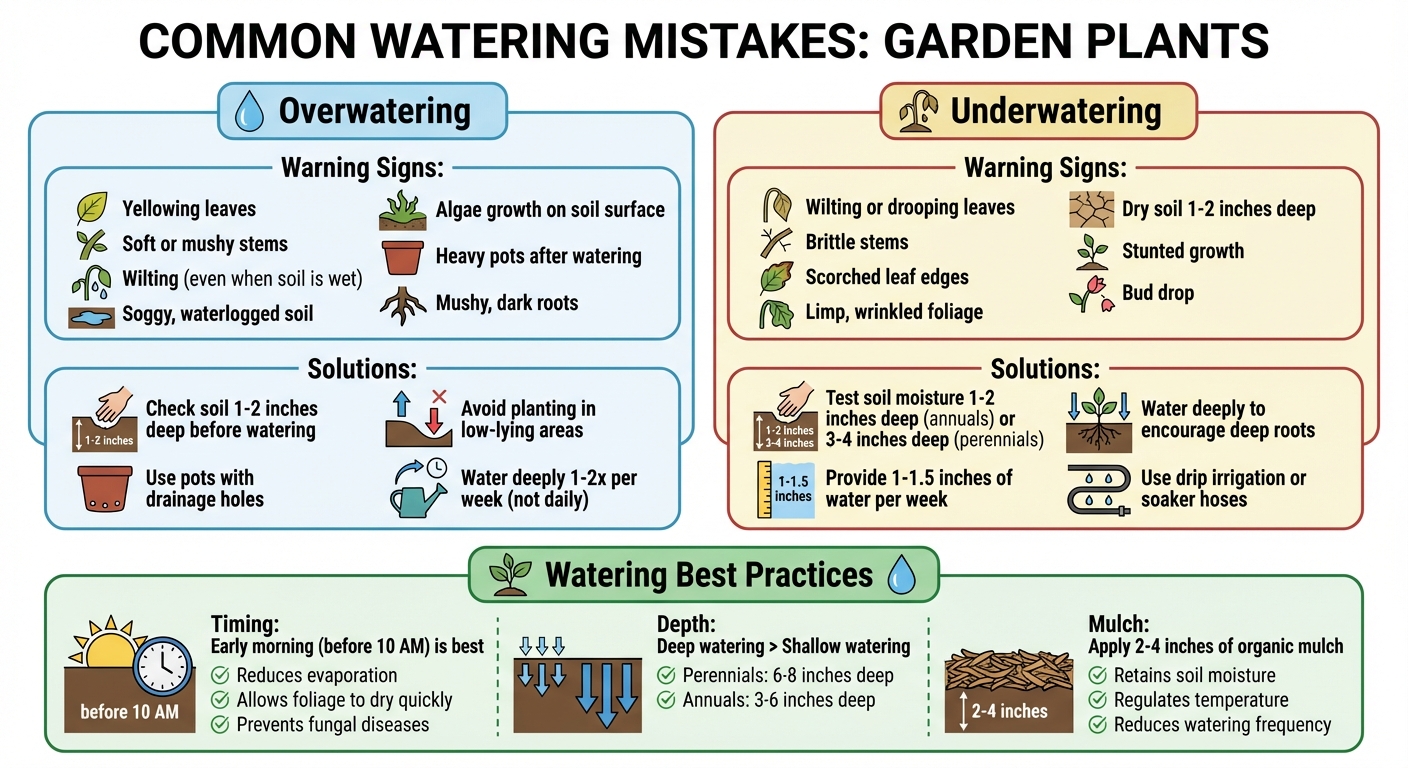
Common Watering Mistakes: Overwatering vs Underwatering Signs and Solutions
7 Watering Mistakes You’re Probably Making
sbb-itb-843f8be
Overwatering: How to Recognize and Prevent It
Overwatering is one of the most common mistakes gardeners make, and it’s especially harmful to perennials and annuals. It’s also a frequent reason new plants fail to thrive in gardens [6]. The problem starts below the surface: overly wet soil deprives roots of oxygen [4][5]. Without oxygen, roots can suffocate and become easy targets for pathogens that cause rot. That’s why it’s crucial to spot the signs of overwatering early.
What Overwatering Looks Like
At first glance, overwatered plants might not look unhealthy. One of the earliest signs is yellowing leaves, even when the plant appears otherwise well-tended [2][4][9]. Stems may feel soft or mushy instead of firm, and the plant’s growth may slow down or completely stall [4][9]. Surprisingly, overwatering can also cause wilting, even when the soil is still wet. This misleading symptom often leads to more watering, which worsens the issue [2][9].
"You might notice yellowing leaves or a pot that feels heavy long after watering – those are red flags."
– Tabar Gifford, Master Gardener, American Meadows [4]
Take a close look at the soil. If it’s soggy, waterlogged, or showing algae growth, these are clear indicators of overwatering [2][9]. For container plants, an unusually heavy pot after watering suggests excess water retention. Beneath the soil, roots that are mushy and dark instead of firm and white point to rot [4].
How to Stop Overwatering
Preventing overwatering starts with checking the soil before you reach for the watering can. Use your finger to probe 1 to 2 inches into the soil, or rely on tools like a trowel or soil moisture meter to test deeper in the root zone. If the soil feels damp at that depth, hold off on watering [2][3][6][9]. This method avoids the common error of watering based on a rigid schedule instead of actual soil conditions.
Proper drainage is essential. For container plants, always use pots with drainage holes to prevent water from pooling and causing root rot [4]. In garden beds, avoid planting in areas where water collects, like low-lying clay spots, as these can create a “bathtub effect” that traps moisture around the roots even if the surface looks dry [6]. When you do water, aim for a deep soak once or twice a week. This encourages roots to grow deeper into the soil, where moisture levels are more stable, rather than staying near the surface where water tends to linger [5][10].
Underwatering and Irregular Schedules: Getting the Water Right
While overwatering often steals the spotlight, underwatering can be just as harmful to your plants. Without enough water, perennials and annuals struggle to thrive. And if they’re watered inconsistently, they won’t develop the resilience needed to handle everyday weather changes.
What Happens When Plants Don’t Get Enough Water
When plants are underwatered, the signs can be dramatic. You’ll often see wilting or drooping leaves – clear indicators of stress [6]. Other symptoms include brittle stems, scorched leaf edges, and limp, wrinkled foliage.
"When a plant lacks water it cannot produce new cells and sustain the existing plant material. The cells will shrivel leading to limp, wrinkled plant material."
– Gardening Know How [2]
Inside the plant, water shortages cause cells to shrink and collapse [2][4]. To conserve what little moisture remains, plants close their stomata – tiny pores that allow gas exchange. While this survival tactic helps in the short term, it halts photosynthesis, stunts growth, and can even cause buds to drop or blooms to stop altogether.
To check soil moisture, use your finger as a simple gauge. For annuals or container plants, test 1–2 inches deep; for perennials, go 3–4 inches [3][8]. If the soil feels dry at those depths, it’s time to water. Some plants, like Ligularia, act as natural indicators by drooping noticeably when thirsty. These visual cues can alert you before other plants begin to show stress. A steady watering routine helps prevent these issues from becoming recurring problems.
Creating a Regular Watering Schedule
A consistent watering schedule is key to avoiding both underwatering and overwatering. Aim for 1–1.5 inches of water per week, combining rainfall and irrigation [5][8]. A rain gauge can help you track rainfall so you know how much extra water your garden needs [8].
Deep watering is especially important. It encourages roots to grow downward into cooler, more stable soil layers. Shallow watering, on the other hand, keeps roots near the surface, leaving them vulnerable to drying out [2][9].
"Frequent, shallow watering only moistens the upper layer of soil, which encourages plant roots to stay shallow. In turn, that top layer of soil dries out quickly, making shallow-rooted plants more susceptible to drying."
– Purdue Extension [5]
Different plants have different needs. Annuals, with their shallower roots, generally require more frequent watering than perennials [3]. Newly transplanted plants may need daily watering until they’re established [12]. And container plants, which dry out faster due to limited root space, might need watering twice a day during hot weather [3]. Tools like drip irrigation systems or soaker hoses with timers can help you maintain consistent moisture levels [11].
When to Water: Timing for Best Results
Getting the timing right for watering is just as important as the amount of water you use. Poor timing can waste water and even harm your plants by increasing the risk of disease.
Why Midday and Evening Watering Don’t Work
One of the most common mistakes is watering during the hottest part of the day. When temperatures are high, water evaporates quickly, leaving little to soak into the soil where roots can access it. As Ankit Singh, Assistant Professor and Ornamental Horticulture Educator at the University of Maine Extension, points out:
"Hot sun and heat cause rapid evaporation, so much less water reaches the roots" [4].
In other words, you’re losing water to the air instead of helping your plants thrive.
Midday watering can also lead to leaf scorch. Water droplets on leaves act like tiny magnifying glasses, focusing sunlight and potentially burning the foliage [2]. This not only wastes water but also stresses your plants.
Evening watering, while avoiding evaporation, comes with its own set of problems – increased disease risk. Wet foliage overnight creates an ideal environment for fungal and bacterial diseases like powdery mildew, root rot, and leaf spot. Tabar Gifford, Master Gardener at American Meadows, cautions:
"If you’re watering too late, you’re leaving foliage wet overnight, which creates a perfect environment for fungal diseases like powdery mildew and leaf spot" [4].
To keep your plants healthy and avoid these pitfalls, timing your watering correctly is essential.
The Right Time to Water
The early morning, ideally before 10 a.m., is the best time to water your plants [8]. During this period, cooler temperatures and calmer winds allow water to soak into the soil effectively. Any moisture on leaves dries quickly as the sun rises, reducing the risk of disease [12].
If morning watering isn’t an option, late afternoon can work as an alternative, provided the foliage has time to dry before nightfall – usually by 6 p.m. [8]. In areas with extremely dry air, evening watering might be acceptable since the humidity is low, but for most Maryland homeowners, morning remains the safest and most effective option.
To further reduce the chance of disease, focus on watering the base of your plants rather than the leaves. Tools like soaker hoses and drip irrigation systems are excellent for delivering water directly to the soil, ensuring it reaches the roots while keeping foliage dry [5].
Shallow vs. Deep Watering: Building Strong Roots
Why Shallow Watering Causes Problems
When you water lightly each day, you’re only wetting the surface soil, which trains plant roots to stay shallow instead of growing deeper where they can access more stable moisture and nutrients [5][7]. This is a big issue for Maryland gardens, especially in the summer. The top layer of soil dries out the fastest during hot, dry spells, leaving shallow-rooted plants quick to wilt and struggle when rain is scarce or temperatures climb [5][2][4]. Megan Foster, Perennial and Bulb Expert at American Meadows, explains:
"Shallow watering can negatively impact the root system of your plants, causing them to develop shallow root systems and making them less resilient to longer dry spells" [4].
Shallow roots also make plants less stable, leaving them more vulnerable to damage during routine garden care [2]. On top of that, shallow-rooted plants miss out on the cooler, nutrient-rich soil found deeper down [8]. The result? Weak, spindly plants that struggle to thrive.
How to Water Deeply
To avoid the pitfalls of shallow watering, switch to deep watering methods. This means watering deeply and less frequently instead of doing light sprinklings every day [8][5][2]. Most perennials and annuals need about 1–1.5 inches of water per week [8][5]. Instead of spreading this out daily, aim to provide this water in one or two thorough soakings. For perennials, water should penetrate 6–8 inches deep, while annuals generally need 3–6 inches.
Soaker hoses and drip irrigation systems are excellent tools for deep watering [8][2][4]. They deliver water slowly and directly to the root zone, allowing it to seep deep into the soil instead of evaporating or running off. The Garden Gate staff emphasizes this approach:
"Deep and less frequent watering is best to promote long roots. They’ll grow down into the ground so they stay cooler and absorb moisture and nutrients that are held there" [8].
After watering, use a trowel to check how far the moisture has reached. If the soil is dry below the top inch, you’ll need to water longer next time. Deep watering not only encourages stronger root systems but also helps prevent common watering mistakes. Pair this method with a 2–4 inch layer of organic mulch, such as bark or wood chips, to retain moisture and keep the surface soil from drying out too quickly [2][6].
New Plants and Container Gardens: Different Watering Needs
Tailoring your watering methods is essential when dealing with new transplants and container gardens. These plants have unique requirements that differ from established ones.
Watering Newly Planted Perennials and Annuals
Newly planted perennials and annuals need consistent care to establish strong root systems. According to Patuxent Nursery, "The first year after planting is critical for landscape plants as they establish their root systems" [13]. During the first week, daily watering is key to keeping the root ball moist. Over the next three months, reduce watering to 2–3 times a week, gradually easing into a less frequent schedule.
Freshly transplanted root balls can dry out faster due to wicking, so it’s a good idea to check the soil about 1–2 inches deep. If it feels dry, water thoroughly. In hotter weather, daily or every-other-day watering may be necessary. Focus on watering slowly at the plant’s base to ensure the roots are deeply hydrated. Adding a 2–4 inch layer of mulch around the plants can help conserve moisture and keep soil temperatures stable, which means you won’t need to water as often.
Watering Plants in Containers
Container plants lose moisture much quicker than those in the ground. For example, unglazed terracotta pots dry out faster than plastic ones. Most container plants need daily watering, while hanging baskets might require twice a day during extreme heat.
For proper hydration, water until excess drips out of the drainage holes. As Ankit Singh, Assistant Professor and Ornamental Horticulture Educator at the University of Maine Extension, explains, "Pots without holes almost always cause root rot" [4]. If you’re unsure about watering, try lifting smaller containers – if they feel light, the soil is likely dry and needs water. Checking soil moisture daily and watering early in the morning ensures plants are hydrated before the heat of the day. Following these techniques helps avoid over- or under-watering while supporting healthy root growth in both new and container plants.
Soil and Mulch: Keeping Moisture in the Ground
Healthy soil combined with the right mulching techniques can dramatically cut down how often you need to water. By improving soil structure and adding a protective mulch layer, you’re tackling two common watering issues: losing moisture too quickly and making it harder for plants to access the water already in the soil.
How Mulch Helps Retain Water
Mulch acts as a protective shield that slows down evaporation, keeping moisture locked in the soil. Organic mulch, like bark, wood chips, or pine straw, does double duty by also regulating soil temperature. As Preen explains, "Two to four inches of organic mulch (bark, wood chips, pine straw, etc.) keeps moisture in the soil far better than bare soil" [6].
But mulch doesn’t just help with water retention – it stabilizes soil temperatures too. This is especially helpful during Maryland’s hot summers and chilly winters. As professional landscaper Bonnie L. Grant puts it, "Mulching will keep the moisture in while also helping to cool the soil in summer, and keep it warmer in the winter" [2]. This temperature control reduces stress on plants and ensures more consistent moisture levels year-round.
However, too much mulch can backfire. Layers over 4 inches thick might absorb light rain before it even reaches the soil. To avoid this, keep mulch away from plant crowns to prevent rot, and if you’re using soaker hoses or drip irrigation, place them underneath the mulch to reduce evaporation.
Making Soil Hold More Water
Mulch is just part of the equation – improving soil itself is key to better water retention. Poor soil structure can undermine even the best watering habits. For instance, Maryland’s heavy clay soil tends to cling to water, making it harder for plant roots to absorb it. The fix? Adding organic matter like compost, shredded leaves, or humus. Bob Beckstrom and his co-authors emphasize this in their guide: "Amending clay soil with plenty of organic matter alleviates this problem" [12].
Each spring, work a 1-inch layer of compost into your planting beds. This complements your mulching and deep watering efforts. The University of Maryland Extension notes, "Organic mulches add some nutrients and humus to the soil, improving tilth and moisture-holding capacity" [1]. Over time, these amendments make it easier for plants to access water, cutting down on how often you need to water while encouraging stronger, healthier roots.
Watering During Dormancy and Drought
Caring for plants during dormancy or drought can be tricky, but getting it right is crucial. Missteps – whether overwatering or neglect – can lead to damage that’s hard to reverse. Understanding what your plants need during these challenging times ensures they’ll thrive when conditions improve.
How Much to Water Dormant Plants
Dormant plants don’t need much water, but letting them dry out completely can be harmful – especially in dry winters or just before the ground freezes. According to Sharon Miller, a Penn State Master Gardener, "a healthy plant can contain up to 90 percent water which is used for essential functions such as the movement of nutrients and photosynthesis" [7]. Even in dormancy, plants rely on small amounts of moisture to maintain basic processes.
Don’t be fooled by rainfall or snow. Heavy rains often run off without soaking into the root zone. Instead of assuming your plants are hydrated, check the soil moisture before watering.
Both overwatering and neglect can harm dormant plants. Excess water can suffocate roots, while dry soil can stress them. To help maintain consistent moisture, apply winter mulch after several frosts. This approach prevents sudden temperature changes and avoids triggering late-season growth, which could be damaged by cold [1]. If water is scarce, adjust these practices to protect your plants.
Watering During Drought
Drought conditions call for a different approach to watering. A common mistake during extreme dry spells is frequent, light watering. This encourages shallow roots, which can’t access deeper moisture. Instead, water deeply but less often – about once a week. As the Garden Gate staff explains, "Deep and less frequent watering is best to promote long roots" [8].
To minimize water loss, direct water to the base of plants using soaker hoses or drip irrigation [8]. Watering early in the morning – before 10 a.m. – also reduces evaporation [8]. Use a trowel to check soil moisture 3–4 inches deep; if it’s still damp at that level, hold off on watering.
During droughts, organic mulch is invaluable. It helps conserve the limited moisture in the soil, giving your plants a better chance to endure tough conditions. For more insights on managing water during drought, consult Pro Landscapes MD.
Pro Landscapes MD: Professional Help for Maryland Homeowners

Sometimes, fixing watering mistakes isn’t as simple as it seems – especially when poor drainage or challenging soil conditions come into play. That’s where Pro Landscapes MD steps in, offering expert landscaping and drainage services to homeowners across central Maryland. Their professional solutions address these issues head-on, ensuring your garden stays healthy and thriving.
Here’s the reality: most garden plants need about 1 to 1.5 inches of water per week [5]. But Maryland’s summer rainfall often doesn’t cut it. The University of Maryland Extension advises:
"Do not rely on summer rainfall to keep flower beds watered. Plan from the beginning to irrigate them. This is particularly important in the case of perennials, which are permanent fixtures in your landscape" [1].
To tackle this, Pro Landscapes MD specializes in drip irrigation and soaker hose systems. These systems deliver water directly to plant roots, reducing the risk of diseases that can occur with overhead sprinklers.
Water management is another major focus. Whether it’s installing French drains, grading, or land leveling, their team ensures water doesn’t pool in unwanted areas. They also apply a 2–4 inch mulch layer – carefully kept away from plant crowns – to retain soil moisture while preventing rot [1][6]. For properties with clay soil or poor drainage, they improve soil structure and design planting beds that avoid waterlogging.
Pro Landscapes MD also offers professional planting services to set your garden up for success. Their horticulturists ensure perennials and annuals are planted with proper spacing and soil preparation, tailoring their recommendations to Maryland’s climate. Whether your issue is overwatering, underwatering, or drainage, their customized solutions keep your landscape in top shape.
From Annapolis to Bethesda, Columbia to Ellicott City, and everywhere in between, Pro Landscapes MD transforms outdoor spaces into healthy, low-maintenance environments. For more information, visit prolandscapesmd.com.
Conclusion
To keep your garden thriving, focus on proper watering habits: water deeply, less often, and early in the morning. Always check soil moisture by feeling 1–2 inches below the surface. Deep watering encourages stronger root systems, while early morning watering helps reduce evaporation and lowers the risk of fungal issues.
Adding a 2–4 inch layer of organic mulch is another smart move. It helps the soil stay cool, locks in moisture, and cuts down on how often you need to water. Keep in mind that container plants and new transplants dry out faster, so they’ll need extra attention until they’re well-established.
If your garden struggles despite these efforts – perhaps due to poor drainage or challenging soil – Pro Landscapes MD offers solutions like drip irrigation systems, French drains, and soil enhancements to make garden care easier for Maryland homeowners.
FAQs
How can I tell if my plant is overwatered or underwatered?
To figure out if you’re overwatering your plants, watch for yellowing leaves, soggy soil, or even root rot. On the other hand, dry, wilted leaves and soil that feels completely dry are signs of underwatering.
Here’s a simple trick: stick your finger about 1–2 inches into the soil. If it feels damp, your plant is getting the right amount of water. If it’s dry, you likely need to water more. If it’s soggy, you’re probably overdoing it. Adjust your watering routine based on these signs to help your plants thrive.
How long should I run a soaker hose to water deeply?
To ensure your garden gets the right amount of water using a soaker hose, aim to deliver 1 to 1.5 inches of water per week – this is generally sufficient for most plants. The exact watering time will depend on factors like your water pressure and the flow rate of your hose, but a good starting point is 30 minutes to an hour.
To check if you’ve watered enough, stick your finger 1-2 inches into the soil. It should feel damp but not overly wet. If it’s too dry or too soggy, adjust your watering schedule accordingly to keep your plants healthy.
What should I do if my flower bed drains poorly after rain?
To fix drainage issues in your flower bed, try adding plants, shrubs, or trees that can handle wet conditions. These types of greenery naturally soak up extra water, helping to keep the area drier. Another option is to design a rain garden. This involves using specific plants and soil that can manage stormwater runoff while also filtering it. Both approaches are great ways to tackle excess water and improve drainage.
Chat with Us