









- bhavya gada
- No Comments
A Stormwater Pollution Prevention Plan (SWPPP) is a document required for construction projects that disturb 1 acre or more of land. Its purpose is to prevent pollutants like sediment, chemicals, and debris from entering stormwater systems and waterways. This is mandated by the Clean Water Act of 1972 and the National Pollutant Discharge Elimination System (NPDES).
Here’s what a SWPPP typically includes:
- Site Details: Maps, drainage patterns, and areas of disturbance.
- Best Management Practices (BMPs): Measures like silt fences, sediment basins, and spill prevention plans.
- Monitoring Plans: Regular inspections and updates to maintain compliance.
Failure to comply can lead to significant fines, as seen in cases where companies were penalized millions of dollars for violations. States like Maryland may impose stricter rules, especially for projects impacting sensitive areas like the Chesapeake Bay.
Key Takeaways:
- Required for construction sites disturbing 1 acre or more (or smaller sites part of larger developments).
- Protects water quality and ensures compliance with federal and state laws.
- Includes site-specific pollution control measures and monitoring protocols.
For compliance and assistance, professional services can help implement SWPPPs effectively.
Who Needs a SWPPP?
EPA Requirements for SWPPP
Federal law mandates a SWPPP (Stormwater Pollution Prevention Plan) for construction projects disturbing one acre or more of land. Even smaller projects may need one if they are part of a larger development [3]. This applies to a variety of projects, including residential neighborhoods, commercial buildings, and infrastructure work. Activities such as clearing, grading, excavating, and stockpiling are all covered under these regulations [3].
For example, in a housing subdivision where individual lots are each less than an acre, a SWPPP is still required if the total development exceeds the one-acre threshold. In these cases, the property owner is identified as the Legally Responsible Person (LRP) and must secure permit coverage, while the general contractor usually takes charge of creating and implementing the SWPPP [1][3].
Additionally, certain industrial facilities – like those in manufacturing, mining, or transportation – and Municipal Separate Storm Sewer Systems (MS4s) must comply with NPDES (National Pollutant Discharge Elimination System) stormwater regulations [5][4]. States often add their own layers of requirements to these federal rules.
SWPPP Requirements in Maryland
Maryland builds on federal SWPPP regulations with its own set of rules. The state operates its own NPDES permitting program, meaning it handles applications and enforcement instead of the EPA [5]. While federal standards provide a baseline, Maryland often enforces stricter measures to safeguard local water quality, particularly for sensitive areas like the Chesapeake Bay [6]. In Maryland, SWPPPs may also go by names like "Sediment and Stormwater Plan" or "Erosion and Sediment Control Plan" [1].
Developers in Maryland should be aware of these heightened requirements, even for projects smaller than an acre [6]. Urban and suburban developments face additional scrutiny due to impervious surfaces – like roads and rooftops – that block water absorption and channel pollutants directly into waterways [5]. These stricter rules reflect Maryland’s dedication to protecting the Chesapeake Bay watershed and preserving water quality in its rapidly growing regions. By meeting these standards, developers not only comply with regulations but also contribute to the responsible management of local water resources.
sbb-itb-843f8be
What Goes Into a SWPPP
Site Description and Maps
Start your SWPPP with a clear and concise description of the site. This should cover the project area, the size of the disturbance, and existing conditions, such as soil types, slopes, and any nearby water bodies. Include detailed maps that highlight construction boundaries, drainage patterns, discharge points, and any key water features [2][3]. These maps should also identify non-disturbance zones and the locations of both structural and non-structural controls [2]. Since construction sites change over time, make sure to regularly update these maps to reflect new conditions and stabilization measures as the project progresses [6]. With this foundation in place, you can then select BMPs to address specific pollution sources.
Best Management Practices (BMPs)
Your SWPPP should include a mix of BMPs that combine engineered solutions and planning strategies. Engineered controls could include tools like silt fences, sediment basins, and detention ponds. Planning measures might involve preserving natural flow paths or minimizing soil compaction. Address key areas such as erosion control, sediment control, waste management, and spill prevention [8][9]. For erosion control, methods like seeding and mulching can be effective. Sediment control might involve silt fences or sediment ponds. Additionally, good housekeeping practices should cover waste management and safe fueling procedures. Spill prevention measures, such as using secondary containment for fueling tanks and establishing clear spill response protocols, are also essential.
Monitoring and Maintenance Plans
Planning alone isn’t enough – ongoing monitoring is critical to ensure BMPs remain effective throughout the construction process. Conduct inspections weekly and within 24 hours of any rain event that exceeds 0.5 inches [7]. The Kitsap County Stormwater Design Manual underscores the importance of adaptability, stating:
The SWPPP shall be treated as a ‘living document’ and shall be modified as needed during the construction process [7].
Your plan should designate a team responsible for implementing and maintaining the SWPPP, complete with defined roles and contact details. For sites larger than one acre, keep a logbook to document BMP activities and monitor when devices, like sediment basins, need cleaning (usually when they reach one-third of their capacity) [7].
What is a Construction SWPPP? Do YOU Need One?
How to Create a SWPPP
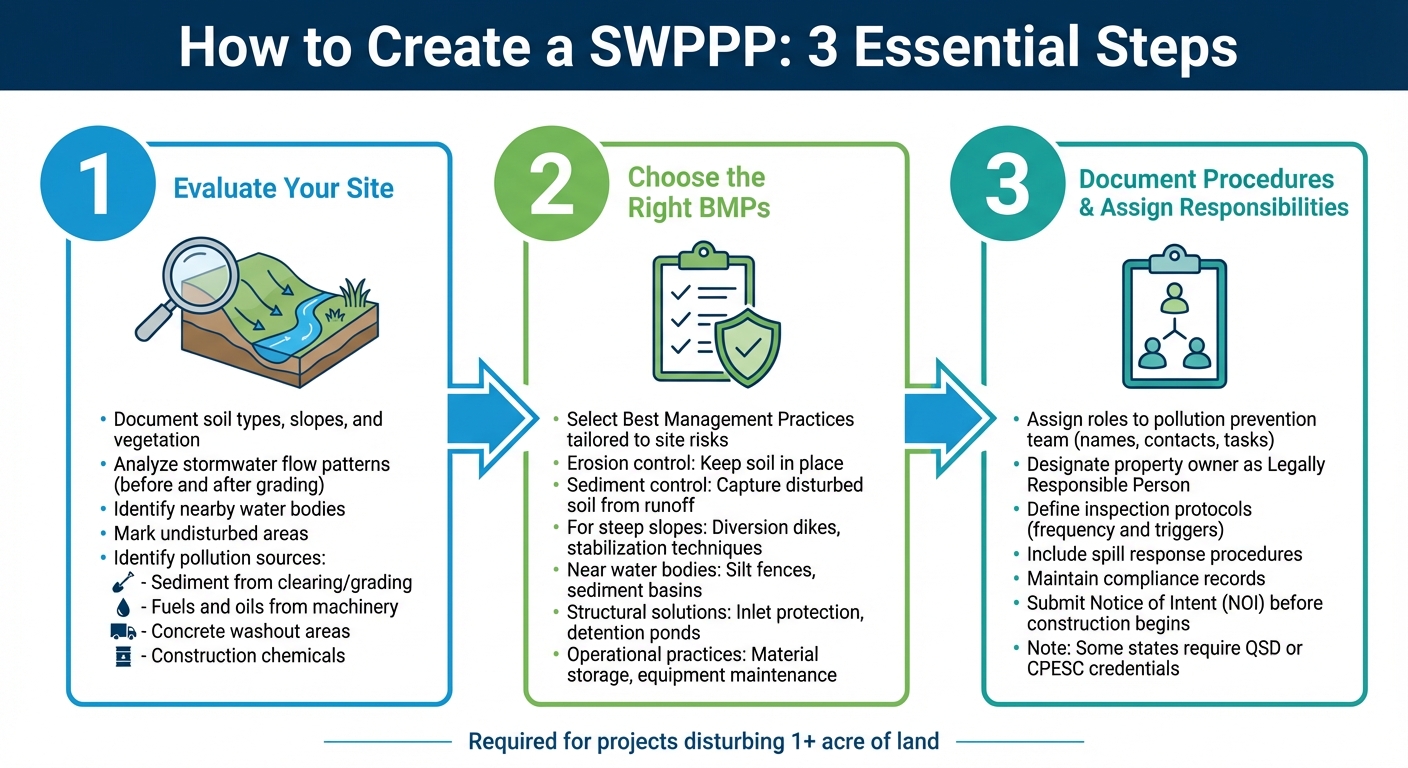
3-Step SWPPP Creation Process for Construction Projects
Evaluate Your Site
Start by thoroughly assessing your site. Document details like soil types, slopes, and vegetation. Pay special attention to how stormwater flows both before construction starts and how it might change after grading activities take place [2][6]. Identify any nearby water bodies and mark areas that will remain undisturbed [3][2]. This evaluation is the backbone of your SWPPP, guiding every decision you make.
Next, identify potential pollution sources. These could include sediment from clearing and grading, fuels and oils from machinery, concrete washout areas, and construction-related chemicals [3]. Knowing where pollutants might originate allows you to focus your prevention efforts and choose effective strategies. This step directly influences the Best Management Practices (BMPs) you’ll select.
Choose the Right BMPs
With your site assessment complete, select BMPs tailored to your site’s specific risks. For example, use erosion control measures to keep soil in place and sediment control methods to capture soil already disturbed by runoff [6]. If your site has steep slopes, you might need tools like diversion dikes and stabilization techniques. For areas near water bodies, silt fences and sediment basins can provide critical protection.
Consider both structural solutions – such as inlet protection and detention ponds – and operational practices like proper material storage and regular equipment maintenance [6]. The goal is to match each BMP to the actual risks on your site. A flat site with minimal drainage concerns will require a very different approach than a sloped property with multiple areas where water discharges.
Document Procedures and Assign Responsibilities
Once you’ve selected the appropriate BMPs, formalize your SWPPP by documenting procedures and assigning responsibilities. Clearly outline the roles of every member of your pollution prevention team, including their names, contact details, and specific tasks related to implementation, monitoring, and compliance [6]. The property owner should be designated as the Legally Responsible Person for obtaining permit coverage [3].
Define inspection protocols – who will conduct them, how often they’ll occur, and what conditions, like specific rainfall amounts, will trigger immediate inspections [6]. Include procedures for handling spills and maintaining records. While federal regulations may allow individuals with construction experience to draft a plan, some states, like Maryland, may require credentials such as a Qualified SWPPP Developer (QSD) or a Certified Professional in Erosion and Sediment Control (CPESC) [1][3][6]. Once your SWPPP is finalized, submit the Notice of Intent (NOI) before construction begins [6].
Conclusion
Key Takeaways
A SWPPP (Stormwater Pollution Prevention Plan) plays a crucial role in managing stormwater and protecting water quality during construction. It identifies potential pollution sources – like sediment, fuels, chemicals, and construction debris – and lays out specific Best Management Practices (BMPs) to keep these pollutants from reaching municipal sewer systems or nearby waterways [1][3]. If your project disturbs 1 acre or more, SWPPP compliance is mandatory [3][6]. Smaller projects may also require compliance if they’re part of a larger development plan.
Ignoring these requirements can lead to hefty penalties. Remember, your SWPPP isn’t a one-and-done document – it needs regular updates to reflect site changes, personnel shifts, or adjusted BMPs [4][6]. And don’t forget to submit the Notice of Intent (NOI) before breaking ground [6].
For projects meeting these regulations, seeking professional guidance can make the process smoother and more efficient.
How Pro Landscapes MD Can Help

Pro Landscapes MD specializes in stormwater management and drainage solutions, serving central Maryland areas like Howard County, Montgomery County, Carroll County, Frederick County, Prince George’s County, and Baltimore County. Their team is experienced in installing key BMPs such as silt fences, sediment traps, and check dams. They also offer professional grading, land leveling, and drainage installation services to manage stormwater flow and prevent site pollutants from spreading [2][3].
Additionally, they provide eco-friendly site stabilization through techniques like seeding, mulching, and sodding [10][2]. For drainage needs, they offer solutions like French drains, dry riverbeds, and comprehensive stormwater systems designed to handle water challenges while preserving the landscape’s appearance. Whether you’re a property owner navigating Maryland’s SWPPP requirements or a contractor needing reliable BMP implementation, Pro Landscapes MD’s local expertise ensures compliance and environmental protection throughout your construction project.
FAQs
How do I know if my project needs a SWPPP?
A Stormwater Pollution Prevention Plan (SWPPP) is generally required for projects that disturb one acre or more of land or involve substantial development or redevelopment. In many cases, projects impacting 2,000 square feet or more of hard surface area or 7,000 square feet of land also necessitate a SWPPP. Furthermore, federal or state regulations, such as the EPA’s NPDES permit (National Pollutant Discharge Elimination System), may require a SWPPP to manage pollutants during construction activities.
What permits and paperwork do I need before construction starts?
Before starting construction, it’s crucial to secure the necessary permits and handle all required paperwork to comply with stormwater management regulations. This includes preparing a Stormwater Pollution Prevention Plan (SWPPP). The SWPPP details how your site will manage erosion, sediment, and pollution, and it’s a key requirement for obtaining a National Pollutant Discharge Elimination System (NPDES) permit.
Make sure your SWPPP is fully approved and kept up-to-date throughout the project. Also, ensure all permit fees are paid promptly to avoid potential fines or project delays.
Who is responsible for SWPPP inspections and updates?
Construction site operators play a key role in managing stormwater pollution. They are tasked with performing regular inspections and keeping the Stormwater Pollution Prevention Plan (SWPPP) up to date. These efforts help ensure the plan remains effective in reducing pollution risks while staying in line with regulatory requirements.
Chat with Us