









- bhavya gada
- No Comments
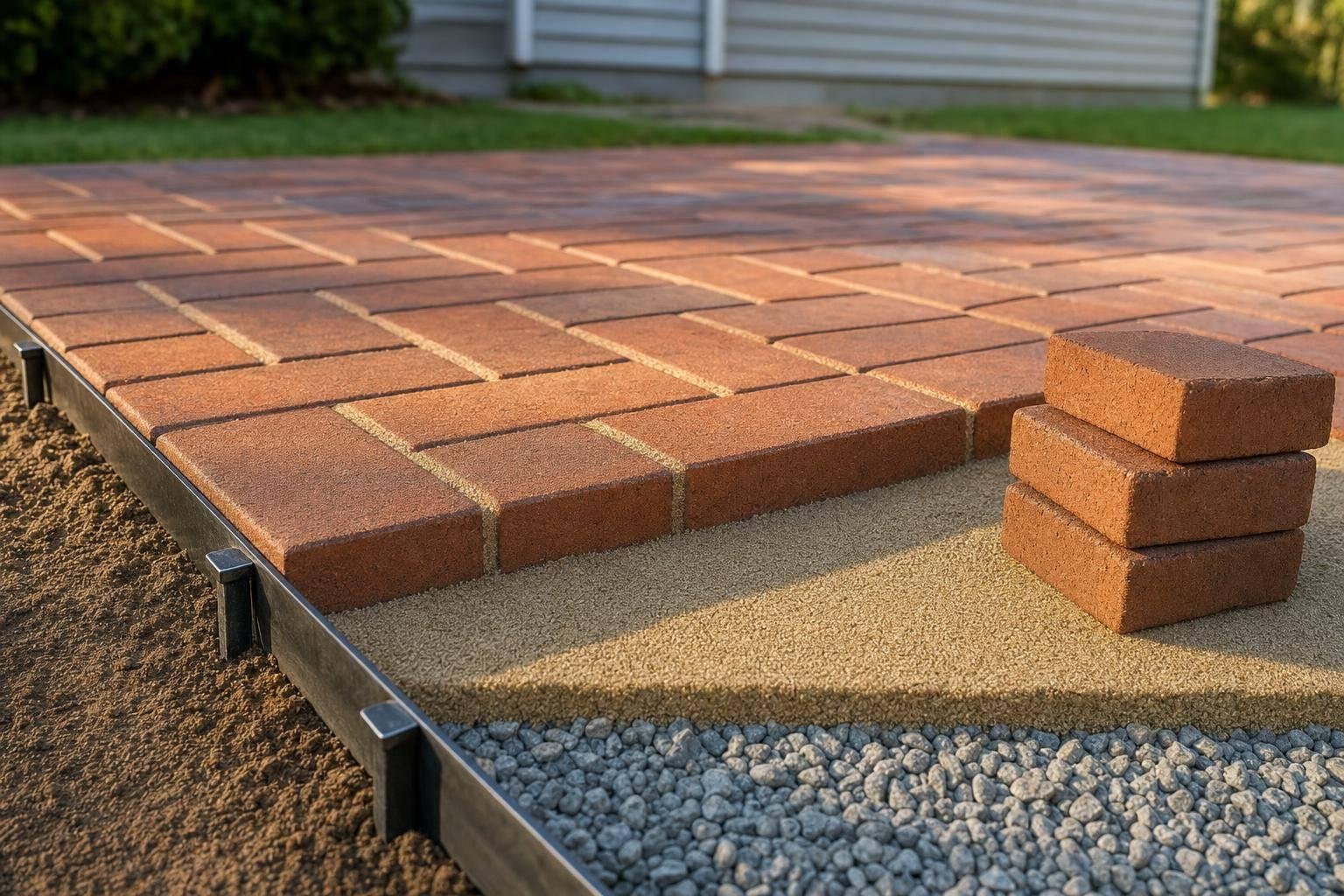
A basket weave patio often costs more than a basic paver patio, even when the surface material is the same. In most Maryland jobs, the extra cost comes from labor, cuts, borders, waste, base work, and drainage – not just the pavers or brick.
If I were pricing this type of patio, I’d focus on these numbers first:
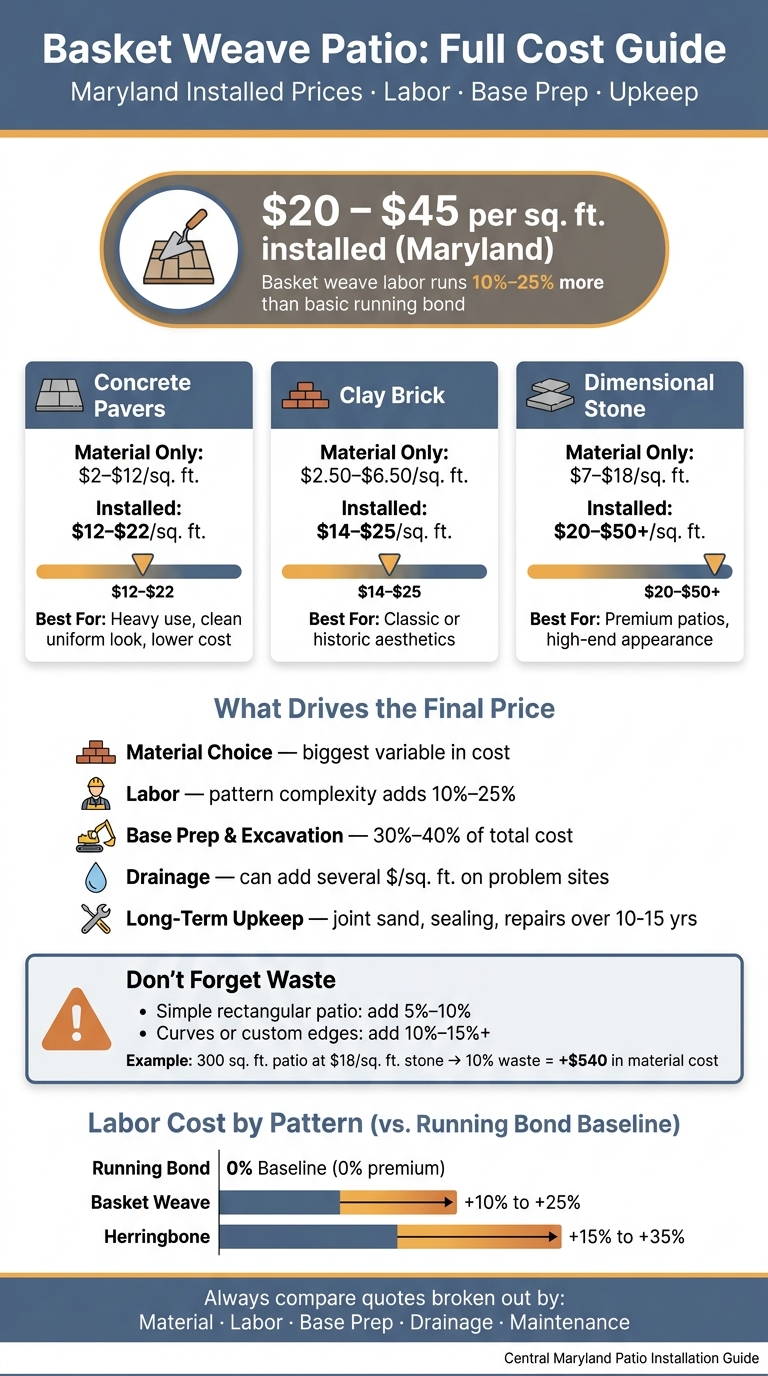
- Installed cost in Maryland: about $20 to $45 per sq. ft.
- Basket weave labor premium: about 10% to 25% more than a basic running bond layout
- Material-only cost:
- Concrete pavers: about $2 to $12 per sq. ft.
- Clay brick: about $2.50 to $6.50 per sq. ft.
- Dimensional stone: about $7 to $18 per sq. ft.
- Waste allowance: about 5% to 10% for simple shapes, often 10% to 15%+ for curves or custom edges
- Base prep share of total cost: often 30% to 40%
- Upkeep over time: joint sand, sealing, cleaning, and small repairs can add a noticeable long-term cost
What this means for you is simple: the square-foot price alone does not tell the full story. A low material price can still turn into a high quote if your patio has curves, tight corners, drainage issues, soft soil, or extra border work.
Basket Weave Patio Cost Breakdown by Material (Maryland)
How Much Does a Paver Patio Cost
sbb-itb-843f8be
Quick comparison
| Material | Material-Only Cost | Usual Installed Cost | Best Fit |
|---|---|---|---|
| Concrete pavers | $2–$12/sq. ft. | $12–$22/sq. ft. | Lower-cost patio with a clean, even look |
| Clay brick | $2.50–$6.50/sq. ft. | $14–$25/sq. ft. | Classic look |
| Dimensional stone | $7–$18/sq. ft. | $20–$50+/sq. ft. | High-end appearance |
I’d compare quotes by separating material, labor, base prep, drainage, and upkeep, because those five items shape the final price more than the pattern name alone.
Material Prices: Cost Per Square Foot Before Labor
Concrete Pavers, Clay Brick, and Dimensional Stone: Price Ranges
Basket weave tends to work best with rectangular units, so the shape of the material matters just as much as the sticker price.
Standard concrete pavers are usually the lowest-cost option for this pattern. Basic 4×8 or 6×9 inch units often cost $2 to $6 per sq ft, while premium finishes can climb to $8 to $12 per sq ft.[4][7][9][11]
Clay brick pavers usually land between $2.50 and $6.50 per sq ft for standard 4×8 units.[5][10] This pattern and brick are a natural match. Most standard red or blended clay bricks sit in the $3 to $5 per sq ft range, while premium colors or special-order picks move closer to the top end.[5][10]
Dimensional natural stone is the priciest category, usually costing $7 to $18 per sq ft based on the stone type and finish.[8][10] Bluestone, a common pick in Maryland, usually falls between $6 and $16 per sq ft depending on grade and surface treatment.[18]
| Material Type | Typical Material-Only Cost per Sq Ft (USD) | Common Look | Fit for Basket Weave |
|---|---|---|---|
| Standard concrete pavers | ~$2–$6 (basic); up to $12 (premium finishes)[4][7][9][11] | Uniform rectangles; wide color and texture range | Excellent – 4×8 and 6×9 units work well in this pattern |
| Clay brick pavers | ~$2.50–$6.50[5][10] | Classic red/brown tones; slight surface variation | Excellent – basket weave is a classic brick pattern |
| Dimensional stone pavers | ~$7–$18 depending on stone type and finish[8][10] | Natural color variation, veining; upscale appearance | Good – rectangular cut stone works, but at a higher cost |
In practice, you’ll usually order more than the patio’s square footage. Basket weave leads to more cuts and more waste around edges, so the material total rarely matches the footprint exactly.
Waste Factor for Straight Layouts, Curves, and Custom Shapes
Basket weave calls for more cutting than a simple running bond, and that extra cutting adds up fast on anything other than a clean rectangle. For a rectangular patio with square corners, a 5 to 10% waste factor is usually enough.[12][13][14][15] Add curved edges, angled borders, or tight obstacles, and that number often moves to 10 to 15% or more.[15][16][17]
This hits harder with higher-cost materials. A 300 sq ft patio with a 10% waste allowance means buying enough material for 330 sq ft. At $4 per sq ft for concrete pavers, that adds about $120. At $18 per sq ft for dimensional stone, the same overage adds $540.[8][10]
That’s why a layout that looks simple on paper can shift the estimate pretty fast once cuts, borders, and labor enter the picture.
Labor Costs: How Pattern Layout, Cuts, and Borders Add to the Price
Once you get past material prices, labor is the next big piece of the bill. In central Maryland, basket weave usually costs about 10%–25% more in labor per square foot than a basic running bond layout with the same pavers. On many jobs, that works out to about $1–$3 more per sq ft.[19][20][2]
That jump makes sense when you look at how the pattern goes together. Basket weave isn’t just “lay the pavers and move on.” Installers have to spend more time keeping the pattern square, lined up, and clean across the whole surface.
Extra Layout Time Compared with Simpler Patterns
Basket weave needs more control lines, more dry-lay checks, and more alignment fixes than simpler layouts because each pair has to stay square across the field.
On a 300 sq ft patio, that extra work can add about 2–5 crew-hours compared with a running bond layout. At Maryland labor rates of $55–$100 per crew-hour, that comes to about $150–$500 in added labor.[20]
Cuts, Border Pieces, and Corners That Add Labor Hours
This is where costs can start to pile up. Edges, obstacles, and borders often call for partial pairs and extra saw cuts, and that adds time in a hurry on a mid-size patio. At the perimeter alone, basket weave can mean about 10–20 extra cuts per 100 sq ft.[20]
| Pattern | Installation Difficulty | Waste Tendency | Relative Labor Impact |
|---|---|---|---|
| Running bond | Low | Low (~8% waste) | Baseline |
| Basket weave | Medium | Moderate (~10% waste) | +10% to +25% vs. running bond |
| Herringbone | High | Medium–High (~12%+ waste) | +15% to +35% vs. running bond |
Borders add another layer of labor. A soldier course border adds about $3–$6 per linear foot in combined material and labor. If you step up to double borders or picture-frame borders, labor can climb 10%–20%, especially when corners need mitered or custom cuts.[24][25]
When Decorative Details Push a Project to the High End
Decorative upgrades can move a basket weave patio from a middle-of-the-road install to a much pricier one. Multiple colors slow down layout and sorting. Inset panels need extra layout lines and exact cuts so the panel edges stay clean. Curved patio shapes are also tougher because basket weave is a square-grid pattern, so fitting it into a curve means custom cuts all along the outside edge.[6][26]
Put those details together – curves, multiple colors, and decorative borders – and labor can get close to the cost of herringbone or other custom patterns, even though basket weave by itself is usually seen as a mid-complexity design.[21][22][23]
Base prep and drainage can change the total as much as pattern layout.
Base Preparation and Long-Term Upkeep Costs
Base prep often costs more than the pattern you pick. In many projects, base prep and excavation make up 30%–40% of the total installed cost. Skip that work, and you can end up with settlement, shifting, and repair bills later. So this part of the job belongs in the main quote, not tucked in as an extra.
Base Prep, Drainage, and Site Conditions That Change the Estimate
A standard patio base usually includes 7–9 inches of excavation, a 4–6 inch compacted stone base, and 1 inch of bedding sand.[42][43] In Maryland’s freeze-thaw climate, that depth helps limit frost heave. ICPI/CMHA guidance says freeze-prone areas may need 2–4 more inches of base depth, which brings the compacted aggregate base to 6–8 inches total.[28][30][33]
Here’s how base work often prices out:[1][3]
| Base Component | Typical Cost Range |
|---|---|
| Excavation (8–12 in., with haul-off) | $1.50–$3.00 per sq ft |
| Compacted gravel base (6–8 in.) | $1.50–$3.00 per sq ft |
| Bedding sand (1 in.) | $0.50–$1.00 per sq ft |
Those numbers can climb fast when the site fights back. Clay or soft soils, poor drainage, sloped yards, root removal, and tight equipment access all mean more digging, more hauling, and in some cases geotextile fabric to help hold the base in place.[27][29][34]
Drainage matters just as much. Industry standards call for a 1%–2% surface slope away from the house so water doesn’t sit under the patio.[27][31][32] On problem sites in central Maryland, drainage fixes alone can add several dollars per square foot to the estimate.
Joint Sand, Sealing, Cleaning, and Repair Over 10–15 Years
Once the patio is in, the main upkeep costs are joint sand, sealing, and small repairs.
Polymeric sand in the joints usually lasts 5–8 years before it needs to be refreshed. In the Northeast, professional polymeric sand replacement often runs $2–$5 per sq ft.[37][41] Simple cleaning and fast spill cleanup help keep stain-removal costs down.[39]
Sealing is optional. Many homeowners choose to reapply it every 3–5 years for stain resistance and to help keep the color looking the same over time.[36][39][41] Professional sealing usually costs $0.75–$2.50 per sq ft, based on the sealer used and how much surface prep is needed.[35][38][40] Minor repairs often mean resetting a few loose pavers or refilling joints where sand has washed out.
When you compare patio budgets, it helps to look past the install price and include these upkeep costs too.
Matching Your Basket Weave Patio Budget to Your Property
Best Material Choice by Budget and Appearance Goals
Once you price materials, labor, base prep, and upkeep, the next step is simple: match that total to your property and the look you want.
Your material choice drives most of the full patio cost. In many cases, the price climbs fast when a better-looking surface also needs more labor, tighter installation, and a thicker base.
| Material | Installed Cost Range | Best For |
|---|---|---|
| Standard concrete pavers | $12–$22 per sq ft | Lower-cost patios, heavy use, and a clean uniform look |
| Clay brick pavers | $14–$25 per sq ft | Classic or historic aesthetics |
| Dimensional natural stone | $20–$50+ per sq ft | Premium patios where appearance matters most |
Concrete pavers are usually the lowest-cost option. They work well for patios that need to handle lots of foot traffic and keep a neat, even look. The downside is that they can look more factory-made than brick or stone.
Clay brick costs more at the start, but it tends to keep its look well over time. One thing to watch: the brick needs to be rated for exterior, ground-contact use. If it isn’t, hard winters can cause spalling, and that can lead to repair or replacement costs later.
Dimensional natural stone has the highest installed price. That’s partly because the material is heavier, partly because cuts need more precision, and partly because the pattern takes more labor to keep joints tight and clean.
What to Confirm Before Requesting a Patio Quote
Clear project details make quotes easier to get and much easier to compare side by side. They also help a contractor break out material, labor, base prep, and drainage in one quote instead of lumping everything together.
Before you ask for pricing, try to confirm:
- Material: concrete paver, clay brick, or dimensional stone, along with any preferred color family or brand
- Size: even a rough sketch with measurements helps contractors scope the job with fewer guesses
- Borders: single or double border, contrasting soldier course, or a simple edge, since each one adds labor and material cost
- Site conditions: wet spots, downspout locations, slopes, or places where water has pooled before, because these directly affect base depth and drainage work
- Maintenance: whether you plan to seal the surface and whether you want polymeric sand or standard joint sand
For central Maryland projects, Pro Landscapes MD can price patio installation with grading and drainage work so the quote reflects the full job.
Conclusion: The Main Cost Factors to Compare Before You Build
When you price out a project like this, the full budget matters more than the unit price. Square-foot pricing is just the starting point. The biggest cost drivers are material choice, labor, base prep, and drainage.
Basket weave usually costs more in labor than simpler layouts. It takes tighter layout work, more cuts, and more border work. If the design includes curves or fine detail, that labor cost climbs even more.
Labor is only one part of the estimate. Site conditions can move the total just as much. Base prep and drainage are not optional. Cut corners on base depth or drainage, and you’ll often end up dealing with settlement and frost-heave issues later.
Maintenance also adds to the long-term cost. Over 10 to 15 years, joint sand, cleaning, sealing, and small repairs can make a noticeable dent in the total. That’s why the last step is to compare full estimates, not just square-foot pricing.
Get quotes that separate:
- Material
- Labor
- Base prep
- Drainage
- Maintenance expectations
Also confirm the exact material, pattern, base prep, and drainage included in each quote.
FAQs
Why does basket weave cost more than basic paver patterns?
Basket weave usually costs more than basic paver patterns because it takes more work to install. The interlocking layout calls for precise cuts and careful alignment, which means the job takes longer.
It can also lead to more material waste. And in many cases, installers need extra border pieces to square off the pattern, which adds to the total project cost.
How much waste should I expect with curves or custom edges?
For a basket weave pattern with curves or custom edges, plan for 10% to 15% extra material.
Why the extra amount? Curved sections and border transitions usually call for more cuts. And those cuts can add up fast.
That extra margin gives you enough pavers to finish the project without delays and keep the pattern looking even along odd-shaped patio edges.
What should a patio quote include besides paver cost?
Besides paver cost, a basket weave patio quote should include labor for laying out the pattern. That means the time and skill needed for precise cuts, plus any extra border pieces that help the design fit cleanly.
It should also cover base preparation and any drainage work needed for long-term stability. If the project involves site changes that call for approval, the quote should include permit fees too.
Chat with Us