









- bhavya gada
- No Comments
If you replant a stormwater basin after weed removal, the main rule is simple: put each plant in the right moisture zone. In Maryland, a basin should get back to about 85% ground cover within 3 years, and that usually means using wet-soil plants in the bottom, soil-holding plants on slopes, and drier-site plants on the rim.
Here’s the short answer:
- Wet bottom: cardinal flower, soft rush, tussock sedge, blue flag iris, fox sedge, buttonbush
- Side slopes: switchgrass, Joe-Pye weed, black-eyed Susan, fox sedge, blue flag iris
- Rim / upland edge: switchgrass, black-eyed Susan, sweet pepperbush (only where woody plants are allowed)
Before I plant anything, I’d check four things first:
- What weeds were removed and whether a seed bank is still in the soil
- Bare soil and erosion spots, especially near inlets and slopes
- How long water stands after rain; more than 48 hours points to a drainage problem
- No-woody zones near embankments, spillways, pipes, and outlet structures
The article’s plant list covers 10 choices and explains where each one fits, how its roots help hold soil, how fast it fills in, and what upkeep it needs in Maryland’s wet summers, dry spells, and freeze-thaw winters.
Beautiful Ponds–Using Native Plants for Color and Function in Stormwater Basins | Webinar
sbb-itb-843f8be
Quick Comparison
| Plant | Best spot | Water level | Main use |
|---|---|---|---|
| Cardinal flower | Wet bottom, shelf, slope toe | Moist to wet | Color near wet edges |
| Soft rush | Wet bottom, lower slope | Very wet; shallow standing water | Dense cover in soggy spots |
| Tussock sedge | Wet bottom, moist slope | Saturated soil | Hold wet soil |
| Switchgrass | Slopes, rim | Medium to dry; some wet tolerance by cultivar | Deep roots for slope hold |
| Blue flag iris | Wet bottom, lower slope | Wet; short ponding | Filler in low wet zones |
| Fox sedge | Wet bottom, low slope | Wet; shallow standing water | Fast fill in moist soil |
| Joe-Pye weed | Moist slopes | Moist, not long flooded | Height and late bloom |
| Sweet pepperbush | Rim, upper slope | Moist to wet | Shrub for allowed woody zones |
| Buttonbush | Wet pockets, shelf | Saturated, periodic flooding | Shrub for soggy low areas |
| Black-eyed Susan | Slopes, rim | Well-drained | Fast color on drier ground |
Bottom line: I’d treat the basin like three planting zones, not one bed. That one move helps plants live, cuts erosion, and lowers the chance that weeds come right back.
Why Plant Choice Matters in a Maryland Basin
After weed removal, a basin needs plants that fill in fast and keep soil in place during storms. Dense root systems help slow runoff and cut erosion. But that only happens when each plant fits the part of the basin where it’s planted.
Maryland weather makes that job a bit tricky. Central Maryland often gets hard summer thunderstorms, then stretches of dry weather, plus freeze-thaw cycles in winter. Basin plants need to survive short periods of flooding after rain and dry conditions between storms. When a plant can’t handle both, it dies back. That leaves bare spots, and bare spots are an open door for erosion and weeds to come right back.
Plant choice also has to work with the drainage system itself. Woody plants set too close to pipes, inlets, or outlet structures can clog grates, grow into pipes, and make inspections harder. That’s why no-woody zones are common near embankments and spillways. In those spots, herbaceous plants are the safer pick because their root systems are more predictable.
Native plants are the practical go-to for all of this. They’re already suited to Maryland’s rainfall patterns, temperature swings, and local soils, so they usually establish faster and last longer than many ornamentals. In Howard County, at least 75% of vegetated BMP plants must be native.[3][4][6] On top of meeting that rule, native plants also support local pollinators and can cut long-term maintenance.
With those limits in mind, the next step is to match plants to each basin zone: the wet bottom, the side slopes, and the rim.
The 3 Basin Planting Zones You Need to Know
Before you pick plants, break the basin into moisture zones. That step makes plant choice much simpler. A basin has three planting zones: wet bottom, side slopes, and rim. When you match plants to each zone, they tend to survive better and need less upkeep.[8][9]
Wet bottom or shallow shelf
This is the basin’s lowest area, and it’s the last part to dry after a storm. After heavy rain, it may hold standing water, so plants here need to handle saturated soil and periodic inundation.[9] Rushes, sedges, and native perennials that like moisture usually work best.
Side slopes with intermittent moisture
The side slopes take in runoff during storms, then dry out much faster than the basin floor between rain events. This zone does best with clumping perennials and sedges that have fibrous roots, since they help hold soil in place and cut erosion. Maryland guidance recommends shaping this slope zone at about a 3:1 ratio. So if ponding depth is 6 inches, the slope zone should be about 18 inches wide.[8]
Basin rim or upland buffer
The rim is the driest part of the basin. Use upland natives here, and add deep-rooted shrubs only where no-woody rules do not apply. Check no-woody restrictions first.
| Zone | Moisture pattern | Best use |
|---|---|---|
| Wet bottom / shallow shelf | Wettest; may hold standing water after storms | Tolerate saturation and periodic inundation |
| Side slopes | Wet-and-dry swings | Stabilize soil |
| Basin rim / upland buffer | Driest edge | Filter runoff, support upland natives |
Once the zones are mapped, the next move is simple: match each plant to the moisture level it can handle. Use these zones to place the plants in the list below where they’re most likely to establish fast.
What to Check Before You Replant
Before you pick plants by zone, make sure the basin can actually handle new growth. A quick site check now can save you a lot of trouble later and help new plants take hold fast.
Confirm what weeds were removed
First, verify which weeds were taken out. If the removed plants were invasive or aggressive – such as Japanese stiltgrass, common reed (Phragmites), multiflora rose, Japanese knotweed, or purple loosestrife – you may still have a heavy seed bank in the soil. And that can wipe out new plantings in a hurry.
In that case, it helps to plant more tightly, use dense native cover, and keep a close eye on the area for at least 2–3 growing seasons. That gives you a better shot at catching regrowth early, before it spreads.
Check bare soil and erosion risk
Next, walk the basin and look for places where soil is washing out. Pay close attention to side slopes, inlet areas, and the basin floor. Common warning signs include:
- Small channels or rills in the soil
- Exposed roots
- Sediment piling up at the bottom
Start with the worst bare spots first. Dense-rooted sedges and native grasses work well for quick cover on slopes, and rock at inflow points can help cut down on scour.
Watch how long water stands
After a rain, check the basin right away, then again at 24 and 48 hours. This matters because plants picked for wet basin bottoms can still fail if water sits too long.
Most Maryland stormwater guides use 24–48 hours as the benchmark for normal drainage.[10][11][12] If water is still standing after 48 hours, deal with the drainage problem before you plant anything.
Mark no-woody areas and buried utilities
Before digging, map out any areas where shrubs or other woody plants should not go. Maryland DOT stormwater criteria prohibit woody vegetation on embankments, within 15 feet of the toe of embankment fill, and within 25 feet of the outlet structure.[13] Thick shrub growth can also get in the way of inspection access to spillways and outlets.
It’s also smart to review property surveys, HOA documents, and local records for stormwater easements, buried utilities, and maintenance access routes. Mark those areas before you dig so you don’t create a new problem while fixing the old one.
Use these checks to place the right plants in the right zone. Once the site clears them, you can match plants to the wet bottom, slopes, and rim.
1. Cardinal Flower
For the wettest parts of a basin, cardinal flower is one of the fastest ways to bring back color and plant cover after weed removal. Cardinal flower (Lobelia cardinalis) is a Maryland-native perennial for wet basin edges, with red blooms from July through September.[15] It prefers wet soil and is a common choice in Maryland stormwater plantings.[1][2][14][16][17]
Basin zone fit
Plant it in the wet bottom, shallow shelf, or at the toe of a side slope. It does well with short periods of flooding, but it is not a plant for long-lasting ponding. Skip the dry rim. In plain terms, it works best as an edge plant, not as the main plant for slope control.
Root depth and soil-holding ability
Cardinal flower grows a fibrous root system instead of a deep taproot. Those fibrous roots help hold moist surface soil along the basin edge. That makes it useful for edge stabilization, but not for steep slopes. If you need more coverage across a larger area, pair it with sedges or native grasses that spread more aggressively.
Spread and colonizing habit
This plant spreads by short rhizomes and self-seeding, slowly forming small clumps. If you want more plants over time, let the seed heads ripen and fall on their own, or shake mature stalks over bare, moist soil where you want new growth. Go easy on mulch in those spots. Cardinal flower seed needs light and open, damp soil to germinate.[15][18]
Maryland maintenance and climate fit
Cardinal flower is well suited to central Maryland’s humid summers and cold winters.[14][15] Plant in spring or early fall so roots have time to settle before harsh weather moves in. It spends winter as a low rosette, so keep mulch and leaf litter off the crown.[15]
For the first 1–2 summers, water during dry spells so the soil stays from drying out between storms. Once established, it needs little care.
Pair it with sedges or grasses if you need faster soil cover.
2. Soft Rush
For dense cover in wet spots, soft rush brings structure while cardinal flower brings color. Soft rush (Juncus effusus) is a clump-forming, grass-like wetland perennial that works well in bare, wet basin areas. It usually grows 2–4 ft tall and has smooth, leafless green stems.[20][27][29]
Basin zone fit
Plant soft rush in the wet basin bottom, on a shallow shelf, or along lower side slopes that stay damp after storms. It can handle 4–6 inches of standing water, so it’s a good match for the soggiest parts of the basin. Skip the dry rim.[19][20][27][29]
Root depth and soil-holding ability
Soft rush has dense, fibrous roots that grip wet soil, slow runoff, and catch sediment. That makes it a strong pick for engineered basins, especially where subsoils are compacted or just plain poor.[22][24][28]
Spread and colonizing habit
It spreads by short rhizomes and seed, which helps clumps fill in over time. Give plants 18–24 inches of space so they can spread without blocking access routes.[21][23][25][26][29]
Maryland maintenance and climate fit
Soft rush handles Maryland’s humid summers, heavy rain, and wet-dry swings well. Maryland stormwater BMP guidance lists it as a suitable species for bioretention cells, ponds, and rain gardens.[1][2]
Once plants are established, maintenance is pretty simple:
3. Tussock Sedge
Tussock sedge (Carex stricta) grows in dense clumps, usually 1–3.5 ft tall and up to 3 ft wide. It’s a strong pick for bare, wet soil after weed removal, especially when you need cover to fill in without much delay.[35][36][39][41]
Basin zone fit
This plant does best in the wet bottom or on a shallow shelf. It can handle saturated soil and short periods of standing water, but it doesn’t do well with deep water that sits for a long time. It may also work on side slopes that stay moist, though it’s not a good match for the dry rim.[36][38][40]
Root depth and soil-holding ability
Tussock sedge has fibrous roots and short rhizomes that reach 12–24 inches deep, with a dense root mat in the top 8–12 inches. That root mass helps grip saturated soil and slow shallow water moving near outlets and other low-flow areas.[38][41]
Spread and colonizing habit
This isn’t a plant that takes off all at once. Instead, its clumps slowly get bigger through short rhizomes and self-seeding. In wet bottoms and shallow shelves, space plants 18–24 inches apart. Near inlets or outfalls, move them closer at 12–18 inches apart, and keep access gaps around built features. Filling bare spots early helps steady the soil and makes it harder for weeds to come back.[34][37]
Maryland maintenance and climate fit
Tussock sedge handles Maryland’s humid summers, cold winters, and freeze-thaw swings well. After planting, don’t use fertilizer. Cut back dead foliage in late winter or early spring, and stay on top of weeds for the first 1–3 years so invasive plants don’t crowd out new plugs.[30][31][32][33] On wetter sites, you can pair it with rushes or other sedges that fill open space sooner.
4. Switchgrass
Switchgrass (Panicum virgatum) is a native warm-season grass that usually grows 3–6 feet tall and forms upright clumps about 3 feet wide [54][55].
Basin zone fit
In the drier parts of a basin, switchgrass is a better pick than species that prefer wetter bottoms. It works well on side slopes and basin rims. Some cultivars, including ‘Kanlow,’ can also handle wetter shelves and longer flooding. Switchgrass grows best in full sun [1][46][49][50][52][54].
Root depth and soil-holding ability
Once weeds are cleared out, switchgrass helps steady slopes early, right when that support matters most. Its roots often reach 5 to 6 feet deep, and after it gets established, they can extend 9 to 10 feet or more. That deep root system makes it very good at holding disturbed soil in place and cutting erosion [43][52][53].
Spread and colonizing habit
Switchgrass spreads through rhizomes and self-seeding, so it slowly ties bare soil together over a few seasons. It starts as clumps, then fills gaps over time. In basin plantings, space plants 18–36 inches on center based on how fast you want cover. Watch dense stands near access paths, inlets, or structures, since tall clumps can start to crowd maintenance areas as they fill in [42][46][47][1][45].
Maryland maintenance and climate fit
After establishment, switchgrass asks for little upkeep. Skip routine fertilizer, and cut stems back in late winter or early spring. In the first season, mow new plantings to 6–8 inches to keep weeds down without hurting young plants. For seed, plant from mid-May through early July in central Maryland [42][44][47][48][51].
Use it where height and deep roots matter most.
5. Blue Flag Iris
Blue flag iris (Iris versicolor) is a Maryland-native perennial that grows 2–3 feet tall and blooms in May and June.[60][62][65][67]
For the wettest planted zones, blue flag iris adds cover without taking over the basin. It fits best in the wet bottom or lower side slopes, where the soil stays moist and water may sit for a short time after storms. It can handle 0–6 inches of inundation and grows in full sun to partial shade. Keep it out of the dry rim.[1][57]
Its short rhizomes and fine roots stay close to the surface, which helps hold wet soil in place. Because it spreads at a slower pace, it works better as a filler than as a plant for fast coverage. In spots with higher flow or more erosion risk, pair it with tussock sedge or fox sedge to form a stronger mixed root mat.[59][63][64]
Blue flag iris forms clumps and spreads slowly by short rhizomes. Space plants 18–24 inches on center so the clumps can grow together over a few seasons without making inspection access harder. Keep thick iris groupings away from inlets and defined flow paths, since rhizome colonies can block small structures over time.[56][2][62][65]
After planting, the first season is pretty simple: water as needed, then cut back dead growth. Once established, blue flag iris needs little upkeep and is hardy in Maryland. Divide clumps every few years to keep them growing well and to avoid overcrowding. Wear gloves when dividing or handling it, since the sap can irritate skin.[58][60][61][66]
6. Fox Sedge
Fox sedge (Carex vulpinoidea) is a Maryland-native sedge that works well in wet basin bottoms, shallow shelves, and low slopes that need fast cover after weed removal. Its bristly bronze seed heads show up from late spring to midsummer and look like a fox’s tail.[83][73][74] That fox-tail look isn’t just a nice detail. It also makes the plant easy to spot when you’re filling in patches of bare soil.
Basin zone fit
Fox sedge belongs in the wettest parts of a basin. Plant it in wet bottoms, shallow shelves, and low side slopes that stay moist after storms. It can handle about 6 inches of standing water, so it fits the lowest parts of a Maryland stormwater basin well.[70][73][74]
Keep it off dry upper slopes and basin rims. Those spots are more likely to stress the plant and lead to decline over time.[69][71][76]
Root depth and soil-holding ability
Fox sedge has fibrous roots that reach about 12 to 18 inches deep.[72][80][81] In plain English, those roots help grip wet soil and hold it in place. That makes this sedge a good pick for basin bottoms and low slopes where exposed ground can wash out.[72][77][79]
Spread and colonizing habit
This plant spreads by seed and by vegetative growth, so it can move into disturbed, moist ground fast.[82][77][68][71] In wet bottom zones, space plants 18 to 24 inches on center.[70][71][78]
Over about 2 to 3 growing seasons, the clumps usually grow together into dense cover.[74][76] In small basins, thin them as needed so water can still move through the planned flow paths.
Maryland maintenance and climate fit
Fox sedge is hardy in Maryland and performs well across USDA Zones 3 to 7.[69][75][78] Once established, it usually needs water only during long dry spells. If you want a neater appearance, cut it back in early spring. Skip fertilizer.
7. Joe-Pye Weed
For that moist middle layer between sedges down low and shrubs up top, Joe-Pye weed brings both height and late-season color. Joe-Pye weed (Eutrochium purpureum and related species) is a tall native perennial that fits moist side slopes and the lower transition zone well. It’s native to Maryland, where it grows in moist meadows, thickets, woodland edges, and streambanks.[86][89][93] It does best in spots where runoff reaches the slope, but water doesn’t sit there for long.
Its large pink-purple flower clusters bloom in late summer and attract pollinators.[84][94]
Basin zone fit
Joe-Pye weed fits best on side slopes and in the transition zone near the basin bottom, where soil stays moist but doesn’t stay flooded for long stretches.[86][90][96] It can handle the wet-dry swings that show up in Maryland stormwater basins. But for the driest upper rims, it usually isn’t the best pick unless those areas get regular runoff.
Root depth and soil-holding ability
Joe-Pye weed has fibrous roots that help hold erodible slopes in place and filter runoff.[86][87][92][85]
Spread and colonizing habit
Mature plants grow 4 to 8 feet tall and 2 to 4 feet wide, so give them 24 to 36 inches of spacing.[86][96] That size can be a big plus on a basin slope, but don’t place them near overflow structures or inspection points where clear access matters.
Maryland maintenance and climate fit
Joe-Pye weed is suited to USDA Zones 4–9, which includes all of Maryland.[86][89][91] It grows best in sun to part shade with steady moisture.[86][90] Once established, it needs relatively little upkeep.[88][90][96]
A few care notes:
- Cut stems to the ground in late fall or late winter.[88][96]
- For shorter, sturdier stems, cut plants back by one-third to one-half in late May or July.[88][95]
- Divide clumps every few years in fall.[88]
It’s a strong in-between plant when a basin needs height without turning to woody growth.
8. Sweet Pepperbush
Sweet pepperbush (Clethra alnifolia), also called summersweet, is a native shrub that works well along moist basin edges, side slopes, and rims where woody plants are allowed. Use it only in spots where basin rules permit woody growth.[97][98]
Basin zone fit
Sweet pepperbush fits side slopes that cycle between flooding and drying, shallow shelves, and basin rims where water collects after storms and then pulls back.[97][98][103][102] Since it can grow to 6–10 feet tall, it’s not a good pick for the basin bottom when that area needs to stay open for inspection, sediment cleanout, or overflow flow paths.[97][98][102][105] In plain terms, it makes more sense on the rim or upper slope than in the lowest part of the basin.
Root depth and soil-holding ability
This shrub has a fibrous root system and handles clay, moist soils, and wet soils well. It’s also recommended for erosion control.[97][99][100][102] On steeper banks, pair it with deep-rooted grasses or sedges to give the slope more support.[99][100][102]
Spread and colonizing habit
Once weeds are cleared out, sweet pepperbush can fill gaps fairly fast with dense growth. It also spreads by suckers, which adds root mass and helps hold slopes in place over time.[97][101][102] Mature plants usually grow 5–10 feet tall and 4–5 feet wide, depending on the cultivar and site.[97][98][99][100][102]
For layout and access, keep a few spacing rules in mind:
- Space plants 3–5 feet apart.[97][99][100][101]
- Thin suckers near outlets and easements so crews can still get in.[97][99][100][101]
- In smaller basins, use the compact cultivar ‘Hummingbird’, which stays about 2–4 feet tall and 3–5 feet wide.[99][100]
Maryland maintenance and climate fit
Sweet pepperbush is hardy in USDA Zones 3–9 and grows in full sun to part shade. It does best in moist, acidic soils.[97][99][100][102][106][109] After it gets established, maintenance is fairly light, but young plants still need water during dry spells in the first growing season.[98][107][108] Routine fertilizer is usually unnecessary. In stormwater settings, native shrubs like sweet pepperbush generally do well without added nutrients.[97][103][104]
9. Buttonbush
When the soggiest parts of a basin need a shrub, buttonbush is a strong match. Buttonbush (Cephalanthus occidentalis) is a native deciduous wetland shrub and an obligate wetland species that almost always grows in wetlands.[119]
Basin zone fit
Use it in wet-bottom zones and shallow shelves that hold standing water and stay saturated for long periods after storms.[111][115] It handles shallow standing water and periodic flooding well. That makes it a good pick for those low basin pockets where other shrubs often fail.
That said, placement still matters. Keep it away from overflow weirs, drain pipes, and inspection corridors.[1][2] Also avoid dry upper side slopes and basin rims. Buttonbush has poor drought tolerance, so it tends to struggle in places that dry out fast between rain events.[123]
Root depth and soil-holding ability
Buttonbush does more than fill space. Its roots help keep wet banks in place. Root depth can reach 3 to 6 feet, depending on site conditions.[114]
Along wet edges that are starting to wear away, its dense stems and roots help hold the bank as water levels move up and down. For tighter cover on eroding areas, space seedlings about 2 feet apart. If you’re using unrooted cuttings, place them about 1 foot apart for faster coverage.[110][112]
Spread and colonizing habit
In good wet conditions, buttonbush can grow 6 to 12 feet tall and form dense thickets.[115][116] That can be useful on low banks that need plant cover, but it can also create visibility and access issues if you let it run unchecked.
A simple spacing plan helps:
- Use 2 to 3 feet between plants along actively eroding low banks.[110][113][115][117]
- Use 5 to 7 feet in more stable areas where equipment access matters.[110][113][115][117]
It also helps to mix buttonbush with herbaceous wetland species so you don’t end up with a solid wall of stems blocking sightlines to outlets.
Maryland maintenance and climate fit
Buttonbush is native across much of the eastern United States, including Maryland, and USDA Zones 5 to 9 cover Maryland.[118][120][121][122] So from a climate standpoint, it fits the state well.
Once established, upkeep and landscape maintenance are fairly light. Prune in late winter, from February through March, before new growth starts. Remove dead or crossing branches at that time.[113][115] If the shrub gets too large or messy, you can cut it back to 12 to 18 inches above ground, and it can still regrow strongly and flower in the same season.[113][115]
At planting, skip fertilizer and lime. Wet basin soils do not need them.[110][117] After that, the main job is keeping an eye on spread near inlets and outlets and making sure access corridors stay open. Use it only in places where woody growth is permitted.
10. Black-Eyed Susan
Maryland’s state flower, black-eyed Susan (Rudbeckia hirta and perennial types such as Rudbeckia fulgida), brings fast color to basin slopes and rims after weed removal while also helping pollinators.[127] It works best in spots that need quick cover but don’t hold water for long. Bloom time runs from June through October, so you get a long stretch of color and pollinator activity.[124][126][140]
Basin zone fit
Use black-eyed Susan on side slopes and basin rims where water drains away fast, and keep it out of the wet basin bottom. Carroll County and Howard County rain garden guides include it among the perennials suggested for stormwater basins and berms.[129][139][141]
Root depth and soil-holding ability
Its fibrous perennial root system helps hold surface soil in the top 6 to 12 inches, with some deeper roots in loose soil.[131][130][137][138] That shallow-to-mid root zone makes it a good pick for disturbed basin slopes. It pairs well with deeper-rooted plants like switchgrass or sedges in lower areas.
Spread and colonizing habit
Black-eyed Susan self-seeds with ease and forms clumps that get larger over time.[124][140] That growth habit helps it cover disturbed slopes fast. For better fill, plant it in clusters or drifts instead of spacing out single plants. Leaving seed heads in place for part of the season can also help it spread into bare spots more quickly.
Maryland maintenance and climate fit
Perennial black-eyed Susan types such as Rudbeckia fulgida are hardy in USDA zones 3–9 and handle Maryland’s hot, humid summers well.[125][133][134][135][132] Care is pretty simple:
- Water during establishment
- Deadhead or cut back after dormancy
- Thin clumps from time to time to improve air flow and help limit leaf disease[124][128][136]
Its ability to handle disturbed ground makes it a strong match for newly graded basin soils.
Basin Plant Comparison Chart
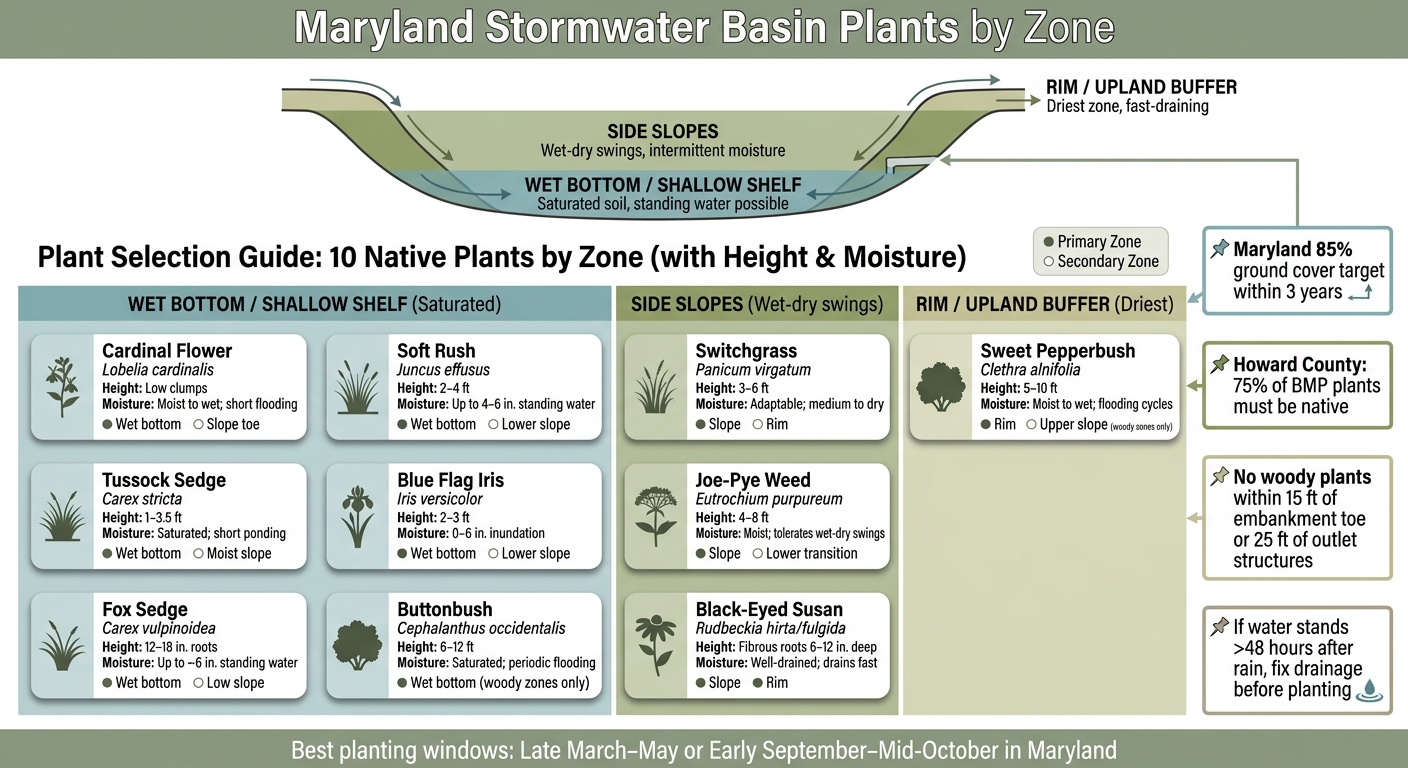
Maryland Stormwater Basin Plants by Zone: Wet Bottom, Slope & Rim
This chart makes it easier to compare zone fit, size, moisture tolerance, and upkeep without bouncing between notes. Use it as a quick side-by-side guide so you can match each plant to the wet bottom, slope, or rim before you buy.
| Plant | Best basin zone | Moisture tolerance | Spread / size | Maintenance |
|---|---|---|---|---|
| Buttonbush | Wet bottom, shallow shelf | Saturated; handles standing water | 6–12 ft tall; dense thickets | Prune late winter; monitor spread near outlets |
| Sweet pepperbush | Side slopes, rim (woody zones only) | Moist to wet; tolerates flooding cycles | 5–10 ft tall; 4–5 ft wide | Light once established; thin suckers near easements |
| Joe-Pye weed | Side slopes, lower transition zone | Moist; tolerates wet-dry swings | 4–8 ft tall; 2–4 ft wide | Cut back late fall or late winter; divide every few years |
| Switchgrass | Side slopes, basin rim | Adaptable; some cultivars handle wetter shelves | 3–6 ft tall; ~3 ft wide | Cut back late winter; mow to 6–8 in. in first season |
| Tussock sedge | Wet bottom, shallow shelf, moist slopes | Saturated; short periods of standing water | 1–3.5 ft tall; up to 3 ft wide | Cut back late winter; weed for first 1–3 years |
| Soft rush | Wet bottom, shallow shelf, lower slopes | Up to 4–6 in. of standing water | 2–4 ft tall | Cut back dead stems late winter; pull weeds first season |
| Blue flag iris | Wet bottom, lower side slopes | 0–6 in. of inundation | 2–3 ft tall; slow clump spread | Cut back dead growth; divide every few years |
| Cardinal flower | Wet bottom, shallow shelf, slope toe | Moist to wet; short flooding | Low clumps; spreads slowly by seed | Water first 1–2 summers; keep mulch off crown |
| Fox sedge | Wet bottom, shallow shelf, low slopes | Up to ~6 in. of standing water | 12–18 in. roots; clumps fill in over 2–3 seasons | Cut back early spring if needed; skip fertilizer |
| Black-eyed Susan | Side slopes, basin rim | Well-drained; drains fast | Fibrous roots 6–12 in. deep; self-seeds readily | Water during establishment; thin clumps periodically |
"It’s best to choose plants with as local a provenance as possible." – Miri, University of Maryland Extension [142]
When sourcing plants, go with locally sourced natives when possible. That helps preserve local adaptation and keeps plants in sync with Maryland’s conditions.
Where Shrubs Work and Where They Do Not
Shrubs fit only a narrow slice of a basin after weed removal. They are not the go-to fix for every patch of bare ground.
Good shrub locations
Place woody plants on the upper rim and upland buffer, where water moves off the site fast. In those spots, roots stay out of drainage paths. Keep woody plants 15 ft from the embankment toe and 25 ft from perforated pipes and principal spillways.[1][143][144]
Places to avoid woody plants
Embankments, dam faces, spillways, outlet structures, and pipe corridors are off-limits for shrubs and small trees. Maryland guidance prohibits woody vegetation on embankment slopes.[143][7] Maryland stormwater design manuals also call for a 25 ft non-woody buffer around control structures.[5][145]
Use herbaceous plants where access matters
In areas that need inspection access or mowing clearance, use grasses, sedges, rushes, and low perennials. That keeps the area easier to see, reach, and maintain. Maryland guidance limits herbaceous vegetation on embankments to under 10 inches so the surface stays mowable and open for inspection.[1][2]
After you mark the woody zones, use herbaceous plants across the remaining open areas to cover bare ground fast.
Planting Tips for Better Results in Maryland
Once you’ve matched each species to the right basin zone, planting method starts to matter. A lot. These steps help new plants settle in before weeds creep back.
Best planting windows
Plant Maryland basins from late March to May or early September to mid-October. In many cases, fall helps roots get established faster because the soil stays warm while the air turns cooler.
Before you install plugs, line up the planting window with the basin zone.
Space plants to close gaps fast
Tight spacing helps stop weeds from coming back after removal. For herbaceous basin plantings, space plugs about 12–18 inches apart in wet bottoms and 12–15 inches apart on side slopes.
It also helps to plant 5 to 7 of the same species together instead of dotting single plugs all over the basin. Grouped natives shade the soil sooner and make upkeep simpler.
After spacing is set, add a light layer of mulch only where runoff won’t carry it away.
Use mulch carefully in stormwater areas
Use 2 to 3 inches of 12-month-old shredded hardwood mulch on upper rims and upland buffers only. Keep loose mulch out of wet bottoms and shallow shelves, where storms can wash it away. Stay at 3 inches or less so roots keep good contact with the soil [146][148].
Skip routine fertilizer
Skip routine fertilizer. If plants seem weak, test the soil before adding anything. If needed, use only a light compost amendment at planting [149][150][151].
Water until plants are established
Water daily for the first week, every other day for the next 2 weeks, 2 to 3 times a week for the next 6 weeks, then once or twice a week through the first summer [147]. Water at the root zone in the morning.
When to Call a Maryland Drainage and Planting Professional
Good planting can fix a lot of basin issues. But it won’t solve a drainage problem that keeps coming back.
Signs the basin needs more than replanting
If new plants keep dying because water sits in the basin for too long, the issue is probably drainage, not plant choice. That’s the big clue.
A few other signs point the same way:
- Water stays pooled after normal rain
- The outlet pipe is clogged or drains slowly
- Erosion is cutting into the basin slopes
Those are drainage issues, not simple planting gaps.
What a professional can assess
If ponding or erosion is still there after weed removal, it’s time for a drainage review. A drainage and planting contractor can check the grading, how water moves through the inlet and outlet, whether erosion control is needed, and which planting zones make sense before any work begins.
When you talk with contractors, ask if they have training through the Chesapeake Bay Landscape Professional (CBLP) program, which focuses on stormwater management and native plant use. Also ask where the plugs were grown. Local provenance is best. [142]
Local help for central Maryland projects
Pro Landscapes MD handles drainage installation, drain pipe placement, French drains, stormwater management, grading, and landscape restoration across central Maryland, including Howard County, Montgomery County, Frederick County, Carroll County, Prince George’s County, and Baltimore County.
If a basin needs both drainage correction and replanting, having one crew handle the job can help keep the work coordinated.
Conclusion
After looking across the plant list, the main rule is simple: match each plant to the right basin zone – the wet bottom, side slope, or rim.
No single species works in every part of the basin. When the whole area gets the same planting, you usually end up with thin spots, plant stress, and weeds coming back sooner. A zone-based layout gives you better cover as the planting settles in.
Once the basin fills out, the focus moves from replanting to upkeep. Dense native cover helps choke out weeds, hold soil in place, and cut sediment buildup around basin structures. By the second or third growing season, maintenance usually becomes much lighter: inspections, light weeding, and selective pruning.
If the basin still holds water too long, erodes, or drains too slowly, the issue goes past plant choice. In that case, a drainage and planting professional can look at the grading, drainage, and plant layout together. For properties in central Maryland, Pro Landscapes MD can assess the basin and build a planting plan that fits the site conditions.
FAQs
How do I map the basin’s moisture zones?
Watch the basin during and after heavy rain so you can see where water pools, how it moves, and where it drains. Most stormwater basins fall into three moisture zones: the wet bottom, the seasonally wet middle, and the drier rim.
To check what’s happening below the surface, dig a few inches into the soil. It also helps to note small microclimates, since south-facing slopes dry out faster than shaded spots.
What if water still stands after 48 hours?
If water is still standing 48 hours after rain, the site likely has poor drainage and may develop unstable soil conditions.
Areas that hold water for 12 to 72 hours can often support plants suited to rain gardens or detention basins. If the soil stays saturated for more than 24 hours, focus on moisture-loving native plants like blue flag iris or cardinal flower. If the problem keeps showing up, it may be time to bring in a stormwater management professional.
How many plants do I need for quick coverage?
For faster coverage, plant groundcovers 12 to 18 inches apart in a staggered pattern. Plugs or quart-sized containers usually establish faster than seed. Just don’t pack them in too tightly, or the plants can end up competing with each other and building weaker roots.
Set larger shrubs 3 to 5 feet apart and trees 15 to 25 feet apart, based on their mature size. Then let the groundcovers spread into the open areas until you reach about 80% soil coverage.
Chat with Us