









- bhavya gada
- No Comments
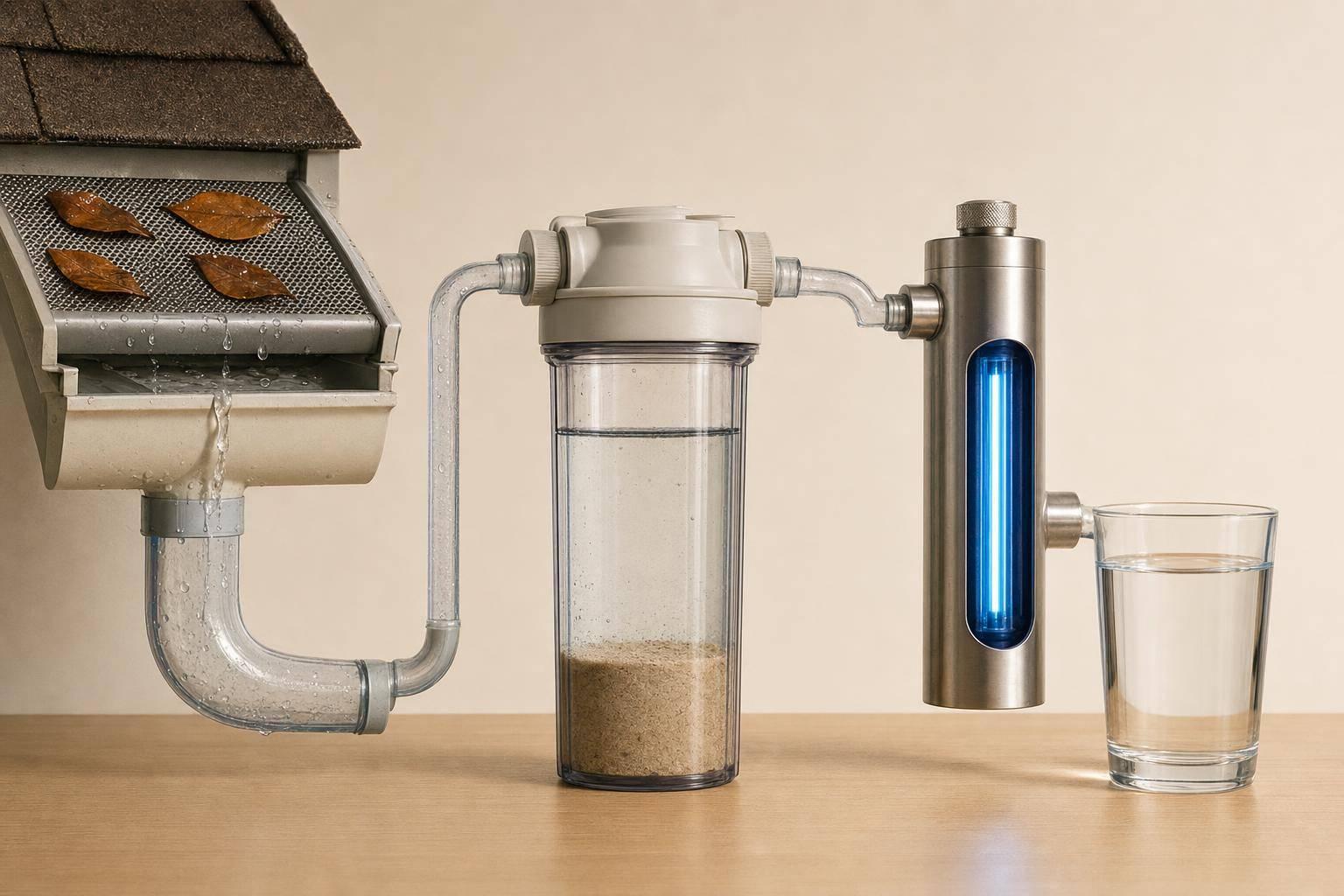
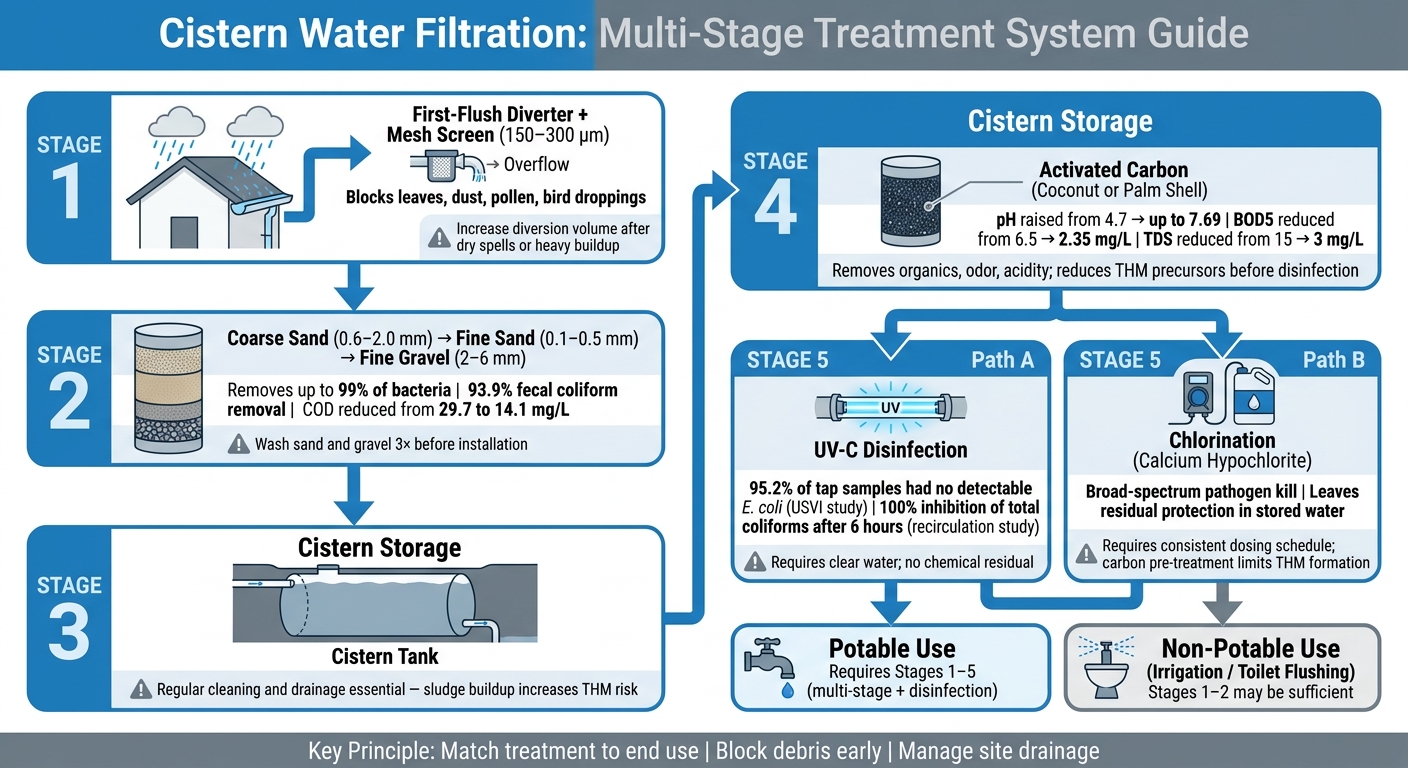
If you use cistern water, filtration is not optional. The studies here point to one clear setup: block roof debris early, cut sediment before storage, and use UV or chlorine if the water will be used for drinking.
I found the same pattern across the research:
- Roof runoff often carries bacteria, including E. coli, coliforms, and Enterococci
- Sediment and turbidity are common and can weaken later treatment
- First-flush diversion helps cut the dirtiest runoff at the start of a storm
- Sand and gravel filters do much of the particle removal
- Activated carbon helps with organics, odor, and acidic water
- UV works best with clear water
- Chlorine adds residual protection in stored water
- Tank cleaning and drainage matter, especially in places like Maryland with leaves, pollen, and hard rain
A few numbers stand out:
- Sand filtration removed up to 99% of bacteria
- Fecal coliform removal reached 93.9%
- One UV study found 95.2% of household tap samples had no detectable E. coli
- A UV-C recirculation test reported 100% inhibition of total and thermotolerant coliforms after 6 hours
- Activated carbon and mixed media shifted pH from 4.7 to as high as 7.69
Cistern Water Filtration: Multi-Stage Treatment System Guide
Filtration and Maintenance for Rain Cistern Systems
sbb-itb-843f8be
Quick Comparison
| Treatment step | What it does | Main limit | Best fit |
|---|---|---|---|
| First-flush + mesh screen | Blocks leaves, dust, and early dirty runoff | Needs cleaning and sizing for storm load | All cistern systems |
| Sand/gravel filtration | Lowers turbidity and suspended solids | Fine media can clog | Pre-treatment |
| Activated carbon | Cuts organics, odor, and acidity | Media needs replacement | Water chemistry control |
| UV-C | Kills microbes without chemicals | Needs clear water and power | Potable use after filtration |
| Chlorination | Kills microbes and leaves residual | Can form byproducts if organics stay high | Stored potable water |
My takeaway is simple: match the treatment to the end use. For irrigation or toilet flushing, coarse screening plus sediment filtration may be enough. For drinking water, I’d treat the studies as a strong case for multi-stage filtration plus disinfection, with routine maintenance and good site drainage built into the plan from the start.
Study Group 1: Sediment Filters and Pre-Tank Filtration
Research on cistern systems shows a simple truth: pre-tank filtration sets the tone for everything that comes after it. If too much debris and sediment get into storage, every later treatment step has to work harder.
A 2025 study found that inlet mesh paired with stratified sand-and-gravel filtration improved overall water quality for non-potable reuse [4]. That result comes down to particle size control, which is why filter rating matters so much. A separate pilot project used coarse filters with 150–300 μm pores to remove debris from rooftop runoff before it reached biofilters. After an initial start-up phase, the system removed at least 97% of pesticides and reduced coliforms and E. coli to WHO standards [5].
What Studies Found About Micron Ratings and Water Clarity
The studies point in the same direction: start with coarse screening, then move to finer cartridges only when you need higher clarity or when UV pretreatment is part of the setup [1][4].
Sand filtration also did a lot of the heavy lifting in the research. Studies showed that sand filters removed up to 99% of bacteria and 93.9% of fecal coliforms [4]. In one study, COD dropped from 29.7 mg/L to 14.1 mg/L after water passed through a sand filtration stage [3].
| Filter Type | Rating/Size | Study-Reported Performance | Maintenance Tradeoff |
|---|---|---|---|
| Coarse Mesh | 150–300 μm | Removes leaves, twigs, large grit; protects downstream modules [5] | Manual cleaning |
| Coarse Sand | 0.6–2.0 mm | Removes large suspended solids; maintains flow rate [3][4] | Lower microbial removal than fine media |
| Fine Sand | 0.1–0.5 mm | Removes fine silt and some bacteria; supports biofilm layer [3][4] | Prone to clogging; needs regular surface cleaning |
| Fine Gravel | 2–6 mm | Structural support; initial straining [4] | Low maintenance; base layer for finer media |
| Cartridge (5–20 micron) | 5–20 micron | High clarity; critical for UV pre-treatment [1] | Frequent replacement without prefiltration |
One small step can save a lot of trouble later: wash sand and gravel at least three times before installation so you don’t dump extra sediment into the system on day one [4].
Even so, a solid filter setup can still struggle if the roof sends a dirty surge into the system at the start of a storm.
How First-Flush Devices Lower Initial Contaminant Loads
Pre-tank screening works best when it’s paired with first-flush diversion. The first runoff from a roof carries dust, pollen, bird droppings, and dry-deposition pollutants. In plain terms, it’s usually the dirtiest part of the storm [3].
Studies found that light rainfall is linked to elevated levels of lead and copper in initial runoff [3]. For Maryland properties, that makes first-flush diversion especially important during heavy pollen seasons and after long dry spells. Use first-flush diversion before storage, and increase the diversion volume after long dry periods or heavy roof buildup [3].
Study Group 2: Combined Filtration, Activated Carbon, UV, and Chlorination
Once sediment is out of the way, the next job is dealing with dissolved contaminants and pathogens. Research points to multi-stage setups that pair sediment filtration, activated carbon, and a final disinfection step like UV-C or chlorination as a strong way to improve cistern water quality.
Research Results for UV and Multi-Stage Treatment
Recent UV studies show strong pathogen reduction when pre-filtration is in place. In the U.S. Virgin Islands, a program tested 271 tap water samples from households using roof-harvested rainwater. In that USVI program, 95.2% of tap samples had no detectable E. coli [1].
A separate lab study using a UV-C recirculation setup reported 100% inhibition of total coliforms and thermotolerant coliforms after just 6 hours of operation [2].
There’s a catch, though: UV needs clear water to work well. High turbidity can block UV exposure, so performance drops as turbidity goes up [1]. In the USVI study, most failures were linked to bypass-valve mistakes [1]. That detail matters because it shows the issue wasn’t always the UV unit itself. Sometimes the weak point is plain old system use.
If a setup needs chemical-free treatment, UV is the cleaner choice. If it also needs residual protection inside stored water, chlorination has the edge.
What Chlorination Studies Show and How Carbon Supports Disinfection
Chlorination, usually with calcium hypochlorite, treats a broader range of pathogens than UV and can also leave a residual in the system [4]. That residual matters in stored water, where contamination can show up again after treatment. UV does not leave that kind of backup protection.
At the same time, chlorine has its own tradeoff. Organic matter can react with chlorine and form trihalomethanes, so carbon pre-treatment plays an important role [4]. Activated carbon also helps improve water chemistry. Studies found it can bring pH from below 6.0 up to a range of 6.07–7.69 while reducing BOD5 from 6.5 mg/L to about 2.35 mg/L [3].
Here’s how the main setup options compare:
| Configuration | Primary Benefit | Key Limitation |
|---|---|---|
| Sediment Only | Reduces turbidity and large particles | Minimal protection against pathogens |
| Sediment + Carbon | Removes organics, odors; stabilizes pH [3] | No disinfection residual |
| Sediment + Carbon + UV | No-chemical disinfection; no residual [1][2] | Requires clear water and power |
| Sediment + Carbon + Chlorination | Broad-spectrum; residual protection [4] | Risk of THMs if organics aren’t fully removed first [4] |
In plain terms, UV fits cleaner water and no-chemical treatment goals. Chlorination fits systems that need residual protection after treatment. But chlorination only works well when dosing stays consistent on a regular schedule and carbon pre-treatment is in place to help limit THM formation [4].
Even strong disinfection doesn’t solve everything. Cistern performance still depends on what happens inside the tank.
Study Group 3: Biofiltration, Biosand, and Cistern Internal Processes
Even after disinfection, the cistern still shapes water quality. That part often gets overlooked. The tank isn’t just a place where water sits – it’s a place where settling, surface growth, and filter media can keep changing the water over time.
Biosand and slow-sand filters can remove microbes, turbidity, and even some dissolved pollutants. Studies on biosand, slow-sand, sand-and-gravel, and mixed-media filters show that these systems can help a lot in home cistern setups. But they also come with limits, especially when flow rate, cleaning, or organic buildup aren’t handled well.
Performance of Biosand, Slow-Sand, and Composite Media Filters
Slow-sand and biosand filters depend on a living surface layer that helps remove turbidity and microbes. In slow-sand systems, this biologically active layer is called the schmutzdecke, and it does much of the treatment work.
Sand filtration can remove up to 99% of bacteria and up to 93.9% of fecal coliforms [4]. Mixed-media filters that pair sand with activated carbon made from coconut or palm shells can also improve water chemistry. In one study, these filters moved acidic rainwater from a pH of 4.7 into a near-neutral range of 6.07–7.69 and cut Total Dissolved Solids from 15 mg/L to as low as 3 mg/L [3].
Between February and March 2022, researchers in Selangor, Malaysia, tested three granular filter columns: sand alone, palm shell-activated carbon with sand, and coconut shell-activated carbon with sand. The coconut shell column gave the best results, dropping TDS from 9 mg/L to 3 mg/L and increasing pH from 4.7 to 7.69. The system met WHO and Malaysian National Water Quality Standards for most parameters. Still, BOD5 increased past recommended limits after 30 liters in one column, which points to a clear maintenance cutoff [3].
| Filter Type | Primary Removal Trends | Household Suitability | Flow Rate and Limits | Upkeep Needs |
|---|---|---|---|---|
| Slow Sand / Biosand | Up to 99% bacteria removal and 93.9% fecal coliform removal; turbidity reduction [4] | High; low-cost, passive [4] | Low flow; requires schmutzdecke maturation [4] | Do not scrub away the biofilm [4] |
| Composite (Sand + Activated Carbon) | Reduces BOD5, COD, TDS, and stabilizes pH [3] | High; improves taste and chemistry [3] | Moderate; monitor for BOD5 breakthrough [3] | Periodic carbon media replacement [3] |
| Sand & Gravel | Efficient at removing suspended solids and bacteria [4] | High; often used as a pre-filter for disinfection systems [4] | High flow; easy to install and clean [4] | Regular cleaning or backwashing [4] |
In a cistern setup, sand-and-gravel media tend to work best as pretreatment before disinfection. They’re good at taking out suspended solids and lowering the load on whatever comes next. Slow-sand systems are pickier. They need a slow, steady flow, because pushing water through too fast cuts down the contact time the schmutzdecke needs to do its job [4].
What Studies Say About Biofilms and Settled Material in Cisterns
Inside the tank, treatment doesn’t stop. Water keeps changing through settling, biofilm growth, and sludge buildup. That can help in some ways and hurt in others.
In biosand filters, the active biofilm layer can reduce dissolved oxygen in incoming water by an average of 60% [3]. That drop points to active treatment, but it can also affect taste.
There’s a tradeoff here. High organic load and settled sludge can weaken chlorine performance and increase THM risk [4]. And stored rainwater can still carry microbial risk even when the basic chemistry looks fine [3]. So tank maintenance isn’t just housekeeping – it’s part of keeping the water safe.
Public Health Risks, Maryland Design Considerations, and Key Takeaways
How Risk Assessments Shape Filtration Choices
The studies point to one practical rule: match treatment to use. That’s the core idea here.
Untreated cistern water can contain coliforms, E. coli, and Clostridium perfringens, all of which can pose health risks. On top of that, high turbidity can weaken the performance of UV and chlorination systems [2][3][4].
For non-potable use, mesh and sand/gravel filtration may be enough. For potable use, carbon should be paired with UV-C or chlorination [2][4].
Research on household UV systems also found that clear installation steps and simple maintenance guidance cut down on user error [1]. In household studies, leaving bypass valves open was a leading cause of bacterial detections in treated systems [1]. That means site drainage isn’t just about landscaping. It’s part of water-quality control too.
Key Points for Maryland Residential Cistern Projects
In Maryland, heavy storms and seasonal leaf buildup make these design choices even more important. Properties in the state need site drainage planning and coarse pre-filtration, especially 150–300 μm mesh screens that can block seasonal leaf debris [5]. On sites with clay-heavy soils, overflow control during storm events matters a lot. When cistern storage is tied into grading and runoff control, it can cut sediment resuspension and limit contamination from outside debris, which helps protect pre-filtration stages [4].
Pro Landscapes MD provides drainage installation, French drains, dry riverbeds, stormwater management, grading, and yard leveling across central Maryland to help move runoff away from cisterns.
| Design Priority | Practical Action | Why It Matters |
|---|---|---|
| Pre-filtration | Coarse mesh screens (150–300 μm) + sand/gravel layers | Removes debris and reduces the load on finer stages [4][5] |
| Disinfection match | UV-C or chlorination for potable use; sand/gravel and mesh screening for irrigation | Aligns treatment with intended exposure [2][4] |
| Site drainage | Grading, French drains, dry riverbeds for overflow control | Helps manage heavy storms and limit sediment resuspension [3][4] |
| Maintenance schedule | Regular lamp checks, filter cleaning, and valve inspections | Helps prevent failure linked to user error and debris buildup [1][5] |
The research supports a multi-stage design: match treatment to use, block debris early, and manage overflow through site drainage.
FAQs
What filter setup is best for drinking water from a cistern?
A point-of-entry (POE) system is a common way to treat cistern drinking water for the entire house. In most setups, the system uses UV light for disinfection and is installed after the pump and pressure tank.
For the UV unit to do its job, turbidity usually needs to stay below 1 NTU. To get there, homes often use one or two prefilters in the 20- to 1-micrometer range.
How often should cistern filters and tanks be cleaned?
Regular cistern maintenance plays a big part in keeping water clean and safe. If you don’t know when your cistern was last serviced, drain, clean, and disinfect it as soon as possible. That gives you a clear starting point.
How often you clean it depends on how the system is used and the conditions around it. Still, routine inspections and cleaning can help prevent sediment buildup, stagnant water, chlorine loss, and microbial growth. It also helps to check your filter manufacturer’s replacement guidelines. UV bulbs usually last one year.
Do I need UV, chlorine, or both for safe cistern water?
It depends on your system and what kind of upkeep you can stick with. UV and chlorine can both kill bacteria and viruses often found in cistern water.
UV tends to work best as a point-of-entry treatment, paired with prefilters that lower turbidity. Manual chlorination is a recognized low-cost option, but it calls for careful routine dosing and testing.
Chat with Us