









- bhavya gada
- No Comments
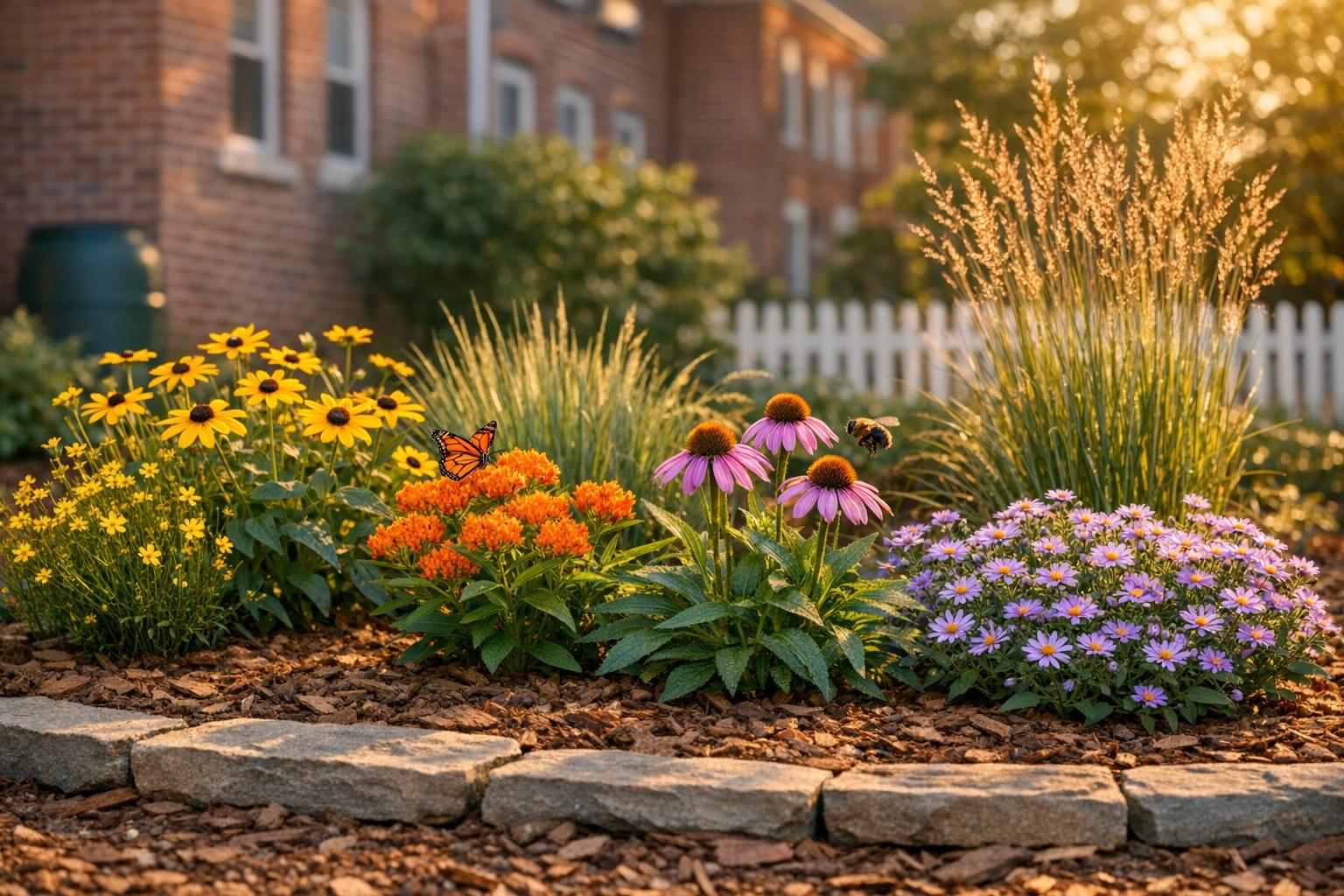
Maryland summers are tough – hot, humid, and prone to dry spells. Instead of constant watering and replanting, consider drought-resistant plants that thrive in USDA zones 6–8. These plants save water, need less care, and support local pollinators like bees and butterflies. Here are seven great options:
- Black-Eyed Susan: Maryland’s state flower, blooms June–October, attracts pollinators, low maintenance.
- Butterfly Weed: Vibrant orange flowers, Monarch butterfly host, thrives in dry, sandy soil.
- Purple Coneflower: Long-lasting blooms, supports pollinators and birds, handles various soils.
- Little Bluestem: Ornamental grass, deep roots for drought tolerance, stunning fall colors.
- Creeping Phlox: Groundcover with spring blooms, stabilizes slopes, supports native bees.
- Fragrant Sumac ‘Gro-Low’: Low-growing shrub for erosion control, colorful fall foliage.
- Red Maple: Hardy tree, provides shade, early-season nectar, and fall color.
These plants are perfect for conserving water and creating a low-maintenance, pollinator-friendly garden.
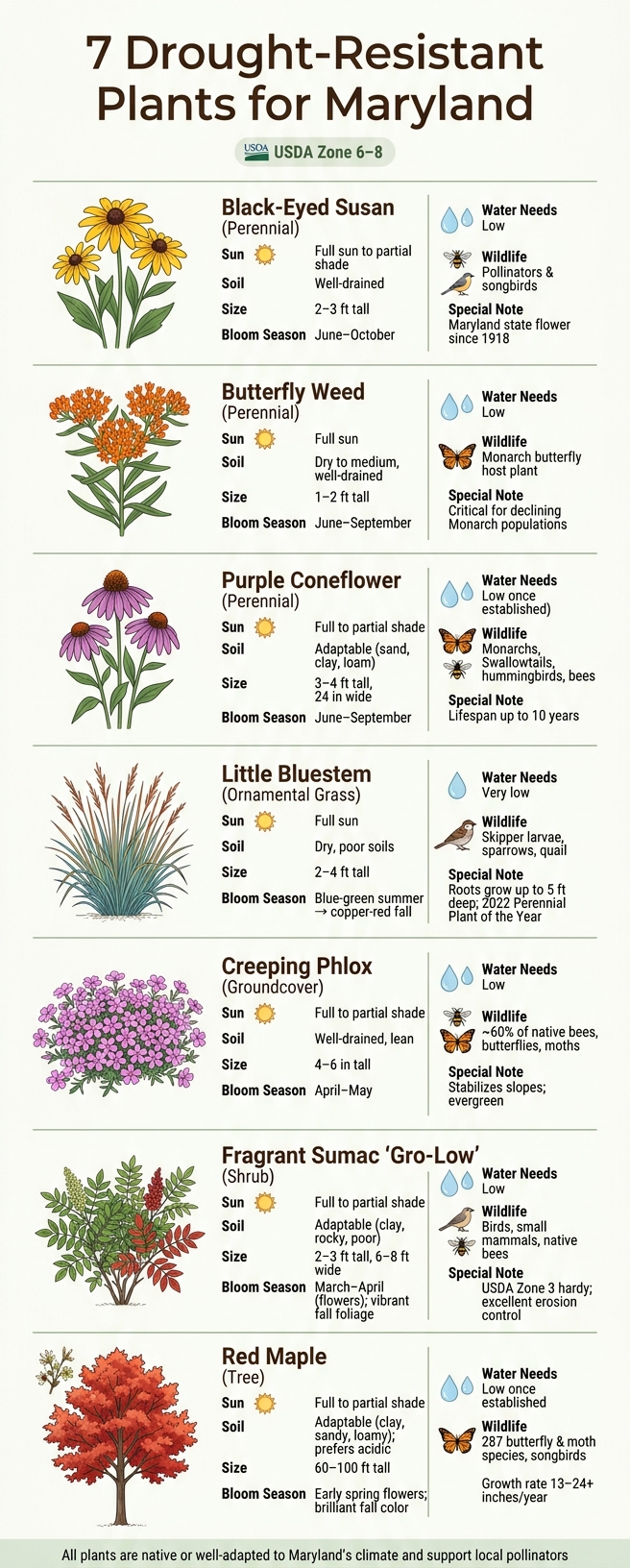
7 Drought-Resistant Plants for Maryland: At-a-Glance Guide
LESS WATERING! With Beautiful Drought Tolerant Native Plants
sbb-itb-843f8be
1. Black-Eyed Susan (Rudbeckia fulgida)
Maryland officially named the Black-Eyed Susan its state flower back in 1918[2]. This hardy wildflower blooms from June to October, brightening up everything from highway medians to wildflower meadows.
As a native plant, Rudbeckia fulgida is perfectly suited to Maryland’s soil and climate. It thrives despite the region’s summer heat and fluctuating humidity. The University of Maryland Extension highlights it as a standout choice for home gardens[1]. Once its roots are well-established – usually after the first growing season – it becomes impressively drought-tolerant, requiring very little attention during dry periods[2].
To help it settle in, regular watering during the first season is key. After that, it does best in well-drained soil with full sun or partial shade. It’s a low-maintenance plant that rarely needs fertilizers or pesticides, as it actually prefers nutrient-lean soil.
The Black-Eyed Susan isn’t just about looks – it’s a magnet for local wildlife. Native bees, butterflies, and seed-loving songbirds flock to it, and it’s a vital nectar source for Maryland’s summer wildflower honey[2]. Plants like this can support up to 90% of butterflies and moths in their ecosystems[3].
For an added boost to pollinator activity, consider planting in clusters of three to five[2]. And if you leave the seed heads on through winter, you’ll provide food for birds and encourage natural reseeding, which helps the plant maintain its drought resistance over time[2].
2. Butterfly Weed (Asclepias tuberosa)
After the hardy Black-Eyed Susan, Butterfly Weed steps up with its own drought-tolerant charm. Known for its vibrant orange flowers, this plant is a pollinator magnet, making it a must-have for Maryland gardens.
Butterfly Weed’s deep taproot and love for dry, sandy, well-drained soil make it a low-maintenance choice once it’s settled in. For best results, plant it on a south-facing slope or near a stone wall to enhance drainage [4]. It thrives in full sun and doesn’t need fertilizer, performing beautifully in lean soil [2]. However, keep in mind that its long taproot makes transplanting nearly impossible [2].
This plant isn’t just pretty – it’s essential for wildlife. Monarch butterfly caterpillars rely exclusively on Butterfly Weed as a food source. With Monarch populations in sharp decline, planting Butterfly Weed plays a critical role in their survival. As Patuxent Nursery explains:
"The Monarch Butterfly community needs every piece of Butterfly Weed they can get, since their populations have decreased dangerously in recent decades." [6]
And it’s not just Monarchs that benefit. Native bees and hummingbirds are also drawn to its blooms, which typically last from June through September [4]. To maximize its impact, plant Butterfly Weed in clusters of three or more to create a strong support system for Monarchs [4]. Skip the fall cleanup, too – leaving the dead stalks provides winter nesting spots for bees [5].
Incorporating Butterfly Weed into your garden not only supports pollinators but also adds a splash of color and resilience to your landscape. It’s a win-win for you and the environment.
3. Purple Coneflower (Echinacea purpurea)
The Purple Coneflower is a drought-tolerant perennial that thrives in Maryland’s gardens, especially in dry conditions once established. This makes it an excellent pick for low-water landscaping or xeriscaping. Typically, it grows between 2 to 4 feet tall, spreads about 24 inches wide, and blooms from June through September. With proper care, it can live up to 10 years[7][8]. Its ability to adapt to different soil conditions adds to its appeal.
This resilient plant can handle various soil types, including sand, clay, loam, and limestone. While it prefers full sun, it can tolerate partial shade and is resistant to urban pollution, making it a great choice for city gardens.
Caring for Purple Coneflower is straightforward. Water it only when the top 2 inches of soil are dry, and skip unnecessary fertilizers. Deadheading spent blooms encourages more flowers, but leaving the spiky seed heads intact in the fall provides food for American Goldfinches and supports beneficial insects[9][10].
For gardeners focused on ecological benefits, opting for the wild-type variety of Echinacea purpurea is key. Unlike double-flowering hybrids, which can block access to nectar and pollen and struggle in Maryland’s winters, the wild-type attracts a wide range of pollinators. Monarchs, Swallowtails, bumblebees, honeybees, Ruby-throated hummingbirds, and specialist bees like the mining bee Andrena helianthiformis are frequent visitors[8][10]. Additionally, it serves as a larval host for the Silvery Checkerspot butterfly and several moth species, such as the wavy-lined emerald and the sunflower moth[10].
4. Little Bluestem (Schizachyrium scoparium)
Little Bluestem, a grass native to Maryland, is celebrated for its ability to handle drought conditions. According to the University of Maryland Extension, it’s a reliable choice even in harsh climates [1][11]. Its deep, fibrous roots can grow as far as 5 feet underground, enabling it to tap into moisture well below the dried-out topsoil [14].
This plant thrives best in full sunlight and prefers poor, well-drained soils. It’s important to avoid planting it in overly rich or moist conditions and to skip supplemental fertilizers [12][14]. For best results, plant it in spring or fall, spacing each one 18–24 inches apart. During the first growing season, water deeply once a week to help establish strong roots.
One of Little Bluestem’s standout features is its changing foliage. In summer, it’s a silvery blue-green, but as fall approaches, it transforms into striking shades of red, orange, and mahogany. Even into winter, it retains its color and structure. As described by the Lady Bird Johnson Wildflower Center:
"Little bluestem is wonderful planted en masse. The visual dynamics it provides range from blue-green in late summer to golden with tufted seedheads in winter." [12]
This grass also plays a key role in supporting wildlife. It serves as a host plant for skipper butterfly larvae, offers nesting material for native bees, and provides seeds that attract song sparrows, white-throated sparrows, and bobwhite quail [12][13][14][3].
To maximize its benefits, leave the grass standing through winter to protect insects and maintain its structure. In late winter or early spring, trim it back to 2–4 inches [12][14]. Highlighting its beauty and ease of care, Little Bluestem was named the 2022 Perennial Plant of the Year® by the Perennial Plant Association [14].
Up next, discover another drought-tolerant species that can elevate Maryland gardens even further.
5. Creeping Phlox (Phlox subulata)
Creeping Phlox, also known as Moss Phlox, is a low-growing, evergreen perennial native to Maryland’s Mountain and Piedmont regions. It creates a thick, carpet-like mat and bursts into vibrant rose, pink, or white flowers during April and May. Since it naturally thrives in Maryland’s ecoregions, it’s perfectly suited to the local soil and climate. Once established, it requires very little water, fertilizer, or upkeep, making it a practical choice for gardeners [1].
This plant loves full sun and does best in well-drained, lean soil. For the best results, plant it in the fall (September through November) to give its roots time to develop. Its drought tolerance means that it needs only minimal watering while also contributing to the health of local ecosystems. This makes Creeping Phlox a low-maintenance option with big ecological payoffs.
Beyond its easy care, Creeping Phlox plays a valuable role in supporting local wildlife. It provides nectar for butterflies, moths, and around 60% of native bees. Additionally, it offers shelter for small mammals and birds, which help keep garden pests in check [3].
For Maryland gardeners aiming to reduce lawn space or stabilize slopes with an eco-friendly groundcover, Creeping Phlox is a fantastic choice. Its drought resistance, minimal maintenance needs, and ability to support local ecosystems make it a standout in conservation landscaping. For personalized tips, Pro Landscapes MD can help you design a native, drought-tolerant garden that thrives [1].
6. Fragrant Sumac ‘Gro-Low’ (Rhus aromatica ‘Gro-Low’)
Fragrant Sumac ‘Gro-Low’ is a standout choice for Maryland landscapes, offering excellent groundcover and erosion control. This low-growing shrub is perfectly suited to the region’s conditions. Miles Minter of Johnson’s Nursery describes it best:
"Gro-low Sumac (Rhus aromatica ‘Gro-low’) is a dense, low-growing shrub that’s tough as nails. It’s easily grown in average soils and can tolerate clay, compaction, salt, and drought." [15]
This plant stays compact at 2–3 feet tall but spreads 6–8 feet wide, forming a thick mat that stabilizes slopes and banks. Its ability to spread through root suckers makes it a natural solution for filling bare spots and preventing erosion without much intervention. Rated for USDA Hardiness Zone 3, it can handle Maryland’s cold winters with ease. Its resilience extends to blooming and its vibrant seasonal foliage.
‘Gro-Low’ thrives in both full sun and partial shade, making it versatile for various garden spots. It’s particularly well-suited to poor, rocky, or clay-heavy soils where other plants might struggle. In March and April, it blooms, offering early nectar and pollen for native bees. By fall, its glossy green leaves transform into stunning shades of orange, red, and maroon, adding a pop of seasonal color to your garden.
For maintenance, prune in spring after it flowers, focusing on removing the oldest, thickest canes to keep its shape neat and natural. Pair it with other hardy plants like Little Bluestem, Sedge, or Aster to create a low-maintenance, soil-stabilizing landscape.
While its red, hairy fruit isn’t a primary food source for wildlife, it serves as a backup during harsh conditions. As Minter points out, "The red, hairy fruit is usually only eaten as an emergency food by birds during migration or in winter when there’s nothing better to eat." [15] Even so, its early spring blooms make it a valuable resource for pollinators when other plants are still dormant.
7. Red Maple (Acer rubrum)
The Red Maple is a tree that thrives across Maryland’s diverse landscapes, from wet marshy areas to dry upland ridges, making it a great choice for various environments [16].
Once established, this tree is impressively drought-tolerant, thanks to its deep taproot that pulls moisture from below the surface. During its first year, consistent watering is essential to help it develop a strong root system. After that, the Red Maple can usually rely on natural rainfall to grow [2].
Red Maples can reach heights of 60 to 100 feet when fully grown, with an annual growth rate of 13 to over 24 inches [17]. They’re hardy in USDA Zones 3–9 and can adapt to many soil types, including clay, sandy, and loamy soils. However, they prefer acidic soil and may develop yellowing leaves (chlorosis) in highly alkaline conditions [16].
To keep your Red Maple healthy, prune it during late winter (February to early March) or late summer (July to August) to reduce sap bleeding [18]. Protecting its thin bark is equally important – damage from lawn mowers can lead to fungal infections and heart rot [16].
These trees also play a key role in supporting wildlife. Their flowers provide early-season nectar for pollinators. As Mike Land from the Bay Journal notes:
"Red maple flowers… provide a vital early food source for various pollinators like bees." [20]
In addition, Red Maples support the life cycles of about 287 species of butterflies and moths [19]. Their seeds are a food source for songbirds and small mammals. However, avoid planting them near horse pastures – wilted or dead Red Maple leaves are toxic to horses, with as little as 1.5 pounds being dangerous and 3 pounds potentially lethal [16].
For guidance on adding native, drought-tolerant trees like the Red Maple to your Maryland landscape, check out Pro Landscapes MD.
Comparison Table
Match each drought-resistant plant to your yard using the table below.
| Plant | Type | Sun/Soil Needs | Mature Size | Seasonal Highlights | Wildlife Value | Water Needs |
|---|---|---|---|---|---|---|
| Black-Eyed Susan | Perennial | Full sun to partial shade; well-drained | 2–3 ft tall | Summer–fall blooms with persistent seed heads | Attracts pollinators and songbirds | Low once established |
| Butterfly Weed | Perennial | Full sun; dry to medium, well-drained | 1–2 ft tall | Blooms from late spring to early fall | Monarch butterfly host plant | Low |
| Purple Coneflower | Perennial | Full sun to partial shade; adaptable | 3–4 ft tall | Mid-summer blooms with winter seed heads | Attracts a broad range of pollinators and birds | Low once established |
| Little Bluestem | Ornamental Grass | Full sun; thrives in dry, poor soils | 2–4 ft tall | Blue-green summer foliage evolving to copper-red fall color | Supports songbirds and small mammals | Very low |
| Creeping Phlox | Groundcover | Full sun to partial shade; well-drained | 4–6 in tall | Early spring blooms | Attracts pollinators | Low |
| Fragrant Sumac ‘Gro-Low’ | Shrub | Full sun to partial shade; adaptable | 2–3 ft tall, 6–8 ft wide | Spring flowers with vibrant red fall foliage | Provides habitat for birds and small mammals | Low |
| Red Maple | Tree | Full sun to partial shade; adaptable | 60–100 ft tall | Early spring flowers with brilliant fall color | Attracts a variety of pollinators and birds | Low once established |
The table above outlines the needs and features of various drought-resistant plants. Each plant offers unique benefits, from the striking copper-red foliage of Little Bluestem to the early spring blooms of Creeping Phlox, which is perfect for low, spreading coverage on slopes or edges. For wildlife enthusiasts, plants like Butterfly Weed and Purple Coneflower attract a wide array of pollinators, while Fragrant Sumac ‘Gro-Low’ provides shelter for birds and small mammals.
When planning your garden, consider layering plants for both aesthetics and functionality. Place taller species like Red Maple and Purple Coneflower at the back, mid-height options like Black-Eyed Susan and Butterfly Weed in the center, and Creeping Phlox at the front for a cascading effect. This arrangement not only creates visual interest but also ensures continuous blooms from early spring to fall.
Conclusion
Maryland summers are becoming increasingly hotter and drier. According to the University of Maryland Extension:
"In our changing climate, more severe droughts are expected in Maryland, in addition to stronger storms and flooding. Weather extremes put stress on our natural water supplies, water quality, and the infrastructure that delivers water to our homes." [11]
This shifting climate highlights the importance of choosing plants that can handle these challenges. The seven plants discussed in this article – from Black-Eyed Susan to Red Maple – are excellent choices for Maryland’s tough conditions. Once established, these plants require minimal watering, stand up well to extreme weather, and benefit local pollinators. They also provide a practical, water-efficient alternative to traditional lawns, which often demand excessive upkeep and irrigation.
To get the most out of your garden, focus on yard maintenance and landscape projects that prioritize smart placement, soil preparation, and site-specific plant selection. Since regional differences can affect plant success, choosing species that thrive in your local environment is key. Consulting a professional can make a big difference – they can help you select the right plants, group them by water needs, and design a garden that blooms beautifully throughout the growing season.
For expert advice and services, Pro Landscapes MD specializes in landscape design, planting, and garden solutions across central Maryland. Their team can guide you in creating a low-maintenance, water-efficient garden filled with native plants that thrive year-round.
FAQs
How often should I water these plants in year one?
During the first year, it’s important to water drought-resistant plants more often to help their roots settle in. For the first two weeks, check the soil daily – if the top 6 inches feel dry, water thoroughly. After this period, shift to watering about three times a week, keeping the soil consistently moist to a 6-inch depth. Once the plants are established, you can cut back to watering just once a month, though it’s a good idea to increase watering during prolonged dry spells.
Which plants work best for clay soil in Maryland?
Native plants such as wild bergamot, blue sedge, and wool rush are excellent options for clay soil in Maryland. These plants are naturally suited to the area and flourish in the dense, heavy soil typical of the region. Their ability to thrive under these conditions makes them a smart pick for local gardens.
Can I use these to replace part of my lawn?
Replacing part of your lawn with drought-resistant plants or native grasses is a smart choice. These options not only require less water but also bring a low-maintenance and eco-friendly touch to your yard. You can introduce them gradually or opt for a complete transformation, depending on your preference and needs.
Chat with Us