









- bhavya gada
- No Comments
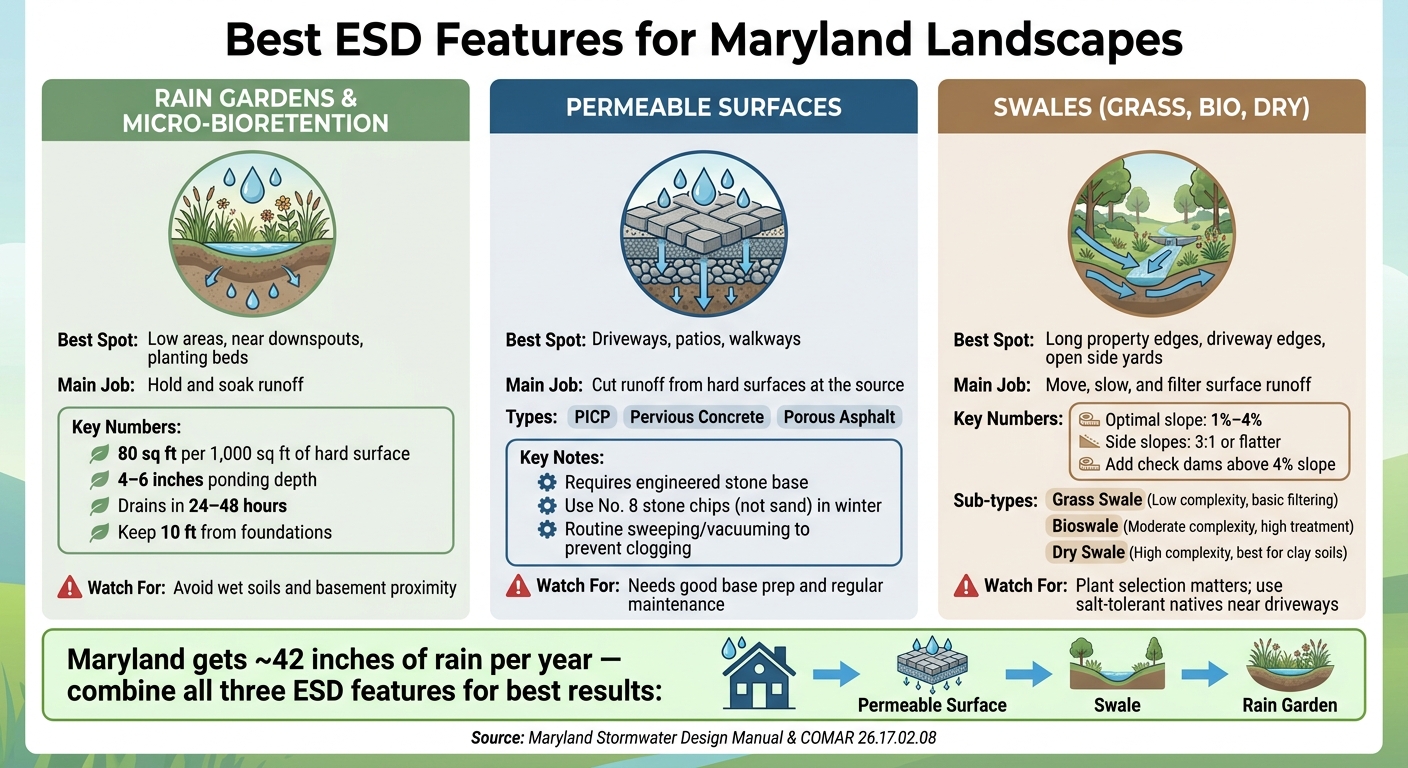
If I had to sum it up fast: rain gardens, permeable surfaces, and swales are usually the top ESD picks for Maryland yards. They each solve a different runoff problem, and the right one depends on your soil, slope, drainage path, and hard surfaces.
I’d look at it this way:
- Rain gardens and micro-bioretention fit low spots, planting beds, and downspout runoff.
- Permeable driveways, patios, and walkways help water soak in instead of running off.
- Grass swales, bioswales, and dry swales help move water across the yard while slowing it down and filtering it.
Maryland gets about 42 inches of rain per year, so runoff is a common yard problem. On many lots, the best setup is not one feature by itself. It’s a simple combo of features that handles water at the source, along the flow path, and at the low point.
Here are the main takeaways from the article:
- Put rain gardens at least 10 feet from basement foundations
- Aim for 4 to 6 inches of ponding in a rain garden
- Water should drain out within 24 to 48 hours
- A common sizing guide is 80 square feet of rain garden per 1,000 square feet of hard surface
- Swales tend to work best with a 1% to 4% slope
- Clay-heavy soils often need engineered soil or an underdrain
- Permeable surfaces need routine cleaning so pores or joints do not clog
Maryland ESD Features Compared: Rain Gardens, Permeable Surfaces & Swales
How to Build a Native Plant Rain Garden – A Step-by-Step Tutorial
sbb-itb-843f8be
Quick Comparison
| Feature | Best Spot | Main Job | Watch For |
|---|---|---|---|
| Rain garden | Low areas, beds, near downspouts | Hold and soak runoff | Keep away from foundations and wet soils |
| Micro-bioretention | Tough soils, larger drainage areas | Filter and drain runoff with soil layers | More build detail and upkeep |
| Permeable surface | Driveways, patios, walkways | Cut runoff from hard surfaces | Needs good base prep and clog control |
| Grass swale | Long edges, open side yards | Move and slow water | Works best on mild slopes |
| Bioswale | Visible drainage areas | Slow, filter, and soak some runoff | Plant care matters |
| Dry swale | Clay soils or spots needing underdrains | Treat runoff in poor-draining ground | More built-in drainage parts |
If you want the short answer, I’d say this: use rain gardens for low planted areas, permeable surfaces for hardscape, and swales for drainage routes. Then match each one to the lot instead of forcing one fix everywhere.
Rain Gardens and Micro-Bioretention
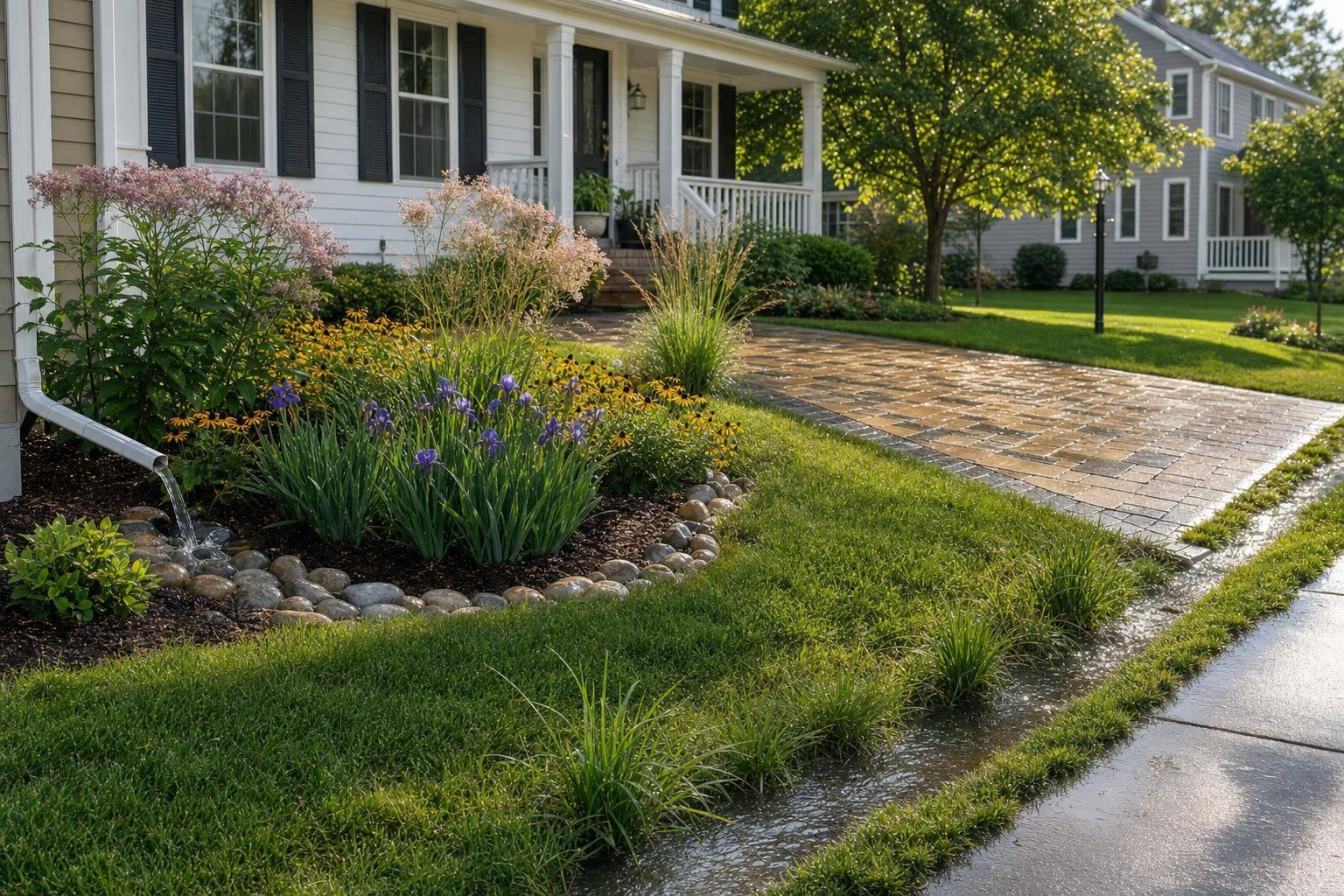
Rain gardens and micro-bioretention make the most sense when you can catch runoff in a small planted area. Both are shallow, landscaped depressions that collect water from hard surfaces like roofs, driveways, and patios, then hold it for a short time so it can soak into the ground. In Maryland, a common sizing rule is about 80 square feet of garden for every 1,000 square feet of impervious area. For many suburban yards, that puts these systems well within reach.
Where Rain Gardens Work Best
The best locations are usually near downspouts, along the edge of a lawn, or at the bottom of a gentle slope where water already tends to gather. Water can move into the garden as sheet flow across grass or through a short grass swale connected to a downspout. A short grass swale or a decorative stone dry creek bed can guide water into the garden and help cut down on erosion at the inlet.
Some spots are off-limits. Avoid placing a rain garden within 10 feet of any foundation with a basement. Also avoid any area where the seasonal water table is within 2 feet of the bottom of the garden. It’s also smart to skip areas over septic systems or directly beneath the drip line of large, established trees.
Soils, Ponding Depth, and Plant Selection
Standard design calls for a ponding depth of 4 to 6 inches, with water draining out fully within 24 to 48 hours. If the native soil drains more slowly than 0.5 inches per hour, use an engineered soil mix made of sand, topsoil, and organic matter. Micro-bioretention goes a step further by adding a layered filter bed and, when needed, an underdrain. It works well in places with poor infiltration and can serve drainage areas up to 0.5 acres.
Plant choice can make or break a rain garden. Native plants that can handle both wet periods and dry spells are usually the best match. In Maryland, spring and fall are the best times to plant because roots get time to settle in before summer heat or winter freezes hit. A yearly layer of shredded hardwood mulch helps control weeds and keep moisture in the soil.
Rain Garden Types for Residential Landscapes: Comparison Table
| Feature Type | Water Quality Performance | Drainage Area Served | Space Needed | Maintenance Intensity |
|---|---|---|---|---|
| Decorative Rain Garden | Moderate | Small (single downspout) | Low | Low – similar to a standard flower bed |
| Maryland Manual-Based Rain Garden | High | Up to 2,000 sq. ft. of impervious area | Moderate (~80 sq. ft. per 1,000 sq. ft.) | Moderate – soil and plant monitoring required |
| Micro-Bioretention | Very High | Up to 0.5 acres | Moderate to High | Moderate to High – may include underdrain and engineered media checks |
A decorative rain garden near one downspout is often the easiest place to start. A manual-based design can manage more runoff and deliver better water quality treatment. Micro-bioretention is the more engineered choice when soil limits or drainage area size go beyond what a simpler rain garden can handle.
For larger paved areas, permeable pavement is the next ESD option.
Permeable Pavement for Driveways, Patios, and Walkways
Permeable pavement does two jobs at once: it gives you a usable surface for a driveway, patio, or walkway, and it helps manage runoff. Water passes through the surface and into a stone reservoir below. From there, it either soaks into the subsoil over time or leaves through an underdrain. The top layer supports foot traffic and vehicles. The base layer stores and drains runoff.
Maryland recognizes three permeable pavement types under COMAR 26.17.02.08 [1]: permeable interlocking concrete pavers (PICP), pervious concrete, and porous asphalt. All three manage water at the base level, but they don’t look or perform the same way. Each one fits a different kind of residential project.
Best Uses on Maryland Properties
Permeable pavers are usually the best all-around pick for homes. Water drains through the aggregate-filled joints between the solid paver units. And because pavers come in many colors, shapes, and patterns, they work well for patios, walkways, and more upscale driveways.
Pervious concrete works well on broad, continuous areas like wide driveways or parking pads where you want one uninterrupted surface. Porous asphalt tends to cost less, so it can make sense for long rural driveways or secondary access roads. One catch: it can rut during extreme heat.
Before installation, check both slope and soil infiltration. Steeper slopes and Type C and D soils often need an underdrain.
Installation and Maintenance in Maryland
Maryland’s freeze-thaw cycles can be hard on paved surfaces. Permeable pavers tend to do well here because the joints between units act like built-in expansion gaps. That helps lower the risk of cracking, which can affect solid slabs such as pervious concrete during winter temperature swings.
Base prep matters a lot. The stone reservoir has to be sized to hold the design ESD volume required by the 2000 Maryland Stormwater Design Manual and its 2009 supplements [1]. It also helps to stabilize nearby soil with mulch or vegetation before installation so sediment doesn’t clog the pores.
For upkeep, skip sand for winter traction on or near permeable pavement. Sand can seal the pores fast. Maryland recommends small stone chips (No. 8 stone) instead [1]. A few routine steps keep the system working:
- Sweep PICP on a regular basis
- Vacuum pervious concrete and porous asphalt to keep pores open
- Refill joint stone when needed
- Keep maintenance records for the required three-year inspections [1]
Permeable Pavement vs. Conventional Pavement: Comparison Table
| Factor | Permeable Pavement | Conventional Pavement |
|---|---|---|
| Runoff Reduction | High – water infiltrates on-site rather than running off | Low – pavement is impervious and sheds runoff |
| Maryland ESD Compliance | Primary ESD practice used to meet MEP requirements | Impervious surface; requires downstream treatment or disconnection |
| Installation Complexity | Higher – requires soil testing, engineered base, and sediment control | Lower – standard base preparation |
| Maintenance Needs | Moderate – periodic sweeping, vacuuming, or joint stone replenishment | Lower – standard crack sealing and resurfacing |
| Freeze-Thaw Durability | Pavers: High. Pervious concrete and porous asphalt: Moderate | Solid slabs and asphalt can be more crack-prone in winter temperature swings |
When runoff needs to travel through planted channels instead of across a paved area, swales are the next ESD option.
Bioswales, Grass Swales, and Dry Swales
Swales move runoff across a site when water needs both conveyance and treatment. In plain English, a swale is a shallow, planted channel that slows runoff, filters out some pollutants, and sends water to a safe outlet. Maryland’s ESD framework recognizes three main residential swale types: grass swales, bioswales, and dry swales [1]. They make sense when runoff needs to slow down, get filtered, and stay visible above ground instead of disappearing into a pipe.
When Swales Work Better Than Underground Drainage
Maryland requires ESD planning and treatment practices first, before structural BMPs come into play. On residential lots, whether a swale works usually comes down to slope, soil, and outlet control. A pipe simply moves runoff. A swale does more than that: it slows flow, filters it, and lets part of it soak into the ground. That’s why swales often work well along long property lines and driveway edges where surface flow needs to be handled without sending water underground right away.
Design Details That Affect Performance
Slope has the biggest effect on how well a swale works. Swales perform best with a channel slope between 1% and 4% [1]. Once the slope goes above 4%, check dams should break a long swale into shorter ponding sections so water has more time to soak in [1]. Side slopes should stay at 3:1 or flatter [1]. If they get steeper, they’re more likely to erode or slump, and upkeep gets harder. For grass swales, gentler side slopes also make mowing much easier.
Plant choice matters too, especially next to driveways. Runoff from pavement often brings road salt with it during winter. Salt-tolerant natives like sedges and rushes usually handle both short-term flooding and salt exposure better than many ornamental plants. In heavy clay soils, dry swales need engineered filter media and an underdrain so they can drain within 48 hours [1].
Bioswale, Grass Swale, and Dry Swale: Comparison Table
| Factor | Grass Swale | Bioswale | Dry Swale |
|---|---|---|---|
| COMAR Classification | Nonstructural Practice [1] | Micro-Scale Practice [1] | Micro-Scale Practice [1] |
| Primary Function | Conveyance and basic filtering | Treatment and infiltration | High-level water quality treatment |
| Construction Complexity | Low | Moderate | High |
| Best Maryland Site Condition | Long property edges and rural residential lots | Front-yard curb appeal and garden-integrated drainage | Areas with poor-draining clay soils or near foundations |
| Maintenance | Routine mowing and sediment removal | Pruning, mulching, and weeding | Weeding and occasional media refresh |
| Water Quality Credit | Often used as pretreatment [1] | High [1] | High [1] |
Pick the swale type that fits the site’s slope, soil, and drainage path.
Combining ESD Features Into a Maryland Landscape Plan
No single ESD feature fixes every runoff issue. The best Maryland plans use a treatment train: each feature handles a different part of the water flow, covering source control, conveyance, and capture.
Here’s what that can look like in practice: permeable pavers cut runoff at the source, a grass swale slows and pre-treats overflow, and a rain garden holds the rest.
Matching ESD Features to Your Site Conditions
Site conditions shape the right mix. From there, the site’s soil, slope, and drainage path determine the best layout.
Soil type is the first thing to check. Slow-draining C and D soils often need engineered media and an underdrain [1]. Swales need a longitudinal slope between 1% and 4%; steeper runs need check dams to break the flow into more manageable sections [1]. Rain gardens should sit at the lowest practical point, at least 10 feet from the foundation. It also helps to map downspout locations early. Redirecting roof runoff straight into a rain garden is a simple way to cut roof runoff [1].
Conclusion: The Most Practical ESD Upgrades for Long-Term Performance
The core idea is straightforward: rain gardens capture and filter runoff at a concentrated point, permeable pavements reduce runoff from driveways and patios, and swales direct surface flow while adding pretreatment. When you layer these features based on the site’s soil, slope, and drainage area, the plan works better as a whole.
For homeowners planning these upgrades, Pro Landscapes MD installs drainage, grading, and environmental pavers across Howard, Montgomery, Carroll, Frederick, Prince George’s, and Baltimore counties.
FAQs
Which ESD feature is best for my yard?
The best ESD feature for your yard depends on the site itself: soil type, groundwater levels, drainage area, slope, and the amount of hard surface already in place.
That’s why a professional assessment matters. It can show whether options like rain gardens or permeable pavement make sense for your property. Pro Landscapes MD provides expert guidance and installation across central Maryland.
How do I know if my soil can support a rain garden?
To figure out whether your soil can handle a rain garden, your property needs a site-specific review. The main things that matter are soil conditions and groundwater levels.
A professional will usually look at the soil type, the depth of the water table, the size of the drainage area, and the slope of the land. In Maryland, rain garden design also needs to follow the Maryland Stormwater Design Manual, including its hydrologic soil group rules.
Can I combine rain gardens, permeable pavement, and swales?
Yes. These ESD features can work together, and the best setups often mix several methods to control runoff.
Rain gardens, permeable pavement, and swales are all recognized ESD treatments. They help mimic natural hydrology, improve water quality, and support local code requirements. Pro Landscapes MD provides design, installation, and drainage services to help bring these features together in one plan.
Chat with Us