









- bhavya gada
- No Comments
Choosing the right pergola material for Maryland’s weather is critical. Maryland’s climate – marked by high humidity, heavy rain, intense sun, and occasional snow – makes durability a priority. Here’s a breakdown of the top materials:
- Wood: Offers a natural look but requires regular maintenance. Lifespan ranges from 10 to 40 years, depending on the type (e.g., pine, cedar, hardwood). Prone to rot, cracking, and UV damage without upkeep.
- Vinyl: Low maintenance and moisture-resistant, lasting over 20 years. However, it may fade under strong sunlight and offers limited design options.
- Aluminum: The most durable option, lasting 30–40+ years with minimal maintenance. Resists rust, UV rays, and extreme weather but comes with a higher upfront cost.
Quick Comparison
| Material | Lifespan | Maintenance | Weather Resistance | Starting Cost (12×12) |
|---|---|---|---|---|
| Wood | 10–40 years | High (sealing, staining) | Struggles with humidity, rot, and cracking | $7,500+ |
| Vinyl | 20+ years | Low (occasional cleaning) | Handles moisture well; fades under UV rays | $7,500+ |
| Aluminum | 30–40+ years | Very low (minimal cleaning) | Excels in all weather conditions | $7,500+ |
Aluminum stands out for its longevity and minimal upkeep, making it ideal for Maryland’s climate. While it costs more initially, its durability and low maintenance make it a smart long-term investment.
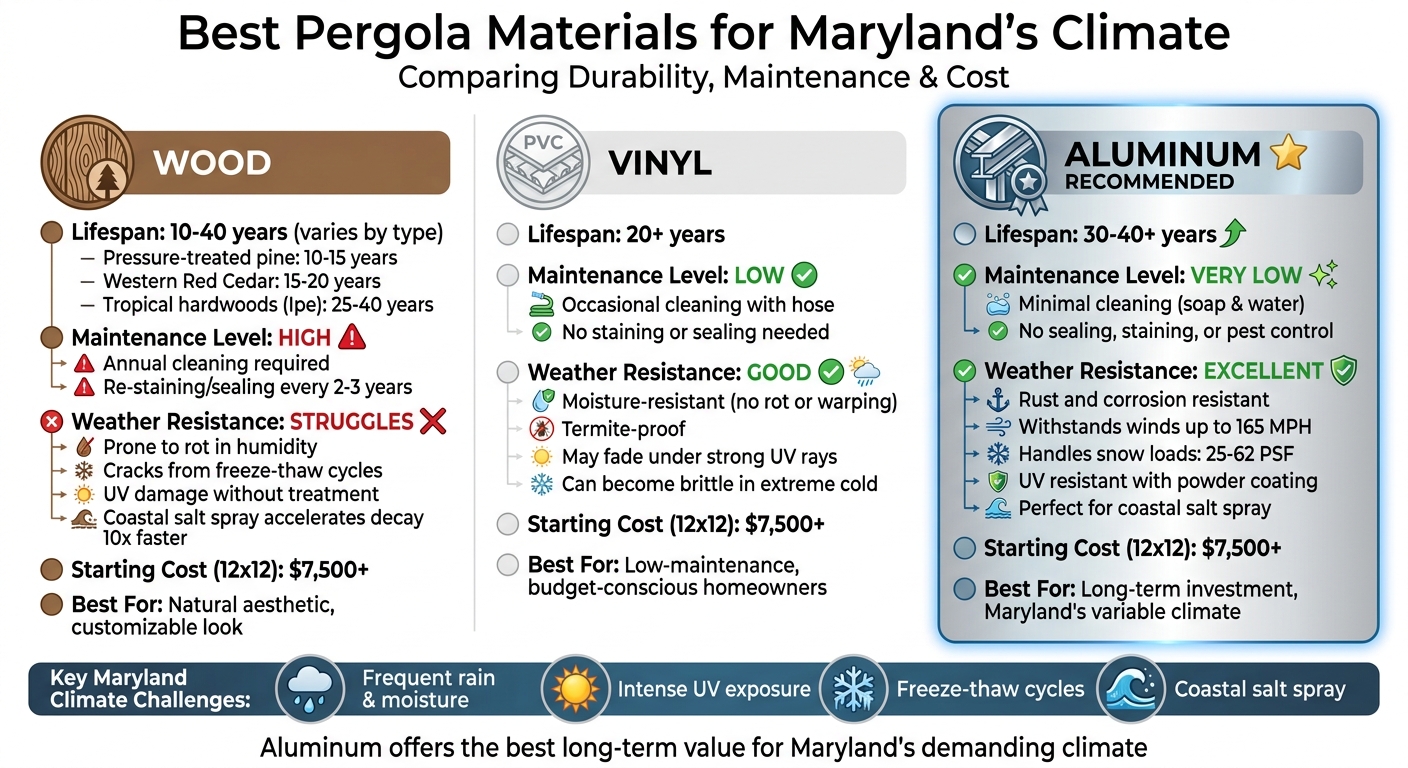
Pergola Materials Comparison: Wood vs Vinyl vs Aluminum for Maryland Climate
What Is the Best Pergola Material for Any Climate?
sbb-itb-843f8be
1. Wood Pergolas
Wood pergolas bring a timeless charm to outdoor spaces. In Maryland’s climate, pressure-treated pine generally lasts 10 to 15 years, while Western Red Cedar can endure 15 to 20 years. High-end tropical hardwoods like Ipe stretch that lifespan to an impressive 25 to 40 years [5][6]. However, Maryland’s unpredictable weather can take a toll on wood performance.
The state’s high humidity and frequent rain create the perfect environment for rot, mold, and mildew. Winters add another challenge with freeze-thaw cycles, where moisture trapped in the wood expands and leads to cracks and structural weakening [4][5]. Coastal areas face an additional issue: salt spray. It can corrode metal fasteners and degrade wood finishes up to 10 times faster than inland conditions [4]. As PERGOLUX explains:
When snow sits on a pergola, and undergoes a cycle of melting during the day and refreezing at night, a traditional wood pergola will experience moisture seeping into the wood grains. This can turn to rot and mold [4].
To combat these challenges, annual cleaning and re-staining or sealing every 2–3 years are crucial for protecting the wood from UV rays and moisture [5][6]. Kevin Manning, President of KD Landscape, emphasizes the importance of upkeep:
Wood also requires some maintenance to ensure their longevity, such as occasional staining or sealing [3].
The cost of a 12×12 wood pergola starts at around $7,500, but more intricate designs with features like masonry pillars or integrated lighting can climb to $25,000 to $35,000 [3]. Maintenance costs over time should also factor into your decision [6].
For those looking to extend the lifespan of their wood pergola, a few strategic choices can make a big difference. Using stainless steel or hot-dip galvanized hardware with ACQ-treated lumber prevents corrosion. Elevating posts with steel brackets and sealing all cut edges adds extra protection [5][6]. Installing a roof can increase the lifespan of support beams by 20–30%, shielding them from UV rays and moisture [6]. Additionally, promoting airflow and removing leaf debris helps the structure dry faster after Maryland’s frequent rains [5].
| Wood Type | Typical Lifespan | Maintenance | Maryland Climate Performance |
|---|---|---|---|
| Pressure-Treated Pine | 10–15 Years | High (Sealing/Staining) | Prone to warping/rot [5][6] |
| Western Red Cedar | 15–20 Years | Moderate (Sealing) | Naturally rot-resistant; needs UV protection [5][6] |
| Tropical Hardwoods | 25–40+ Years | Low to Moderate | Excellent durability; resists moisture/pests [5] |
| Untreated Pine | 5–10 Years | Very High | Poor; rapid decay in wet conditions [5] |
2. Vinyl Pergolas
Vinyl pergolas stand out for their durability and ease of care. Unlike wood, vinyl doesn’t rot, warp, or attract termites, making it a solid choice for homeowners building beauty in their backyards [1][2]. This resistance to moisture damage is especially handy in Maryland’s humid climate, where wooden pergolas often struggle with mold and decay [7]. Cleaning is a breeze – just a quick rinse with a hose keeps vinyl looking sharp [1]. As John Smucker, Owner of Smucker Fencing, puts it:
"While a high-quality vinyl piece will cost a little more up front, it pays you back with a lifetime of beautiful, low-maintenance performance" [7].
The one notable durability issue with vinyl is its susceptibility to UV fading or discoloration over time, particularly when exposed to strong, direct sunlight. To minimize this, consider placing your pergola in a spot that avoids intense afternoon sun [1].
When it comes to cost, vinyl pricing is comparable to wood. A 12×12 vinyl pergola starts at around $7,500, with more elaborate designs reaching up to $35,000 [3]. However, vinyl’s real advantage lies in its minimal maintenance. You won’t need to spend extra on stains, paints, or replacements, making it a cost-effective option in the long run [7].
That said, vinyl does have some limitations. It offers fewer design and color choices than wood or aluminum, which can be a drawback for those seeking a more customized or "natural" look. Many homeowners feel that vinyl lacks the warmth and character of cedar and other premium woods [1]. Up next, we’ll dive deeper into the pros and cons of each material to help you make the right decision.
3. Aluminum Pergolas
Aluminum pergolas are a strong choice for Maryland’s unpredictable weather. Thanks to their natural resistance to rust and corrosion, they hold up well against the region’s high humidity and frequent rainfall [1]. Unlike wood or vinyl, aluminum doesn’t warp, crack, or rot when exposed to fluctuating temperatures or UV rays [1]. This makes them a reliable option across Maryland, whether you’re near the coast or in areas with heavy inland snow.
These pergolas are built to last. Standard models can withstand winds up to 120 MPH, while heavy-duty versions are engineered to endure hurricane-force winds of up to 165 MPH [1]. They can also handle snow loads ranging from 25 PSF to 62 PSF, depending on the model [1]. With a lifespan of 30 to 40 years or more, aluminum pergolas offer durability that requires little effort to maintain.
Speaking of maintenance, it’s as simple as giving them a quick rinse to remove dirt or debris – no staining, sealing, or pest control needed [1]. A powder-coated finish adds an extra layer of protection against UV rays, helping the pergola retain its appearance over time [3]. Compared to wood and vinyl, aluminum pergolas deliver consistent performance with far less upkeep.
In terms of cost, basic aluminum pergolas start around $7,500, while fully customized options can range from $25,000 to $35,000 [3]. Although the initial price is higher than wood, the low maintenance and long lifespan make aluminum a smart long-term investment [1]. For Maryland’s variable weather, consider adding a louvered roof system. This feature allows you to close the roof during rain or snow and open it for ventilation on hot, humid days [1].
For professional installation tailored to Maryland’s climate, check out Pro Landscapes MD.
Material Comparison: Advantages and Drawbacks
Here’s a closer look at the strengths and weaknesses of different pergola materials, particularly in the context of Maryland’s unique climate challenges.
Wood pergolas offer unmatched natural charm and can be customized with paint or stain to achieve your desired look. However, they don’t hold up well against Maryland’s humid summers. Moisture can seep into the wood, and during freeze-thaw cycles, this often leads to cracks or splits. Termites can also pose a threat. Even with routine maintenance – like sealing and staining every two to three years – wood pergolas typically last between 10 and 20 years.
Vinyl pergolas, on the other hand, are a low-maintenance option. Cleaning is as easy as rinsing with a garden hose, and they resist rot and pests effectively. That said, extended exposure to UV rays can lead to fading, and extreme cold may cause brittleness. Still, vinyl pergolas tend to last over 20 years, making them a more durable choice than wood, though they don’t quite match aluminum in longevity.
Aluminum pergolas stand out as the most durable option for Maryland’s varied conditions, whether inland or coastal. They’re built to resist rust, rot, and UV damage. Plus, they can handle wind speeds up to 165 MPH and snow loads of 50 to 65 pounds per square foot. Aluminum naturally forms a protective oxide layer, and the double powder coating adds extra defense against salt spray – an essential feature for coastal areas. With a lifespan of 30 to 40+ years and minimal upkeep (just occasional cleaning with soap and water), aluminum offers a long-term solution, though it does come with higher initial costs.
Here’s a quick comparison of the three materials:
| Material | Lifespan | Maintenance | MD Climate Performance | Initial Cost Range |
|---|---|---|---|---|
| Wood | 10–20 years | High (requires sealing) | Struggles in humidity; prone to rot and cracking | Moderate |
| Vinyl | 20+ years | Low (occasional cleaning) | Handles moisture well; may fade under intense UV rays | Lower upfront |
| Aluminum | 30–40+ years | Very low (minimal cleaning) | Excels in salt air, heavy snow, and UV exposure | Higher upfront |
When choosing a pergola material in Maryland, long-term performance is key. For homeowners near the coast, aluminum’s double powder coating is especially valuable for protecting against salt-induced corrosion.
Conclusion
Aluminum pergolas are a perfect match for Maryland’s climate. They resist rot, cracking from freeze-thaw cycles, and UV fading, offering an impressive lifespan of 30 to 40+ years. Plus, they’re built to handle winds up to 165 MPH and snow loads up to 62 PSF, making them a durable choice for the region’s varied weather conditions [1].
While the initial cost of aluminum is higher, its low maintenance requirements – just an occasional cleaning – make it a cost-effective option in the long run. The powder-coated finish adds an extra layer of protection, especially for coastal areas prone to salt exposure.
Choosing the right material is important, but expert installation is just as critical. Skilled contractors who understand Maryland’s specific challenges – from heavy snowfalls in Frederick County to the coastal conditions of Annapolis – ensure your pergola meets local codes and performs reliably for years to come.
Pro Landscapes MD specializes in custom hardscaping across central Maryland, serving areas like Howard, Montgomery, Carroll, Frederick, Prince George’s, and Baltimore counties. With their expertise, your aluminum pergola will not only endure Maryland’s demanding climate but also elevate your property’s beauty and functionality for decades.
FAQs
Which pergola material is best for coastal Maryland?
Aluminum stands out as the preferred material for pergolas in coastal Maryland. Its strength against harsh weather, resistance to rust, and immunity to warping make it ideal for the region’s challenging coastal conditions. Plus, it requires minimal upkeep, offering a dependable and long-lasting solution.
What maintenance does a pergola need in Maryland?
To keep your pergola in Maryland looking great and standing strong, regular maintenance is essential. Start by giving it a thorough cleaning to remove dirt, leaves, and other debris that can accumulate over time. This not only keeps it looking fresh but also prevents potential damage.
Next, inspect your pergola for any signs of wear, such as cracks, warping, or loose components. Catching these issues early can save you from more extensive repairs down the road. Finally, apply protective finishes or sealants periodically. These treatments shield the wood (or other materials) from the effects of Maryland’s weather, helping to prevent damage from moisture, sun, and temperature changes.
With these simple steps, your pergola can stay durable and attractive for years to come.
How do pergola costs compare long-term by material?
When considering long-term costs for a pergola, the material you choose plays a big role in both durability and maintenance.
- Aluminum stands out as the most durable option. It requires very little upkeep and can last a lifetime, making it a low-maintenance choice.
- Vinyl is another durable material that only needs occasional cleaning to stay in good shape.
- Wood, on the other hand, has lower upfront costs but demands regular sealing or staining every few years. Over time, these recurring maintenance expenses can add up.
While wood might seem like a budget-friendly option initially, materials like aluminum and vinyl often prove to be more cost-effective over the years.
Chat with Us