









- bhavya gada
- No Comments
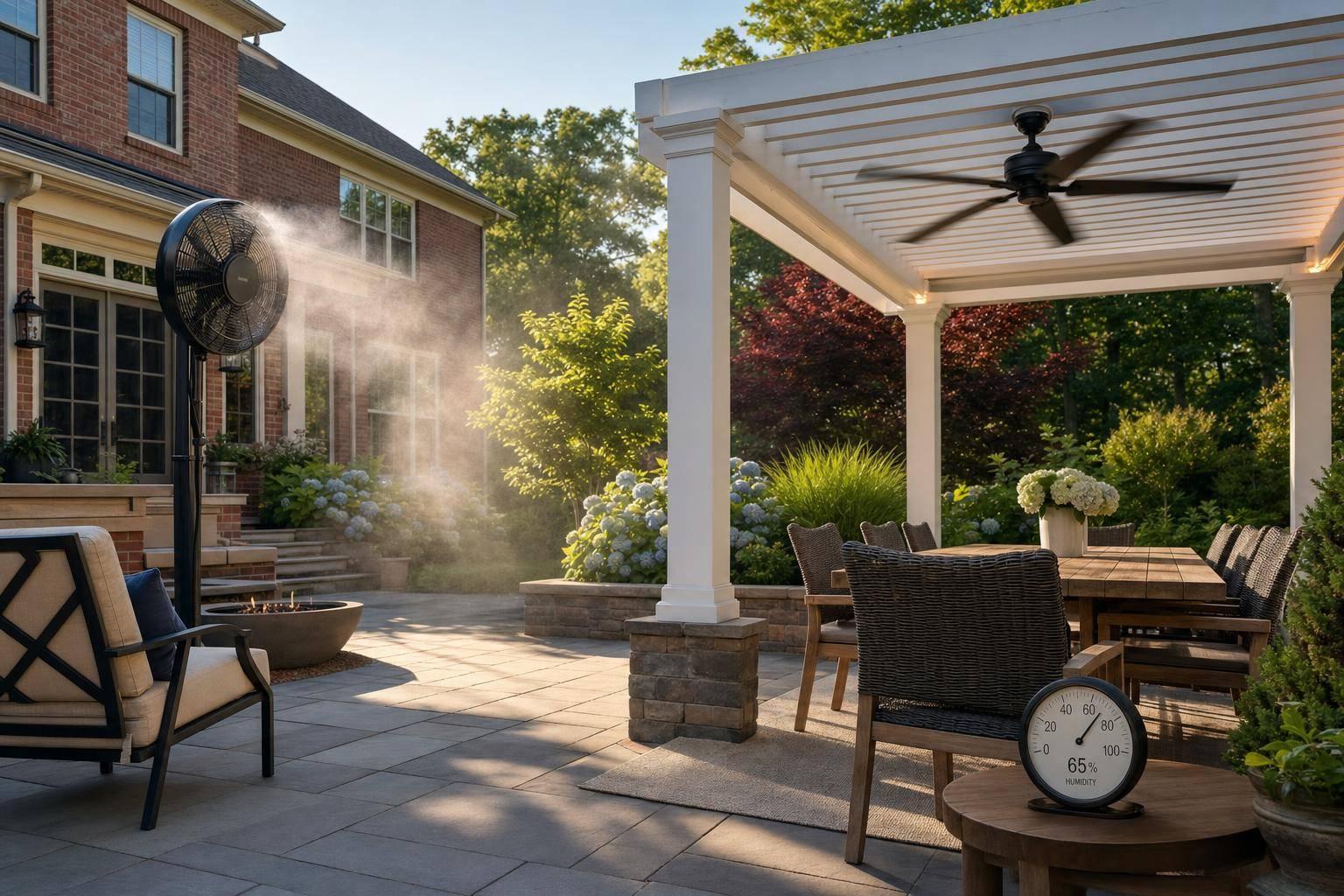
If I had to sum it up in one line: for most Maryland homes, open spaces do best with misting fans, covered spaces do best with wet-rated fans, and evaporative coolers are hit-or-miss once humidity passes 60%.
Maryland summers are hot, humid, and sticky. When humidity climbs past 60%, some outdoor cooling systems lose a lot of their effect. So before I buy anything, I’d look at shade, airflow, moisture risk, power access, and water access first.
Here’s the short version:
- Misting fans work best in open patios, deck edges, and pool areas with moving air.
- Evaporative coolers fit semi-open, shaded spaces with a steady cross-breeze.
- Pergola-mounted or ceiling fans are often the best pick for covered patios, pergolas, and pavilions.
- Low airflow + high humidity can leave mist hanging in the air and surfaces damp.
- Costs can range from about $15 to $700+, depending on system type and size.
- Outdoor electrical gear should use a GFCI outlet or circuit.
If I were choosing fast, I’d use this rule:
- Open and sunny: misting fan
- Covered and breezy: fan or evaporative cooler
- Covered and humid: wet-rated ceiling or wall fan
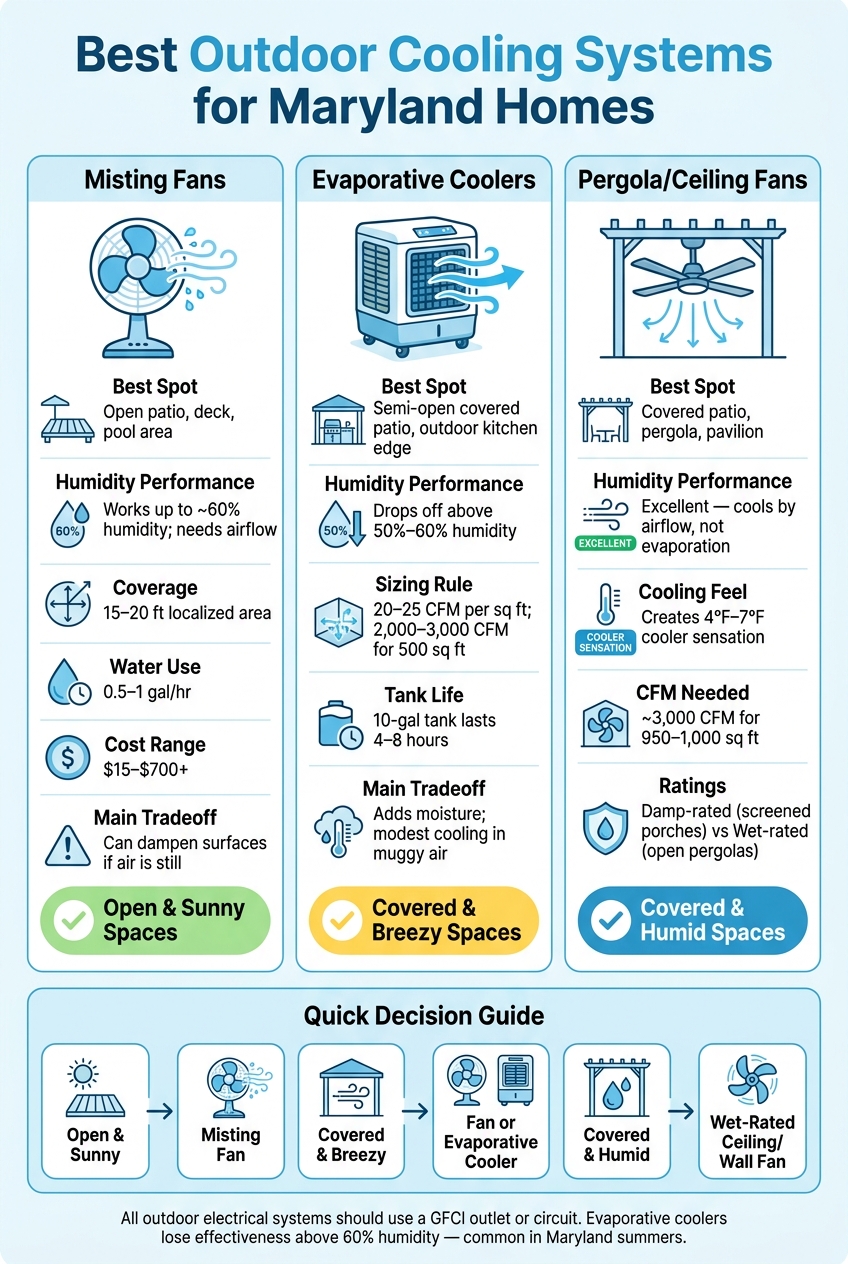
Best Outdoor Cooling Systems for Maryland Homes: Side-by-Side Comparison
Introduction to a High Pressure Mist System
sbb-itb-843f8be
Quick Comparison
| System | Best Spot | How It Handles Maryland Humidity | Main Tradeoff |
|---|---|---|---|
| Misting fan | Open patio, deck, pool area | Better than evaporative coolers in muggy weather, but still needs airflow | Can dampen surfaces if air is still |
| Evaporative cooler | Semi-open covered patio, outdoor kitchen edge | Drops off once humidity gets above 50%–60% | Adds moisture and may cool only a little in muggy air |
| Pergola-mounted or ceiling fan | Covered patio, pergola, pavilion | Works well because it cools by air movement, not evaporation | Doesn’t lower air temperature |
So the best choice is less about brand and more about where you plan to use it. If your space is shaded, gets a breeze, and can handle a little moisture, you have more options. If it’s covered, damp, or near wood, cushions, or electronics, I’d keep it simple and focus on airflow.
Best Misting Fans for Maryland Patios and Decks
When Maryland heat and humidity start to press down, a misting fan can cool an open patio or deck fast. High-pressure misting fans run at about 1,000 PSI, which lets them push out a very fine mist that dries fast. The result is noticeable cooling without soaking nearby furniture [2]. In the right setup, they can make the seating area feel much cooler, even when the air is moderately humid [1].
The key is airflow. These fans do their best work when moving air can carry the mist before it settles.
The table below shows how high-pressure misting fans stack up for Maryland patios and decks:
| Cooling System | Cooling Effect in Humidity | Coverage Area | Water Use | Impact on Surfaces | Maintenance |
|---|---|---|---|---|---|
| High-Pressure Misting Fan | High – fine mist evaporates faster [2] | Localized (15–20 ft) [1] | 0.5–1 gal/hr [1] | Low – fine mist that dries quickly [1] | High – nozzle cleaning, pump care [1] |
Where Misting Fans Work Best in Humid Conditions
Misting fans tend to work best in open or partly covered spaces where natural airflow helps the mist dry before it lands. That makes them a good fit for pool decks, patio edges, and outdoor dining areas. In those spots, the mix of moving air and fine mist creates a cooler zone around where people sit [1].
Still, enclosed spaces are a different story. If the air isn’t moving, mist can hang around and collect on cushions, wood, and stone. Over time, that can leave you dealing with damp surfaces.
For fixed patio layouts, a mounted system keeps the mist pattern steady and aimed where you want it. If you move furniture around or change seating zones often, a freestanding unit gives you more control. As Mark Buskuhl, Founder and CEO of Ninebird Properties, puts it:
"Mounted systems fit fixed seating areas; freestanding units work better when you need flexibility." [2]
For larger semi-open spaces, evaporative cooling is often the next system people compare.
Installation and Maintenance Points That Matter
Setup matters just as much as cooling output. Maryland well water can clog fine nozzles, so it’s smart to use an inline hose filter and brass nozzles to cut down on mineral buildup [1][3].
A few placement rules make a big difference:
- Don’t aim mist straight at porous natural stone, untreated wood decks, or fabric cushions. Over a season, that can lead to mold or rot [1].
- Aim the fan across the seating area, not directly at it, so the mist has time to disperse [1].
- Keep high-output units 10–15 feet from cushions and wood surfaces [1].
- Use a GFCI outlet for any corded unit set up near water [1][4].
Best Evaporative Coolers for Semi-Open Outdoor Spaces
For shaded areas where misting leaves things too damp, evaporative coolers are usually the next thing people look at. These units pull air through wet pads to cool it down. The catch is simple: once humidity gets above about 60%[4], they lose a lot of their punch. That matters in Maryland. When the air is already humid, an evaporative cooler will often drop the temperature by only a few degrees.
Best Uses for Covered Patios and Outdoor Kitchens
Evaporative coolers work best in covered patios and outdoor kitchens that still get steady airflow. Picture a covered patio with open sides, a pergola with a cross-breeze, or an outdoor kitchen seating area where outside air keeps moving through the space[4]. In setups like that, the extra moisture has a chance to drift away instead of hanging in the air and making the whole area feel muggy.
Placement makes a big difference too. A good rule is to put the cooler near the edge of the covered area, close to a source of fresh air, instead of shoving it against the back wall. That gives the unit a better shot at pulling in fresher air and sending cooler air across the seating area[4].
Sizing, Water Refills, and Seasonal Upkeep
Once you’ve picked a breezy location, sizing becomes the big issue. A solid rule of thumb is 20–25 CFM per square foot of outdoor space[7]. For a 500 sq. ft. covered patio, that usually means 2,000–3,000 CFM. For larger outdoor kitchen areas over 1,000 sq. ft., move up to 4,000–5,000+ CFM[4][6]. Go too small, and the unit can run all day without doing enough.
For long afternoons and evenings, especially near an outdoor kitchen, it helps to choose a model with a built-in float valve and garden hose adapter. A standard 10-gallon tank usually lasts about 4 to 8 hours[4]. That may not carry you through a full day without a refill. A continuous hose connection solves that problem.
If your home uses well water, pay close attention to mineral buildup on the cooling pads. Regular cleaning or pad replacement helps the honeycomb media keep working and can cut down on mold during humid stretches[4][7]. Before winter sets in, drain the tank and lines all the way, clean the pads, and store the unit in a dry spot so freezing weather doesn’t damage it[4].
If your space is fully covered and what you need most is airflow, not evaporation, pergola-mounted and ceiling fans are the next fit.
Best Pergola-Mounted and Ceiling Fans for Covered Outdoor Areas
On covered patios and pergolas, airflow is often enough to make the space feel more comfortable. Ceiling and pergola-mounted fans can create a 4°F to 7°F cooler feel [9]. If the area already has overhead cover and just needs better air movement, a well-sized fan is the best place to start. In fully covered spaces, the main choice comes down to two things: moisture rating and airflow.
Wet-Rated Fans for Pergolas, Pavilions, and Covered Patios
Start with the moisture rating. Use damp-rated fans only in fully covered, moisture-protected spaces, such as screened porches. Use wet-rated fans for open pergolas, pavilions, and any spot where rain can reach the fixture [1][4]. If rain can hit the fan, a damp-rated model isn’t the right pick.
For larger covered patios, size the fan by airflow, measured in CFM. A 950- to 1,000-sq.-ft. space needs about 3,000 CFM [4]. After you confirm the right rating, match the fan to the patio’s square footage. Look for UV-resistant blades and powder-coated finishes to help the fan handle sun and humidity [5]. The fixture should also be wired to a GFCI-protected circuit [1][4].
When Air Movement Alone Is Enough
A fan-only setup makes sense in spaces with wood ceilings or outdoor electronics, where misting moisture can lead to damage or mildew [1][5]. In those cases, fans give you steady comfort across multiple seasons without the water control issues that come with misting systems.
Match the fan’s size, exposure, and moisture tolerance to the layout below.
How to Match the Right Cooling System to Your Maryland Landscape
Best Fits for Small Patios, Pergola Seating Areas, and Larger Yards
The right setup comes down to four things: your square footage, how much shade the area gets, how close it is to power and water, and what surfaces are nearby.
That matters because a system that works well on an open patio can be a poor fit under a covered pergola or next to an outdoor cooking area. In Maryland, where summer air often feels heavy and damp, the layout of the space can matter just as much as the product itself.
Use this table to match each cooling system to the kind of area you have, whether it’s humid, in full sun, or under cover.
| Layout | Best System | Key Reason |
|---|---|---|
| Small townhome patio | Portable misting kit or compact misting fan | No permanent mounting needed; easy to reposition [2][1] |
| Covered pergola or pavilion | Mounted misting system or wet-rated wall-mounted fan | Even overhead distribution; requires solid overhead framing [2][8] |
| Outdoor kitchen | High-CFM fan or evaporative cooler | Moves air without wetting prep surfaces [4][5] |
| Large open backyard | High-output evaporative cooler or portable misting fan | Covers wide areas when hose and power access are limited [4][1] |
In plain terms, the best fit depends less on brand and more on whether the area is open or enclosed, shaded or sunny, and set up for water and power.
Once you pick the system type, check that both utilities can reach the spot without turning the space into a mess of cords and hoses. Measure the distance to the nearest faucet and GFCI outlet before you buy. Many portable units need only a 6- to 10-foot cord and a 7- to 15-foot water line [1].
If you’re putting in a new patio or outdoor kitchen, it’s smart to run water and power during the hardscape install. That keeps the cooling setup cleaner, easier to use, and far less awkward later.
Conclusion: The Best Choice Depends on Shade, Airflow, and Moisture Tolerance
Misting fans tend to work best on open decks and small patios [2][1]. In Maryland’s humid climate, evaporative coolers usually provide only modest cooling in many conditions [4]. For most covered Maryland spaces, a wet-rated ceiling fan is the simplest low-maintenance option [2][8].
FAQs
How do I choose between a misting fan and a ceiling fan?
It comes down to your space and how much cooling you want.
Ceiling fans move air around and can make the area feel 4 to 7 degrees Fahrenheit cooler. That makes them a solid fit for large, covered outdoor spaces like patios.
Misting fans spray a fine water mist for evaporative cooling. They work better when you want stronger relief in hot weather and more focused cooling in outdoor seating areas.
Will a misting fan make my patio furniture wet?
Yes. A misting fan can make patio furniture wet if it’s set too close or the mist level is too high.
It works by spraying a fine mist into the air to cool the space. So you may need a little trial and error to find the right spot. The goal is simple: get the cooling effect without drenching nearby chairs, cushions, or tables.
Are evaporative coolers worth it in Maryland humidity?
Usually not. Evaporative coolers, also called swamp coolers, tend to work poorly in Maryland’s humid summers.
They cool air by evaporating water, and that works best when the air is dry. Once humidity climbs above 60%, their cooling power drops in a noticeable way.
Chat with Us