









- bhavya gada
- No Comments
If water sits on your driveway, patio, or walk, the right permeable surface can fix that at the source. I’d narrow the top choices to permeable concrete pavers for heavy use, grass grid pavers for a greener look, and gravel-grid hybrids for lower-cost paths and casual driveways.
Here’s the short version:
- Permeable concrete pavers fit patios, main walkways, and driveways
- Grass grid pavers fit overflow parking and low-traffic driveways
- Gravel-grid hybrids fit garden paths, side yards, patios, and some driveways
- The main things to compare are drainage, look, traffic load, and upkeep
- In the article, one system handles about 15 to 30 inches of water per hour
- Open stone bases can hold around 3 inches of rainfall before water moves into the soil
- For Maryland homes, slope, soil, winter freeze-thaw, and stormwater rules all matter
What I like about this article is that it keeps the choice simple:
match the surface to the site and to how much maintenance you’ll actually do.
How Permeable Pavers Work
sbb-itb-843f8be
Quick Comparison
| Option | Best For | Drainage | Traffic | Upkeep | Look |
|---|---|---|---|---|---|
| Permeable concrete pavers | Patios, walks, driveways | High | High | Low | Clean, modern |
| Grass grid pavers | Overflow parking, light-use driveways | Very high | Medium to high | Medium | Green, lawn-like |
| Gravel-grid hybrids | Paths, side yards, casual patios, some driveways | Very high | Medium to high | Medium | Natural, textured |
If you want a flat surface for furniture or daily driving, I’d start with permeable concrete pavers. If you want the area to blend into the yard, I’d look at grass grids. If cost and drainage matter most for a path or casual area, gravel-grid hybrids are often the better pick.
Best Permeable Paver Designs for Patios, Walkways, and Driveways
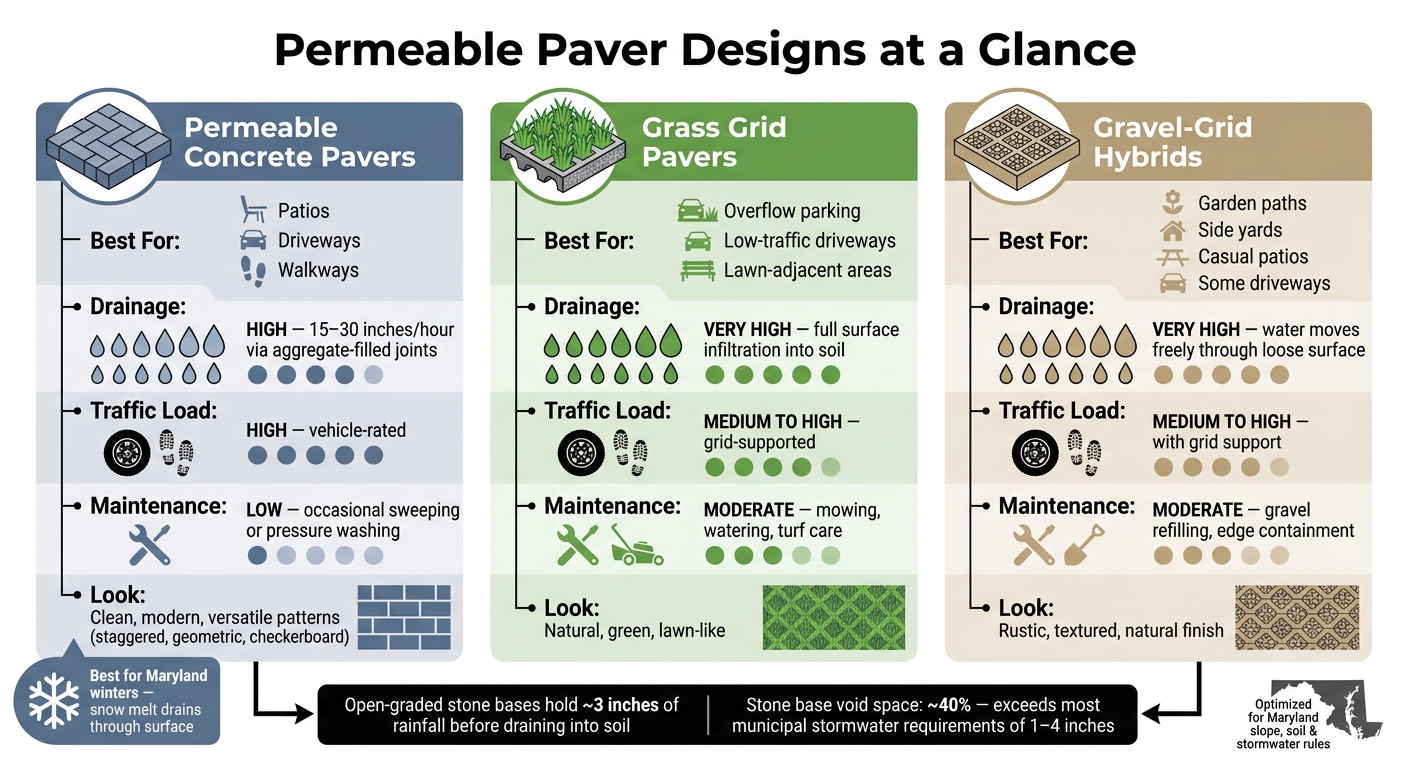
Permeable Paver Types Compared: Drainage, Traffic & Maintenance
Most home patio, walkway, and driveway projects come down to three main options: permeable concrete pavers, grass grid pavers, and interlocking or gravel-grid hybrid systems. Each one handles stormwater in its own way. Each also fits a different mix of traffic, style, and maintenance needs.
The right pick usually comes down to four things: load, drainage, appearance, and upkeep.
Permeable Concrete Pavers
For surfaces that need to do the heavy lifting, permeable interlocking concrete pavers are often the best fit. PICP works well for patios, main walkways, and residential driveways because it stands up to both foot traffic and vehicle traffic while still draining water well.
The drainage comes from the joints. These wider joints, usually around 1/4 inch, are filled with stone or a resin-bound material so water can move down into the base. PICP can move 15 to 30 inches of water per hour, and open-graded stone bases can hold about 3 inches of rainfall before that water drains into the soil [3].
From a design standpoint, PICP gives you a lot to work with. It fits clean layouts like:
- Staggered patterns
- Geometric patterns
- Checkerboard patterns
That mix of function and style is a big reason people use it for front-entry walks and driveways. In Maryland winters, there’s another plus: melting snow drains through the surface instead of sitting on top and turning into ice [2].
For driveways, use a two-part epoxy resin. For patios, wet-sweep compounds are a better match [3].
Grass Grid Pavers
If you want something softer-looking and the surface won’t take heavy daily traffic, grass grids make a lot of sense. These systems use a plastic or concrete grid that spreads vehicle weight across the surface while letting turf grow through the openings.
That makes them a good fit for overflow parking areas, low-traffic driveways, and spots that sit between hardscape and lawn. They don’t look as hard or built-up as standard pavers, which can be a big plus if you want the area to blend into the yard instead of standing out.
Drainage is one of their strong points. Since much of the surface stays open and planted, water can pass straight into the soil below. The tradeoff is simple: you’re still dealing with grass. That means mowing, watering, and general turf care are part of the job [1].
If the goal is a greener-looking surface that feels more connected to the surrounding landscape, grass grids are a strong option.
Permeable Interlocking and Gravel-Grid Hybrids
For paths, side areas, and more casual spaces, gravel-grid hybrids offer a nice middle ground. These systems pair a stable interlocking base, such as plastic grid cells or interlocking concrete units, with loose gravel or other infill materials.
The grid does the hard part behind the scenes. It keeps the gravel in place and helps stop it from shifting under foot traffic or vehicle pressure. That makes these systems a practical choice for garden paths, side yards, patios, and even driveways.
Drainage is strong because water moves freely through the loose surface. And from a style angle, there’s room to change the look. Colored stone or glass infill can add variety without making the surface feel too formal.
The main thing to watch is gravel movement. Without clear edging, the material can wander into the lawn or nearby planting beds. Defined borders made from metal, stone, or brick help keep everything in place [1].
Gravel-grid systems also tend to cost less upfront than PICP, which makes them appealing for larger areas or tighter budgets. The flip side is that they usually need more regular maintenance to stay level and neat [1].
Permeable Paver Designs Compared by Project Type
Design Comparison Table
This table gives you a side-by-side look at the three main systems based on drainage, looks, upkeep, and load strength. In Maryland, those differences matter. Stormwater rules and local soil can change which option makes the most sense.
| Feature | Permeable Concrete Pavers | Grass Grid Pavers | Gravel-Grid Hybrids |
|---|---|---|---|
| Best Use | Patios, driveways, walkways | Driveways, overflow parking, lawns | Walkways, sustainable driveways |
| Drainage Performance | High (15–30 in./hr via aggregate-filled joints) [3] | Excellent (full surface infiltration) | Excellent (loose aggregate surface) |
| Visual Style | Clean, modern, versatile colors and patterns | Natural, green, lush | Rustic, textured |
| Maintenance Level | Low (occasional sweeping) | Moderate (mowing and watering) | Moderate (gravel refilling) |
| Load Capacity | High (vehicle-rated) | Moderate to high (grid-supported) | Moderate to high (with grid support) |
Open-graded stone bases can store a lot of water during heavy storms. With about 40% void space, they can hold well above the 1–4 inches of rainfall many municipalities require [3].
Use the table above to line up each design with how your property will be used day to day.
Best Choices for Maryland Patios, Walkways, and Driveways
Maryland stormwater rules lean toward systems that keep runoff on-site [3]. For patios where people gather, PICP or an open-graded hybrid gives you a flat, furniture-ready surface and solid stormwater control. For walkways used every day, staggered PICP or pea-stone joints can help cut down on puddles and ice. For driveways, heavy-duty PICP with an 8-inch-or-deeper reinforced base, or a properly installed grass grid, can handle vehicle loads [1][3].
How to Choose the Right Permeable Paver Design
Match the Design to Slope, Soil, and Traffic Load
After you compare the main systems, the next step is simple: fit the design to the site. That means looking at slope, soil, and traffic load together.
Steep grades and soils that don’t drain well usually need a deeper aggregate base. In some cases, they also need a perforated pipe at the low point [3]. That extra support helps the system drain the way it should instead of turning into a problem after the first heavy rain.
Traffic matters too. Interlocking pavers give you a stable, low-maintenance surface for areas that get regular foot traffic or vehicle use. Grass grids can also handle vehicle loads, but they keep more of a planted look [1].
Plan for Maintenance, Drainage, and Curb Appeal
Once you’ve picked the surface, maintenance and edge control do a lot of the heavy lifting. Keep joints clear, sweep debris off the surface, and pressure wash when permeability starts to drop. For driveways, use a two-part epoxy resin jointing compound. Standard wet-sweep products tend to wear poorly under vehicle traffic [3].
If you go with gravel, clean edges make a big difference. Metal, stone, or brick borders help hold the material in place and keep the boundary neat [1]. And if you want the area to look a little more polished, geometric patterns, colored stone, or glass inserts can give it a cleaner custom feel.
Permeable paving also works best when it’s part of a bigger drainage plan. Pairing the installation with grading, French drains, or dry riverbeds helps manage runoff across the whole property, not just through the surface itself. That approach helps match the base to the site and drainage needs [3].
When to Work with Pro Landscapes MD

Some sites are more than a weekend project. If you’re dealing with steep grades, poor drainage, or stormwater requirements, it’s smart to bring in a pro before locking in the design.
Pro Landscapes MD is a good fit for those cases. Their grading, drainage, and environmental paver work can help match the base to the site before installation.
Conclusion: Choosing the Right Permeable Paver Design
Now that the main options are on the table, the right pick comes down to site conditions and how the space gets used every day. Permeable concrete pavers, grass grids, and gravel-grid hybrids each work best in different settings.
Permeable concrete pavers are a strong fit for areas with heavy traffic and dependable drainage needs. Grass grids work well when you want a planted look but still need to support vehicle loads. Gravel-grid hybrids make more sense for walkways and low-traffic paths where a more natural finish feels like the better match.
For Maryland properties, the choice should come down to slope, soil, drainage, traffic, and curb appeal. There’s also the upkeep side of the equation. Permeable concrete pavers need occasional joint cleaning or pressure washing. Grass grids need regular mowing and lawn care. Gravel-grid hybrids need defined edges and periodic gravel upkeep.
The simplest way to think about it: pick the system that fits both the site and the level of maintenance you can keep up with over time.
If grading or drainage could affect how the system performs, connect the paver design to the drainage plan from the start. For slope, drainage, or stormwater issues, Pro Landscapes MD can pair permeable paving with grading, French drains, or dry riverbeds to help prevent drainage problems later.
FAQs
Which permeable paver is best for clay soil?
Clay soil and other slow-draining, impermeable ground can make standard permeable installations tough.
There isn’t one best paver for this kind of site.
The better path is a system designed for the property itself. That means having a qualified professional assess the site and plan an installation that works with the soil’s limits, not against them.
Pro Landscapes MD provides expert landscaping and drainage services across central Maryland, including site assessments for properties with tricky soil conditions.
How long do permeable pavers usually last?
Properly installed permeable pavers usually last 20 to 30 years or more. In many cases, they last as long as – or longer than – standard asphalt.
Their modular design helps them handle freeze-thaw cycles without cracking as easily. It also helps prevent common problems like potholes. Pro Landscapes MD notes that professional installation and simple upkeep, like clearing surface sediment and debris, can keep them draining well for decades.
Do permeable pavers work in winter freeze-thaw cycles?
Yes. Permeable pavers work well in winter freeze-thaw cycles. Their modular design gives them a bit of flex, which helps them resist cracking when temperatures swing up and down.
They also let melting snow drain through the surface instead of pooling and turning into ice. In areas with harsh winters, you can even install radiant heating systems beneath the pavers to melt snow and ice on their own.
Chat with Us