









- bhavya gada
- No Comments
Gardening in small spaces can be challenging, but choosing the right plants can make all the difference. Adding plants with varied textures – fine, medium, or coarse – creates depth and visual interest, making compact areas feel more dynamic. For Maryland gardeners, selecting plants that thrive in local conditions, such as humid summers and diverse soil types, is key. Here’s a quick guide:
- Fine-textured plants like ornamental grasses (e.g., Blue Fescue) create an airy, light feel.
- Medium-textured plants like Dwarf Solomon’s Seal offer balance with layered foliage.
- Coarse-textured plants like Oakleaf Hydrangea anchor designs with bold, structured leaves.
- Opt for compact or columnar varieties to avoid overcrowding in tight areas.
- Match plants to light and soil conditions for better growth and minimal maintenance.
Whether it’s the cascading Japanese Forest Grass or the striking Coral Bark Japanese Maple, these plants can transform small gardens into layered, thriving spaces. Choose wisely and consider Maryland’s hardiness zones (5b–8a) for long-lasting results.
🌿Top Foliage Plants For Brilliant Texture & Contrast | Shrubs & Perennials To Elevate Your Garden ✨
sbb-itb-843f8be
How to Choose Texture Plants for Small Spaces
Picking plants for small gardens requires careful thought about their mature size, growth habits, and how well they match the site’s conditions. The key is proportion – stick to plants that stay under half the width of your planting bed to avoid a crowded or overgrown look within a few years [5].
"Choosing the right plant for a particular location requires some homework. The time you spend beforehand will pay off by greatly reducing plant ‘failures.’" – Cindy Weiner, UC Master Gardeners of Butte County [4]
For tight spaces, compact plants like dwarf varieties (under 4 feet) or columnar shapes are ideal. They provide height and interest without taking up too much ground space. These basics set the stage for looking at texture, size, and environmental factors.
Plant Texture Categories Explained
Understanding plant texture is essential for creating balance in small gardens. Texture generally falls into three categories: fine, medium, and coarse.
- Fine-textured plants, like ornamental grasses, have thin, delicate leaves that bring a light, airy feel.
- Medium-textured plants strike a middle ground, offering a balanced visual weight.
- Coarse-textured plants, such as hostas or hydrangeas, have bold, large leaves that act as focal points.
In small spaces, combining these textures can add depth without needing extra room. Fine-textured plants tend to visually "recede", making the space feel larger, while coarse-textured plants draw attention and anchor the design [4][5].
Placement matters, too. If you view your garden from a window, position coarse-textured plants closer to your home and finer-textured ones farther away to create depth. In very compact areas, use fine and medium textures for background interest, reserving one or two coarse-textured plants as focal points to keep the design cohesive [4].
Size and Growth Considerations
A plant’s growth habit plays a big role in its suitability for small spaces. Columnar forms – plants that grow taller than they are wide – are excellent for narrow paths or privacy screens. Trailing plants like sedum or clematis can soften hard edges like rock walls or pathways. Mounded plants, on the other hand, work well for edging beds and creating layers [2][3].
Make sure to check the mature size of any plant before committing. In extremely limited spaces, consider plants that serve dual purposes, like purple-leafed blueberries or columnar apple trees, which combine visual interest with edible rewards [3]. You can also use vertical gardening techniques, such as trellises or espalier, to make the most of wall space. Slim plants like Sky Pencil Holly or columnar apple trees are great for narrow strips, even as small as 3 feet wide [2][3].
"Structural plants help define garden areas, gives the eye a place to rest, and establishes a sense of place and order. Without structure, an outdoor space can be chaotic and lacking in focus." – Janet Loughrey, Proven Winners [6]
Next, it’s time to focus on the light and soil conditions to ensure your plants thrive.
Light and Soil Needs
Matching plants to the conditions they’ll face is a time-saver and reduces the risk of failure. Many high-texture plants, like Blue Fescue and sedums, need at least six hours of full sun each day to maintain their color and form [7]. For shady spots, such as north-facing areas or under eaves, go with shade-tolerant choices like Ajuga or Heuchera [7].
Good drainage is critical, especially in containers or small planting beds. Most plants suited for compact spaces need soil that drains quickly to avoid root rot [2][7]. When using pots or window boxes, always make sure they have drainage holes. Plants like sedum thrive with little care but can’t handle standing water [7].
If your garden includes hardscapes like stone walls or pathways, keep in mind that these surfaces can reflect heat. Choose heat-tolerant plants like Portulaca or Phlox for these areas [2]. Before planting, test your soil’s drainage, pH, and texture – these factors directly affect plant health in compact spaces [4][5].
Best Plants for Adding Texture to Small Spaces
These plants bring a variety of textures to small gardens, creating visual interest without overwhelming the space. From delicate, flowing foliage to bold, structured leaves, each plant offers something unique for compact areas.
Japanese Forest Grass (Hakonechloa macra)
This shade-loving grass forms soft, cascading mounds of bright green or golden leaves that drape gracefully over pathways or container edges. Perfect for woodland gardens or shaded corners, it thrives in moist, well-drained soil. Its fine-textured foliage creates a movement reminiscent of a flowing waterfall. At maturity, it typically grows to about 12–18 inches tall and wide.
Fountain Grass (Pennisetum alopecuroides)
Fountain Grass is known for its graceful, arching stems and feathery plumes that sway gently in the breeze, adding both texture and motion to sunny gardens. Blooming from summer to frost, its dramatic flower heads make it a standout feature. The ‘Rubrum’ variety thrives in zones 9–11 and reaches a height of 3–4 feet, making it a striking choice for compact spaces.
Dwarf Solomon’s Seal (Polygonatum humile)
This perennial brings a layered, horizontal texture to shady areas with its arching stems and oval leaves. In spring, small white bell-shaped flowers dangle beneath the stems, followed by blue-black berries. Ideal for shaded paths or under trees, it stays under 12 inches tall, making it perfect for tight spots.
Palm Sedge ‘Little Midge’ (Carex muskingumensis)
With its narrow, palm-like leaves arranged in whorls, this sedge creates a unique fine texture. It adapts well to sun or partial shade and prefers consistently moist soil, even tolerating wet conditions. Growing to just 8–12 inches tall, it forms neat clumps that work well as edging or for filling gaps between larger plants.
Oakleaf Hydrangea (Hydrangea quercifolia)
This shrub’s bold, oak-shaped leaves add a coarse texture that anchors small garden designs. In summer, it produces white, cone-shaped flower clusters, while its foliage turns rich shades of burgundy and orange in fall. The peeling bark adds winter interest. Dwarf varieties stay under 4 feet, making them ideal for compact spaces while offering year-round beauty.
Coral Bark Japanese Maple (Acer palmatum ‘Sango-kaku’)
This small tree features finely dissected leaves that form an elegant canopy. Its standout feature is its coral-red bark, which glows in the winter sunlight, adding a pop of color when gardens often look bare. While standard varieties can grow 15–20 feet tall, dwarf options are much smaller and are well-suited for containers or narrow spaces.
Fescue (Festuca glauca)
Blue Fescue forms tidy clumps of spiky, blue-gray foliage that contrasts beautifully with green plants. Drought-tolerant and thriving in full sun, it requires watering just 2–3 times per month during summer [8]. Staying under 12 inches tall and wide, it’s a great choice for edging, rock gardens, or containers, offering low-maintenance charm.
Little Bluestem (Schizachyrium scoparium)
This native grass adds a soft, wispy texture with its blue-green foliage, which turns a striking coppery-orange in fall. Perfect for full sun and drought-tolerant once established, it grows 2–3 feet tall with a slender profile, making it ideal for vertical interest in small beds. Fluffy seed heads appear in late summer and last through winter, adding texture year-round.
Goat’s Beard ‘Misty Lace’ (Aruncus ‘Misty Lace’)
This compact plant features feathery flower plumes above deeply divided foliage, creating a delicate texture. Thriving in partial to full shade with moist soil, it grows to 18–24 inches tall, making it perfect for small woodland gardens or shaded borders. Its creamy-white flower spikes bloom in early summer, adding subtle height without overwhelming other plants.
Each of these plants contributes to creating a layered and visually dynamic garden, even in the smallest of spaces. They offer a mix of textures and forms that can transform compact areas into lush, inviting landscapes.
Plant Comparison Chart
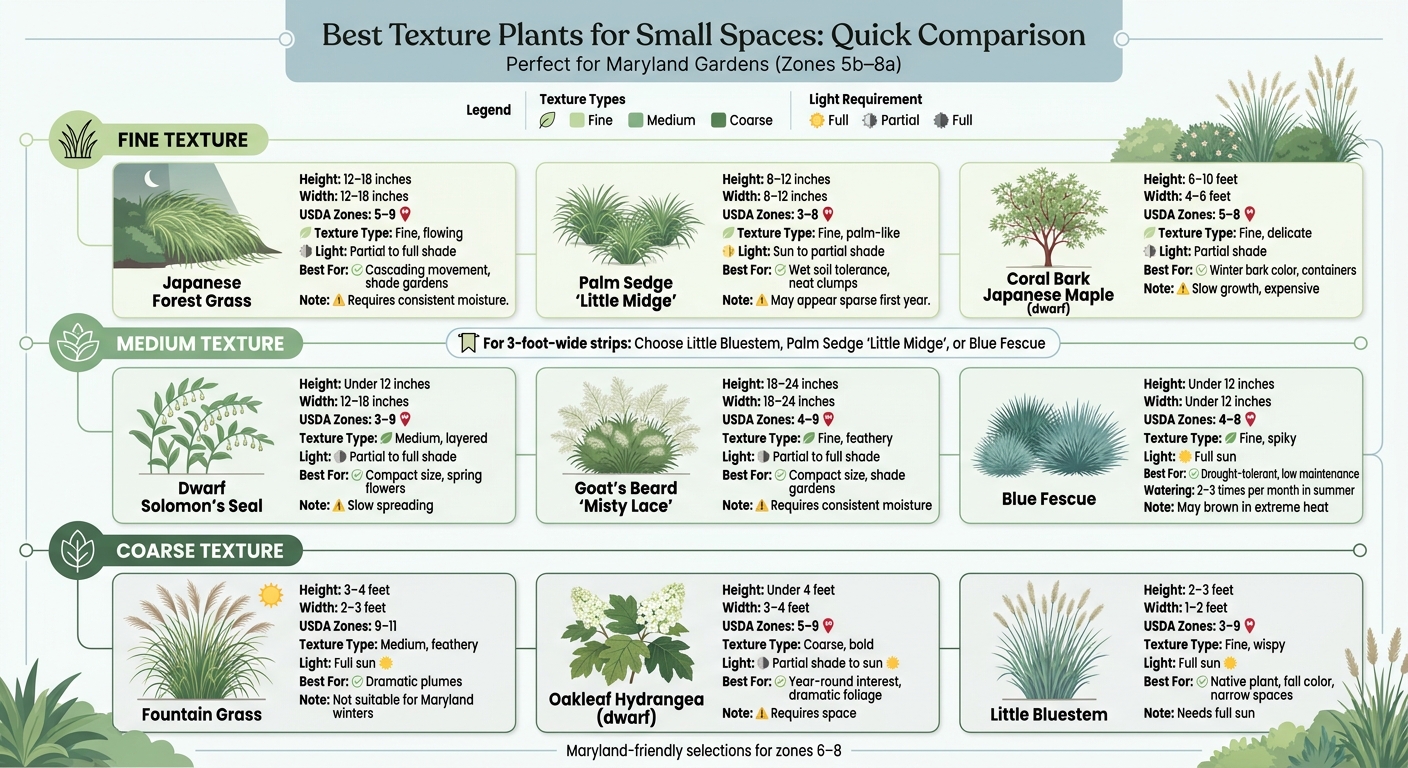
Texture Plants for Small Spaces: Quick Comparison Guide
The table below serves as a handy guide for choosing texture plants that thrive in small spaces. It provides a side-by-side comparison to help you make the most of your landscape while achieving a balanced, textured look.
Texture Plant Comparison Table
| Plant Name | Height | Width | USDA Zones | Texture Type | Light Needs | Advantages | Disadvantages |
|---|---|---|---|---|---|---|---|
| Japanese Forest Grass | 12–18 inches | 12–18 inches | 5–9 | Fine, flowing | Partial to full shade | Creates cascading movement; thrives in shade; adapts well to Maryland’s climate | Requires consistent moisture; slower to establish |
| Fountain Grass | 3–4 feet | 2–3 feet | 9–11 | Medium, feathery | Full sun | Features dramatic plumes | Limited hardiness; not suitable for Maryland winters |
| Dwarf Solomon’s Seal | Under 12 inches | 12–18 inches | 3–9 | Medium, layered | Partial to full shade | Compact size; spring flowers; tolerates cold | Slow spreading; dies back in winter |
| Palm Sedge ‘Little Midge’ | 8–12 inches | 8–12 inches | 3–8 | Fine, palm-like | Sun to partial shade | Tolerates wet soil; forms neat clumps; versatile placement | May appear sparse in the first year |
| Oakleaf Hydrangea (dwarf) | Under 4 feet | 3–4 feet | 5–9 | Coarse, bold | Partial shade to sun | Year-round interest with dramatic foliage and peeling bark | Requires space; may outgrow very tight areas |
| Coral Bark Japanese Maple (dwarf) | 6–10 feet | 4–6 feet | 5–8 | Fine, delicate | Partial shade | Striking winter bark color; elegant form; suitable for containers | Slow growth; can be expensive |
| Blue Fescue | Under 12 inches | Under 12 inches | 4–8 | Fine, spiky | Full sun | Drought-tolerant; low maintenance; needs minimal watering | May brown in extreme heat; short lifespan |
| Little Bluestem | 2–3 feet | 1–2 feet | 3–9 | Fine, wispy | Full sun | Native plant; attractive fall color; fits narrow spaces | Needs full sun; can flop without enough light |
| Goat’s Beard ‘Misty Lace’ | 18–24 inches | 18–24 inches | 4–9 | Fine, feathery | Partial to full shade | Compact size; stays below window height; thrives in shade | Requires consistent moisture; limited sun tolerance |
For planting strips that are 3 feet wide or less, consider options like Little Bluestem, Palm Sedge ‘Little Midge’, or Blue Fescue due to their vertical growth habits. Maryland gardeners, particularly those in zones 6–8, will find these plants well-suited to their climate. Many of the plants listed also thrive across broader zones, offering flexibility for different conditions. These choices allow you to achieve layered, textured landscapes even in compact spaces.
How Pro Landscapes MD Can Help Transform Your Outdoor Space

Creating a functional and visually appealing garden in a compact Maryland yard takes more than just picking a few pretty plants. Pro Landscapes MD specializes in designing outdoor spaces across Howard County, Montgomery County, Carroll County, Frederick County, Prince George’s County, and Baltimore County. They focus on maximizing both beauty and practicality, even in limited spaces.
Their process begins with a detailed site assessment, including soil testing and light analysis, to determine the best conditions for your plants. For example, layering Christmas Ferns with Blue Sedge can create a dynamic look, while their tailored designs ensure plant sizes fit perfectly for townhomes or smaller yards [9][1].
A key part of their philosophy is using at least 70% native plants, which not only support local biodiversity but also make maintenance easier. Popular choices include Northern Bayberry and Red Chokeberry, both of which thrive in the Maryland climate [9][1]. They also help homeowners navigate Maryland HOA regulations, ensuring your landscape aligns with local guidelines.
When it comes to installation, they strategically place larger plants near structures first to shield smaller ones and use organic matter along with a 3-inch mulch layer to retain soil moisture [9]. To make the most of smaller spaces, they recommend dwarf cultivars like ‘Ground Hug’ Black Chokeberry or ‘Gray Owl’ Dwarf Eastern Redcedar, which offer texture without overwhelming the area. By choosing compact, sun- and heat-tolerant plants that require little pruning, they create low-maintenance landscapes that stay beautiful year-round [2].
With this thoughtful approach, Pro Landscapes MD transforms even the smallest Maryland gardens into textured, functional, and enduring outdoor spaces.
Conclusion
Incorporating texture plants into a small garden space can completely transform it from a flat, uninspiring area into a visually dynamic and layered retreat. These plants add much-needed structure, whether it’s the soft, cascading look of Japanese Forest Grass or the striking winter stems of Coral Bark Japanese Maple.
Beyond their structural appeal, these plants bring year-round charm. Features like textured bark, seed heads, and evergreen foliage ensure your outdoor space remains inviting, even during Maryland’s colder months. Plus, they create visual balance, offering the eye a calm place to rest – an essential element in compact spaces where too many competing features can feel overwhelming.
If you’re looking to bring this vision to life, expert advice can make all the difference. Pro Landscapes MD specializes in helping central Maryland homeowners choose and install the perfect texture plants. With their detailed site evaluations and thoughtful plant placement – like using columnar varieties for tight spaces or dwarf cultivars for smaller gardens – they ensure your space is both beautiful and functional.
FAQs
How can I combine fine, medium, and coarse textures in a small garden without it feeling cluttered?
To create a visually appealing small garden without overwhelming the space, focus on balance and thoughtful spacing. Select plants with distinct shapes, such as upright or columnar varieties, to maintain a clean and structured look. Combine different textures by incorporating plants with varying leaf sizes and surfaces, but ensure each plant has enough room to showcase its unique form. This method adds depth and character while keeping the overall design neat and harmonious.
Which of these texture plants are best for containers on a patio or balcony?
Plants such as coleus, caladium, asparagus fern, and trailing verbena are fantastic choices for container gardening on patios or balconies. These plants not only thrive in compact spaces but also bring a mix of textures and bold, vibrant colors to your outdoor setup.
How can I easily check if my small bed or pot has good drainage?
To test if your pot has proper drainage, lift it and check if water flows easily from the drainage holes. Another method is to pour water onto the soil – if it drains out within a few minutes, the drainage is working well.
Chat with Us