









- bhavya gada
- No Comments
Maryland homeowners face unique water quality challenges, from rooftop contaminants like mercury and lead to urban runoff affecting the Chesapeake Bay. Choosing the right rainwater filtration system can protect your health, improve water quality, and reduce long-term costs. Here’s a breakdown of three effective options:
- Advanced Multi-Stage Filters: Remove up to 99% of contaminants like nitrates, lead, and chlorine. Costs range from $369.99 to $1,015+, with annual maintenance around $40.
- Compact UV Systems: Focus on killing bacteria and viruses without chemicals. Prices range from $300 to $5,000, with minimal upkeep (annual bulb replacement).
- Eco-Friendly Carbon Units: Improve taste and odor by removing chlorine and VOCs. Costs vary from $200 for under-sink systems to $5,000 for whole-house setups, with filters replaced every 3–12 months.
Each system addresses specific needs, whether you rely on municipal water or private wells. Start by testing your water to identify contaminants, then select a system tailored to your home.
Whole House Water Filter Install for my Rainwater Harvesting System
sbb-itb-843f8be
1. Advanced Multi-Stage Rainwater Filter
In Maryland, where water quality concerns are increasingly prominent, multi-stage filtration systems have become a standout solution. These systems are designed to tackle a wide range of contaminants, including nitrates, lead, arsenic, and cysts, by using a series of specialized filters [2].
Performance
Multi-stage systems often incorporate catalytic carbon, KDF media, and sediment filters, which not only improve filtration performance but also extend the lifespan of the system. These filters can remove up to 99% of chlorine and its byproducts [1][3]. For example, the SpringWell CF whole-house system achieved a 96% reduction in lead during lab tests [1]. Additionally, high-performance units have been shown to eliminate chlorine byproducts (THMs), reducing levels from 31.83 ppb to undetectable amounts [3].
For homes in Maryland that rely on well water, where iron and manganese levels are often high, specific stages in a 3-stage system can effectively reduce these minerals, preventing issues like staining and unpleasant odors [3]. Many modern systems also maintain strong water flow rates, delivering 15–20 GPM, which ensures sufficient water pressure even in large homes with multiple bathrooms [3]. Systems with reverse osmosis (RO) stages further enhance filtration by removing dissolved solids, boosting overall water quality. These impressive results make these systems a worthwhile investment for homeowners.
Cost
Cost is always a key factor for Maryland homeowners. Multi-stage systems vary widely in price based on capacity and features. For instance, the Waterdrop 3-Stage Whole House System is priced at $369.99 [3], while the SpringWell CF Whole House System starts at $1,015 or more [1]. Installation costs can range from $300 to $1,000, depending on whether professional assistance is needed or the system is DIY-friendly. Systems like the Waterdrop are designed for simpler homeowner installation.
While tank-based systems tend to have higher upfront costs, their long-term operating expenses are lower. The SpringWell CF, for example, boasts a 1 million-gallon capacity, translating to a cost of just $0.0013 per gallon [1]. Maintenance costs also vary, with whole-house tank systems requiring about $40 annually, while under-sink RO units can cost up to $200 per year [1].
Ease of Installation
Some systems are designed for DIY installation, while higher-capacity systems typically require professional plumbing assistance [3]. To ensure smooth installation, the setup area should provide at least 3–4 feet of clearance, which allows for easy access when replacing filter cartridges every 6–12 months [3].
Maintenance Requirements
Proper maintenance is essential for keeping these systems running effectively. Most filter cartridges need to be replaced every 3–12 months, depending on water quality and household usage [5]. For systems with UV components, the lamp must be replaced annually to maintain its ability to neutralize 99.99% of bacteria and viruses [4].
Water treatment expert Mike Stevens emphasizes:
"Select a system that sequences filters to target your specific contaminants" [3].
To ensure the best results, homeowners should conduct independent water testing to identify their specific needs, such as whether their water contains chloramine or chlorine [3]. For Maryland homes with well water, combining reverse osmosis with UV sterilization is often the best approach to address both chemical contaminants and potential bacterial issues [2].
2. Compact UV Filtration System
Compact UV filtration systems focus on one primary goal: microbial sterilization. Unlike multi-stage filters, these systems use ultraviolet light to neutralize harmful microorganisms like E. coli, salmonella, norovirus, and giardia. By damaging their DNA, UV systems effectively eliminate these pathogens without relying on chemicals, which means your water stays both odorless and tasteless[6].
Performance
UV filtration systems excel at targeting chlorine-resistant pathogens, with over 90% effectiveness against cryptosporidium[6]. In Maryland, counties such as Howard, Anne Arundel, and Baltimore frequently use these systems to protect residential water supplies. Their flow-through design ensures continuous sterilization without the need for a holding tank[6].
As Water Doctor puts it:
"UV sterilizers kill bacteria 24/7 without bleach, which creates ‘disinfection byproducts.’ Healthy water without chemicals is better for hair and skin!"[6]
Cost
Adding a UV stage to an existing filtration system typically costs between $300 and $1,000. For whole-house systems with UV components, prices range from $1,000 to over $5,000[7]. Maryland homeowners may want to explore potential rebates or tax incentives offered by local governments or utility providers for energy-efficient installations. Many modern UV systems now feature smart technology, including lamp life monitoring and smartphone maintenance alerts, which add convenience to their operation[7].
Ease of Installation
Some compact under-sink models are designed for easy, tool-free DIY installation. However, many Maryland homeowners opt for professional installation to ensure compliance with state plumbing codes[7]. A sediment pre-filter is a must-have before the UV unit to ensure clear water for effective sterilization. Additionally, if your home uses a water softener, it should be installed ahead of the UV system to avoid performance issues. Matching the UV unit to your home’s water flow rate is also critical to prevent any drops in water pressure[6].
Maintenance Requirements
UV lamps generally last around 9,000 hours, or roughly a year of continuous use[6]. Replacing the UV lamp annually and changing the pre-filter as needed is key to maintaining the system’s effectiveness. Beyond these straightforward tasks, the system runs automatically with minimal upkeep. To ensure it’s working properly, homeowners should test their water before and after installation to confirm it’s addressing local contaminants[7]. For added peace of mind, systems equipped with safety features – like solenoid valves – can automatically shut off water flow if the UV lamp fails or sterilization levels drop below safe thresholds[6]. These measures help maintain the system’s reliability while ensuring consistent water quality.
3. Eco-Friendly Carbon Filtration Unit
Eco-friendly carbon filtration units are often part of multi-stage systems that include sediment and UV pre-filters, making them an excellent choice for meeting Maryland’s varied water quality needs. These units use activated carbon to remove chlorine, unpleasant odors, and certain volatile organic compounds (VOCs) from rainwater, improving both taste and smell. In Maryland, such systems are commonly paired with sediment pre-filters and UV disinfection to ensure microbiological safety in the water supply[4][5].
Performance
Activated carbon filters work by using their porous structure to adsorb impurities like organic compounds, chlorine, pesticides, and specific VOCs as water flows through. In 2025, Maryland homeowners are leaning toward units with biodegradable and recyclable filter media, reusable cartridges, and access to filter recycling programs. Modular designs are another big plus, allowing users to tailor filtration combinations to suit the unique water conditions in their area – a practical feature in a state with differing water profiles across counties[7].
Cost
The cost of eco-friendly carbon filtration units depends largely on the type of installation.
- Under-sink models: Typically range from $200 to $500.
- Whole-house systems: Can cost anywhere from $1,000 to $5,000 or more.
- Integrated systems: Units like the VIQUA Arros 15-IHS22 are priced between $1,925.25 and $2,265.00.
- Mid-range systems: Pre-assembled options such as the Viqua VH410-F20 generally cost between $1,270.75 and $1,495.00[4].
Maintenance costs usually involve replacing carbon filter cartridges every 3 to 12 months, depending on water quality and usage[5]. Maryland homeowners should also explore potential rebates or tax incentives from local governments or utility companies for choosing eco-conscious or energy-efficient systems[7].
Ease of Installation
Modern carbon filtration systems are designed for flexible installation. Many under-sink and countertop models are DIY-friendly, featuring tool-free assembly. However, professional installation is often preferred to ensure compliance with Maryland’s plumbing codes[7]. Before selecting a system, it’s wise to obtain a local water report to determine whether activated carbon alone will suffice or if additional filtration stages are needed for specific contaminants. Residents can also take advantage of free water analysis services offered by local specialists to identify the best filtration setup for their needs[5][7].
Maintenance Requirements
Carbon filters need replacement every 3 to 12 months, depending on water usage and quality[7][5]. According to Water Doctor:
"The system itself, if well-maintained, can last for many years, often up to 10 years or more."[5]
Smart systems have made maintenance even easier by monitoring filter life in real time and sending notifications directly to your smartphone. With proper care, a whole-home filtration system in Maryland can last a decade or longer[5]. Companies like Water Doctor, which serves areas such as Anne Arundel, Howard, Baltimore, and Montgomery counties, offer professional design and installation services to ensure optimal system performance[5][8].
Pros and Cons
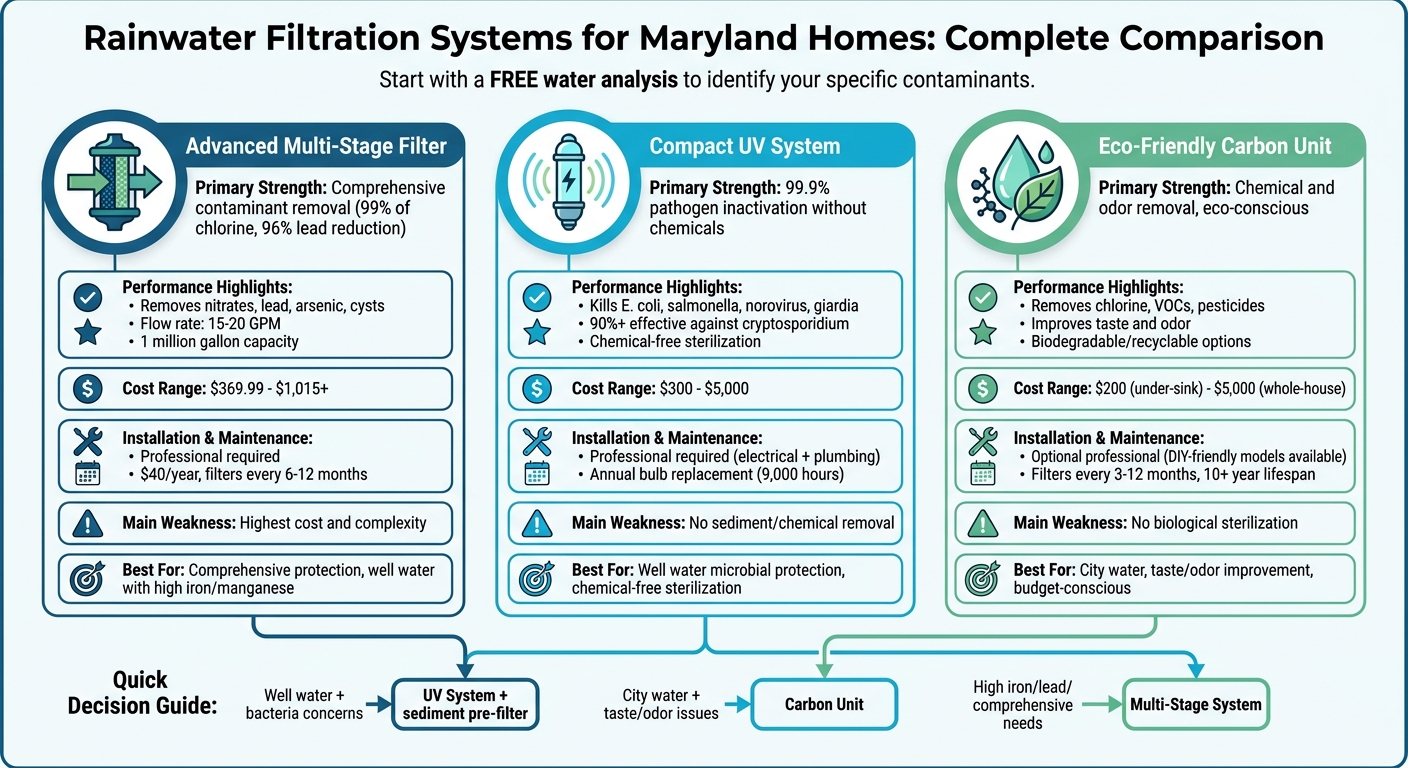
Comparison of 3 Rainwater Filtration Systems for Maryland Homes: Cost, Performance & Maintenance
This section takes a closer look at the strengths and weaknesses of each rainwater filtration system, focusing on performance, cost, and installation requirements.
The Advanced Multi-Stage Rainwater Filter provides robust protection by addressing sediment, chemicals, and microorganisms in one system. On the downside, it has the highest upfront cost, starting at around $1,015, and requires professional installation [1]. Maintenance costs are about $40 annually, with periodic filter replacements needed [9].
The Compact UV Filtration System is highly effective at biological safety, neutralizing 99.9% of bacteria and viruses without relying on chemicals. However, it needs both electrical and plumbing work for installation. Maintenance is minimal, requiring only an annual bulb replacement. Its limitation lies in the fact that UV systems don’t handle physical debris, odors, or chemical contaminants, often necessitating an additional filtration stage.
The Eco-Friendly Carbon Filtration Unit strikes a balance between performance and cost, with prices ranging from $200 for under-sink models to $5,000 for whole-house systems. It effectively removes chlorine, odors, and VOCs, with filters needing replacement every 3–12 months. When properly maintained, the system can last up to 10 years [5]. However, it doesn’t sterilize water biologically, which can be a drawback for some users.
| System Type | Primary Strength | Main Weakness | Professional Installation Required | Filter Replacements |
|---|---|---|---|---|
| Advanced Multi-Stage | Comprehensive contaminant removal | Highest cost and complexity | Yes | Every 6–12 months |
| Compact UV | 99.9% pathogen inactivation | No sediment/chemical removal | Yes | Annual bulb change |
| Eco-Friendly Carbon | Chemical and odor removal | No biological sterilization | Optional | Every 3–12 months |
For Maryland homeowners who might not be technically inclined, Dr. Jonathan Doyle highlights that multi-stage cartridge systems are a convenient choice. He describes them as "set-it-and-forget-it" solutions with "no huge-scale plumbing nightmares involved" [3]. This comparison underscores the importance of balancing filtration effectiveness with ease of installation and maintenance, helping Maryland residents choose the best system for their specific water quality needs.
Conclusion
Selecting the best rainwater filtration system for your Maryland home starts with understanding your water quality challenges and household requirements. Begin by conducting a free water analysis to identify common Maryland contaminants like iron, bacteria, and lead [2]. This step can save you from unnecessary expenses and missed issues.
When tackling specific water concerns, consider these options: For well water, a Compact UV system paired with a sediment pre-filter offers reliable microbial protection. With over 43 million Americans relying on unmonitored private wells [3], UV sterilization becomes a critical safeguard. For city water, an Eco-Friendly Carbon Unit is a smart choice, improving taste and odor while being budget-friendly. If high iron levels are an issue – a common concern in Maryland water systems – the Advanced Multi-Stage system effectively removes iron with its combination of sediment, carbon, and KDF media, all while protecting your plumbing and appliances.
Water Treatment Engineer Mike Stevens advises:
"Plan a multi-stage system to tackle your unique contaminants in sequence by size and by type." [3]
This method ensures that each filtration stage addresses a specific issue, avoiding the pitfalls of a one-size-fits-all approach. These tailored solutions are well-suited to Maryland’s distinct water challenges.
Additionally, Maryland’s weather patterns pose stormwater management concerns, making efficient water handling essential for protecting your property’s landscape and drainage systems. Follow installation guidelines for proper clearance and flow rates to maintain consistent water pressure throughout your home [3]. Professional installation, typically costing between $200 and $500, ensures seamless integration with your existing plumbing [3].
For expert assistance, consult Pro Landscapes MD to design and install rainwater filtration and drainage systems that meet Maryland’s specific needs.
FAQs
Is rainwater safe to drink in Maryland?
Rainwater in Maryland is suitable for tasks like irrigation and outdoor cleaning. However, it’s not advisable to drink it without proper treatment, as it can carry contaminants. If you plan to use rainwater for drinking, make sure it’s thoroughly filtered and treated to ensure safety.
Do I need a sediment pre-filter before UV filtration?
Yes, using a sediment pre-filter before your UV filtration system is a smart move. It removes larger particles such as dirt, rust, and silt, preventing them from clogging the system. This not only keeps the UV filter working efficiently but also helps extend its lifespan.
How do I choose the right filter stages after a water test?
After conducting a water test, choose filter stages that address the specific contaminants found. For instance:
- Sediment filters handle particles like dirt and sand.
- Activated carbon filters remove chlorine, odors, and certain chemicals.
- UV systems target bacteria and other microorganisms.
It’s a good idea to consult a filtration expert to create a system that matches your needs. Once your system is in place, make it a habit to test your water regularly to confirm it continues to effectively remove the impurities identified.
Chat with Us