









- bhavya gada
- No Comments
If I had to pick one shed base for most Maryland yards, I’d pick a compacted gravel pad. Maryland clay soil swells when wet, shrinks when dry, and the frost line can reach about 30 inches in colder inland areas. That mix can shift a shed, trap moisture, and leave doors stuck out of square.
Here’s the short version:
- Best overall: Compacted gravel pad
- Best for heavy-use sheds: Concrete slab
- Lowest-cost pick: Concrete blocks
- Middle-ground option: Paver base
- Light-duty choice: Pressure-treated wood skids
What I’d keep in mind before choosing:
- Clay soil holds water and moves through the year
- Low spots and runoff can keep the base wet
- Sites with more than 8 inches of slope often need extra support
- Prefab sheds with wood floors usually do best on a drained stone base
- Heavy sheds without floors may need concrete instead
How to Make a Gravel Shed Foundation | Ask This Old House

sbb-itb-843f8be
Quick Comparison
| Option | Drainage | Holds Level on Clay | Winter Performance | Best For |
|---|---|---|---|---|
| Compacted gravel pad | High | High | High | Most prefab sheds and most Maryland yards |
| Concrete slab | Low to medium | High if base prep is done right | High | Workshops, garages, sheds without built-in floors |
| Concrete blocks | Medium | Low | Low | Small, temporary sheds on flat ground |
| Paver base | Medium to high | Medium | Medium | Small sheds on flat, well-drained sites |
| Wood skid base | Low on bare ground | Low | Low | Light, temporary sheds with stone underlayment |
A few build details matter more than people think: use 3/4-inch clean crushed stone (#57 stone) for gravel bases, compact it in 2-inch lifts, and extend the pad 12 inches past the shed on all sides. If water already sits in the area after rain, I’d fix grading or drainage first. Otherwise, even a good base can fail early.
If you want the simple answer, it’s this: match the base to your shed weight, floor type, drainage, and slope before you build.
Why Maryland Soil Conditions Matter for Shed Foundations
Clay Soil and What Happens After Rain
Maryland clay is expansive soil. After rain, it swells. As it dries out, it shrinks again. That constant back-and-forth is a big reason foundation choice matters.
Clay also holds water around the base of a shed, pulls moisture upward, and shifts with the seasons. All of that puts stress on whatever sits above it. Over time, that movement can rack the frame and jam doors. If a foundation holds moisture or can’t handle soil movement, it tends to fail sooner.
Low Spots, Runoff, and Poor Drainage
Clay drains slowly, so water often pools near the base. If your shed sits in a low spot or at the bottom of a slope, rainwater and storm runoff collect right where the foundation meets the ground.
That standing water can wick into floor joists and create the kind of damp conditions that speed rot and attract termites [1]. A flat base with no drainage path keeps the shed floor wet. And when water sits there day after day, wood floor systems don’t last as long.
Freeze-Thaw Movement in Winter
In colder inland parts of Maryland, the frost line reaches about 30 inches deep [1]. When trapped water freezes, it expands. That can lift the foundation or push it out of level.
Foundations that sit above the frost line and hold moisture underneath are hit the hardest. The result is pretty simple: a tilted shed and doors that suddenly won’t close.
How Shed Size, Weight, and Slope Affect Your Foundation Choice
Slope changes what kind of foundation makes sense. Sites with more than 8 inches of grade change need added support or a different foundation type [1].
In those cases, you usually have two paths:
- Build up the pad with pressure-treated perimeter timbers
- Switch to a pier-style foundation
The point is to match the foundation to the site. On clay soil, that usually means choosing an option that drains well, stays level, and handles seasonal soil movement.
1. Compacted Gravel Pad
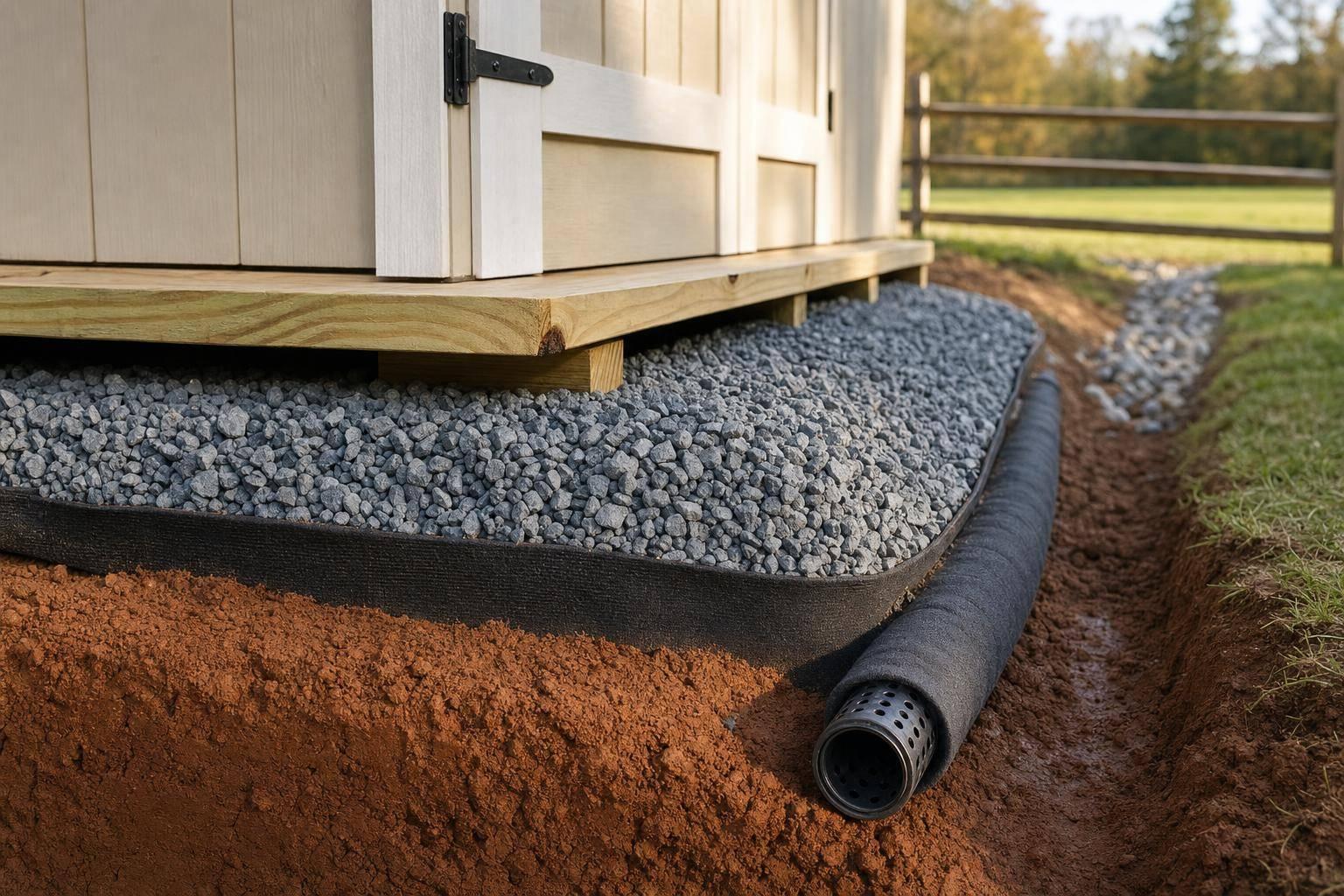
A compacted gravel pad is often the best all-around base for sheds in Maryland. It drains well, stands up to clay-heavy soil, and helps keep moisture away from the shed floor. In many Maryland yards, it’s the most practical first pick because it handles seasonal soil movement better than many other base types.
Drainage Performance
Crushed stone has thousands of small gaps that let water move down and away from the shed base. That helps keep the floor system drier and lowers the chance of rot [1][3].
For this kind of pad, use 3/4-inch clean crushed stone, usually #57 stone. Skip round river rock, pea gravel, and sand. They move around under weight and don’t compact into a firm base. It also helps to place stabilization fabric under the pad so clay doesn’t work its way up and clog the drainage layer [1][4].
Stability on Clay-Heavy Soil
A compacted stone pad spreads the shed’s weight more evenly and tends to stay level better than loose fill [1][5].
The key is compaction. Loose gravel can shift after the shed is installed, which leads to uneven settling. Use a plate compactor, and install the stone in 2-inch lifts to make the base firmer [1][2]. Extend the pad 12 inches beyond the shed on all sides to help stop edge washout. So if you have a 10×12 shed, plan for a 12×14 pad [1].
Freeze-Thaw Durability
A free-draining gravel base tends to move as one unit during freeze-thaw cycles. That helps cut down on uneven heaving, which is the kind of movement that can make shed doors stick or throw the frame out of square during Maryland winters [1].
Best Shed/Site Use
Gravel pads are a strong fit for prefab sheds with built-in floors and for yards with only a mild slope. They do well on flat to gently sloped sites. Gravel is also generally seen as a pervious surface, which may matter if your property falls under Maryland’s Chesapeake Bay Critical Area impervious surface limits [1][4].
If your shed needs a more permanent, rigid base, the next option is a concrete slab.
2. Concrete Slab
A concrete slab is one of the most rigid and permanent foundation choices on this list. It makes sense when the shed doesn’t have a built-in floor and needs to hold heavy weight, like a workshop, garage, or equipment storage area. If a gravel pad won’t give you enough rigidity, a slab delivers the most strength. In Maryland clay, though, it only works well when the base is prepped the right way.
Drainage Performance
Concrete sheds water, which means the site needs to slope away from the slab. Grade the soil around it so water moves off, and add a swale or French drain in low spots. A 6-mil moisture barrier under the pour also helps cut down on ground moisture wicking up through the slab [1][2][4].
Stability on Clay-Heavy Soil
Don’t pour concrete straight onto clay. Start with a compacted stone sub-base instead. Remove the topsoil, then install 4 to 6 inches of compacted #57 crushed stone before the pour [1][2]. For larger structures, add 30-inch-deep perimeter footings [1].
Freeze-Thaw Durability
For Mid-Atlantic weather, specify 3,500 to 4,000 PSI concrete so the slab can better handle freeze-thaw cycles [2][4]. A 7-day wet cure after the pour can also cut shrinkage cracks by 50% [2][5].
Best Shed/Site Use
Concrete is the better fit for permanent, heavy-use structures, not prefab sheds with wooden floors. Near the Chesapeake Bay, concrete also counts as an impervious surface, which can limit what you’re allowed to build under Critical Area rules [1].
If a slab feels too rigid or too expensive for the site, the next option is concrete blocks.
3. Concrete Blocks
Concrete blocks, also called deck blocks, are the lowest-cost option in this group. But on Maryland clay, they tend to struggle.[1][3] If a concrete slab feels too rigid or too expensive, blocks can be a budget backup – but only if the ground is stable.
Drainage Performance
Blocks lift the shed floor off the ground, which helps a bit. The problem is that they don’t direct water away from the site. On Maryland’s clay-heavy soil, water can sit around the blocks for days after a rainstorm. That leaves the underside of the shed damp long after the weather clears.[1]
If you go with blocks, add landscape fabric and a layer of compacted 3/4-inch clean crushed stone underneath. Setting blocks right on bare dirt or grass can speed up rot.[1][3]
Stability on Clay-Heavy Soil
Maryland clay swells when it’s wet and shrinks when it dries out. That movement matters because each block settles on its own. On this kind of soil, one block may shift more than another, which can twist the frame and knock doors out of alignment.[1][3]
Freeze-Thaw Durability
Because blocks sit above the frost line, they’re still exposed to freeze-thaw movement. In practice, that means individual blocks can lift and tilt as the seasons change. Re-leveling is often part of the deal.[1]
Best Shed/Site Use
Concrete blocks make sense only for small, temporary sheds on flat, well-drained sites.[1] They’re a poor match where Maryland clay and seasonal soil movement come into play. If you want a base that stays more even over time, the next option is a paver base.
4. Paver Base
A paver base lands in the middle on both cost and durability. It sits between concrete blocks and a slab. The two main options here are solid pavers and permeable grid pavers.
Drainage Performance
Drainage is where the difference shows up fast. Solid pavers don’t handle clay-heavy soil very well, while permeable grid pavers let water move through instead of collecting on the surface.[3]
The basic setup is pretty straightforward:
- Excavate 6 to 8 inches of topsoil
- Lay geotextile fabric
- Install and compact 3/4-inch clean crushed stone[1][5]
That drainage layer helps a lot. Still, clay can swell and shrink as moisture changes, and that ground movement can shift the base anyway.
Stability on Clay-Heavy Soil
Clay movement can cause pavers to shift or sink over time. When that happens, the shed doesn’t just look a little off. Uneven settling can rack the frame and throw the doors out of line.[1][3]
Freeze-Thaw Durability
Because paver bases sit at grade, they’re still exposed to frost heave in Maryland’s roughly 30-inch frost zone.[1][3] In plain terms, winter freeze-thaw cycles can push the base up and leave it uneven.
Best Shed/Site Use
A paver base is usually best for small sheds under 100 square feet on flat, well-drained ground.[1][3] For larger sheds, a frost-proof foundation is often the better fit.[3][6]
It also pays to check the shed warranty before you build. Many warranties call for a base that drains properly. If you want something simpler, the next option uses pressure-treated skids.
5. Pressure-Treated Wood Skid Base
A skid base is the lightest option here, and it still needs a stable layer underneath to work well. Most prefab sheds use pressure-treated skids – usually 4×4 or 4×6 timbers under the floor frame. But skids are not a full foundation, which means the material below them does a lot of the heavy lifting.
Drainage Performance
On Maryland clay, skids set right on bare dirt or grass tend to stay wet after rain. That damp ground can speed up rot, even with pressure-treated wood.[1]
Moisture is the first issue. Movement comes next.
Stability on Clay-Heavy Soil
Wet clay can cause skids to sink and shift unevenly as time goes on. And when the wood sits right against the ground, termite risk goes up too.[1]
Freeze-Thaw Durability
Because skids sit on grade, freeze-thaw cycles can push them up and throw the shed out of square.[1]
Best Shed/Site Use
A skid base makes the most sense for small or temporary sheds on level sites that drain well. Even then, it should sit over 4 to 6 inches of compacted #57 stone plus stabilization fabric. It’s also smart to check the manufacturer’s foundation rules before installation.[1][3]
That tradeoff leaves skids as the most limited option on this list.
Side-by-Side Comparison of All 5 Foundation Options
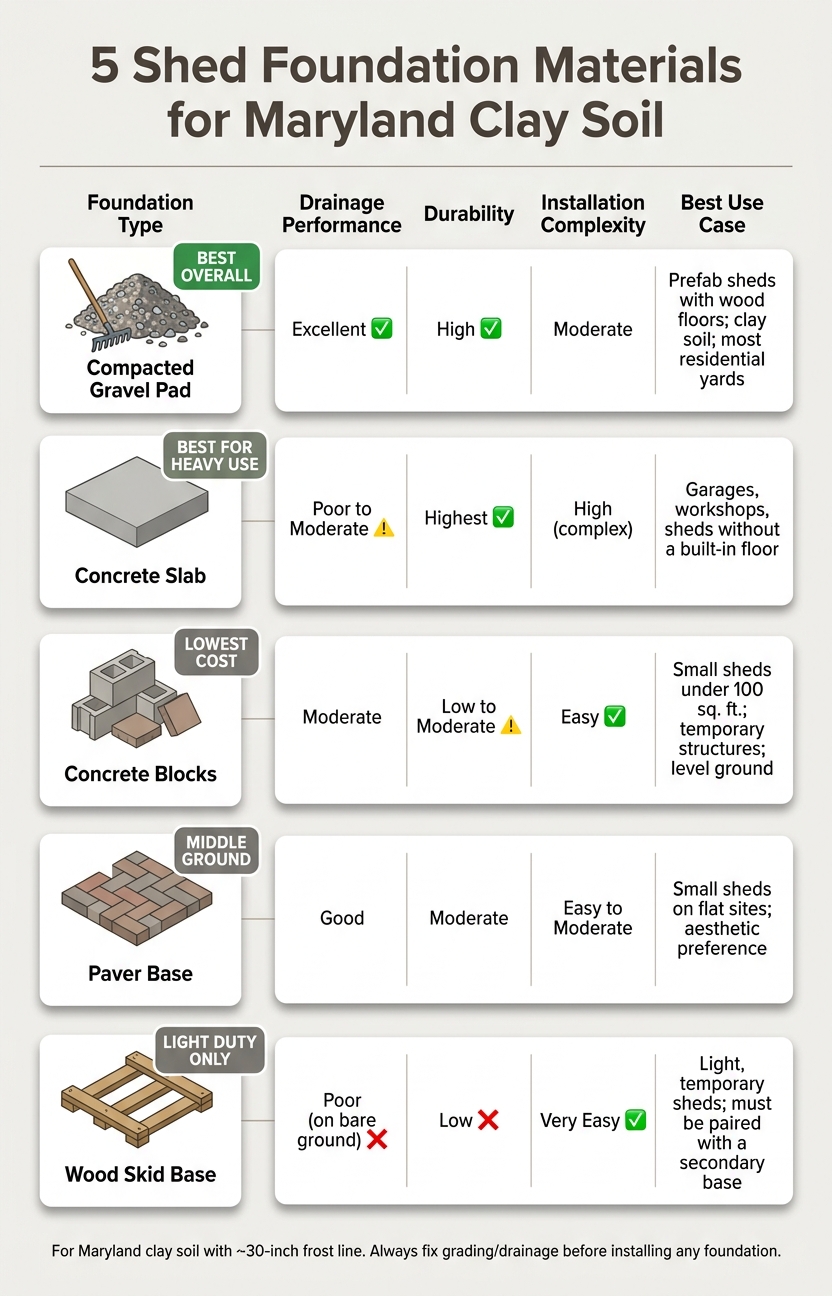
5 Shed Foundation Materials for Maryland Clay Soil: Side-by-Side Comparison
Use this quick comparison to match each material to your site conditions. The table below compares drainage, durability, installation difficulty, and best use.
| Foundation Type | Drainage Performance | Durability | Installation Complexity | Best Use Case |
|---|---|---|---|---|
| Compacted Gravel Pad | Excellent | High | Moderate | Prefab sheds with wood floors; clay soil; most residential yards [1][3] |
| Concrete Slab | Poor to Moderate | Highest | High | Garages, workshops, sheds without a built-in floor [1][3] |
| Concrete Blocks | Moderate | Low to Moderate | Easy | Small sheds under 100 sq. ft.; temporary structures; level ground [1][3] |
| Paver Base | Good | Moderate | Easy to Moderate | Small sheds on flat sites; aesthetic preference [3] |
| Wood Skid Base | Poor (if on bare ground) | Low | Very Easy | Light, temporary sheds; must be paired with a secondary base [1][3] |
For most Maryland yards with clay-heavy soil, compacted gravel tends to handle drainage and seasonal ground movement better than the other options on this list. In plain English, if your yard holds water or shifts through the year, gravel usually gives you fewer headaches. Pick the base that fits your drainage, slope, and shed type.
When to Fix Grading or Drainage Before Installing a Shed Base
No foundation material lasts long on a site that holds water. If the ground stays wet, it will wear down any base you install. That’s why grading and drainage come first, before you put down stone, a slab, or timbers.
Before you choose a base, inspect the ground and look for warning signs like these:
| Site Warning Sign | What It Means for Your Foundation |
|---|---|
| Standing water after rain | Soil is saturated; base will soften and settle |
| Soggy grass near the planned footprint | Poor subsurface drainage; rot and termite risk |
| Yard slopes toward the shed site | Runoff will collect at the foundation edge |
| Shifted or uneven existing pavers nearby | Frost heave or soil instability already active |
If the site stays wet or uneven, it can rack a shed out of square over time. [1] So if your yard shows any of the signs above, fix those problems first.
For low spots or runoff paths, install a French drain or swale before building the base. If the slope has more than 8 inches of grade change, level the site with cut-and-fill or retaining timbers so the foundation stays level. [1][3]
Once the site is fixed, picking the right foundation gets a lot easier.
Conclusion
For most yards in Maryland, a compacted crushed-stone gravel pad is the best all-around base. It drains well, deals with freeze-thaw movement, and helps keep wood off damp clay.
Use concrete when you need a permanent, load-bearing floor for a garage or workshop.
Blocks, pavers, and pressure-treated skids work best for small, light sheds on flat, well-drained sites.
Start by fixing drainage and grading. Then match the base to the shed’s size and weight.
FAQs
How thick should a gravel shed pad be?
A proper gravel shed pad should be 4 to 6 inches deep. For the best stability and to help prevent settling, use 3/4-inch clean crushed stone and compact it well in 2-inch lifts.
The pad should also extend 12 inches beyond the shed on all sides. That extra foot helps control erosion and gives the structure better support over time.
When do I need a concrete slab instead of gravel?
Choose a concrete slab if your shed needs a permanent floor, will serve as a workshop or garage, or has to hold heavy equipment or vehicle traffic.
A gravel pad is a good fit for most standard storage sheds because it drains better and usually costs less. If you’re in Maryland, check local building codes too. Larger sheds may need a permanent foundation or frost-proof footings.
Should I fix drainage before building a shed base?
Yes. In Maryland, fixing drainage first is critical. Heavy clay soil tends to hold water, then swell and shrink as conditions change. That can lead to rot, mold, and termite problems.
A properly prepared compacted gravel pad made from crushed stone helps move water away and keeps your shed off ground moisture. Pro Landscapes MD provides grading, land leveling, and drainage services across central Maryland and Washington, DC.
Chat with Us