









- bhavya gada
- No Comments
If you want a dry Maryland slope to stop washing out, plant layered roots, not turf.
I’d keep it simple: use low shrubs for surface cover, larger shrubs for spread, and trees for deep root support. For this type of site, the article points to fragrant sumac, winged sumac, shrubby St. Johnswort, pasture rose, sweetfern, chestnut oak, white oak, Virginia pine, pitch pine, serviceberry, and eastern redbud as the main picks.
Here’s the short version:
- Best low shrub for smaller banks: Fragrant sumac ‘Gro-Low’
- Best shrubs for bigger slopes: standard fragrant sumac, winged sumac, shrubby St. Johnswort
- Best for thin or worn soils: pasture rose and sweetfern (sweetfern is not for heavy clay)
- Best long-term trees: chestnut oak and white oak
- Best trees for rocky, rough ground: Virginia pine and pitch pine
- Best smaller trees: serviceberry and eastern redbud
- Best layout: plant in contour rows, not straight up and down
- Best mulch depth: 2–3 inches
- Best watering schedule during dry weather: deep watering every 10–14 days for the first 2 growing seasons
- Best extra step on steep slopes: use jute, coir, or straw blankets on slopes steeper than 3:1
One point stood out to me: the article makes it clear that plant choice alone is not enough. If the slope is slumping, staying wet at the base, or taking runoff from above, you may need grading, drainage, or a retaining wall first.
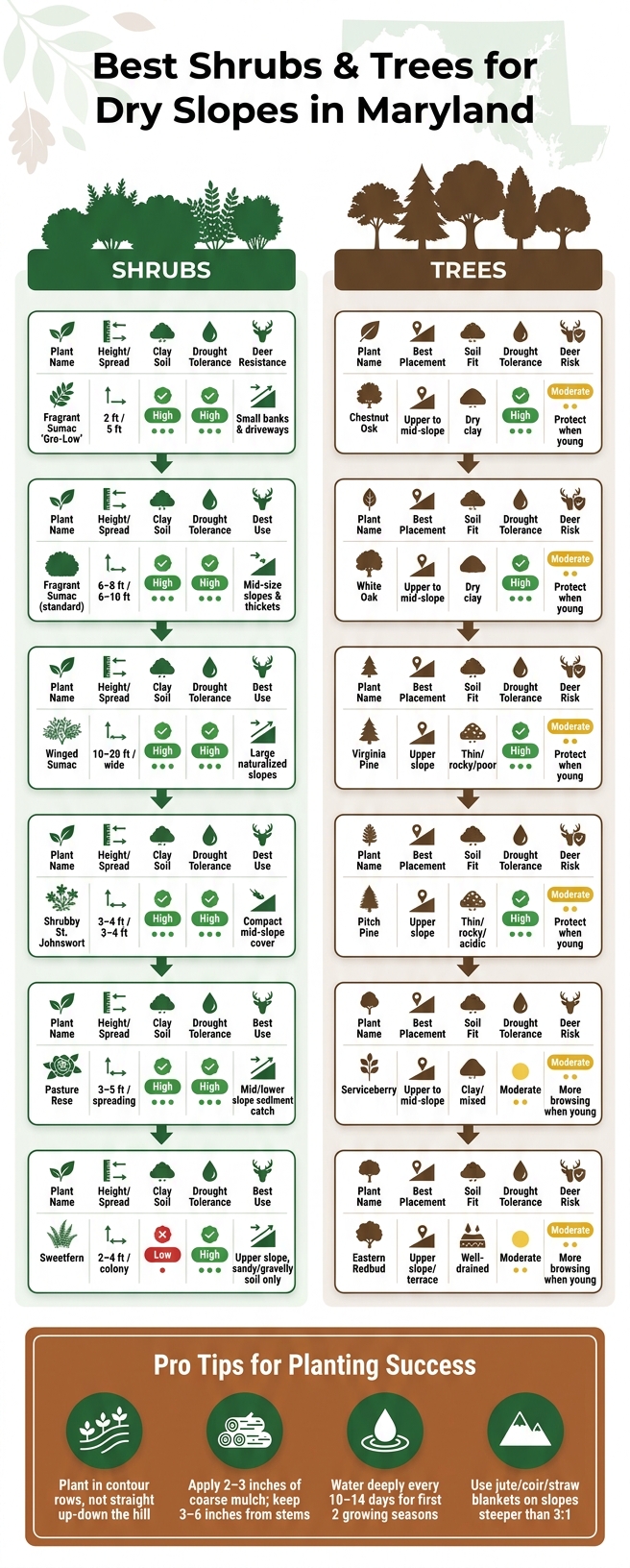
Best Shrubs & Trees for Dry Slopes in Maryland: Quick Reference Guide
Quick comparison
| Plant | Best use | Clay soil | Dry soil | Deer pressure |
|---|---|---|---|---|
| Fragrant sumac ‘Gro-Low’ | Small banks, low spread | High | High | Holds up well |
| Fragrant sumac | Mid-size slopes, thicket cover | High | High | Holds up well |
| Winged sumac | Large naturalized slopes | High | High | Holds up well |
| Shrubby St. Johnswort | Compact mid-slope cover | High | High | Holds up well |
| Pasture rose | Mid/lower slope colonies | High | High | Holds up well |
| Sweetfern | Upper slope, sandy or gravelly soil | Low | High | Holds up well |
| Chestnut oak | Long-term upper/mid-slope support | High | High | Young trees may need protection |
| White oak | Long-term upper/mid-slope support | High | High | Young trees may need protection |
| Virginia pine | Rocky upper slopes | Mixed/poor soils | High | Young trees may need protection |
| Pitch pine | Acidic, rocky upper slopes | Mixed/poor soils | High | Young trees may need protection |
| Serviceberry | Smaller tree for upper/mid-slope | Moderate | Moderate | More browsing when young |
| Eastern redbud | Small tree near upper slope or terrace edge | Moderate | Moderate | More browsing when young |
My takeaway: if your slope is dry, sunny, clay-heavy, and deer-prone, the safest plan is a mixed planting. Use shrubs to cover the surface early, then let trees add deeper root support over time.
sbb-itb-843f8be
Best Shrubs for Dry Slopes in Maryland
Fragrant Sumac, Winged Sumac, and Shrubby St. Johnswort
University of Maryland Extension guidance recommends these three shrubs for dry, sunny slopes in Maryland [15][16][17].
Fragrant sumac (Rhus aromatica) is one of the top low, spreading shrubs for slope stabilization in Maryland. The cultivar ‘Gro-Low’ stays about 2 feet tall and spreads around 5 feet, so it works well on residential banks and along driveways. It spreads by stolons, forms dense ground cover, and helps hold disturbed soil in place [14][3][18][22][26].
The standard form is much larger, growing 6–8 feet tall with a spread of 6–10 feet. That makes it a better fit for bigger embankments where you want a taller thicket.
Winged sumac (Rhus copallinum) grows much larger, reaching 10–20 feet, and it spreads hard by suckers. Over time, it forms colonies that tie together dry, rocky, or disturbed ground [19][23][25]. It fits best on large slopes or naturalized areas where that aggressive spread is a plus, not a problem.
Shrubby St. Johnswort (Hypericum prolificum) brings a compact shape and bright yellow summer flowers. It grows 3–4 feet tall, handles dry clay or compacted soil, and forms dense mid-height cover [2][4][7]. Space plants about 3–4 feet apart on-center if you want them to fill in and create continuous cover within a few years [20][21][24].
Pasture Rose, Sweetfern, and Other Native Shrubs for Thin or Clay Soils
When slopes are thinner, rockier, or more worn down, it often makes sense to shift from broad-cover shrubs to plants that spread through rhizomes or colonies.
Pasture rose (Rosa carolina) spreads by rhizomes and forms dense, thorny colonies that can catch sediment on mid- and lower-slope areas. It handles clay, loam, sand, and shallow rocky soils, and it grows across conditions from occasionally dry to very dry [8][10][11].
Sweetfern (Comptonia peregrina) is a nitrogen-fixing shrub with lots of underground rhizomes and deep roots [5][6][12]. Use it on dry, acidic, sandy, or gravelly upper slopes. Heavy clay is a bad match [9][6][13].
Both shrubs appear on the University of Maryland’s deer-resistant native woody plants list [1].
Use the table below to match each shrub to slope position, soil type, and deer pressure.
Shrub Comparison Table: Drought, Clay Soil, Deer Pressure, and Soil-Holding Strength
| Shrub | Mature Height / Spread | Sun Needs | Clay-Soil Tolerance | Drought Tolerance | Deer Resistance | Primary Erosion-Control Role |
|---|---|---|---|---|---|---|
| Fragrant sumac ‘Gro-Low’ (Rhus aromatica) | 2 ft / 5 ft | Full sun to filtered shade | High | High | High | Low, spreading stolon cover; binds slope surface on residential banks |
| Fragrant sumac (standard) | 6–8 ft / 6–10 ft | Full sun to filtered shade | High | High | High | Mid-slope thicket; fibrous roots hold embankments |
| Winged sumac (Rhus copallinum) | 10–20 ft / wide-spreading | Full sun | High | High | High | Large slope stabilizer; aggressive suckering fills banks |
| Shrubby St. Johnswort (Hypericum prolificum) | 3–4 ft / 3–4 ft | Full sun | High | High | High | Compact mid-slope cover; dense growth reduces runoff |
| Pasture rose (Rosa carolina) | 3–5 ft / spreading | Full sun | High | High | High | Mid- and lower-slope; rhizome colonies catch sediment |
| Sweetfern (Comptonia peregrina) | 2–4 ft / colony-forming | Full sun | Low | High | High | Upper slope on thin, sandy soils; rhizomes knit bare ground |
Shrubs help lock down the surface fast, while trees bring deeper, longer-term support for the slope.
Best Trees for Long-Term Slope Stability
Shrubs usually lock down the surface first. Trees come in later with deeper, slower root support. For the best long-term result, stick with native species that can handle heat, drought, and clay after they get established.
Oaks and Pines for Deep Roots and Dry-Site Durability
Chestnut oak (Quercus montana) and white oak (Quercus alba) are the top long-term picks for dry, sunny slopes. Once established, both do well in dry, well-drained clay soils. They also develop broad, spreading roots that help hold soil deeper in the slope.
Place these trees on the upper or middle part of the slope, where their mature canopy has room to spread without running into buildings, utilities, or retaining walls.
Virginia pine (Pinus virginiana) and pitch pine (Pinus rigida) make sense when soils are thin, rocky, or acidic. Their year-round cover helps soften the force of rainfall, which matters on exposed slopes. They also fit spots where oaks would get too large or where the site is rougher and less forgiving.
Pines do not live as long as oaks, so they work best as part of a mixed planting instead of carrying the whole slope on their own.
Serviceberry, Redbud, and Other Smaller Trees for Upper and Mid-Slope Planting
Serviceberry (Amelanchier spp.) and eastern redbud (Cercis canadensis) are better fits when you need a smaller tree. Serviceberry often grows in multi-stem clumps and spreads by suckering, which slowly expands root coverage and helps bind soil over time [27]. It can handle clay or mixed-texture soils as long as drainage is decent, and it pairs nicely with lower shrubs on the slope.
Redbud fits best near the upper slope or along terrace edges, where its smaller mature size helps avoid problems later.
Deer browsing is a bigger issue for young serviceberry and redbud, but young oaks and pines may need protection too. If deer are active on the site, temporary cages or repellents during establishment are worth using.
Use the table below to line up tree size, placement, and deer risk with the slope.
Tree Comparison Table: Size, Rooting Habit, Drought Tolerance, and Deer Risk
| Tree | Best Placement | Soil Fit | Drought Tolerance | Planting Role | Deer Note |
|---|---|---|---|---|---|
| Chestnut oak (Quercus montana) | Upper to middle slope | Dry, well-drained clay soils | High | Broad, spreading roots for long-term soil hold | Young trees may need protection during establishment |
| White oak (Quercus alba) | Upper to middle slope | Dry, well-drained clay soils | High | Broad structural roots that stabilize soil over time | Young trees may need protection during establishment |
| Virginia pine (Pinus virginiana) | Upper slope | Thin, rocky, or poor soils | High | Year-round cover helps reduce rainfall impact | Young trees may need protection during establishment |
| Pitch pine (Pinus rigida) | Upper slope | Thin, rocky, or acidic soils | High | Year-round cover helps reduce rainfall impact | Young trees may need protection during establishment |
| Serviceberry (Amelanchier spp.) | Upper to mid-slope; near planting beds | Clay or mixed-texture soils with adequate drainage | Moderate | Multi-stem clumps and suckering increase root coverage over time | More deer browse when young |
| Eastern redbud (Cercis canadensis) | Upper slope; terrace edges | Best in well-drained sites | Moderate | Small tree for upper-slope or terrace-edge plantings | More deer browse when young |
Layer these trees above shrubs and groundcovers so roots occupy more of the slope, from the surface down into deeper soil.
How to Plant and Establish Shrubs and Trees on a Maryland Slope
Choosing the right plants is only half the job. On a slope, the first year of planting often decides whether the soil stays put or starts to wash.
Plant in Contour Rows and Layer Shrubs With Trees
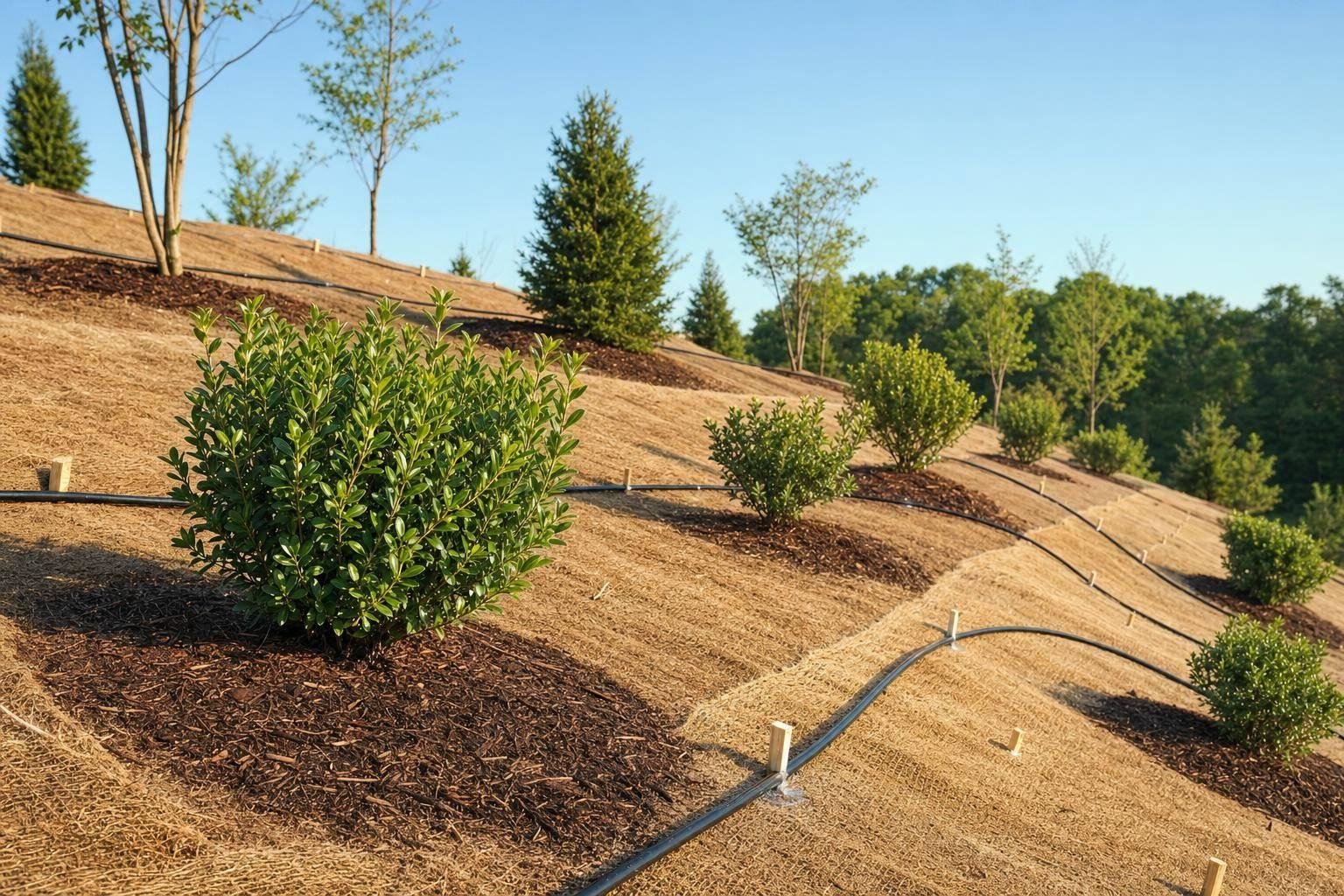
Once you’ve picked your plants, installation does the heavy lifting. Plant shrubs and trees in contour rows, not in lines that run straight up and down the hill. That simple shift helps spread water across the slope instead of letting it race downhill.
Stagger plants within each row so you get better coverage and more root overlap. Think of it like laying bricks instead of stacking blocks in a single line. Place low shrubs on the steepest parts of the slope, and use larger shrubs and trees on the gentler areas.
Use Mulch, Erosion Blankets, and Deep, Infrequent Watering
Apply 2–3 inches of coarse shredded hardwood mulch or bark over the planted area, but keep it 3–6 inches away from stems and trunks. The goal is to cover most of the soil so raindrops don’t pound bare ground and start washing it away.
Fine or lightweight mulch tends to slide on a hill. Coarse, interlocking material stays in place better, which is why it works well here.
On slopes steeper than 3:1, mulch by itself often won’t cut it. Use a biodegradable jute, coir, or straw blanket instead. Trench the top edge, overlap the seams, and cut planting holes where needed.
For the first two growing seasons, water deeply every 10–14 days during dry weather, but only after the top 4–6 inches of soil feel dry. That pattern helps roots go down instead of hanging near the surface.
When Grading, Drainage, or Retaining Walls Are Part of the Fix
Sometimes planting isn’t the first step. If runoff is causing the trouble, deal with that before anything goes in the ground.
If a slope slumps after rain, or if water pools at the bottom and soaks upward, the issue is structural, not plant-related. In that case, grading, drainage work, or retaining walls need to come first.
French drains and dry riverbeds can redirect runoff from above before it saturates the soil. Dry creek beds can also slow runoff and help more water soak in. Retaining walls create stable terraces, which makes planting on steep grades much easier. Pro Landscapes MD handles grading, French drains, dry riverbeds, retaining walls, and planting across central Maryland.
Conclusion: Choosing the Right Plant Mix for a Dry Maryland Slope
A dry, sunny Maryland slope doesn’t have to stay bare. The best planting mix usually combines low shrubs for surface cover with deeper-rooted trees for long-term support. It also helps to protect young plants with tree tubes or cages so deer don’t wipe out new growth.
The big job is matching the plants to the site. Soil type, sun exposure, and deer pressure all matter. In Maryland, clay soil and deer browsing can make or break a planting plan, so it pays to build around tough species that fit the spot.
If runoff or grading is the main issue, handle that first. Maryland allows low-impact landscaping, and HOAs can’t require turf-only landscapes. Pro Landscapes MD can fix drainage, grading, and retaining-wall problems before planting.
Once the slope is stable, the right plant mix can fill in, hold soil in place, and get easier to care for as the roots grow in.
FAQs
How do I choose plants for different parts of the slope?
Assess sun exposure, soil type, moisture, and slope steepness first. That groundwork matters more than people think. A south-facing slope is usually dry and sunny, while a north-facing slope tends to stay cooler and hold more moisture.
You should also check drainage before planting. An easy way to do that is to dig a 12-inch hole and see how fast it absorbs water.
For planting, use a layered approach. Put trees at the top and bottom, shrubs in the middle, and groundcovers in the open gaps. This setup helps the slope hold together and keeps the planting from looking random.
When picking plants, go with native species that have deep or fibrous roots. Leave enough room for each plant’s mature size, not just how it looks in the pot. And once everything is in the ground, water it consistently for the first two growing seasons.
What should I do if the slope stays wet or keeps slumping?
First, check drainage and soil stability again. Saturated clay soil can lose strength fast, which changes what the site can handle.
A simple way to test drainage is to dig a 12-inch hole, fill it with water, and see if it drains within 24 hours. You should also test the soil pH.
If water is still sitting in the hole after that, fix drainage before you plant anything. In the meantime, protect the soil right away with erosion-control cloth or geotextile mats.
To deal with runoff, use systems like:
- French drains
- berms
- swales
- box-and-pipe systems
How long does it take slope plantings to control erosion?
A multi-layered planting system usually needs several months to a year before it starts doing a good job of stabilizing a slope. It usually takes several growing seasons to reach full effect, as the plants settle in and build stronger root systems.
During that period, you’ll need to stay on top of a few basics: deep watering, mulching, and regular monitoring. Plants need time, and slopes don’t always wait.
For support right away while the plants mature, it’s smart to pair planting with structural options like rock barriers, retaining walls, or biodegradable erosion-control blankets.
Chat with Us