









- bhavya gada
- No Comments
A Maryland rain garden works best in a spot that gets runoff, drains within 24 to 36 hours, has partial to full sun, and sits well away from your house, utilities, septic areas, and big tree roots. If one inch of rain falls on a 1,500-square-foot roof, it can send out 900+ gallons of runoff, so where you place the basin matters more than most people think.
If I were picking a site, I’d check these six places first:
- Low spots that collect runoff
- Areas downhill from roof downspouts
- Spaces beside driveways and walkways
- Open lawn areas with good sun
- Gently sloped yard sections
- Safe zones that meet setback rules
I’d also rule out any spot that:
- stays wet for more than 36 hours
- sits within 10 feet of a house foundation
- is within 5 feet of patios, sidewalks, or driveways
- is near septic systems or large tree roots
- sits on slopes steeper than 12%
A fast yard check can save a lot of work later: watch runoff during a storm, run an infiltration test, check sun through the day, and call 811 before digging.
Rain Garden Step 1: Selecting a Site
sbb-itb-843f8be
Quick Comparison
| Site Type | Best Use | Main Risk | Typical Fit |
|---|---|---|---|
| Low spots | Yard runoff already gathers there | Can stay soggy too long | Good if drainage is fast enough |
| Downhill from roof runoff | Handles heavy roof water | Too close to house or poor soil | Often one of the top picks |
| Beside driveways/walkways | Takes pavement runoff | Compacted soil, salt, heat | Good with the right plants |
| Open lawn areas | Easy layout and sun | May not get much runoff | Good if flow crosses the lawn |
| Gently sloped sections | Uses natural grade | Erosion on steeper slopes | Good on 2%–10% slopes |
| Setback-safe zones | Keeps distance from hazards | May be less direct for runoff | Best for safety and long-term use |
Bottom line: I’d choose the spot that balances runoff flow, soil drainage, sun, slope, and setbacks instead of picking the lowest point by default.
What Makes a Good Rain Garden Site in Maryland
In Maryland, a good rain garden site follows the way runoff already moves, drains at a decent pace, gets enough sun, and stays a safe distance from structures. There are five things to check: runoff flow, soil drainage, slope, sunlight, and setbacks.
Natural Runoff Flow and Shallow Drainage Paths
The best spot is usually where stormwater already wants to go. That might be a shallow swale, a low dip in the yard, or an area that catches sheet flow from a roof or driveway.
A simple rule: put the garden between the runoff source and the place where water leaves your property, like the street or a storm drain. If a spot stays soggy for days after rain, skip it. That usually means the soil drains too slowly.
Soil That Drains Within 24 to 36 Hours
A rain garden in Maryland needs soil that drains well enough to empty within 24 to 36 hours after a storm. That helps limit plant stress and mosquito breeding [1][2][4].
Because many Maryland soils have a lot of clay, a percolation test is a must. Once you’ve tracked where the runoff goes, the next step is to make sure the ground can soak it in.
If the soil doesn’t pass a basic drainage test, that doesn’t automatically kill the project. In many cases, you can replace the top 18 to 24 inches with a planting mix made of about 65% sand, 20% topsoil, and 15% compost to get drainage into a workable range [4].
Gentle Slope and Workable Grading
A slope of 2% to 10% works best. That’s enough grade to guide water into the basin without sending it in too fast.
Once the slope gets steeper than 12%, the site usually becomes a poor fit. Fast-moving runoff can scour the basin and wear away the soil [4][3].
Sun Exposure and Plant Performance
Rain gardens do best in partial to full sun. Morning sun is especially helpful because it dries the basin sooner after a storm.
Heavy shade from buildings, or a north-facing spot with limited light, can slow drying [1]. That may not sound like a big deal at first, but over time it can make the area harder to manage.
Safe Setbacks From Structures and Systems
Drainage and sunlight matter, but safe spacing matters just as much. A rain garden should be kept away from your house, hardscaping features, utility lines, and septic areas. Here’s the minimum spacing for Maryland residential sites [1][3][4]:
| Feature | Minimum Setback |
|---|---|
| House foundation or retaining wall | 10 feet |
| Patios, garages, sidewalks | 5 feet |
| Gas utility lines | 36 inches |
| Other utility lines (water, electric) | 18 inches |
| Septic tanks or drain fields | Avoid |
Place the garden downhill from the foundation, never uphill. Also stay out of large tree root zones.
Quick Site Check Before You Dig
Before you break ground, take a few minutes to walk the yard. That small step can save you a headache later. A spot might look good on paper, but the yard tells the real story. Use these checks to see how the area handles runoff, drainage, sun, and required setbacks before you dig.
Watch Runoff During a Real Storm
The best time to judge water flow is during an actual storm. Watch where water comes in, where it travels, and where it sits. Pay attention to what spills off the roof, moves across the driveway, and gathers on the lawn.
A spot that takes runoff from those areas can work well, as long as it doesn’t stay soggy for days.
Run a Basic Infiltration Test
Dig a hole that’s 12 inches wide and 24 inches deep. Fill it twice, then time how long the second round takes to drain. Keep sites that empty within 36 hours [1].
Check Sun and Shade Through the Day
Look at the site in the morning, at midday, and again in the late afternoon. Pick a spot with partial to full sun. That usually helps the area dry out faster and supports stronger plant growth.
Confirm Setbacks and Call Before Digging
Double-check the setback distances listed above. Then call 811 before you dig so underground gas, water, and electric lines can be marked at no cost [1].
When to Get Professional Site Help
Some yards need more than a quick walkthrough. If you’re dealing with erosion that won’t stop, poor grading, slow drainage, or water damage around the house, it makes sense to bring in a pro.
Pro Landscapes MD handles drainage, grading, and stormwater management across central Maryland for homeowners dealing with tougher site conditions.
Once your site clears these checks, you can compare it with the placement options below.
1. Low Spots That Collect Runoff
Low spots are usually the first place to look. Why? Because they already do part of the job by collecting water.
That said, not every low area is a good fit. A low spot only works if it catches runoff and then drains within 24–36 hours. If water sits there too long, the soil is too slow for a rain garden.
Runoff Capture Potential
Pick a low spot that intercepts runoff before the water leaves your yard. You’ll also want enough space for water to overflow safely during heavier storms.
Drainage Within 24–36 Hours
Check how long the area stays wet after rain. If it’s still soggy for days, that spot drains too slowly for a rain garden.
Setbacks
Before you dig, check the standard setbacks:
- 10 feet from foundations or retaining walls
- 5 feet from patios, driveways, and sidewalks
- Clear of septic areas and major roots
If a low spot drains too slowly or sits too close to a structure, move on to the next likely option: areas below roof runoff.
2. Areas Downhill From Roof Runoff
If you don’t have a natural low spot, the next place to check is the area below roof runoff.
Downspouts send a lot of water to one spot, which makes them one of the best sources for a rain garden on Maryland homes. Put the garden below a downspout, and you can catch that water before it leaves your property.
Runoff Capture Potential
The job here is simple: intercept roof runoff and let the soil filter it. You can move downspout water with a pipe, a swale, or a rock-lined channel [1]. At the inlet, add river rock to spread the flow and help prevent erosion [4].
Drainage Within 24–36 Hours
This step matters a lot in Maryland because many soils have a high clay content. To test the site, dig a hole 1 foot wide and 2 feet deep, fill it with water, and time how long it takes to drain all the way. Then refill the hole within 12 hours and time the second round. For a standard rain garden, both tests need to drain within 36 hours [3][1].
If the water sits too long, cross that spot off your list for a standard rain garden.
Setback and Site Safety
Keep the basin at least 10 feet from any foundation or retaining wall. That buffer helps protect the structure from seepage and soil washout. If you plan to run a pipe from the downspout to the garden, slope it away from the house by at least 2% and use rigid pipe for the first 10 feet [4].
Before you dig, call 811 (Miss Utility) so buried lines can be marked [1]. It also makes sense to stay away from septic systems, drain fields, and the root zones of large trees.
If roof runoff isn’t the right fit, the next spots to look at are hardscape edges like driveways and walkways.
3. Spaces Beside Driveways and Walkways
If roof runoff is already handled, the next spot to check is the edge of your hardscape.
Driveways and walkways can be strong places for a rain garden because they shed water FAST. And that runoff often carries road oil, sediment, and winter salt toward storm drains and nearby streams. Catching that water early gives the soil and plants a chance to filter some of that pollution before it moves downstream.
Runoff Capture Potential
The goal is simple: give runoff a clear path into the basin.
You can direct water from the hardscape with a shallow swale or an inlet. A swale or pipe can move runoff from the pavement to the basin, and a stone inlet helps spread the flow and cut down on erosion.
Once the runoff has a route into the basin, check how fast the soil drains.
Drainage Within 24–36 Hours
Driveway edges are often compacted, which means water may drain slowly. Dig a hole 1 foot wide and 2 feet deep, fill it with water, and see whether it drains within 36 hours [1]. If it takes longer, the site is not a fit for a standard rain garden.
Sun Exposure
Areas next to driveways often get full sun, and that can work well for many rain garden plants. Still, watch out for strong afternoon sun from the west. Heat reflecting off pavement can stress plants that are more sensitive [1]. Native plants that can handle full sun are the safer pick.
Setback and Site Safety
Keep the rain garden at least 5 feet from the driveway or walkway slab [1]. Along salted pavement, use salt-tolerant native plants [1].
If the driveway edge fails the drainage test, shift your search to open lawn areas with better soil and sun.
4. Open Lawn Areas With Partial to Full Sun
If roof edges and driveway margins don’t work, open lawn is often the next best place to look. These spots tend to get partial to full sun, and they often have enough room to meet setback rules without forcing the garden into a tight corner.
Runoff Capture Potential
Open lawns often sit between hard surfaces like roofs and driveways and the street or storm drain. That makes them a common path for stormwater. In plain terms, water has to go somewhere, and lawn areas often end up in the middle of that route.
The best way to check is simple: walk the yard during a storm and watch where the water moves. You want to confirm that runoff regularly crosses that spot [1].
Once you’ve confirmed the lawn gets runoff, the next step is to see whether the soil can drain it fast enough.
Drainage Within 24–36 Hours
Run a drainage test. Keep only the sites that drain within 24 to 36 hours [1].
If the water sits too long, the basin can stay soggy and cause plant or drainage problems. After the site drains, check how much light it gets. Sun helps the basin dry out between storms.
Sun Exposure
Partial to full sun is best. More light helps the basin dry faster and gives you more planting options, especially for native plants [1].
A shady lawn might still look good on paper, but if it stays wet for too long, it can turn into a headache.
Setback and Site Safety
Give the garden enough space from nearby structures and utilities:
- Keep it at least 10 feet from foundations and 5 feet from patios or sidewalks.
- Call 811 before digging.
- Stay 36 inches from gas lines and 18 inches from other utilities [1][3].
You’ll also want a clear overflow path for heavy storms. If the basin fills up during a big rain, the extra water needs a safe place to go.
If the lawn doesn’t pass these checks, move on to gently sloped sections of the yard.
5. Gently Sloped Yard Sections
If your yard already has a usable grade, a gentle slope can do a lot of the work for you. Water tends to move downhill on its own, so you may not need much regrading to guide runoff into the basin.
Runoff Capture Potential
With a gentle slope, runoff can flow into the basin naturally instead of needing heavy reshaping. Slopes in the 2% to 10% range tend to work best [1][3][4].
Set the basin a bit uphill from the lowest spot, then build a compacted berm on the downhill side to hold the water in place [1][4]. If the slope is steeper than 12%, the area will usually need terracing or grading help from a pro [1][3].
Drainage Within 24–36 Hours
This setup only makes sense if the soil drains within 24 to 36 hours. If drainage is slow, you can improve infiltration by mixing in 2 inches of compost worked into 12 inches of depth [3].
Sun Exposure
South-facing slopes dry out the fastest. West-facing slopes get the hottest afternoon sun [1].
Setback and Site Safety
Keep the basin away from structures and utilities, and call 811 before you dig. If you’re sending a downspout into the garden through piping, keep at least a 2% downward slope away from the house [4].
If the slope seems workable but the spot is too close to a building or utility line, shift the basin to a safer area.
6. Safe Zones Away From Foundations, Septic Systems, and Large Tree Roots
Where you put a rain garden matters just as much as where you don’t put it. A spot may look perfect at first glance, but if it sends water too close to your house, septic system, or big tree roots, it can lead to costly damage.
This is the stage where you rule out problem areas before you get too far into planning.
Drainage Within 24–36 Hours
Make sure the site drains within 24 to 36 hours. If water sits longer than that, pick another area with better drainage.
Setback and Site Safety
Keep the basin out of all no-go zones, including areas near:
- Foundations
- Patios, garages, and sidewalks
- Gas lines and other utilities
- Septic systems
- Large tree roots
Call 811 before you dig so underground lines can be marked. Also stay away from visible surface roots and major root zones.
Use the table below to compare the remaining site options.
Rain Garden Site Comparison Table
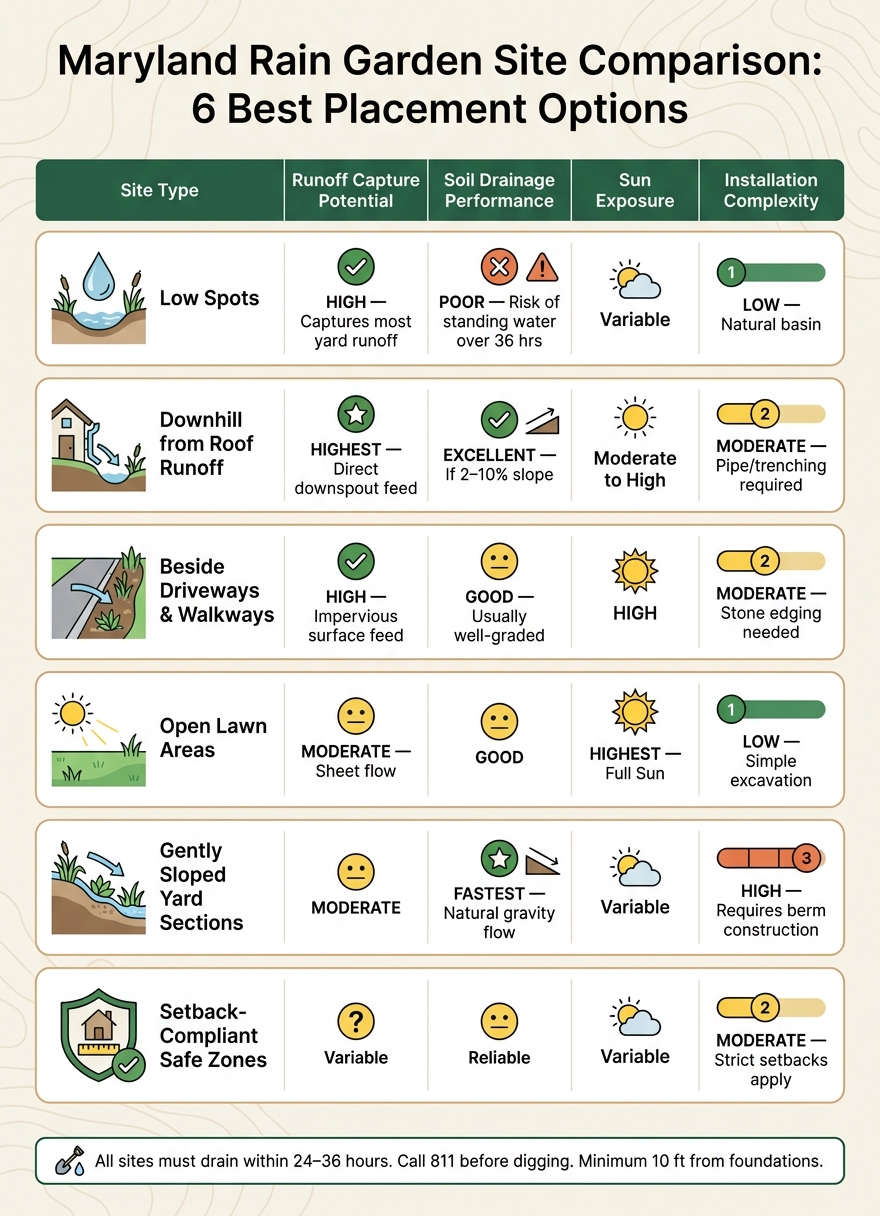
Maryland Rain Garden Site Comparison: 6 Best Placement Options
Not every spot in your yard will work the same way. Some areas collect runoff with almost no effort. Others drain better but take more work to build out.
Use this table to compare the six site types across Maryland’s main site conditions.
| Site Type | Runoff Capture Potential | Soil Drainage Performance | Typical Sun Exposure | Installation Complexity |
|---|---|---|---|---|
| 1. Low Spots | High (captures most yard runoff) | Poor (Risk of standing water over 36 hours) [2][3] | Variable | Low (Natural basin) |
| 2. Downhill from Roof Runoff | Highest (Direct downspout feed) | Excellent (If 2–10% slope) [4][2] | Moderate to high | Moderate (Pipe/trenching) |
| 3. Beside Driveways & Walkways | High (Impervious surface feed) | Good (Usually well-graded) | High | Moderate (stone edging) |
| 4. Open Lawn Areas | Moderate (Sheet flow) | Good | Highest (Full Sun) | Low (Simple excavation) |
| 5. Gently Sloped Yard Sections | Moderate | Fastest draining (Natural gravity flow) | Variable | High (Requires berm) |
| 6. Setback-Compliant Areas | Variable | Reliable | Variable | Moderate (Strict setbacks) |
This gives you a quick side-by-side look at drainage, sun exposure, and build difficulty. If you want the easiest install, low spots and open lawn areas often stand out. If your main goal is catching the most runoff, areas downhill from roof runoff usually lead the pack.
Before you pick a final location, review the placement mistakes below.
Common Maryland Placement Mistakes to Avoid
Once you’ve narrowed down your site options, it’s time to cross off the mistakes that can cause trouble later.
Placing the Basin Too Close to the House
This is the big one. A rain garden placed too close to the house can push water toward the foundation instead of away from it.
Keep rain gardens at least 10 feet from foundations and retaining walls, and 5 feet from patios, driveways, and sidewalks. If you place the basin any closer, water can end up in basements or crawl spaces and can also weaken retaining walls. The garden should sit downhill from the foundation, not level with it and definitely not above it.
Ignoring Slow-Draining Clay Soils
Heavy clay or compacted soil can turn a rain garden into a puddle that just won’t clear. That’s a problem.
If water does not drain within 36 hours, standing water can create mosquito breeding conditions and lead to root rot [1][2]. If the site drains slowly but still clears within that 36-hour window, amend the soil with compost to a depth of 12 inches [3].
Building on Steep Slopes Without Proper Support
A steep slope might look workable at first glance, but looks can fool you. Slopes steeper than 12% usually need professional grading or a different stormwater solution.
Picking Dense Shade Without Checking Dry-Out Time
Dense shade can slow drying and shrink your plant choices. Before you commit to a spot, test how long it takes the area to dry out.
Cutting Into Tree Roots or Buried Utilities
Digging in the wrong place can cause damage fast. Avoid working near large trees or disturbing major root zones. Stay outside those root areas, and call 811 before digging.
Conclusion
The best Maryland rain garden sites follow the path of runoff, drain within 24 to 36 hours, get enough sun, and stay well away from foundations, utilities, and septic systems [1]. If a spot misses even one of those checks, it’s smart to move on and find a better location.
If the soil doesn’t pass a perc test or the slope is too steep, that area may need a different stormwater fix or another drainage plan.
Before you dig, run a perc test, watch how water moves through your yard during an actual storm, and confirm your setbacks. That prep work can save a lot of hassle later. And if the site feels tricky, getting expert help can save time and help you avoid costly missteps. Pro Landscapes MD can help evaluate drainage and placement before digging begins.
The right site makes planting, upkeep, and long-term performance much easier.
FAQs
How big should a rain garden be?
A rain garden is usually sized at 20% to 30% of the area that drains into it, like runoff from your roof or driveway. For most homes, that means a rain garden should be at least 75 square feet.
Depth is often between 3 and 12 inches. The right size also depends on how much runoff your property gets and how well your soil drains, so Pro Landscapes MD can help make sure the design fits your site.
What if my yard has heavy clay soil?
You can still install a rain garden in heavy clay soil. But you may need to adjust the site so it drains the way it should.
Clay takes in water slowly. So in some cases, the existing soil needs to be removed and replaced with an amended mix made up of:
- 50% to 60% sand
- 20% to 30% topsoil
- 20% to 30% compost
If the soil drains very poorly, an underdrain system can help the garden empty within 24 to 48 hours.
Do I need a permit for a rain garden in Maryland?
It depends on the project. A voluntary rain garden on your property usually does not need to meet state site design rules.
But if the rain garden is part of a required stormwater management plan for development, your local authority has to approve the design.
Before you dig, contact your local permitting office or Miss Utility at 811.
Chat with Us