









- bhavya gada
- No Comments
If I were planting succulents in Maryland, I’d focus on one thing first: drainage. In Zones 6–7, winter wet soil kills more outdoor succulents than cold does. And since about 95% of Maryland drains to the Chesapeake Bay, plants that help keep soil in place can do more than fill a dry corner.
Here’s the short version:
- I’d stick with cold-hardy succulents only
- I’d use them in full sun unless I’m planting Woodland Stonecrop
- I’d fix clay soil and runoff issues before planting
- I’d choose plants based on how they grow:
- Sedum for broad coverage
- Delosperma for hot, sunny slopes
- Sempervivum for tight rosettes and rocky spots
- Eastern prickly pear for dry, sandy, exposed areas
- Yucca filamentosa for upright form and dry banks
These are the five outdoor picks covered in the article, along with where each one fits best, what sun it needs, and what can make it fail.
Cold Hardy Succulents 101 – Care Tips & Unique Traits
sbb-itb-843f8be
Quick Comparison
| Plant | Best use | Sun | Main watchout |
|---|---|---|---|
| Sedum | Slopes, banks, groundcover | Full sun to part shade | Wet winter soil |
| Delosperma | Hot, open slopes | Full sun | Poor drainage |
| Sempervivum | Rock gardens, borders, crevices | Full sun | Damp soil |
| Opuntia humifusa | Dry, rocky, sandy areas | Full sun to part shade | Spines, spread near paths |
| Yucca filamentosa | Upright accent on dry sites | Full sun | Sharp leaf tips, placement |
If you want low-care succulents that can stay outside year-round in Maryland, these are the main ones I’d look at first.
Why Succulents Work in Maryland Yards
Hardy succulents do well in the kinds of spots that give other plants trouble: lean soil, rocky patches, sandy areas, compacted ground, retaining walls, driveways, and new slopes. In those places, they act a lot like living mulch. They slow stormwater runoff and help keep soil from washing away [4]. That comes down to two things: strong roots and low, spreading growth.
University of Maryland Extension horticulturist Miri Talabac notes:
"Roots will continue to hold soil to combat erosion, even if leaves die back for winter." [4]
That matters in Maryland, where bare soil can erode fast. Mat-forming and creeping types spread fast and root along their stems, which helps build a thick layer over the soil. That cover helps keep the ground in place. Clumping types like Sempervivum work a bit differently. They fill open spaces with offsets and make a tight mat that also helps block weeds [4].
Once established, these plants need very little extra water. That makes them a good fit for Maryland’s dry summer periods. If you’re dealing with heavy Maryland clay, mix sand or gravel into the top few inches so the roots don’t sit in wet soil [2]. Even then, not every succulent will make the cut, which is why Maryland yards tend to favor a small group of hardy types that can handle those conditions.
What to Know Before Planting Outdoor Succulents
Before you buy anything, check three things: cold hardiness, drainage, and sun. Those are the big ones. If a succulent is going to make it outdoors, those factors usually decide it.
Cold hardiness matters more than many people expect. Aloe, Jade, and Echeveria can’t overwinter outdoors in Maryland[2]. If you want something that can stay in the ground all year, stick with hardy types like Hens and Chicks (Zones 3–8), creeping Sedum (Zones 4–9), Ice Plant (Zones 5–9), and Eastern Prickly Pear (Zones 4–9)[2]. For permanent outdoor planting, hardy varieties are the safe bet.
Drainage is everything. In Maryland, succulents usually fail because of winter wet and root rot, not cold temperatures[2]. That catches a lot of people off guard. A plant can handle low temps, then still die because its roots sit in soggy soil for too long. Slopes and rock gardens tend to drain better than flat, low spots. Don’t plant near downspout outlets or in places where water pools after a storm. Skip wood chips since they hold too much moisture. Use pea gravel or small stone instead. And if your yard has slopes, pooling water, or compacted clay, deal with grading and drainage first.
Most need full sun, which means 6+ hours of direct summer sun[4]. The main exception worth knowing is Sedum ternatum (Woodland Stonecrop), a Maryland native that can handle partial shade and naturally grows in the state’s western counties[1].
With those basics in place, the best Maryland-friendly varieties are below.
1. Sedum Stonecrop Varieties
Among Maryland-friendly succulents, sedums give you the most flexibility. They work in a broad mix of yard conditions, especially on slopes, rocky banks, and other hard-to-plant areas where grass tends to struggle.
Maryland also has two native stonecrop species that are worth knowing. Allegheny Stonecrop (Hylotelephium telephioides) grows wild in western Maryland. It’s a compact perennial that does well in sunny, rocky ground. Woodland Stonecrop (Sedum ternatum) is a better fit for semi-shade and occurs naturally in many Maryland counties.
If your site gets full sun, hardy creeping sedums can help hold soil in place. Caucasian Stonecrop is one good pick for that kind of spot. One plant to avoid is Stringy Stonecrop (Sedum sarmentosum), which can spread too aggressively in Maryland landscapes.
| Variety | Sun Requirement | USDA Hardiness Zones |
|---|---|---|
| Allegheny Stonecrop | Full sun | – |
| Woodland Stonecrop | Semi-shade | – |
| Caucasian Stonecrop | Full sun / part shade | 3–8 |
| Creeping Sedum | Full sun | 4–9 |
| ‘Autumn Joy’ | Full sun | – |
For hotter, drier sites, the next succulent type handles full sun even better.
2. Delosperma Ice Plant
Delosperma is a low-growing, creeping succulent that spreads into a dense mat. That growth habit makes it a smart pick for hot, sunny slopes and rocky banks. It grows in USDA hardiness zones 5 to 9 [2], and although it isn’t native to Maryland, it’s considered non-invasive and works well in home landscapes [1].
Because it hugs the ground and fills in well, Delosperma can help hold soil in place on slopes while also crowding out weeds. For hot Maryland spots with fast-draining soil, it’s a strong match.
Sun and drainage are the big deal here. Delosperma needs at least 6 hours of direct sun and soil that drains fast [1]. If you’re dealing with Maryland clay, mix gravel or coarse sand into the planting area to help water move through more easily [2]. For mulch, skip wood chips or bark and go with pea gravel or small stone instead.
"Avoid using organic mulch around succulents, as this can increase fungal or pest issues. It also conserves too much moisture for these desert-dwelling plants." – Rooted in Nature MD [2]
Once the plant settles in, upkeep is light. Water sparingly during the first month. After that, water deeply only when the soil feels dry a few inches below the surface. You can deadhead faded blooms and feed lightly once in spring [2]. It’s best to avoid shade, low-lying areas, and clay soil that hasn’t been amended.
If you want something just as tough but with a tighter rosette shape, the next plant is a better pick.
3. Sempervivum Hens and Chicks
If you want a tougher rosette shape, Sempervivum is a strong pick. Often called hens and chicks, it’s one of the most dependable outdoor succulents for Maryland. It handles winter in Zones 3–8 and keeps its good looks all year [2][4].
Sempervivum spreads by sending out offsets, or pups, that root next to the main rosette and slowly form a thick mat [4]. That growth habit makes it a good fit for slopes, rocky borders, and spots with thin soil where holding the ground in place matters.
Plant Sempervivum in full sun and fast-draining soil. If you’re dealing with Maryland clay, mix in sand or gravel, then add pea gravel or stone on top [2][4].
Water only when the soil is dry a few inches down, and cut back hard in winter. Don’t use fertilizer on a regular schedule. A light feeding in spring is enough [2][5]. Deer usually leave it alone [4].
If you want more coverage or need to fill bare spots, pull up the pups and replant them where you need them [5]. It works well in rock gardens, stone-wall crevices, and along slope edges where erosion control matters.
4. Opuntia humifusa (Eastern Prickly Pear)
Eastern prickly pear is one of the few succulents native to Maryland. It has been documented in Allegany County and is hardy to Garrett County [1][4]. That makes it a solid pick for dry slopes and other spots where erosion can be a problem.
Its low, spreading growth helps hold dry, exposed soil in place on slopes and banks. Give it sandy, rocky, fast-draining soil. If you’re dealing with Maryland clay, drainage is the whole game. Mix in gravel or coarse sand, then add a top layer of pea gravel or stone [2].
Placement matters because the pads spread over time. Keep it away from walkways and other busy areas where people brush past plants. If it sits next to a lawn, add garden edging so the pads don’t creep into the turf [4].
It flowers best in full sun. It can handle partial shade, but only if the soil stays dry [1]. It’s also deer-resistant and salt-tolerant, which makes it a good match for roadside strips and coastal yards [4].
5. Hardy Agave Selections
For Maryland yards that need more height and shape than a groundcover can give, hardy agave-like plants can do the job. But there’s a catch: they only work in full sun and fast-draining soil.
Yucca filamentosa (Adam’s needle) is a native, cold-hardy stand-in for agave in Maryland yards [1]. These plants grow in upright clumps and slowly make offsets over time, which can help hold exposed soil in place once the plants are settled in [4]. Since they stay spiny and upright, where you plant them matters just as much as the soil does. Keep them away from walkways and play areas [4].
Full sun and sharp drainage are non-negotiable. If you’re dealing with Maryland clay, mix in gravel or coarse sand, then top-dress with pea gravel instead of wood chips [2]. You’ll also want at least six hours of direct summer sun to help the plants keep that strong, upright form [1][4].
Maryland-Friendly Succulents: Side-by-Side Comparison
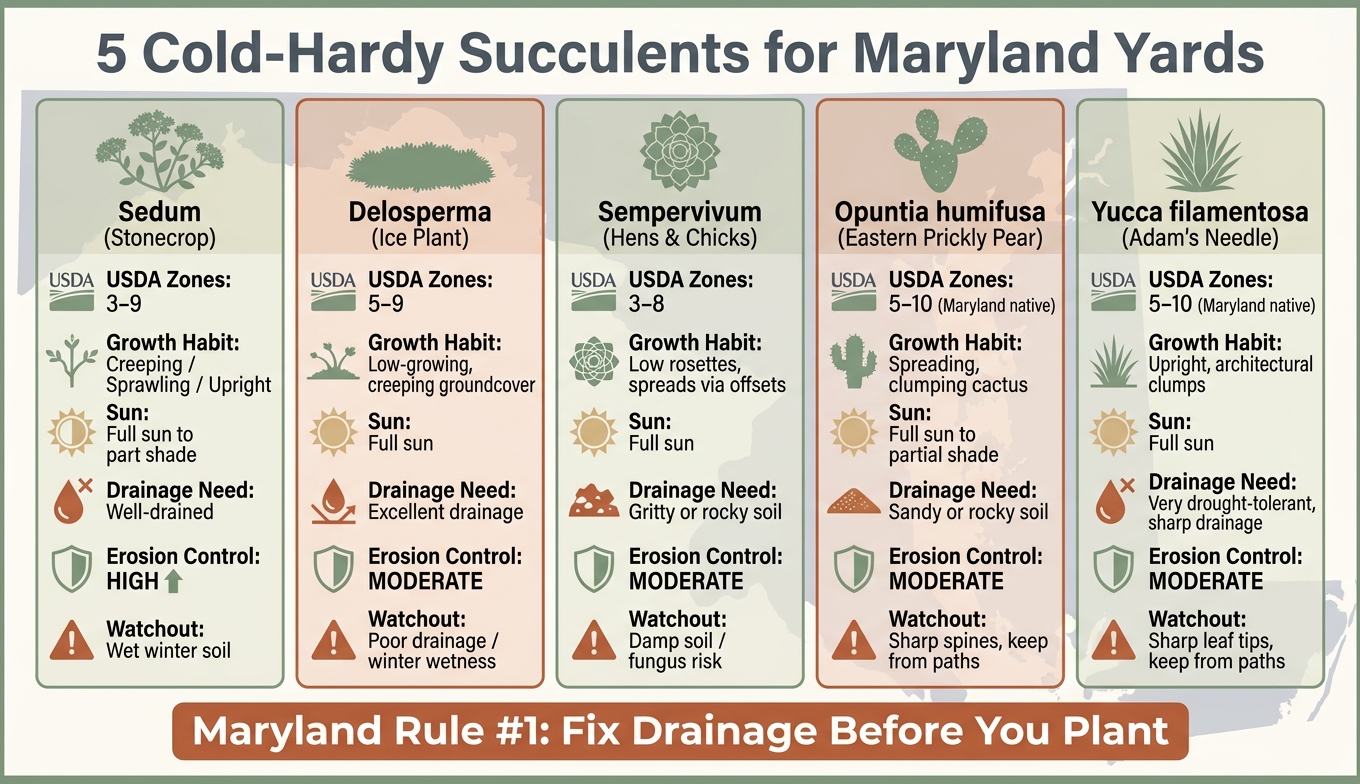
5 Cold-Hardy Succulents for Maryland Yards: At-a-Glance Comparison
Use this quick comparison to match each succulent to your site conditions.
| Variety | USDA Zone Range | Growth Habit | Preferred Site Conditions | Erosion Control Value |
|---|---|---|---|---|
| Sedum (Stonecrop) | 3–9 | Creeping, sprawling, or upright | Full sun to part shade; well-drained soil | High – fast-spreading types quickly cover bare soil |
| Delosperma (Ice Plant) | 5–9 | Low-growing, creeping groundcover | Full sun; excellent drainage | Moderate – provides quick coverage from a few plants |
| Sempervivum (Hens & Chicks) | 3–8 | Low rosettes; spreads via offsets | Full sun; gritty or rocky soil | Moderate – slow, dense coverage |
| Opuntia humifusa (Prickly Pear) | 5–10 (native to MD) | Spreading, clumping cactus | Full sun to partial shade; sandy or rocky soil | Moderate – stabilizes dry, rocky, or sandy slopes |
| Yucca filamentosa (Adam’s Needle) | 5–10 (native to MD) | Upright, architectural clumps | Full sun; very drought-tolerant | Moderate – deep roots anchor soil over time |
For most Maryland yards, drainage matters more than the plant tag. That’s the thing that usually makes or breaks succulent planting.
If you need to cover bare or washing-out slopes fast, Sedum and Delosperma are usually the best picks. Sempervivum works well in smaller areas where you want tighter, slower fill. Opuntia humifusa makes sense for dry, rocky, or salt-exposed places, including roadside strips and coastal Maryland yards [4].
No matter which of these five you plant, the same rule applies: fix drainage first. In many Maryland gardens, that means working on heavy clay before planting, because the soil can matter just as much as the variety you choose [2].
Maintenance at a Glance
After you pick the right succulent, upkeep is pretty simple. Once these plants are established, they need very little attention: water deeply, then wait until the soil dries a few inches below the surface before watering again. That kind of deep soak pushes roots farther down and outward, which helps the ground cover stay thick and keeps soil in place.
Maryland’s humid summers can still mean you’ll need to water now and then. But winter moisture is the bigger problem. If roots stay too wet in winter, plantings can struggle, and that can weaken erosion control going into spring.
For mulch, use pea gravel or small stone, not wood chips. Stone helps keep the crowns dry.
Use this quick guide to keep each plant healthy and steady in Maryland conditions.
| Variety | Watering | Cautions |
|---|---|---|
| Sedum (Stonecrop) | Little to none; drought-tolerant [3] | Avoid overwatering; needs well-drained soil [3] |
| Delosperma (Ice Plant) | Low; drought-tolerant [3] | Needs full sun; sensitive to winter wetness [1] |
| Sempervivum (Hens & Chicks) | Very low; drought-tolerant [5] | Avoid damp soil; susceptible to fungus if wet [5] |
| Opuntia humifusa (Prickly Pear) | Very low; highly drought-tolerant [1] | Sharp spines; needs excellent drainage; site away from high-traffic paths [1] |
| Hardy Agave / Yucca | Minimal to none [1] | Sharp leaf tips; site away from high-traffic paths [1] |
Stick to that basic routine, and these succulents are more likely to stay thick and useful on slopes, banks, and other erosion-prone areas.
How to Use Succulents in Maryland Residential Landscapes
Placement matters. Put succulents in the right spot, and they can help hold soil in place while staying healthy. The goal is simple: match each plant type to the setting, whether that’s a slope, rockwork, a path edge, or a dry drainage feature.
Sunny slopes and berms are one of the best places for creeping succulents. Sedum and Delosperma can work like a living mulch once they settle in. During that early establishment period, a light layer of pea gravel between plants can help shield bare soil.
Around paths and patios, succulents work best in spots with light traffic. Keep succulents out of frequent foot traffic and use a mulched or paved walkway through them. University of Maryland Extension advises keeping a mulched or paved path through frequently traveled areas.
Rock gardens, stone steps, and retaining walls also suit Sempervivum and creeping Sedum. Hens-and-chicks spread by producing offsets that tuck neatly into crevices between stones, and young plugs fit crevices well.
For built drainage features, stick with plants that do well in fast-draining, open sites. Dry riverbeds are a good match for succulents because water moves through them fast. Opuntia humifusa and Yucca filamentosa both handle full sun and dry, open sites well.
If a site has tougher issues like clay soil, poor grading, or downspout runoff, don’t rely on plants alone. Pair planting with grading work, drainage fixes, or retaining walls. When runoff is the main issue, drainage comes first; the succulents finish the job.
Conclusion
The best Maryland succulents fit the spot: cold-hardy, sun-tolerant, and set in fast-draining soil. That’s the same rule that often marks the line between a planting that takes off and one that fades out too soon. It’s why Sedum, Delosperma, Sempervivum, Opuntia humifusa, and hardy agave-type selections made the list.
As Miri Talabac notes, plant choice works best when it lines up with the conditions you already have. That site-first approach can also help with erosion control.
In the right place, drought-tolerant succulents can help hold soil and slow runoff. On slopes, berms, and dry banks, they add ground cover that helps keep soil in place.
Fix drainage and grading first. Then pick the succulent that fits your USDA zone and sun exposure.
FAQs
Which succulent is best for a sunny Maryland slope?
Allegheny Stonecrop is a great pick for a sunny slope in Maryland. This native, compact perennial does well in bright sun and rocky, well-drained soil.
Other solid choices include Adam’s-Needle Yucca, Ice Plant, and different Sedum types. They all do best in full sun with good drainage, and the soil shouldn’t stay too wet.
Can succulents grow in Maryland clay soil?
Yes, but fix the drainage first. Maryland’s heavy clay soil holds too much water, and most succulents don’t like sitting in damp ground.
Mix sand or gravel into the top few inches of soil to make that layer looser and better drained. Since succulents have shallow roots, that’s often enough. For the best fit, pick types that like rocky, fast-draining soil, such as native stonecrops.
What outdoor succulents survive Maryland winters?
Several cold-hardy succulents can stay outdoors year-round in Maryland. If you want plants that fit local conditions with less fuss, native picks are a smart place to start. Eastern Prickly-pear, Allegheny Stonecrop, and Woodland Stonecrop all do well in the state.
You’ve also got a few cold-tolerant non-native choices that can handle Maryland winters. Good options include Hens and Chicks, certain Ice Plants, and Sedum cultivars such as ‘Autumn Joy.’
Chat with Us