









- bhavya gada
- No Comments
Managing dust during landscaping projects is essential for health, safety, and compliance. Activities like grading, soil movement, and concrete cutting release fine particles, including harmful respirable crystalline silica (RCS). Dust can irritate workers and nearby residents, harm plants, and worsen air quality. Here are four effective methods for temporary dust control:
- Water Spraying: Simple and affordable but requires frequent reapplication. It’s less effective in hot or dry conditions.
- Calcium Chloride: Attracts moisture to keep dust down for weeks but may harm soil and plants over time.
- Magnesium Chloride: Similar to calcium chloride, with slightly lower environmental risks, though it can still damage vegetation downslope.
- Physical Barriers: Plastic sheeting or reusable systems stop dust from spreading. They are chemical-free, reusable, and ideal near sensitive areas.
Each method has pros and cons depending on project size, site conditions, and environmental concerns. Below is a quick comparison for clarity.
Quick Comparison
| Method | Effectiveness Duration | Cost Level | Environmental Impact |
|---|---|---|---|
| Water Spraying | Hours | Low (high labor) | High water use; runoff possible |
| Calcium Chloride | Weeks | Moderate | Salt buildup harms soil/plants |
| Magnesium Chloride | Weeks | Moderate to High | Less harmful but still risky |
| Physical Barriers | Entire project | Moderate (low long-term) | Minimal; reusable options reduce waste |
Choose the best solution based on your specific project needs, proximity to sensitive areas, and local conditions.
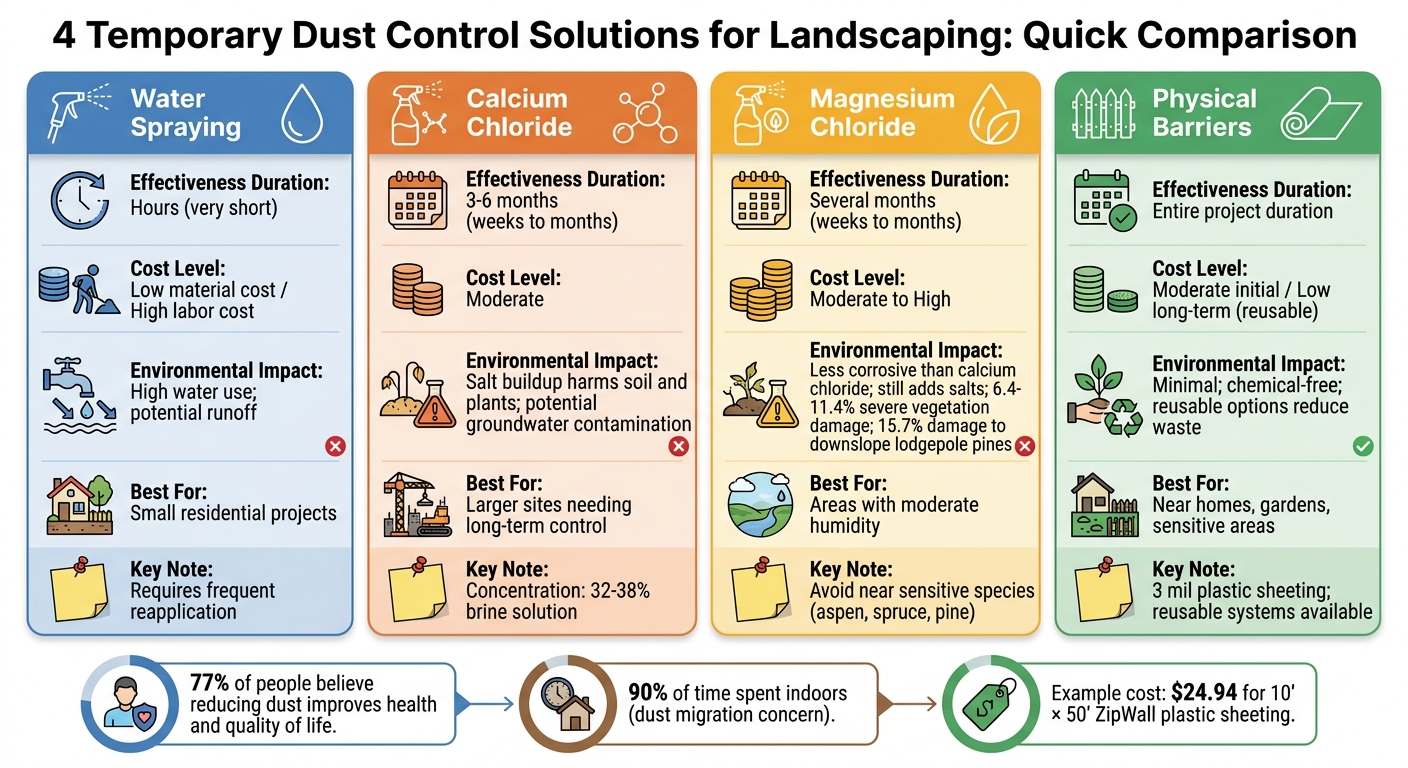
Comparison of 4 Temporary Dust Control Solutions for Landscaping Projects
Learn how to use the Dust Shield – Temporary Wall System
sbb-itb-843f8be
1. Water Spraying
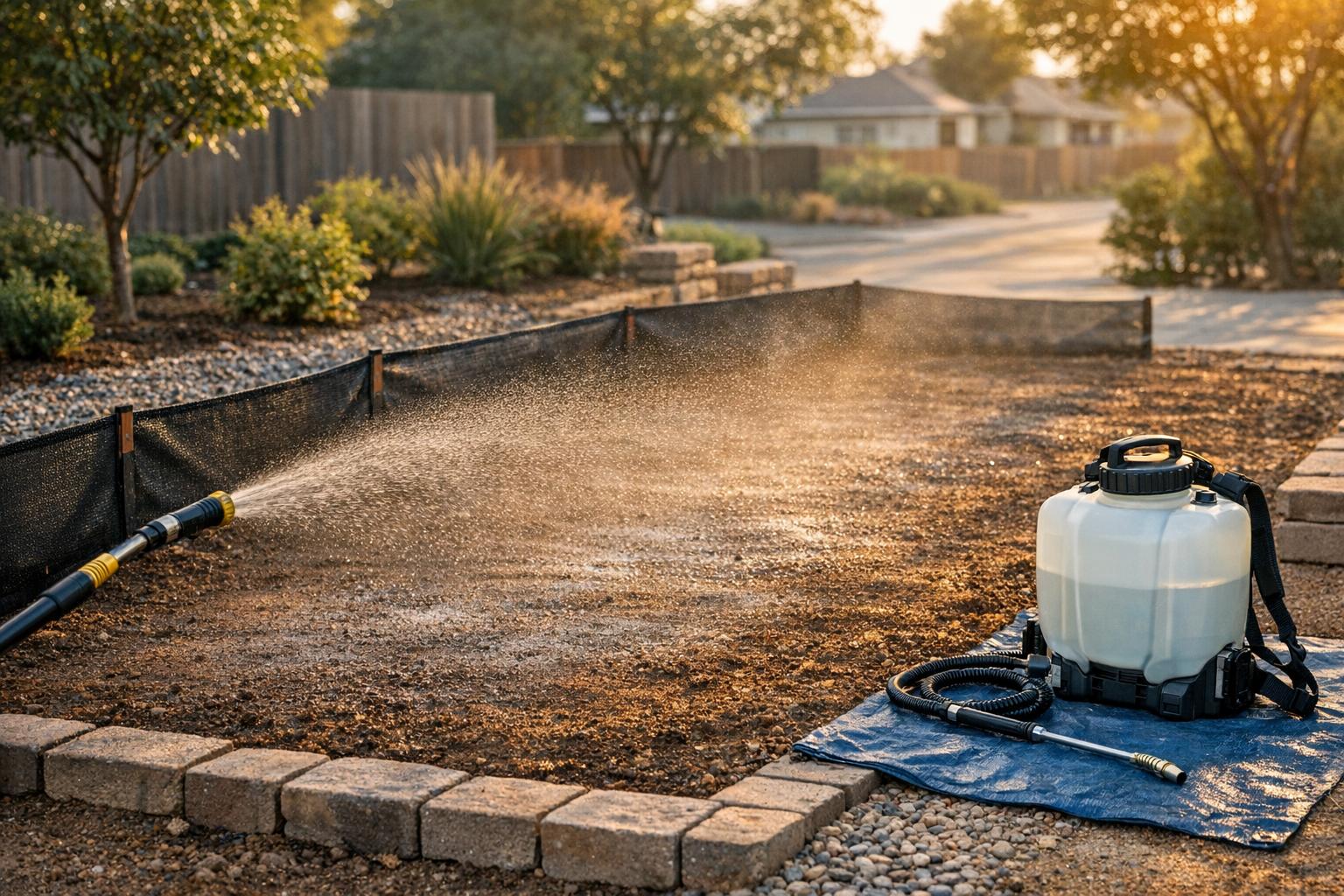
Water spraying is a common method used on landscaping sites to control dust. Crews rely on hoses, water trucks, or sprinkler systems to dampen exposed soil, gravel roads, and work areas. By adding moisture, the dust particles become heavier, reducing their chances of becoming airborne during activities like grading or transporting materials.
Application Method
To use this method, water is applied until the surface is thoroughly soaked. For large areas, water trucks equipped with spray bars are ideal, while smaller sites can be managed with garden hoses or portable sprayers. Consistent moisture is essential, so reapplication is often necessary every few hours – especially on hot or windy days, when evaporation rates are higher.
Duration of Effectiveness
The effects of water spraying are short-lived, as water evaporates quickly, particularly in Maryland’s summer heat. This means frequent reapplication is required to maintain dust control. It is especially ineffective in sandy or low-clay soils. For example, in 2017, authorities in San Simon, Arizona, reported that water evaporated too quickly in low-clay soils, rendering it ineffective for dust suppression [4]. Unlike chemical suppressants, which form a bond with soil particles, water simply dissipates, offering no long-term solution.
Environmental Impact
Although water spraying doesn’t introduce chemicals into the environment, excessive watering can cause sediment runoff. In areas with drought conditions or water restrictions, the large amounts of water required for this method can become a serious issue. Additionally, water spraying is ineffective at controlling the smallest particulate matter – PM10 and PM2.5 – which are the most harmful to human health, particularly in soils with insufficient clay content [4].
2. Calcium Chloride Sprays
When it comes to managing dust, calcium chloride offers a longer-lasting solution compared to water sprays. This chemical dust suppressant works by attracting and holding onto moisture from the air, which helps keep surfaces damp for extended periods.
Calcium chloride is typically applied as a liquid brine with a concentration of 32% to 38%, making it more effective at controlling dust particles than water alone.
Application Method
To apply calcium chloride effectively, start by grading the area to create a smooth, well-draining surface. Remove any large debris that might interfere with the application. In especially dry conditions, mist the surface lightly with water before spraying the calcium chloride brine. Use spray equipment or water trucks equipped with specialized nozzles to ensure even coverage.
Duration of Effectiveness
How long calcium chloride remains effective depends on the surrounding humidity. In areas with moderate moisture, a single application can last anywhere from 3 to 6 months. However, heavy rainfall or very dry climates may shorten its effectiveness, requiring more frequent reapplications.
Environmental Impact
While calcium chloride can be an efficient dust control solution, repeated use has its downsides. Over time, salt can build up in the soil, which may damage its structure and reduce plants’ ability to absorb water. Runoff or direct exposure can also cause salt burns to vegetation, and the chlorides may leach into groundwater or nearby water sources, posing additional environmental risks.
3. Magnesium Chloride Applications
Magnesium chloride is another option for temporary dust control, particularly after methods like water spraying or calcium chloride treatments. This compound works by attracting moisture from the air, which helps keep surfaces damp and reduces airborne dust.
Application Method
To ensure effective application, start by grading the area and clearing it of large rocks or debris. This helps achieve even coverage. Magnesium chloride is typically applied as a liquid brine using specialized spraying equipment or water trucks equipped with adjustable nozzles. Timing is crucial – avoid applying it right before heavy rain, as excessive rainfall can wash away the treatment before it has a chance to bond with the soil. Proper application is key to maximizing its dust control benefits.
Duration of Effectiveness
The longevity of magnesium chloride depends on environmental factors like humidity, temperature, and rainfall. In moderate climates, it can last for several months. However, in hot or dry conditions, reapplication may be necessary more frequently to maintain its effectiveness.
Environmental Impact
While magnesium chloride is effective at reducing dust, it can pose risks to nearby vegetation. A 2004 study from Colorado State University highlighted its potential to harm plants, particularly those located downslope where salt accumulates. For example, lodgepole pines downslope of treated areas showed a 15.7% rate of severe damage, compared to 7.3% upslope. Other species, including aspen and Engelmann spruce, exhibited similar trends [5]. Overall, between 6.4% and 11.4% of vegetation near treated areas experienced severe damage (defined as over 50% foliage loss), while 72.3% to 79.3% of plants remained unaffected [5].
"Percent of plants with severe or moderate damage increased with increasing MgCl2 application rates for roadside aspen, Engelmann spruce, and lodgepole and ponderosa pines." – Betsy A. Goodrich, Graduate Degree Program in Ecology, Colorado State University [5]
Because magnesium chloride can move through the soil with water flow, plants downslope are particularly vulnerable to salt buildup. To minimize environmental harm, avoid applying the chemical near sensitive species like aspen, spruce, and pine trees, and carefully monitor drainage and storm water management in treated areas.
4. Physical Barriers (Tarps and Fencing)
Physical barriers provide a chemical-free and immediate way to control dust. By creating a physical wall, they stop dust from spreading beyond the work area. This makes them especially handy for projects near homes, gardens, or delicate plants.
Application Method
Setting up physical barriers is pretty simple. Plastic sheeting with a 3 mil thickness is durable enough to create an effective temporary dust barrier [6]. White plastic is a great choice because it offers privacy while still letting light into the workspace [6].
To install, start by pre-cutting tarps or plastic sheeting to the required size [6]. For pole-supported systems, begin at a fixed point, like a wall or fence post, and install one pole at a time. Keep the bottom of the material loose until all poles are in place [6]. To ensure stability on smooth surfaces, place non-skid pads (like GripDisk™) under the poles [6]. Once everything is set, tuck the barrier material under each support and compress the tension springs for a snug seal [6].
Duration of Effectiveness
Physical barriers remain effective as long as they are intact and properly secured. A well-installed barrier can last throughout the duration of landscape projects, whether it’s just a few days or several weeks. Regular inspections are crucial to ensure weather or wind hasn’t loosened the supports or damaged the material. Unlike chemical treatments, which lose effectiveness over time, physical barriers provide consistent dust control as long as they are maintained.
Cost Level
Physical barriers are a cost-effective option, particularly when reusable systems are used. For example, a 10′ × 50′ roll of ZipWall® 3 mil white plastic sheeting costs $24.94, offering an affordable solution for temporary projects [6]. Reusable systems, though more expensive upfront, save money over time by eliminating the need to buy new materials for every project [1]. Spring-loaded poles and magnetic doors, while requiring a higher initial investment, can be reused across multiple jobs, reducing long-term costs [1]. Additionally, rapid-setup systems help cut down on installation time and labor expenses [1].
Environmental Impact
Compared to chemical suppressants, physical barriers are easier on the environment. They don’t introduce salts or chemicals into the soil, making them safe for use around sensitive plants and water features. Reusable systems further reduce waste by cutting down on the amount of plastic discarded [1].
Studies reveal that 77% of people believe reducing dust directly improves health and quality of life [2]. Since most people spend around 90% of their time indoors [2], physical barriers play a critical role in keeping dust from migrating indoors. By stopping dust at its source, these barriers help maintain clean air both outside and inside, protecting gardens, homes, and overall air quality.
Comparison of Dust Control Solutions
This section breaks down the main differences between temporary dust control methods, offering insights for Maryland landscapers aiming for effective and compliant solutions.
Each approach has its own strengths and is suited to specific project needs, budgets, and environmental considerations. Water spraying, for instance, is straightforward and has low upfront costs. However, it needs frequent reapplication since moisture evaporates quickly – making it labor-intensive and less viable in arid regions with limited water supplies [3].
Chemical treatments, such as calcium chloride and magnesium chloride, deliver longer-lasting results but can impact nearby vegetation due to the salts they introduce [3].
Physical barriers provide a chemical-free alternative with durability throughout the project. Unlike water-based methods that suppress dust at its source, these barriers catch dust already in the air, stopping it from spreading to cleaner areas [1]. Reusable barrier systems, while more expensive initially, can cut down on plastic waste and offer savings over time [1].
Here’s a quick comparison of these options:
| Method | Application Method | Duration of Effectiveness | Cost Level | Environmental Impact |
|---|---|---|---|---|
| Water Spraying | Manual or automated spraying | Very short (hours) | Low material / High labor | High water use; potential for runoff [3] |
| Calcium Chloride | Surface treatment using spray equipment | Long-term (weeks) | Moderate | Adds salts; effectiveness varies with weather [3] |
| Magnesium Chloride | Surface treatment using spray equipment | Long-term (weeks) | Moderate to high | Less corrosive than calcium chloride; still adds salts [3] |
| Physical Barriers | Spring-loaded poles with plastic or reusable sheets | Throughout the project | Moderate initial / Low long-term | Low impact; reusable options reduce waste [1] |
When deciding on a solution, consider factors like wind direction and proximity to sensitive areas. For example, physical barriers are ideal near plants or water features to avoid chemical runoff. In regions with limited water, chemical treatments or reusable barriers may be more practical than relying on constant water spraying.
Conclusion
Choosing the right dust control method depends on your project’s size, site conditions, and surrounding factors. For smaller residential projects, water spraying is a simple and cost-effective option, but it requires frequent reapplication and can deplete water resources. On larger sites, chemical treatments like calcium chloride or magnesium chloride provide longer-lasting suppression but must be applied carefully, especially near vegetation or water features. For those seeking a chemical-free approach, physical barriers are a reliable choice, particularly useful for protecting client properties during hardscaping or renovation work.
For residential settings, physical barriers – such as spring-loaded poles with plastic sheeting – create a dust-tight seal for tasks like concrete cutting, paver installations, or wall construction. These setups often include convenient features like hands-free magnetic doors for easy access [1]. On larger commercial projects, chemical suppression is often the go-to solution for controlling dust on busy haul roads where dust can quickly become a problem [3].
Maryland’s unpredictable weather – shifting winds, varying humidity, and proximity to sensitive areas – makes tailored planning a necessity. Experts emphasize the importance of capturing dust at its source, especially in high-traffic zones, to prevent it from spreading [3]. In Maryland, professionals adapt these techniques to suit local conditions, ensuring effective and efficient dust control.
Pro Landscapes MD applies these strategies across central Maryland, serving areas like Howard, Montgomery, Carroll, Frederick, Prince George’s, and Baltimore Counties. Whether it’s a patio installation, retaining wall project, or paver driveway construction, they prioritize creating safe and clean work environments using proven methods.
No matter the project – be it a small garden renovation or a large-scale commercial build – choosing the right dust control solution for your specific needs can help reduce costs, improve results, and limit disruptions to the surrounding environment.
FAQs
Which dust control method is best for my project?
The best temporary dust control method hinges on your project’s specific requirements and site conditions. Popular approaches include:
- Coverings, like tarps or plastic sheets, to shield exposed areas.
- Watering, using hoses or sprinklers, for quick and easy dust suppression.
- Chemical stabilizers, which offer extended dust control for areas needing more durability.
- Wind fencing, which helps contain dust and works well when paired with other techniques.
Your choice should align with the project’s scale and whether you need a short-term solution or something more robust.
How do I reduce dust without harming plants or soil?
To manage dust without harming plants or soil, try using temporary coverings like tarps or plastic sheets. Make sure they’re securely anchored to avoid being blown away by the wind. Another effective method is watering the area with hoses, sprinklers, or even water trucks, both before and during work. For a more lasting solution, you can apply chemical stabilizers or soil binders. Just be sure to carefully follow the manufacturer’s instructions to ensure they’re environmentally safe.
What should I do to control dust during concrete cutting?
To manage dust effectively during concrete cutting, start by using water to keep dust emissions under control. Apply water directly to the cutting blade through nozzles at a consistent flow rate. Pair this with dust collection systems like industrial vacuums equipped with HEPA filters or shrouded tools that include extraction features. Additionally, ensure the workspace has adequate ventilation and always use personal protective equipment, such as respirators, to maintain safety and minimize exposure to harmful dust.
Chat with Us