









- bhavya gada
- No Comments
Pruning young trees at the right time is essential to their health and growth. The best time is during dormancy, typically late winter to early spring, when trees aren’t actively growing. This minimizes stress, promotes faster healing, and encourages root development. However, timing can vary based on tree species and Maryland’s climate.
Key Timing Tips for Maryland:
- Dormant Season (Nov–March): Ideal for most deciduous trees.
- After Flowering: For trees blooming on old wood (e.g., Redbud, Dogwood).
- Late Fall or Late Spring: For "bleeding" trees like Maple and Birch to reduce sap loss.
Avoid pruning during:
- Active Growth (Summer): Disrupts energy flow.
- Late Summer/Early Fall: Interferes with winter preparation.
For first-year trees, limit pruning to removing damaged branches. Retain temporary low branches to strengthen the trunk. Over the next 2–5 years, focus on shaping a single dominant leader and well-spaced scaffold branches, removing no more than 25% of the canopy annually. Proper early pruning ensures a strong, stable tree structure for years to come.
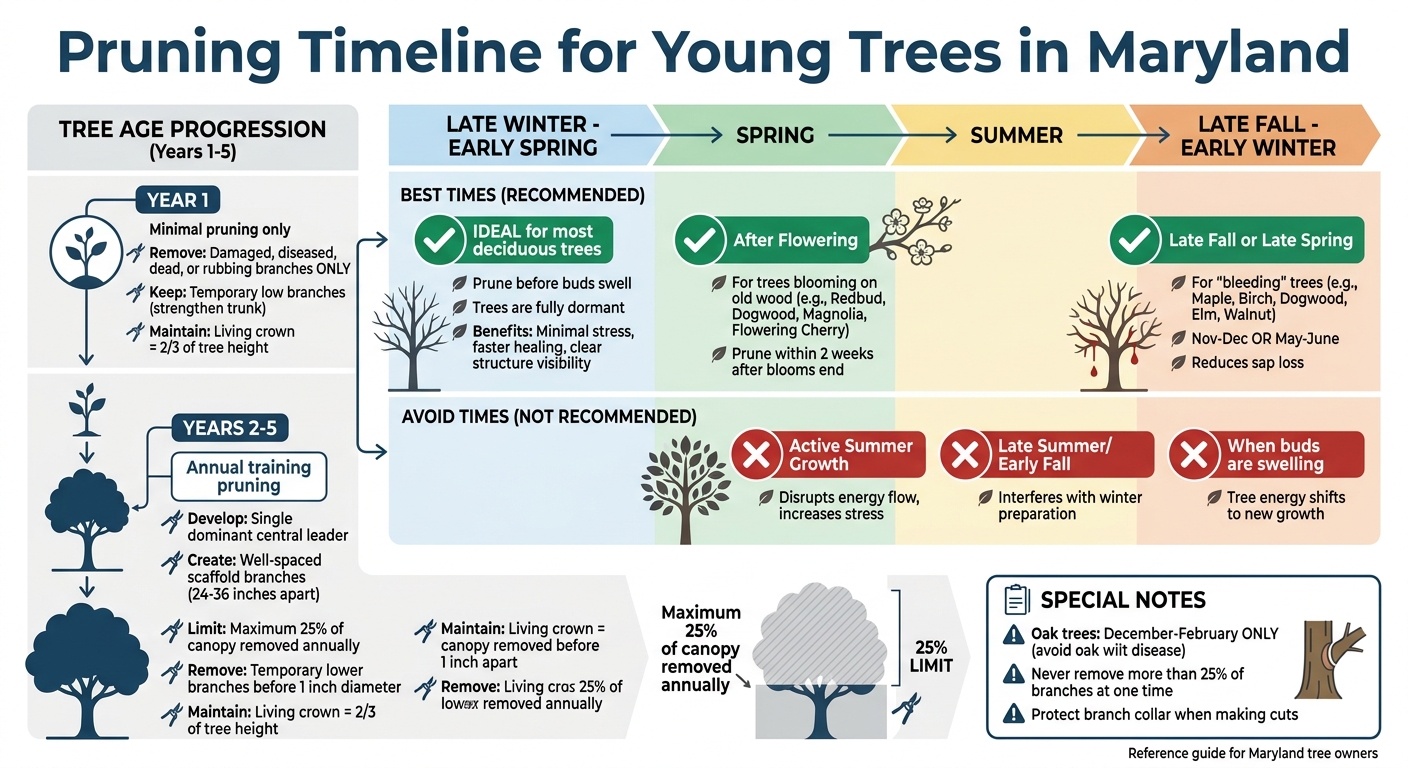
Pruning Timeline for Young Trees in Maryland by Season and Tree Age
Late Winter to Early Spring: The Best Pruning Season
Benefits of Pruning During Dormancy
Pruning during dormancy sets the stage for healthier spring growth. With no leaves in the way, you can clearly see the tree’s structure, making it easier to spot and address issues like crossing or competing branches [1] [3].
This timing also works in harmony with the tree’s natural healing process. When you prune just before the spring growth spurt, the tree can start sealing the wounds almost immediately as new growth begins. The branch collar – the area where a branch connects to the trunk – has special tissue that helps close wounds faster [3]. By pruning before buds begin to swell, the tree conserves energy for root development and the branches you decide to keep [4], instead of wasting resources on growth that will be removed.
Another advantage is reduced stress on the tree. Dormant pruning minimizes the risk of shock and prevents excessive sap loss, which can happen with structural cuts made outside this period. Trees are also less prone to infections during dormancy, as certain disease organisms are less active in cooler weather [3] [4].
Timing Recommendations for Maryland
For Maryland’s climate, late winter to early spring is ideal for pruning. Most deciduous trees in central Maryland should be pruned between November and early March while they remain fully dormant [3]. Be sure to finish pruning before buds begin to swell. Once buds break, the tree shifts its energy toward new growth, and cutting at that point can slow its recovery [4].
It’s also important to avoid pruning during transitional phases, like when leaves are emerging in spring or falling in autumn. These are high-energy periods for the tree, and pruning then can disrupt its natural processes [4]. For trees that are prone to sap "bleeding" – such as Maple, Birch, Dogwood, Elm, and Walnut – plan your pruning for late fall (November–December) or after their spring growth is complete in May or June. This helps prevent excessive sap dripping [3].
sbb-itb-843f8be
First-Year Pruning Guidelines
Keep First-Year Pruning to a Minimum
During a tree’s first year, pruning is less about shaping and more about ensuring the tree has what it needs to thrive. Right after planting, avoid trimming the crown or removing leaves, as they play a critical role in helping the tree recover and establish its roots. Studies show that trees adapt more quickly when pruning is limited to addressing only essential issues like damaged or problematic branches [1].
Focus only on removing branches that are broken, diseased, dead, or rubbing together. These cuts are the only ones that truly benefit the tree during this stage. Leaves and shoot tips are vital because they produce the nutrients and growth hormones that drive root development. For newly planted trees, stick to removing damaged or defective branches. This approach ensures that the tree retains the branches it needs to build a strong trunk and a healthy foundation.
Keep Temporary Low Branches
In addition to minimal pruning, preserving temporary low branches is essential for the tree’s early structural development. These branches, even if they seem unnecessary, play a critical role in strengthening the trunk. They help the trunk grow thicker at the base, improving the tree’s overall stability and structure [1]. They also act as a protective layer for the trunk during the early years.
"These lateral branches help the trunk increase in base diameter or caliper making for a sturdier tree." – Dr. Jeff Iles, Professor and Chair, Department of Horticulture, Iowa State University [1]
To promote healthy growth, maintain a living crown (branches and leaves) that makes up at least two-thirds of the tree’s total height [1][2]. Over time, these temporary branches can be gradually removed from the bottom up. Aim to prune them before they grow thicker than 1 inch in diameter to ensure that the pruning wounds heal quickly and cleanly [1][2].
Training and Growth Pruning: Years 2-5
Annual Pruning for Scaffold Branch Development
After the first year, annual pruning becomes essential to guide your tree’s structure. Each spring, focus on shaping a strong, permanent framework by continuing training pruning practices.
Start by maintaining a single, dominant central leader – this is the tallest and strongest vertical stem. Remove any competing or crooked secondary leaders to avoid weak V-shaped crotches that can compromise the tree’s stability.
Select scaffold branches with wide, U-shaped attachment angles, spacing them 24–36 inches apart (or 8–12 inches for ornamental trees) in a radial pattern. These branches should be distributed evenly around the trunk – like spokes on a wheel – to create a balanced canopy.
"The time and expense invested in training a young tree will always be much less than costly and time‐consuming corrective pruning of neglected mature trees."
– Dr. Jeff Iles, Iowa State University [1]
While shaping your tree, aim for a balance between structural corrections and preserving enough foliage to support the tree’s energy needs.
Pruning Limits and Tree Health
Pruning during these years requires a careful balance. To avoid stressing the tree, limit pruning to no more than 25% of the canopy annually [2]. Removing too much foliage at once can hinder the tree’s ability to produce the energy it needs for healthy growth.
Maintain a living crown that makes up at least two-thirds of the tree’s height. This ensures there are enough leaves to support growth while you continue shaping the structure [2]. If major structural corrections are needed, spread the work over several years, using smaller cuts instead of a single large one.
"Never remove more than one‑fourth of a tree’s branches at one time. Remember: it is better to make several small pruning cuts than one big cut."
– University of Maryland Extension [2]
Continue managing temporary lower branches retained from the first year. Gradually remove these lower branches before they exceed 1 inch in diameter, starting from the bottom [2]. This method not only helps build trunk strength but also prevents large pruning wounds that take longer to heal.
How to Prune Young Shade Trees
Pruning Different Tree Types
When it comes to pruning, timing isn’t one-size-fits-all. Different tree types demand specific schedules to thrive. While late winter dormancy pruning works for many species, flowering and fruit trees need extra attention to protect their blooms and ensure healthy yields. Tailoring your approach to the type of tree ensures you’re giving it the care it needs.
Deciduous Trees: Prune During Dormancy
For deciduous trees like oak, ash, and hickory, the best time to prune is between February and March [5]. During this dormant period, the absence of leaves makes it easier to spot problems like diseased branches or weak attachments. Plus, pruning now allows wounds to start healing as the tree prepares for new growth.
Oak trees, however, require extra care. Prune them only between December and February to avoid oak wilt disease. This disease is spread by beetles that are active from March through October [5]. Timing is equally critical for flowering tree varieties.
Flowering Trees: Prune After Blooming
Spring-flowering trees – such as magnolia, redbud, flowering cherry, crabapple, and serviceberry – develop their flower buds on last year’s growth. Pruning them before they bloom will remove these buds, cutting short their spring display. Instead, wait until flowering ends and prune within two weeks. This gives the tree enough time to form buds for the next year [6].
On the other hand, summer and fall-flowering trees like crape myrtle and smoke tree bloom on new growth from the current season. Prune these in late winter, before growth begins, to encourage strong new shoots that will carry the season’s flowers [2]. Fruit trees follow a similar dormancy-based schedule but require additional structural considerations.
Fruit Trees: Late Winter Pruning for Better Yields
Fruit trees benefit most from pruning in late winter or early spring while they’re dormant [2]. This timing encourages robust spring growth and helps shape a strong framework capable of supporting heavy fruit loads. Focus on creating wide, U-shaped branch angles and spacing scaffold branches evenly to handle the weight of fruit.
"The spreading and spacing of branches is an old established practice for fruit trees that can be applied to any tree."
– University of Maryland Extension [2]
For young branches, tools like spreaders, weights, or ties can help widen narrow attachment angles. This strengthens their connection to the trunk and reduces the risk of branch failure as the tree grows. By focusing on these structural improvements during dormancy, you’re setting the stage for years of productive fruiting.
Common Pruning Timing Mistakes to Avoid
Pruning at the wrong time can throw off a young tree’s growth and make it more vulnerable to diseases. It’s not just about knowing when to prune – it’s equally important to know when not to. By steering clear of these common timing errors, you can help ensure your trees stay healthy and thrive.
Avoid Pruning in Late Summer or Early Fall
Late summer and early fall might feel like a good time to clean up your yard, but it’s actually one of the worst periods to prune young trees. Why? Because during this time, trees rely on their foliage to gear up for winter and strengthen their roots. Removing branches depletes the energy reserves they need for these critical processes.
Pruning late in the season can also mess with the tree’s natural transition into dormancy. According to the University of Maryland Extension, “stressed trees should not be pruned since all leaves are important for recovery” [2]. Cutting branches during this period forces the tree to divert energy away from essential winter prep and root development – exactly when it can’t afford to.
Avoid Pruning During Active Summer Growth
In the peak of summer growth, every leaf plays a vital role in nourishing the tree. Removing them can stress the tree, making it more susceptible to pests and diseases. As noted by the University of Maryland Extension, “leaves and shoot tips provide food and growth substances that stimulate root production” [2].
The only exception? Light pruning of firs and spruces in late summer, but only after their seasonal growth has fully wrapped up [2].
Avoid Pruning in Extreme Weather
Timing is everything, especially when dealing with extreme weather. Pruning during heatwaves, droughts, or freezing conditions can strip stressed trees of the foliage they need to survive. For species like maple, birch, and elm, it’s best to wait until late fall or after spring growth to avoid excessive sap loss.
Another factor to consider is the tree’s canopy, which acts as a natural shield for the trunk. Removing too much during extreme weather can expose the trunk to temperature swings and sunscald injury [2]. And remember, never take off more than 25% of a tree’s living branches at once – this rule is even more critical when trees are already under stress [2].
Conclusion
Timing plays a crucial role in successfully pruning young trees.
Pruning during the early years is a smart way to invest in your landscape’s future. The first five years are especially important for shaping a tree’s structure, which sets the stage for decades of healthy growth. As Dr. Jeff Iles from Iowa State University explains, "The time and expense invested in training a young tree will always be much less than costly and time-consuming corrective pruning of neglected mature trees" [1].
Here are a few key points to remember: prune deciduous trees between late winter and early spring; in the first year, only remove damaged branches; and avoid cutting more than 25% of the tree’s live foliage [2]. These practices are particularly well-suited for Maryland’s varied climate, helping trees stay strong and grow steadily.
When making cuts, be sure to protect the branch collar – this tissue is vital for the tree’s natural defense against decay [2].
The main goal of early pruning is to develop a single dominant leader and well-spaced scaffold branches, ideally 24 to 36 inches apart [1]. This method ensures a sturdy tree structure that can handle Maryland’s weather challenges and flourish for years to come. By sticking to these seasonal guidelines, you’re setting the stage for a vibrant and enduring landscape.
FAQs
How can I tell if my tree is dormant enough to prune?
To figure out if your tree is dormant and ready for pruning, look for key indicators. Deciduous trees will typically shed their leaves, and there should be no signs of new growth, such as buds or fresh leaves. The ideal time for dormant pruning is between late fall and early spring. During this period, the tree’s growth slows down, reducing stress and allowing it to heal more effectively before the growing season kicks in.
What’s the safest way to prune a young tree without harming the branch collar?
To prune a young tree without harming its branch collar, make a precise cut just above the branch bark ridge, angling slightly away from the collar. Use sharp bypass pruning shears for smaller branches, ensuring the bark ridge and collar remain intact. This approach helps the tree heal faster, stay healthy, and retain its structure.
When should I hire a professional to prune a young tree?
If pruning involves handling large branches, climbing, or working near power lines, it’s best to hire a professional. These tasks can be dangerous and require specialized skills. For routine pruning, concentrate on cutting away broken, damaged, diseased, or rubbing branches, particularly when the tree is newly planted. When it comes to structural shaping or more advanced techniques – or if you’re uncertain about the right approach – a professional can help maintain the tree’s health and safety.
Chat with Us